Claims audit software for insurance companies tests claim files against the rules that govern them, the policy, the authority schedule, the service levels and statute, and reports the files that fail, so auditors spend their time on findings rather than on reading files that pass. For claims handled by third-party administrators and MGAs, it replaces the slowest part of the oversight cycle: the wait between audits. The law sets a floor of semiannual or annual reviews for those delegates, and examiners have faulted carriers that did fewer, but a payment can breach authority or a claim can cross a reporting trigger on any day in between. Botminds' Delegated Claims Audit is a claims oversight solution for carriers that checks every note, reserve change, payment and letter a TPA posts as it lands, instead of sampling files at an annual audit, and leaves every decision to the claims manager.
The examples on this page come from a fictional sample carrier, Harrowgate Specialty, and its fictional administrators. The audit rules come from NAIC model laws, state statutes and a Delaware examination report, each linked where it appears.
Days until a breach made on day 10 after a review is first read
What is claims audit software?
It is software that reads claim files and tests them, rather than software that handles claims. The category covers three different jobs, and buyers searching for claims audit software for insurance companies usually mean one of them. The first is quality assurance on the carrier's own desk, testing whether each step of a claim would satisfy a market-conduct examiner; the second is bill review, testing whether an adjuster's or vendor's invoice matches the work; the third is delegated claims audit, testing whether a TPA or MGA handled the carrier's claims within the authority and terms it was given.
This page is about the third. The first is covered in an AI claims audit tool for a carrier's own files, and the second in fifteen questions for claims auditing tools on adjuster bills. They overlap in technique, but a delegated claims audit differs in one decisive way: the files live in someone else's system, and the evidence has to be fetched before it can be tested.
How do insurance companies audit claims today?
Mostly by sample, on a calendar. An internal team or a contracted auditor selects files, reads them against a checklist, writes findings and agrees actions. For a delegate, that happens on site or by remote access once or twice a year, typically reading a few hundred files; in the fictional sample, the largest administrator's last on-site audit read 240 files and produced 11 findings. Between audits, the carrier sees a monthly bordereau and whatever the administrator chooses to refer.
The calendar is not arbitrary; much of it is law. The rule that sets the clock depends on what the delegate is and which state's law applies, and the floors are set out below.
How often should delegated claims be audited?
At least as often as the rule for that delegate requires, which in most cases means twice a year. For an MGA that settles claims, the NAIC model act asks for an on-site review of its claims processing operations at least semiannually; Florida asks annually, and within six months of engaging a new MGA. For a TPA administering life, annuity, health or stop-loss benefits for more than 100 people, the NAIC guideline asks for a semiannual review, at least one on site. Texas, for administrators in its scope, asks for a semiannual review and an audit at least every two years.
The legal floor for reviewing delegated claims, by source
| Rule | Delegate | Floor |
|---|---|---|
| NAIC Model #225 §5C | MGA (as enacted by each state) | On-site review of underwriting and claims processing, at least semiannually |
| New York 11 NYCRR §33.6 | MGA | On-site review at least semiannually; actuarial opinion annually where the MGA sets reserves |
| Florida §626.7454 | MGA | On-site review at least annually; within 6 months of engaging a new MGA |
| NAIC GL-1090 §7H | TPA, life, annuity, health, stop-loss, over 100 people | Review at least semiannually, at least one on site |
| Texas §4151.1042 | Administrator, over 100 people | Review at least semiannually; audit at least biennially |
| Delaware 18 Del. Admin. Code 1406 §7.3 | TPA, over 100 certificate holders | Semiannual reviews, at least one an on-site audit |
Examiners check the calendar. Delaware's market-conduct examination of Connecticut General's group health operations, as of 31 December 2008, asked for the audit reports on every TPA in scope. Its finding, listed among four areas of concern in the report's summary, was short:
"It was noted that the company was only able to provide copies of only one audit a year, rather than semiannually as required."
Delaware Department of Insurance, market conduct examination report, Connecticut General Life Insurance Company (as of 31 Dec 2008)
The report describes the standard it applied, taken from the NAIC's Market Regulation Handbook, as intended to ensure that the company "adequately monitors all activities of vendors and TPAs contracted to perform functions or conduct business on its behalf." The result was recorded as a pass with comment. The lesson for a claims audit programme is less about that exam than about what examiners ask for: the reports, by TPA, with dates. Software that keeps every check and every decision with its date makes that request easy to answer.
What a yearly visit cannot see: six months is a trigger, not an audit cycle
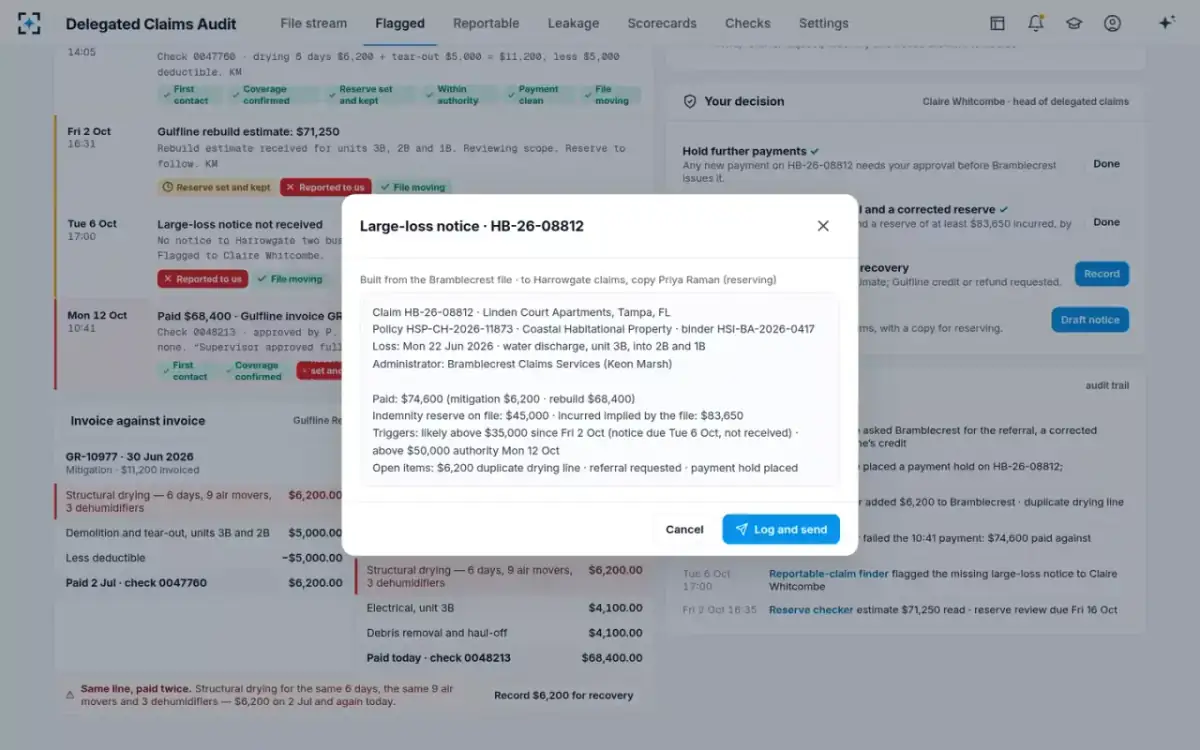
The same model law that sets a semiannual review also lists, among the claims an MGA must send to the insurer, one that "Is open for more than six months". Florida's version requires notice when a claim "Is open for more than 6 months". The coincidence of numbers hides a mismatch. A review every six months will meet a claim that crossed the six-month line just after the last visit only at the next one, by which time the notice it should have triggered is months late. A carrier that relies on the review to catch missed reporting triggers is relying on a calendar that runs at the same speed as the trigger it is checking.
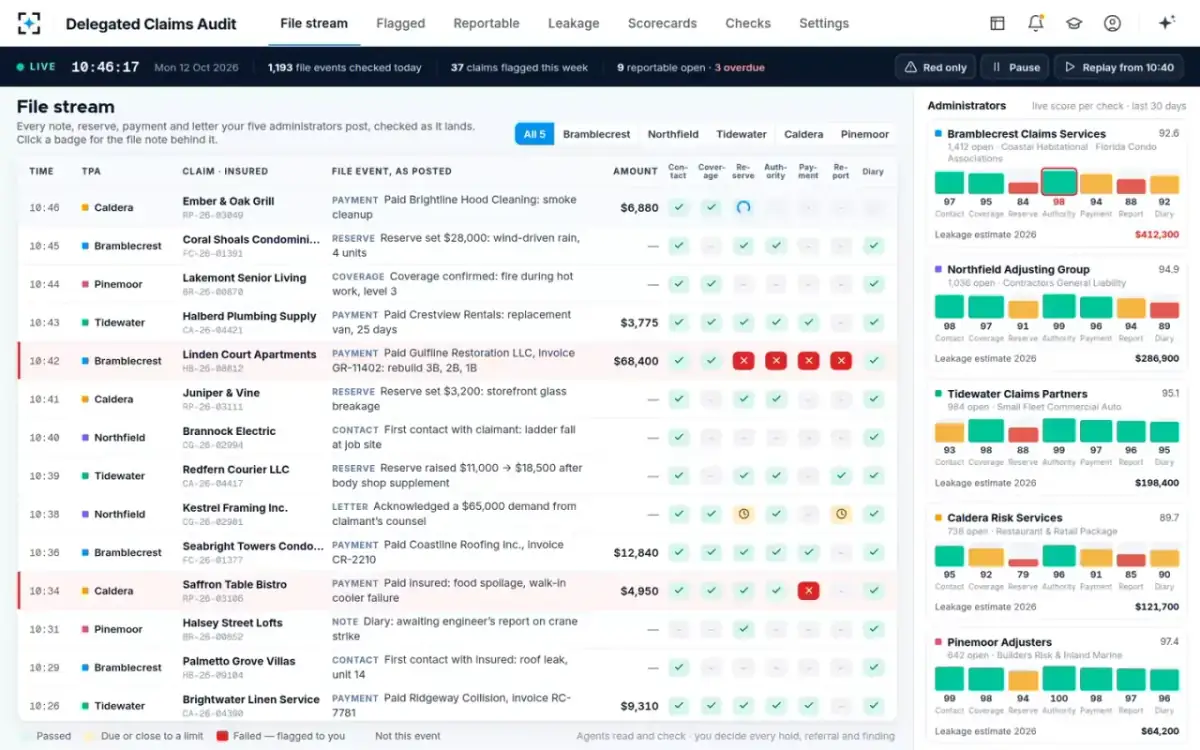
The same is true of authority. A payment above the delegate's settlement authority can be made the day after a review and repeated before the next. In the fictional sample, a TPA paid $68,400 on a claim where $6,200 had already been paid, taking the total to $74,600 against $50,000 of authority. Read at an audit, that is a finding; read the same morning, it is a payment hold before the next check is cut.
Delegated Claims Audit reads every file event as it lands, from five administrators
Can claims audits be automated?
The file reading can; the audit cannot. Testing a payment against a binder's authority, a reserve against the latest estimate, an invoice line against every earlier payment, a trigger date against a notice date: those are comparisons, and software can make them on every file event. Judging whether a finding is a breach, deciding what to do about it, testing the administrator's people, controls and systems on site, and signing the audit opinion stay with people. The useful change is in what the auditor already knows on arrival.
A claims audit programme with periodic sampling, and with Delegated Claims Audit checking every event
Periodic sample audit: A few hundred per visit, chosen at random or by risk.
Every file event checked, audit retained: Every note, reserve change, payment and letter, as posted.
Periodic sample audit: At the next visit, if the file is in the sample.
Every file event checked, audit retained: The day it happens, with the file note and the rule.
Periodic sample audit: Reads files, then tests controls if time allows.
Every file event checked, audit retained: Tests controls, people and systems; reads the files that failed.
Periodic sample audit: An audit letter months later.
Every file event checked, audit retained: A request drafted from its own file, with a date to answer by.
Periodic sample audit: Audit reports, by date.
Every file event checked, audit retained: Audit reports, plus every check and decision on each claim, dated.
Periodic sample audit: See the files it did not read.
Every file event checked, audit retained: See anything the administrator did not post to the file.
What does claims audit software check?
For delegated claims, seven things, in the configuration the sample carrier uses: first contact on time, coverage confirmed against the policy and binder, reserves set and kept against the latest estimate and never below paid, payments within the binder's authority with a referral where needed, payments clean of duplicates, missing deductibles and unapproved payees, claims reported when a trigger is met, and files moving within the diary limit. Each check quotes the clause it applies, so a finding can be argued on the agreement's own words. How one payment passes through all seven, second by second, is traced in the delegated claims management system walk-through.
A missed reporting trigger, turned into the notice the TPA should have sent
What to look for in claims audit software for insurance companies
Look for the properties an auditor and an examiner would need, not just the ones a claims manager wants on a screen. The checklist is written from the audit side.
Eight audit-grade questions for claims audit software
- Is every check written down, with the clause it applies?
An auditor must be able to read the test, not infer it from results.
- Is each check versioned, with the date it changed?
A finding is only as good as the rule in force on the day of the event.
- Can a changed check be run on past events before it goes live?
So a rule change is tested against files whose answers you know.
- Does every finding cite the file evidence?
The note, payment or invoice, with the sentence or line that triggered it.
- Are decisions kept with the person’s name and the time?
Holds, referral requests, accepted and rejected findings, notices: an examiner will ask who decided.
- Does it keep rejected findings, not just accepted ones?
A programme that silently drops flags cannot show it reviewed them.
- Can it select files for the on-site review?
The failed files, and a random sample of passed ones to test the software itself.
- Does it produce the per-TPA, dated report an examiner asks for?
The Delaware request was for audit reports by TPA; the software should produce them without a project.
Ask for a pilot before a contract, on one administrator and the period your last audit covered; the method and the scorecard are set out in a one-TPA pilot of claims oversight software. Which rules apply to each delegate depends on whether it is an MGA or a TPA, as explained in the difference between an MGA and a TPA.
What claims audit software cannot do
It cannot see what was never posted. A promise made by phone, a payment issued outside the claims system, a file note written after the fact: none of these is visible to software that reads the file, and all of them are what an on-site review is for. It cannot judge culture, training or staffing, the things the FCA's 2025 review of outsourced claims found behind many poor outcomes, from resourcing constraints to committee minutes too thin to show real challenge. And it does not remove the legal duty to review: every rule in the table above still applies.
What it removes is the wait. In Delegated Claims Audit, the agents have read-only access to the administrators' systems, run the seven checks on every event, and draft requests and notices; the claims manager places every hold and sends every notice, and changes to authority need a second approver. The audit programme keeps its calendar, now pointed at the files that failed.
Questions people ask
What is a claims audit for insurance companies?
A review of claim files against the rules that govern them: the policy, the authority schedule, the service levels in any administration agreement and state claims law. For delegated claims it also checks the administrator's reporting to the carrier. Model law requires one for MGAs at least semiannually.
What are insurance claims auditing services?
Firms or teams contracted to audit claim files, often a carrier's TPAs, on its behalf. Florida's statute for life and health administrators allows an insurer to contract a qualified third party to conduct its semiannual review. The responsibility for acting on the findings stays with the insurer.
How do insurance companies audit TPA claims between audits?
Traditionally through the monthly claims bordereau, referrals and large-loss notices sent by the TPA, and meetings. With software that reads each file event, the carrier can check every payment, reserve change and letter as it posts, and the periodic audit tests controls and the files that failed.
Is continuous claims checking allowed instead of on-site audits?
No rule we know of accepts it as a substitute. The model laws and state rules require periodic reviews, several of them on site, and examiners ask for the reports. Checking every file event adds to the programme; it does not replace the review the law requires.
What does a delegated claims audit cost?
No public source gives a reliable figure; it depends on the number of administrators, files read and travel. A useful way to estimate it is per finding: the audit's hours and fees divided by its findings, set beside the cost of reading every event and the findings that produces, on the same administrator.