A delegated claims management system is software a carrier or managing agent uses to oversee claims that delegates handle under its authority: it takes in what each TPA or claims-handling MGA does on a file, tests it against the authority, clocks and coverage the carrier granted, and puts exceptions in front of the person who answers for them. It is not the administrator's own claims system, where the adjuster works; it sits on the carrier's side, reading that work. Most carriers still oversee delegates through a monthly bordereau and a periodic audit, which see a summary line and a sample. Botminds' Delegated Claims Audit is a claims oversight solution for carriers that reads every note, reserve change, payment and letter a TPA posts as it lands, runs seven checks on each, and leaves every hold, referral, recovery and notice to the claims manager.
This guide traces one file event through the solution, using a fictional sample carrier, Harrowgate Specialty, and a fictional Tampa TPA, Bramblecrest Claims Services. The claim is HB-26-08812, water damage at Linden Court Apartments, under a binder that gives Bramblecrest $50,000 of indemnity authority per claim and a $35,000 large-loss notice threshold. None of the people, firms or claims is real.
Two clocks were already running on the claim when the payment landed
- Over $35,000: notice due in 2 daysFri 2 – Tue 6 Oct
- Notice overdue, flagged to the claims managerTue 6 – Mon 12 Oct
- Review due after the new estimateFri 2 – Mon 12 Oct
- Still due when the payment landsto Fri 16 Oct
What is a delegated claims management system?
It is the carrier's view of delegated claims, built from the delegate's own file rather than from what the delegate chooses to summarise. Three capabilities define one. It ingests file events, not just monthly lines: notes, reserve changes, payments, invoices, letters and reports. It tests each event against the specific authority and service levels in the binder the claim sits under. And it routes what fails to a named person with the evidence attached, then keeps the decision on the claim's trail.
The term is sometimes used for something else: software an administrator uses to run delegated claims for many carriers. That is a claims administration platform, and buying one does not give the carrier oversight; it gives the administrator a better workbench. People searching for delegated claims management software from the carrier's side usually mean the oversight layer this guide describes.
How do insurers monitor TPA claims today?
Mostly at a distance and after the fact. The administrator sends a monthly claims bordereau, a line per claim with paid, reserved and status; referrals and large-loss notices arrive by email when the administrator remembers them; and an auditor visits once or twice a year to read a sample of files. Each of those is legitimate. None of them shows the carrier a payment on the day it is made.
The law has long assumed the carrier can get at the files. The NAIC's model act for MGAs makes claim files joint property of insurer and MGA and, where files are electronic, requires the contract to address the timely transmission of the data. Regulators have also found the information carriers receive to be thin. The FCA's 2025 review of 23 insurers judged the management information firms used to oversee outsourced claims generally inadequate, and found some firms failed to receive it consistently from their third parties at all.
The file event: what arrives, and from where
A file event is anything an administrator posts to a claim: a first-contact note, a coverage letter, a reserve set or changed, a payment issued, an invoice, a diary entry, a report from an engineer or a demand from counsel. In the sample carrier, a feed from each of five administrators' claims systems refreshes every 30 seconds, and the monthly bordereau is reconciled against the events behind it. The agents have read-only access to those systems; nothing is written back into the TPA's file.
The payment arrives in the stream, and its badges evaluate
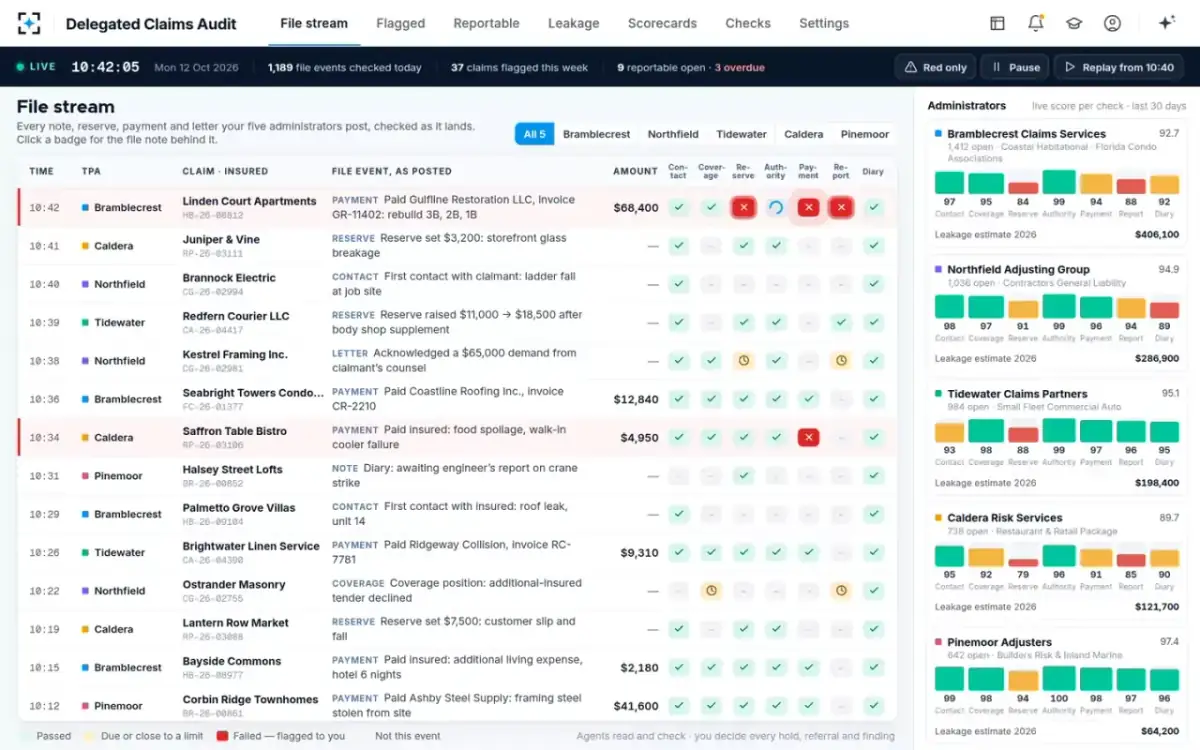
10:41:37 to 10:55: one payment, traced
At 10:41:37 on Monday 12 October, Bramblecrest's claims system recorded check 0048213: $68,400 to Gulfline Restoration on invoice GR-11402, the rebuild of three units. Fifteen seconds later the solution's file reader had read it and tied it to the claim, the policy and the binder. What followed is set out below, with the time each check took on the claim screen.
The trace in Delegated Claims Audit: what each step found, and who did it
| Time | Step | What it found |
|---|---|---|
| 10:38 | Adjuster’s file note (Bramblecrest) | “Supervisor approved full invoice.” Payment to be issued today. |
| 10:41:37 | Payment posted (Bramblecrest) | Check 0048213, $68,400, invoice GR-11402; referral to carrier: none. |
| 10:41:52 | File reader · 1.0 s | Payment read and tied to claim HB-26-08812, policy and binder HSI-BA-2026-0417. |
| 10:42 | Coverage checker · 1.0 s | Policy in force; sudden water discharge covered; $5,000 deductible already taken on 2 Jul. Pass. |
| 10:42 | Payment checker · 1.4 s | All six lines matched against two earlier invoices: line 4, structural drying, $6,200, was paid on GR-10977 in July. |
| 10:42 | Authority checker · 1.4 s | $74,600 paid against $50,000 of indemnity authority; no referral and no carrier approval on file. |
| 10:42 | Reserve checker · 1.1 s | Indemnity reserve $45,000 against $74,600 paid; the estimate implies at least $83,650 incurred. |
| 10:42 | Reportable-claim finder · 1.1 s | Over $35,000 since 2 Oct, notice 6 days overdue; a second trigger today, above authority. Notice drafted. |
| 10:42 | Leakage estimator · 1.0 s | $6,200 duplicate priced; Bramblecrest’s 2026 estimate moves from $406,100 to $412,300 once accepted. |
| Minutes later | Claims manager (Harrowgate) | Places a payment hold; edits and sends a request to the TPA due Wed 14 Oct. |
| 10:55 | Claims manager (Harrowgate) | Logs the large-loss notice to claims, with a copy to reserving. |
The claim, on its money
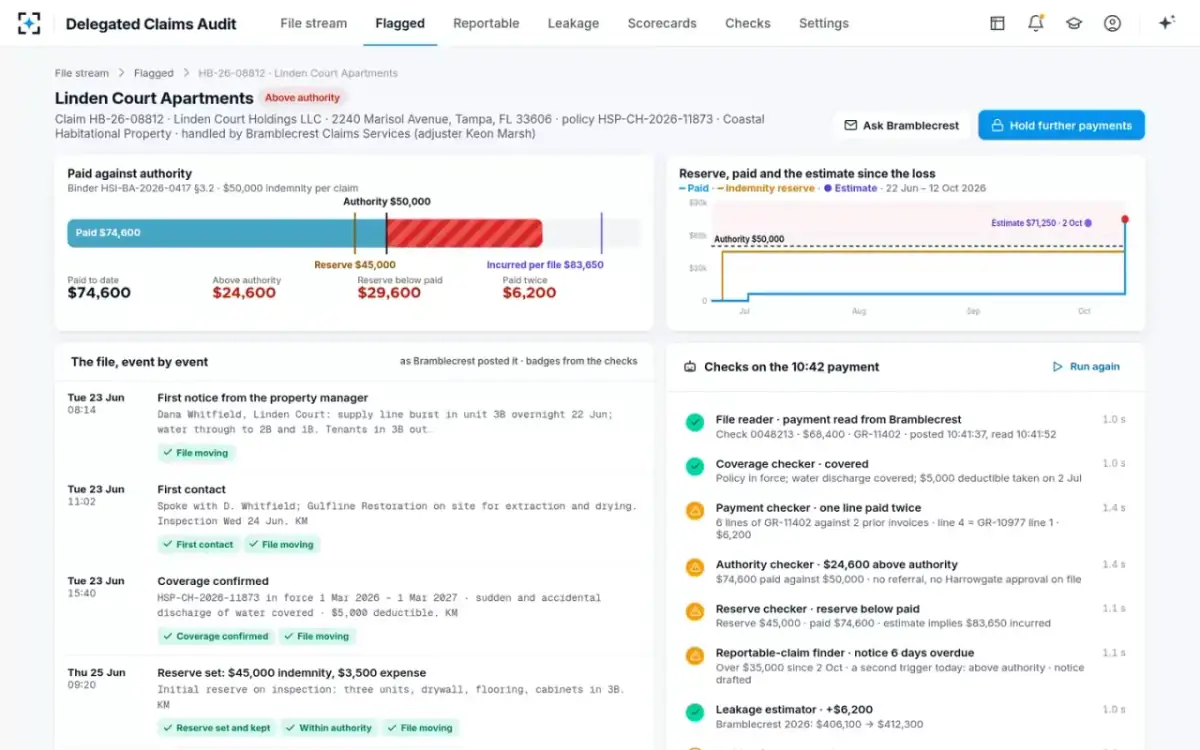
Two details in the trace matter more than the speed. The checks read the administrator's own words: the adjuster's note is quoted, the payment entry is quoted, and the rule applied, binder §3.2, is quoted beside them. And three of the four problems on this claim existed before the payment. The reserve had been stale since 2 October and the large-loss notice overdue since 6 October; the payment made them expensive, and visible together.
What checks run on a delegated claim?
Seven, in the sample configuration, each tied to a clause the carrier wrote. Contact and diary checks test service levels. Coverage tests the policy and binder terms. Reserve tests the reserving rule. Authority tests the settlement limit. Payment tests the payee, the arithmetic, the deductible and every prior payment on the claim. Reporting tests the triggers that oblige the administrator to tell the carrier. A leakage estimator then prices whatever a person accepts.
How a file event moves through Delegated Claims Audit, and where a person decides
Agent
File readerReads each note, reserve change, payment, letter and report as it posts, and the monthly bordereau; ties the event to claim, policy and binder.
Never: edits the administrator’s file
Agent
Coverage, reserve, authority and payment checkersTest the event against the binder’s coverage, the reserving rule, the settlement authority and every prior payment on the claim.
Never: takes a coverage position or writes to reserves
Agent
Reportable-claim finderApplies the reporting triggers, starts the notice clock on the day a trigger is met, and drafts the notice from the file.
Never: sends a notice
Agent
Leakage estimatorPrices each finding: duplicate, deductible, outside coverage, vendor rate, missed subrogation, expense above guidelines.
Never: counts a finding no person has accepted
A person decides
Delegated claims managerHolds payments, sends referral requests, accepts or rejects findings, logs notices; changes to authority need a second approver.
Several of the reporting triggers come straight from statute. Where an MGA settles claims, the NAIC model act sends the file to the insurer on a coverage dispute, a claim that may exceed settlement authority, a claim open more than six months and amount thresholds. A TPA's triggers come from its contract, and a sensible carrier writes them to mirror that list; how to draft them is the subject of the claims settlement authority letter.
Where the claims manager decides, and what the agents may not do
Every action that changes money or a relationship stays with a person. The agents read, compare, price and draft. They cannot hold a payment; in the sample carrier, automatic holds are off by policy. They cannot send the request to the TPA or the notice to the reinsurer. A change to an authority limit, a clock or a threshold is saved as a draft until a second person approves it.
The request the claims manager edits and sends
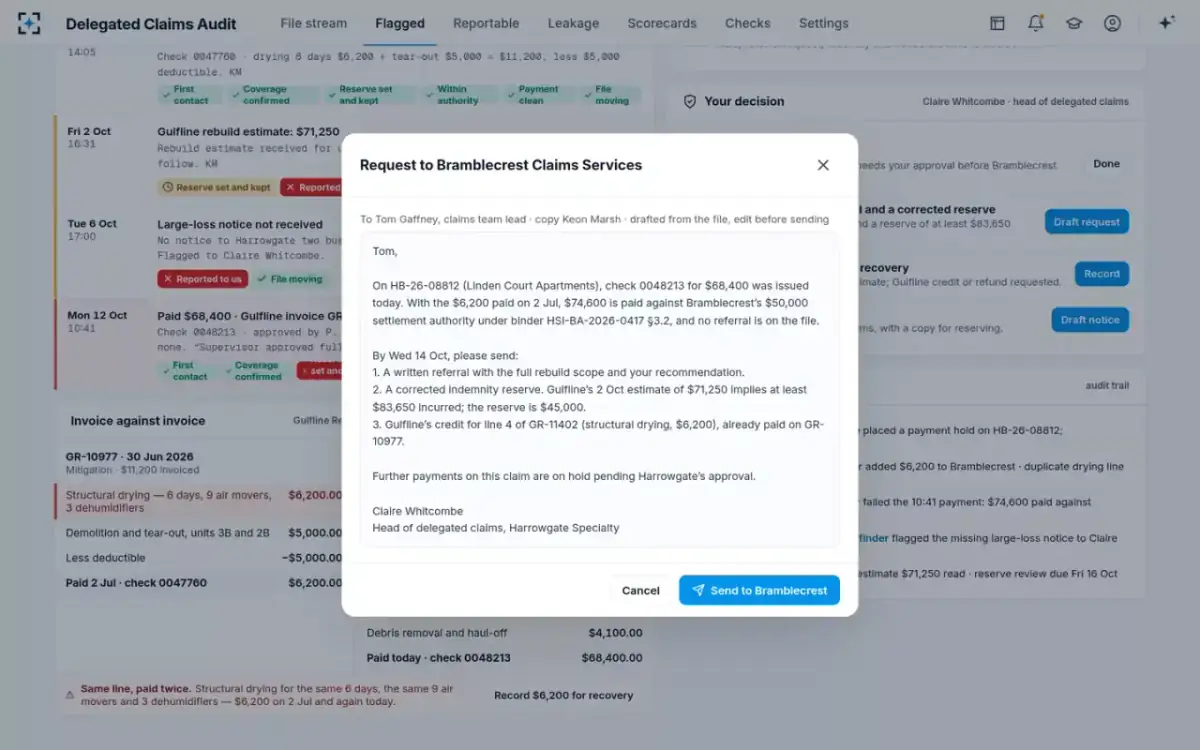
That boundary is also what regulators expect when software is involved. The European insurance supervisor's 2025 opinion on AI governance says firms remain ultimately responsible for the AI systems they use, whether built in-house or bought. The FCA has said it will assess how insurers use AI in claims and other internal processes during 2026, alongside an expanded review of how they oversee outsourced claims and delegated authority, and plans to report its findings in early 2027. Neither has published a rule specific to AI in delegated claims oversight.
Can AI review claim files?
It can read them, and for oversight that is most of the work. Reading every reserve change against the latest estimate, every invoice line against every prior payment, every payment against a binder's authority: these are comparisons a person can make on a sampled file and software can make on all of them. What it should not do is decide. A coverage position, a reservation of rights, a reserve, a hold or a finding against a vendor is a judgement with consequences, and the carrier will be asked who made it.
The reliable test of an AI file reviewer is not a demonstration but a comparison on files whose answers you already know. A carrier can plant known errors in closed files and count what comes back, the method set out in the TPA claims audit checklist. In the sample, September's 36,904 file events were run through the checks and compared with the 412 files the claims auditor had reviewed: the checks missed none and flagged six in error, all six of them referrals that had been sent by email and attached to the file late.
What to ask before buying a delegated claims management system
Ask for evidence on your own files, and ask about the boundaries as carefully as the features. These questions separate an oversight layer from a dashboard over the bordereau.
Twelve questions for any delegated claims management system
- What does it read: file events or monthly lines?
A system built on the bordereau sees a claim once a month. Ask which of notes, reserves, payments, invoices and letters it ingests, and how often.
- How does it get the data from each administrator?
A feed, an export, or a person uploading files. Ask what happens when one administrator’s feed stops.
- Is access read-only?
Oversight software that can write into a TPA’s claims file blurs who handled the claim.
- Are authority, clocks and thresholds set per binder?
One delegate can hold several binders with different limits. A single limit per firm will miss breaches.
- Can you see the evidence behind every flag?
The note, payment or invoice it relied on, and the clause it applied. A score without the file note cannot be argued with a TPA.
- Does the same event always get the same answer?
Ask how a check is versioned, and whether a changed rule can be tested on past events before it runs.
- Who can hold a payment, send a notice or accept a finding?
The answer should be a named person, every time, with the decision kept on the claim.
- Who can change a limit?
A second approver for authority changes is a basic control; ask to see it.
- Does it compare every invoice line with every prior payment on the claim?
Duplicates are often split across invoices months apart, as on the sample claim.
- Does it start the reporting clock on the trigger date?
Not the date someone noticed. Ask which triggers are configured and where each comes from.
- How is leakage counted?
Only on findings a person accepted, or on everything the software flagged? The second inflates the number.
- What does the administrator see?
If the TPA gets the same reason the carrier sees, disputes are about facts, not about a score.
Where Delegated Claims Audit fits as a delegated claims management system, and where it does not
Botminds' Delegated Claims Audit fits a carrier or managing agent that delegates claims authority to one or more administrators and wants to see their work on every claim, not on a sample. It needs a feed or regular export of each administrator's file events, the binders and authority schedules, policy forms, and the vendor list and rate guidelines. It reconciles the monthly claims bordereau against those events; the gap between the two is examined in what one bordereau line can never tell the carrier.
It does not replace the administrator's claims system, adjust claims, set reserves or take coverage positions. It is not a fair-claims-practices compliance tool for a carrier's own desk, nor a bill-review service for independent adjusters. And it does not remove the audit: an on-site review still looks at people, controls and things a file cannot show. What it changes is what the auditor and the claims manager already know before the visit.
Questions people ask
What is delegated claims handling?
It is claims handling done by a third party under authority the insurer has delegated: a TPA, an MGA that settles claims, or in the UK a coverholder or delegated claims administrator. The insurer keeps the regulatory responsibility; the FCA found in 2025 that 5 of the 23 insurers it reviewed had limited control over such arrangements, or material weaknesses in overseeing them.
What is delegated claims authority?
It is the limit up to which a delegate may settle and pay claims without referring to the insurer, usually set per claim and per binder, often separately for indemnity and expense. For an MGA, the NAIC model act caps the amount it may pay without prior approval at 1% of the insurer's policyholder surplus.
How is a delegated claims management system different from a claims administration system?
The claims administration system is where the TPA's adjusters work the claim. The delegated claims management system is the carrier's view of that work: it reads the events, tests them against the binder and routes exceptions. A carrier can have the second without owning the first.
How fast should a carrier see a TPA payment?
Fast enough to act before the next payment on the same claim. In the fictional sample, the payment was read 15 seconds after it posted and the hold placed within minutes. A monthly bordereau would have shown it weeks later, after further payments could have been made.
Does a delegated claims management system replace TPA audits?
No. Model law still requires periodic reviews, at least semiannually for an MGA's claims operation. The system changes what the reviewer brings: the auditor arrives knowing which files failed which checks, rather than discovering it from a random sample.