TPA license requirements by state depend first on the line of business. Most states that license third-party administrators do so for life, annuity, health, stop-loss and, in many, workers' compensation administration, following the NAIC's guideline: Texas requires a certificate of authority and makes the insurer check for it before referring a claim, Florida requires a certificate of authority and fines anyone acting without one $5,000 to $10,000 per violation, and New York licenses no TPAs at all but requires any that adjusts claims to hold an independent adjuster licence. For property and casualty claims, the people handling the claim usually need adjuster licences, and an MGA that settles claims acts under its producer and MGA licences. For a carrier, the first question before handing over claims authority is which licence the administrator needs in each state for each line, and whether it holds it. Botminds' Delegated Claims Audit is a claims oversight solution for carriers that checks every file event a TPA posts once the work starts; the licence check comes before that, and is the carrier's.
The rules below come from state statutes, a New York regulatory opinion and the NAIC's own guideline and state chart, each linked. Statutes change: check the current text in each state before relying on any line here. The administrators in the screens are fictional, from a sample carrier.
Which licence a delegated claims administrator usually needs
Life, health, stop-loss and workers’ compensation administration: The state’s TPA act, usually modelled on the NAIC’s TPA statute and guideline.
Property and casualty claims administration: The state’s adjuster licensing law, and the MGA act if the delegate also underwrites.
Life, health, stop-loss and workers’ compensation administration: The administrator, as a business: a TPA licence or certificate of authority.
Property and casualty claims administration: The individuals adjusting, and in many states the firm, as adjusters.
Life, health, stop-loss and workers’ compensation administration: Texas: a certificate of authority under Insurance Code chapter 4151.
Property and casualty claims administration: New York: an independent adjuster licence, for the firm and each employee adjusting.
Life, health, stop-loss and workers’ compensation administration: In Texas, confirm the certificate with the commissioner before the first referral.
Property and casualty claims administration: Check the adjusters’ licences and the contract’s authority; the TPA act often does not apply.
Life, health, stop-loss and workers’ compensation administration: Semiannual reviews where the TPA serves more than 100 people (NAIC; Texas; Florida; Delaware).
Property and casualty claims administration: Set by the contract, or by the MGA act if the delegate is an MGA.
What are TPA license requirements?
They are the conditions a state sets before a business may administer insurance for an insurer or plan: usually an application with organisational documents and audited financial statements, a written agreement with each insurer, a fiduciary account for funds, records kept for a set period, and an annual report; Texas adds a fidelity bond. The NAIC's guideline sets out the model. It defines a TPA as a person who underwrites, collects premiums or charges from, or adjusts or settles claims on residents of the state, but only in connection with life, annuity, health, stop-loss or workers' compensation coverage, and it lets a TPA designate a home state that licenses it, with other states licensing it as a nonresident.
The guideline excludes some people who would otherwise fit: a producer acting within the scope of its licence (except for adjusting workers' compensation claims), a licensed MGA "when acting within the scope of that license", an attorney adjusting claims as part of practice, and an insurer administering its own policies. Those exclusions are where most licensing questions in property and casualty get answered.
What states require a TPA license? What the NAIC's chart shows
The NAIC keeps a chart of state law related to its TPA guideline. In its Fall 2024 edition, the chart lists a statute, regulation, bulletin or opinion for 48 of the 56 jurisdictions it covers and shows "no current activity" for eight: Alabama, American Samoa, Colorado, the District of Columbia, Guam, the Northern Marianas, Puerto Rico and Virginia. The citations are a starting point, not a verdict; the NAIC itself warns that the chart is not a formal legal opinion and should not be relied on as one. New York's entry, for example, is an opinion, not a licensing statute.
Where to find the TPA law in states people ask about
| State | Citation in the NAIC chart (Fall 2024) | What a carrier should note |
|---|---|---|
| Texas | Tex. Ins. Code §§ 4151.001 to 4151.309 | Certificate of authority; insurer must confirm it before the first referral; semiannual review and biennial audit above 100 people. |
| Florida | Fla. Stat. §§ 626.88 to 626.891 | Certificate of authority for life and health administrators; fines of $5,000 to $10,000 per violation without one. |
| Georgia | Ga. Code Ann. §§ 33-23-100 to 33-23-105; Ga. Comp. R. & Regs. 120-2-49 | Statute and rule; check the current licence class with the department. |
| Tennessee | Tenn. Code Ann. §§ 56-6-401 to 56-6-412 | Statute; confirm which lines it covers. |
| Illinois | 215 Ill. Comp. Stat. 5/511.100 to 5/511.113 | Statute. |
| Kentucky | Ky. Rev. Stat. Ann. §§ 304.9-051 to 304.9-052; §§ 304.9-371 to 304.9-377 | Two sets of provisions; read both. |
| Alaska | Alaska Stat. §§ 21.27.630 to 21.27.660; Bulletins 92-3 and 97-6 | Statute plus bulletins. |
| Arkansas | Ark. Code Ann. §§ 23-92-201 to 23-92-208 | Statute. |
| California | Cal. Ins. Code §§ 1759 to 1759.10 | Statute. |
| New York | O.G.C. opinion 11-2-2006 | No TPA licence; adjusting requires an independent adjuster licence. |
| Colorado, Virginia, Alabama, D.C. | No current activity | No entry in the chart; check the state code and adjuster rules directly. |
Texas TPA license requirements: a certificate, a referral check, and reviews
Texas requires an administrator to hold a certificate of authority before acting as one, and puts a duty on the insurer as well as the administrator. An "administrator" in Texas is a person who, for annuities or life, health, accident, pharmacy or workers' compensation benefits, collects premiums or contributions from, or adjusts or settles claims for, Texas residents. A licensed adjuster acting within the scope of its licence is exempt, as is an agent licensed under the MGA chapter acting under appointment.
"Before first referring a claim or loss for administration, an insurer must ascertain from the commissioner whether the person performing the administration holds a certificate of authority under this chapter."
Texas Insurance Code §4151.1041(b)
Once confirmed, the insurer may keep referring claims until it learns the certificate has gone. The same chapter makes the insurer responsible for the benefits, rates and claims-payment procedures the administrator applies, says the insurer "shall ensure competent administration of its programs", and, where the administrator serves more than 100 people, requires the insurer to review its operations at least semiannually and audit them at least biennially. That section was last amended in 2025.
Florida TPA license requirements: a certificate of authority, and two exclusions that matter
Florida makes it unlawful to act as an administrator "without a valid certificate of authority" from the Office of Insurance Regulation, with a fine of not less than $5,000 or more than $10,000 for each violation. Florida's definition of administrator covers programmes that provide life or health coverage and authorised commercial self-insurance funds, plus some billing services and pharmacy benefit managers. Its list of exclusions includes a person appointed as a managing general agent whose activities stay within the appointment, and an adjuster licensed in Florida whose activities are limited to adjusting claims.
Two other Florida provisions matter to a carrier once the administrator is in place. Administrators must keep books and records of all transactions with insurers and insureds for the duration of the agreement and five years after, and the insurer keeps a right of continuing access to them. And where the delegate is an MGA settling property and casualty claims, Florida's MGA statute requires that "all claims must be adjusted by properly licensed persons", which is a licence check the carrier can test on the file.
New York: no TPA licence, but an adjuster's
New York does not license TPAs as a class. Asked whether a TPA needs any licence from the state, the Insurance Department's Office of General Counsel answered in 2007 that "The Department does not license TPAs, but if the entity adjusts claims, it must be licensed as an independent adjuster." It added that the entity "and every employee adjusting claims" must hold the licence. What counts as adjusting is broad. A 2006 opinion held that processing a health claim and deciding whether to pay it "would constitute adjusting, inasmuch as it involves the exercise of discretionary authority".
The practical point for a carrier writing in New York is that the licence to check is the independent adjuster licence, for the firm and each of its adjusters. Location does not help an out-of-state TPA: the same 2006 opinion said that being outside New York "is inconsequential" if the company is adjusting claims for an insured or claimant in New York. Both opinions are from 2006 and 2007; read the current Insurance Law before relying on them.
Is a TPA license the same as an adjuster license?
No. A TPA licence or certificate authorises a business to administer coverage, often including premium handling and claims, for an insurer or plan in the lines the state's TPA act covers. An adjuster licence authorises a person, and in many states a firm, to investigate and settle claims. The two meet in the exemptions: Texas and Florida both exclude a licensed adjuster working within the scope of the licence from their TPA acts. A property and casualty claims administrator therefore often needs adjuster licences and no TPA licence; a health or workers' compensation administrator needs the TPA licence, and in some states adjuster licences too.
The MGA that settles claims: which licence?
An MGA acts under its producer licence and, in many states, a separate MGA licence or appointment. The NAIC model act says no one may act as an MGA for risks in the state unless licensed as a producer there, and a September 2026 draft of the NAIC's State Licensing Handbook summarises: "In most states, MGAs must be licensed as producers and are not allowed to place business until a written contract exists among all parties." Texas requires a separate MGA licence, and asks at appointment whether the MGA will settle claims and whether its authority exceeds $25,000 on any one claim.
Because a licensed MGA is excluded from most TPA acts while it acts within its licence, its claims work falls under the MGA act's claims provisions instead: timely reporting, files sent back to the insurer on set triggers, and a claim cap. How those provisions shape the authority a carrier grants is the subject of the difference between an MGA and a TPA.
TPA license lookup: what a carrier must check before the first claim
Check the licence, the scope and the paper before any claim moves. A lookup on the state department's licensee search, or through the national producer database where adjusters and producers are listed, answers the first question; the others need the agreement and the administrator's own documents.
Seven checks before referring the first claim to a new administrator
- Which law applies, per state and line?
TPA act, adjuster licensing or MGA act. Map it for every state the binder writes and every line it covers.
- Does the administrator hold the licence or certificate?
Confirm with the state, not the administrator’s letterhead. In Texas the insurer must ascertain it from the commissioner before the first referral.
- Are the adjusters licensed?
Each person who will adjust your claims, in each state, including any emergency or nonresident licences.
- Is there a written agreement that meets the statute?
TPA acts and MGA acts list required contract terms: duties, records, funds, reporting and termination.
- Where will your money sit?
A fiduciary account in the administrator’s name for your funds, with your right to see statements.
- Who keeps the records, for how long, and can you get them?
Florida asks for the life of the agreement plus five years, with continuing insurer access; the NAIC guideline asks for five years.
- When will you first review the operation?
Diary the first review within the clock your state sets; Florida asks for one within six months of engaging a new MGA.
Delegated Claims Audit starts where the licence check ends: each administrator's binders and authority
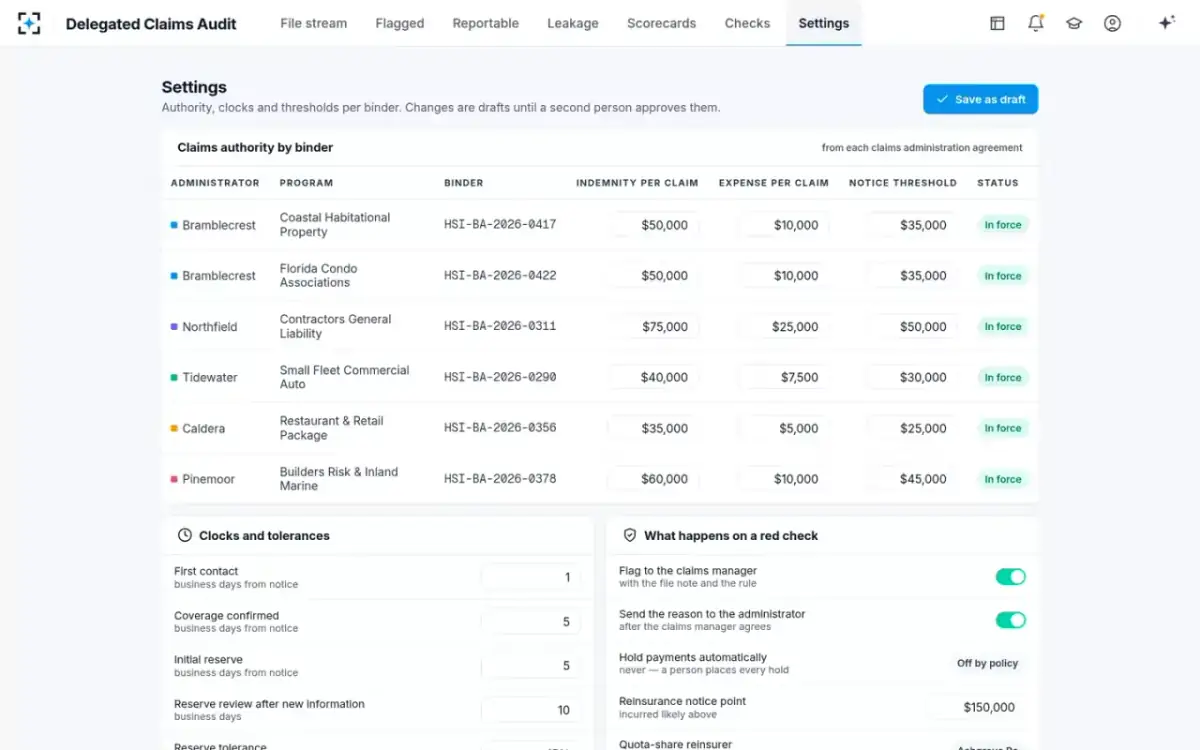
What a licence does not tell you
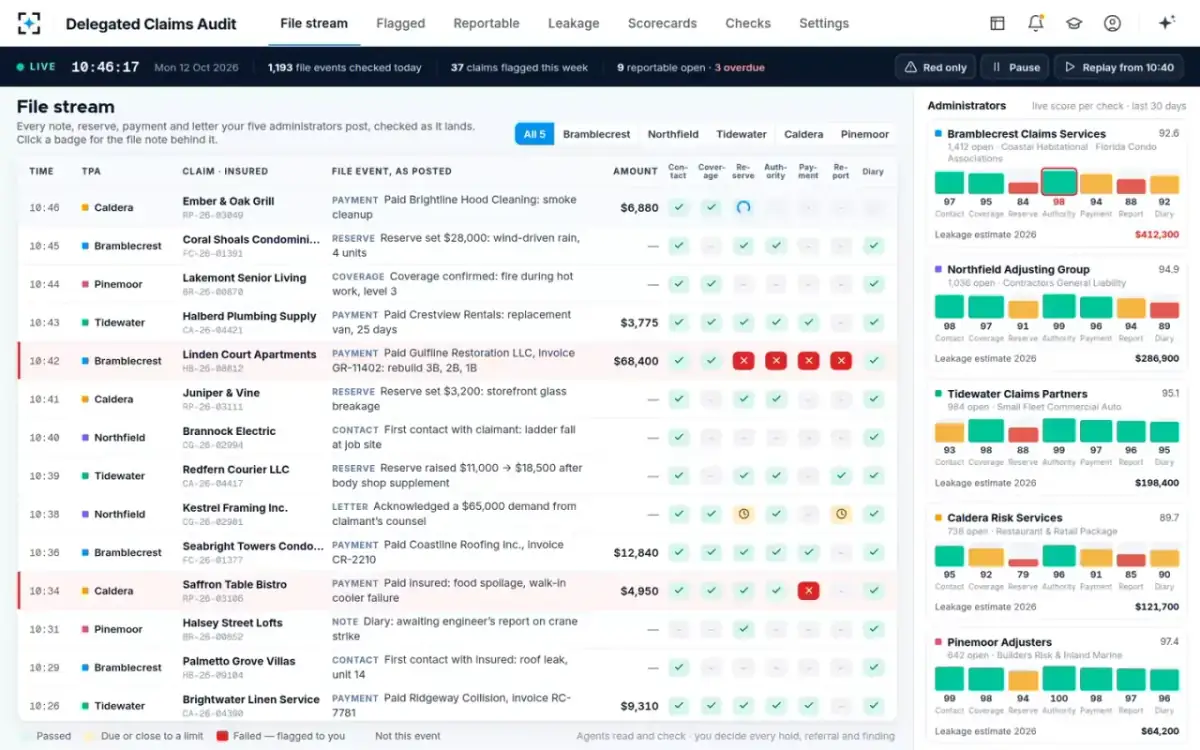
A licence says an administrator may do the work, not that it does it well. Texas and Florida both put competent administration on the insurer, not the administrator: Florida makes it the insurer's responsibility alone (quoted in TPA oversight manager). The NAIC guideline puts the same duty on the payor. That is why licensing is the first check and not the last. Once claims flow, the questions become whether the administrator stays within its authority, reports what it must, and keeps reserves honest, which is what a TPA oversight manager watches and what Delegated Claims Audit checks on every file event.
The reviews the licence laws require are a floor for that watching, not a substitute for it. Where examiners have looked, they have found carriers doing fewer reviews than required; one such finding, and what changes when every file event is checked, is in claims audit software for insurance companies.
After the licence check: every file event from each administrator, checked as it lands
Questions people ask
Do TPAs need a license?
In most states, yes, if they administer life, health, stop-loss or workers' compensation coverage: the NAIC's chart lists related law in 48 of 56 jurisdictions. New York licenses no TPAs but requires one that adjusts claims to hold an independent adjuster licence. Property and casualty claims handlers usually need adjuster licences instead.
What is a TPA license?
It is a state's authorisation for a business to act as a third-party administrator, called a licence in some states and a certificate of authority in others, such as Texas and Florida. It usually requires audited financial statements, written agreements with insurers, a fiduciary account for funds and an annual report; Texas also requires a fidelity bond.
How do I look up a TPA license?
Use the licensee search of the state insurance department where the administrator works for you; Texas expects the insurer to confirm the certificate with the commissioner before the first referral. For adjusters and producers, state lookups and the national producer database list licences and their status.
Can a TPA operate in several states on one licence?
Under the NAIC guideline, a TPA designates a home state for its licence and applies to other states for a nonresident licence, which the guideline says should be issued promptly on a complete application if the home state applies substantially similar rules. Each state where it administers coverage for residents still expects that licence or its own certificate if it has a TPA act.
What happens if a TPA operates without a license?
The state can fine it; Florida's fine for acting as an administrator without a certificate is $5,000 to $10,000 per violation. In Texas the insurer is also at fault if it knowingly refers a claim to an administrator without a certificate of authority.