Claims leakage is the money an insurer pays out on claims that it would not have paid if each claim had been handled exactly as its policy wording, its settlement authority and its contracts with vendors required: an invoice line paid twice, a deductible not taken, a payment outside coverage or above a sublimit, a contractor billed above the agreed rate, a recovery from a responsible third party never pursued, expense above the guidelines. It is not the cost of covered losses and it is not the same as fraud, though fraud is one way money leaks. In delegated claims it is harder to see, because the payments are made in a third-party administrator's system and the carrier sees a monthly summary. No regulator or academic source publishes a reliable leakage rate, so the honest way to talk about it is as a measurement method on your own files. Botminds' Delegated Claims Audit is a claims oversight solution for carriers that prices each finding on each TPA file event and counts leakage only on the findings a claims manager has accepted.
The examples come from a fictional sample carrier, Harrowgate Specialty, and its five fictional administrators; every dollar figure describing them is sample data, not a customer result. Industry figures come from the NAIC and are linked where they appear.
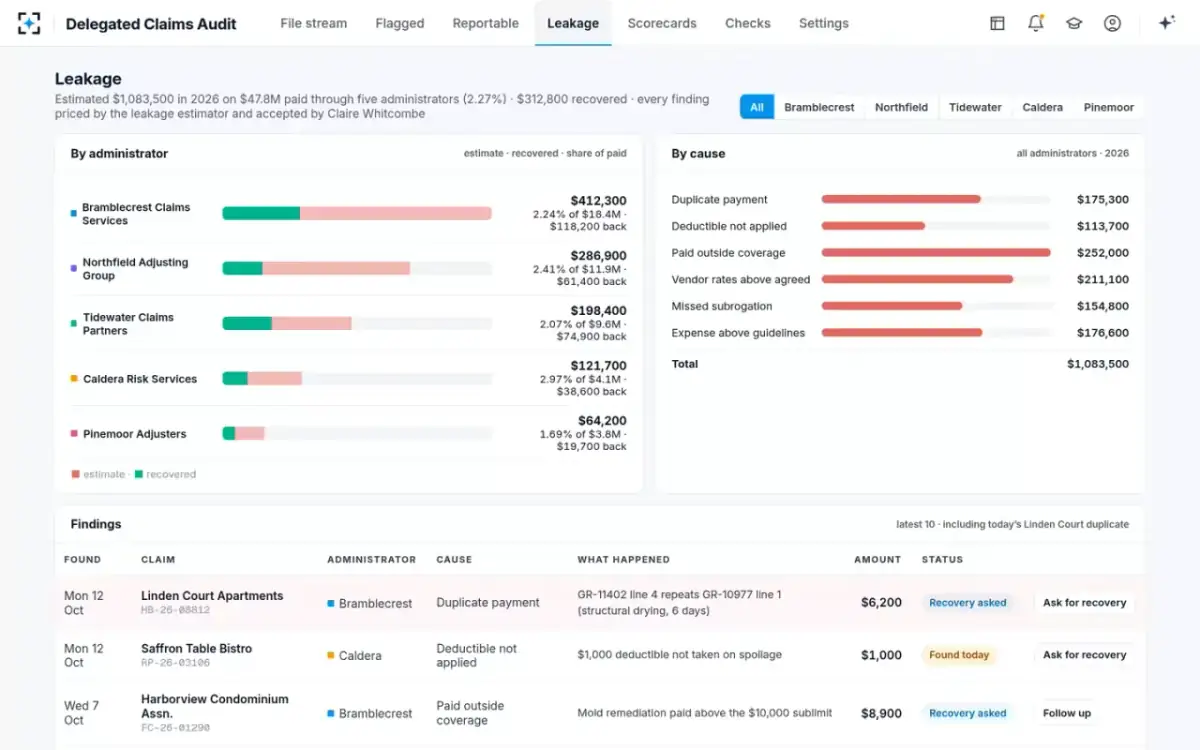
Where a sample carrier's 2026 claims leakage came from, by cause
Accepted findings across five TPAs: $1,083,500
- Paid outside coverage $252,000 · 23.3%
- Vendor rates above agreed $211,100 · 19.5%
- Expense above guidelines $176,600 · 16.3%
- Duplicate payment $175,300 · 16.2%
- Missed subrogation $154,800 and deductibles not applied $113,700 · 24.8%
What is claims leakage in insurance?
In insurance, claims leakage is the gap between what was paid and what should have been paid under the rules that applied to the claim. The term is managers' shorthand rather than an accounting line, which is why definitions drift. An open actuarial textbook, written largely by university actuaries for students, puts it in one sentence:
"Insurance managers sometimes use the phrase claims leakage to mean dollars lost through claims management inefficiencies."
Loss Data Analytics, an open text by the actuarial community (Frees et al., University of Wisconsin–Madison), 2018
Two boundaries make the definition usable. First, leakage is judged against the rules in force for that claim, not against hindsight: a reserve that later proved low is not leakage if it matched the estimate on file at the time. Second, leakage is a payment, or a recovery not made; a late letter or a slow first contact is a service failure that may cause leakage but is not itself money. A measurement that mixes those in will be large, persuasive and unusable.
What causes claims leakage in delegated files?
Six causes account for nearly all of it, and each leaves evidence in the administrator's file. That is the useful property: a leakage finding can be priced from the documents, argued on the documents and, where it is recoverable, recovered with the documents. The checklist sets out each cause with the evidence that proves it.
Six causes of claims leakage, and the file evidence that proves each
- Paid outside coverage or above a sublimit
The policy and binder terms against the payment: a mould remediation paid at $18,900 on a $10,000 mould sublimit, in the sample.
- Duplicate payment
Every invoice line against every prior payment on the claim. In the sample, a $6,200 drying line paid in July reappeared in an October invoice.
- Deductible not applied
The deductible on the policy against the first payment net of it: a $4,950 spoilage payment made with no $1,000 deductible, in the sample.
- Vendor rates above the agreed rate
Each line’s unit price against the rate guideline for that vendor and service.
- Missed subrogation
A responsible third party named in the file, and no demand or recovery on it.
- Expense above guidelines
Adjusting, legal and expert fees against the expense guideline and the expense authority on the binder.
Two other failures often get counted as leakage and should be kept apart. An authority breach is a control failure: a payment above the TPA's limit is leakage only to the extent that the amount was not owed. And a reserve set too low is a reserving problem; it changes the carrier's books, not what was paid. Both should be found and fixed, and both appear in the same review, but adding them to the leakage figure double counts.
Why delegated claims leak differently from claims handled in-house
Delegated claims leak in the same six ways as in-house claims, but three features of delegation make the leaks harder to see and slower to close. The payment is made in the administrator's system, so the carrier's first sight of it is a total on a monthly bordereau. The vendor relationships are often the administrator's, so the rate guideline the carrier agreed may not be the one the contractor bills against. And the administrator's incentives are set by its fee basis: a fee per claim or per file rewards closing files, not checking the third invoice against the first.
Regulators have noticed the pattern, if not the dollar figure. In its 2025 review of home and travel claims, the FCA found service problems across its sample but wrote that "We often saw the most extreme examples in firms that materially outsourced claims handling activity to a third party." Where the delegate is an MGA whose profit share depends on its own claim payments, the model act deals with the conflict directly: interim profits are held back one year on property business and five on casualty, and not paid until verified, so that overpayments made now can still reach them.
How much is claims leakage? Why no honest rate is published
Nobody knows, in a form that would survive a regulator's or an auditor's reading. We found no regulator, academic or non-profit research body that publishes a measured claims leakage rate for the market. The percentages in circulation come from vendors and consultancies, measured on their clients' sampled files with definitions that are rarely stated. That does not make them wrong; it makes them impossible to check, and a figure you cannot check is a poor basis for a budget.
What can be stated is the scale of the base. In 2025 the US property and casualty industry incurred $551.8 billion of net losses and $86.0 billion of loss adjustment expense, for a net loss ratio of 66.5%, according to the NAIC. On that base, each one percent of net losses is about $5.5 billion (our arithmetic). The question for any one carrier is not what the market's rate is, but what its own is, on its own files, by administrator and by cause.
How do you measure claims leakage? A method on the whole file population
Measure it as accepted findings over paid, on every file in the period, split by administrator and by cause. Each part of that sentence is a choice. Accepted, because a finding nobody has reviewed is a hypothesis. Every file, because leakage concentrates in a few large claims that a sample is likely to miss. By administrator and cause, because the number is only useful if it says who should do what differently.
Measuring claims leakage on every delegated file, as Delegated Claims Audit does
Leakage found
Σ priced findings accepted by the claims manager
Each finding priced from the file: the duplicate line, the deductible, the excess over a sublimit or rate.
Head of delegated claims
Leakage rate
leakage found ÷ claims paid in the period
Per administrator and per cause; the denominator is paid, not incurred, so the two match.
Claims finance
Recovered
credits and refunds received on accepted findings
Tracked separately: a recovery does not erase the leakage, it offsets it.
Head of delegated claims
Rejected findings
findings reviewed and not accepted
Excluded from the rate, and reported, so a reader can see how much was flagged and set aside.
Claims auditor
Three cautions keep the number honest. Price at the amount that should not have been paid, not the whole payment. Count a finding once, under its main cause, even if two checks failed. And publish rejected findings alongside accepted ones, because a leakage estimate whose author can silently drop the awkward cases is not an estimate.
What is a claims leakage audit, and why do samples mislead?
A claims leakage audit reads a set of closed files, prices every payment that should not have been made, and extrapolates to the book. The extrapolation is where it goes wrong. Leakage is lumpy: a few large errors carry most of the money. Suppose one file in 200 carries a $25,000 overpayment. An audit of 240 files should expect to meet about 1.2 of them, and by simple probability it will meet none roughly three times in ten (our arithmetic, assuming errors fall at random). The same administrator can then look clean one year and badly leaking the next, with nothing changed but the draw.
A review of every file event removes that swing; it does not remove the need to check the reviewer. How to test whether any review, a sample audit or software, actually finds what is there is set out in the TPA claims audit checklist, which plants known errors and counts what comes back.
Leakage as a share of paid, by administrator, in a sample carrier
Claims leakage examples, priced from the file
Examples make the method concrete. On the morning of 12 October in the sample, a TPA paid a contractor $68,400 on a water-damage claim. The payment check compared all six lines of the invoice with every earlier payment on the claim and found line 4, six days of structural drying with nine air movers and three dehumidifiers, already paid at $6,200 on a July invoice. The leakage is $6,200, not $68,400: the rest of the invoice was owed.
One line, paid twice, three months apart
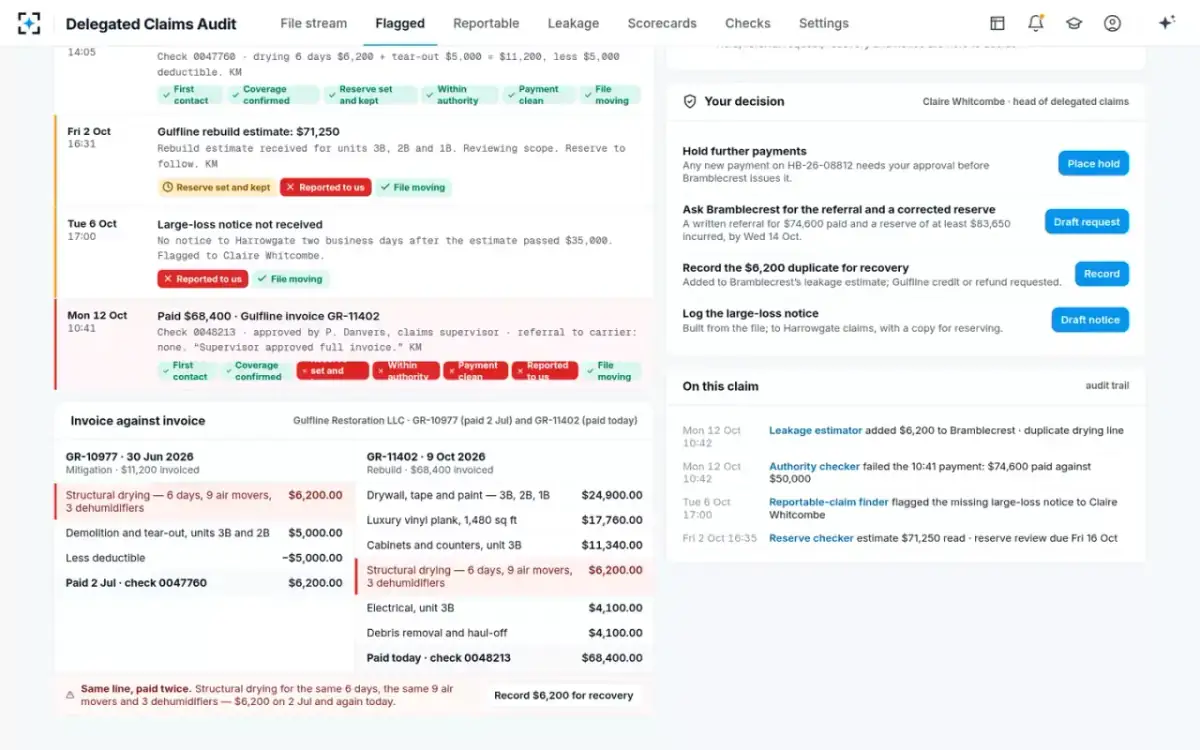
The same week produced other kinds. A different administrator paid $4,950 for spoiled stock with no $1,000 deductible taken; that administrator had, by then, 31 such payments in the year worth $46,500 of deductibles not applied, the largest single cause of its leakage. Another paid $18,900 for mould remediation on a policy with a $10,000 mould sublimit: $8,900 leaked. In each case the evidence was a policy term and a payment line, both in the file, and the finding priced only the part that should not have been paid.
Leakage you can recover, and leakage you can only stop
Some leakage comes back and most does not. A duplicate line paid to a contractor still working the claim can be credited on the next invoice. A deductible not taken from an insured is awkward to claw back and usually is not. A payment outside coverage made months ago, after the TPA told the insured it was covered, is often money the carrier decides to leave where it is. In the sample, $312,800 of $1,083,500 had been recovered: 29%, on invented data.
That ratio is why timing matters more than the leakage rate itself. A finding made the minute the check is cut can stop the next payment and be settled as a credit while the vendor is still on the job. A finding made in next year's audit is a negotiation over money already spent, with a vendor who may have moved on, and the administrator's file has to be reconstructed from memory as much as from documents.
Leakage in Delegated Claims Audit, by administrator and by cause
What the leakage number is for
A leakage figure earns its keep in three conversations. With the administrator, where a finding drafted from its own file and priced line by line is argued on the facts, not rediscovered at audit. With the carrier's own claims leadership, where leakage by cause says whether the fix is a rate guideline, a deductible rule or a coverage training session. And at renewal of the administration agreement, where leakage as a share of paid sits on the scorecard beside days to close and reserve accuracy. How that scorecard is built and tested on a single administrator is covered in a one-TPA pilot, and what a monthly bordereau line can and cannot reveal about leakage in claims bordereaux.
What the number is not for is a headline. A carrier that announces a leakage rate invites the question of how it was measured, and the only good answer is the method on this page: every file, priced from the evidence, counted when accepted, with the rejected findings shown.
Questions people ask
What is leakage in claims handling?
It is money paid that the policy, the authority or the vendor terms did not require: duplicates, deductibles not taken, payments outside coverage, rates above agreed, recoveries not pursued and expense above guidelines. In the fictional sample carrier, paid-outside-coverage was the largest single cause, at $252,000 of $1,083,500.
Is claims leakage the same as fraud?
No. Fraud is deliberate deception by a claimant, vendor or insider, and some of it shows up as leakage. Most leakage is error or inattention: the duplicate invoice line, the missed deductible. Treat them separately, because fraud goes to an investigator and leakage to the claims manager.
What is a claims leakage study?
A one-off audit that reads a sample of closed files, prices every overpayment and extrapolates to the book. Its weakness is the extrapolation: with rare, large errors, a 240-file sample can miss a one-in-200 error about three times in ten. Measuring every file removes that swing.
How do you reduce claims leakage with a TPA?
Find it while the claim is open, price it from the file, and send the administrator the same reason the carrier sees. A finding made before the next payment can be credited on the next invoice; one made a year later is a negotiation. Add leakage as a share of paid to the TPA's scorecard and review it at each renewal.
Does claims leakage include loss adjustment expense?
It should include expense paid above the guidelines or above the binder's expense authority, priced at the excess. The NAIC reports $86.0 billion of loss adjustment expense incurred by the US P&C industry in 2025, so expense is a real share of the base, not a rounding error.