A TPA oversight manager is the person at a carrier or managing agent who answers for claims a third-party administrator handles under delegated authority: they set and police the TPA's settlement authority, watch its reserves and payments, receive the claims it must report, run or commission its audits, and decide holds, referrals and recoveries. The seat exists because the law leaves the responsibility with the insurer when the work moves out. What makes it hard is distance. The adjuster's notes, the reserve history, the invoices and the letters sit in the TPA's claims system, while the carrier sees a line on a monthly bordereau and a sample at the next audit. Botminds' Delegated Claims Audit is a claims oversight solution for carriers that reads every note, reserve change, payment and letter a TPA posts as it lands and runs seven checks on it, so the oversight manager decides with the file in front of them.
The examples come from a fictional sample carrier as it runs through the solution: Harrowgate Specialty, five administrators, and Claire Whitcombe as its head of delegated claims. The people, companies and claims are invented. The rules come from statute, the NAIC's model laws and the UK Financial Conduct Authority, linked where they appear.
The oversight seat in Delegated Claims Audit, and the three people it depends on
Today
Learns of an authority breach or a missed large-loss notice from the next audit letter, months after the payment cleared.
With agents
Sees the breach the morning the check is cut, with the adjuster’s note and the authority clause beside it, and places the hold herself.
Still theirs: Every hold, referral request, accepted finding and notice
Today
Four TPA audits a year at about 250 files each; signs for files nobody opened.
With agents
Owns the checks that read every file event, and tests a change on last month’s events before it runs.
Still theirs: The definition of each check and the audit opinion
Today
Reviews TPA reserves by programme each quarter.
With agents
Sees a reserve below paid, or drifting from the latest estimate, the day it happens.
Still theirs: Reserve adequacy calls and the actuarial view
Today
Hears about a problem in next year’s audit letter.
With agents
Gets the same reason the carrier sees, drafted from his own file, with a date to answer by.
Still theirs: The file: reserves, payments and coverage positions stay the administrator’s to change
What does a TPA oversight manager do?
A TPA oversight manager makes sure that claims paid in the carrier's name by someone else's staff are handled within the authority, the clocks and the coverage the carrier granted. In practice that is five jobs: writing and maintaining the claims authority schedule and service levels in each claims administration agreement; watching what the TPA does against them; receiving and acting on the claims the TPA must refer or report; running the audit programme; and taking the consequences, from a request for a corrected reserve to a payment hold, a recovery or, at the end, a termination.
TPA oversight specialist, claims oversight manager: one seat, many titles
Job titles vary. Carriers advertise the same seat as TPA oversight manager, TPA oversight specialist, claims oversight manager or delegated claims manager, and a London market firm may call it delegated claims oversight. Whatever the title, the duties trace back to a small number of legal hooks, and the table below sets them side by side.
Where each duty of the seat comes from
| Duty | What the rule says | Source |
|---|---|---|
| Keep the authority within limits | An MGA may not pay or commit the insurer to pay a claim above a set amount, capped at 1% of the insurer’s policyholder surplus, without the insurer’s prior approval. | NAIC Model #225 §4M(4) |
| Receive the claims that must come back | The claim file goes to the insurer on a coverage dispute, a claim that may exceed settlement authority, one open more than six months, and on amount thresholds. | NAIC Model #225 §4I |
| Treat the file as the carrier’s own | Claim files handled by an MGA are the joint property of the insurer and the MGA. | NAIC Model #225 §4I(3) |
| Answer for the administrator | An insurer using a TPA is responsible for the TPA’s acts and for producing its books and records to the regulator. | NAIC Guideline GL-1090 §7C |
| Review the operation | Semiannual on-site review of an MGA’s claims operation; semiannual review of a life and health TPA serving more than 100 people. | Model #225 §5C; GL-1090 §7H |
| Supervise what is outsourced | Firms must take reasonable care to supervise outsourced claims activity and make sure third parties deliver outcomes consistent with in-house handling. | FCA, home and travel claims review, 2025 |
Who is responsible for TPA claims? The carrier, whatever the contract says
The carrier is. Delegation moves the work, not the accountability, and both US and UK regulators say so in plain terms. In the United States the NAIC's guideline on third-party administrators makes the insurer responsible for the acts of the TPA, and Florida's statute for life and health administrators puts it more bluntly still: "It is the sole responsibility of the insurer to provide for competent administration of its programs." Where the delegate is a managing general agent that settles claims, the NAIC model act makes the claim files joint property of insurer and MGA and lists the claims that must come back to the insurer.
The UK regulator reached the same place from the other direction. In 2025 the Financial Conduct Authority reviewed the claims arrangements of 15 home and 8 travel insurers, every one of which outsourced some part of claims handling, and opened its expectations with a single sentence:
"Firms may outsource elements of their claims handling, but they cannot outsource their regulatory responsibilities."
Financial Conduct Authority, home and travel claims handling arrangements, July 2025
The sentence is the job description. The oversight manager is the person through whom a carrier shows that it supervised the outsourced work, rather than merely contracted for it. That is why the evidence matters more than the policy: a regulator, an auditor or a court will ask what the carrier knew about a file, and when.
What is TPA oversight meant to catch? What the FCA found when it looked
TPA oversight is meant to catch a delegate drifting from its authority, its clocks or the carrier's standards before customers or the balance sheet feel it. The FCA's 2025 review is the most detailed public account of how that goes wrong, and its numbers are worth knowing by heart.
What the FCA found across 23 insurers that outsource claims handling
Two findings matter most to an oversight manager. First, governance on paper was common and oversight in practice was not: 21 of 23 firms had broadly appropriate committee structures, yet the FCA found minutes that lacked "sufficient detail to prove meaningful discussion, challenge or decision-making". Second, the information that oversight runs on was weak, and weakest where the work was most outsourced. Some firms could not show that management information reached decision-makers in time; some monitored a handful of metrics that were not produced for every product.
The FCA also found six firms that used claims handlers inside their own group. It said an insurer should oversee those arrangements as if it were outsourcing to an external third party, and that some did not. For a carrier with an affiliated TPA, that is the sentence to read twice.
The five things a TPA oversight manager must see, produced by someone else's staff
An oversight manager needs to see five things on every claim, and all five are produced by the administrator's people, in the administrator's system. The checklist below is the minimum; each item names the file event that proves it and where the obligation comes from.
Five things to see on every TPA claim, and the file event that shows each
- Contact and movement
First contact within the agreed clock, and no file left without activity beyond the diary limit. Evidence: the contact note and the diary entries. Source: the claims administration agreement’s service levels.
- Coverage positions
Policy in force on the loss date, the cause of loss covered under the binder, deductibles and sublimits applied, and no reservation of rights or declination issued without the carrier. Evidence: the coverage letter and the payment line.
- Reserves that follow the file
An initial reserve within the agreed days, reviewed when new information lands, never below paid. Evidence: the reserve history against each estimate, demand or report. Where the delegate sets reserves, model law adds an annual actuarial opinion.
- Payments within authority
Indemnity and expense paid or reserved within each binder’s settlement authority, with a referral on file for anything above it, and no invoice line paid twice. Evidence: the payment and the referral, side by side.
- Claims that must be reported
Large losses, coverage disputes, suits, claims beyond authority and claims open more than six months, notified on time. Evidence: the trigger date in the file against the notice date. The statutory list for MGAs is in Model #225 §4I.
The settlement authority behind item four is a document in its own right, and writing one that the law and an auditor will both accept is covered in the claims settlement authority letter. Which rules apply at all depends on whether the delegate is an MGA, a TPA or both, and the difference between an MGA and a TPA is set out separately.
A morning in the seat: one payment over authority
The seat is easiest to understand on a single claim. On Monday 12 October, Bramblecrest Claims Services, a fictional Tampa TPA handling a habitational property programme for Harrowgate, paid a restoration contractor $68,400 on a water-damage claim at Linden Court Apartments. In the solution, the file reader picked up the payment 15 seconds after it posted, and the authority check summed it with the $6,200 paid in July: $74,600 against $50,000 of settlement authority on that binder, and no referral on the file.
The file note behind a red authority badge
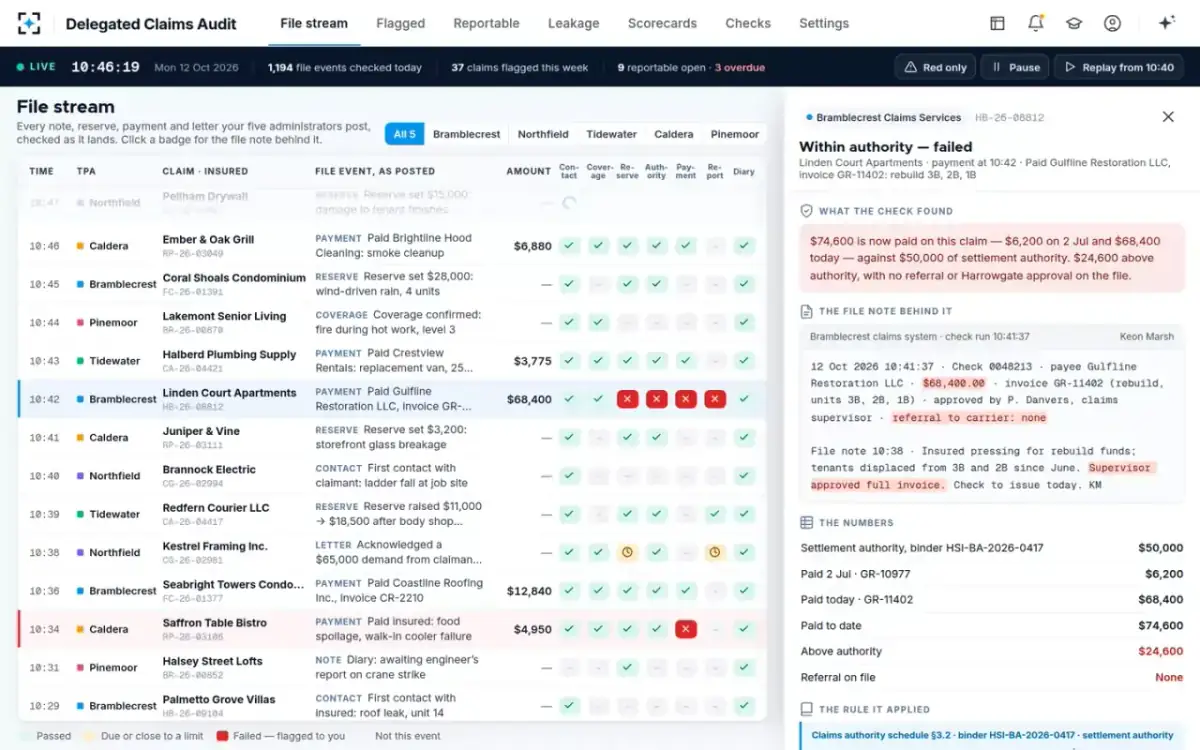
Nothing about the breach was hidden. The adjuster's note said the supervisor had approved the full invoice; the payment entry said no referral had gone to the carrier. Under a periodic audit, both would have been read months later, if the file was sampled at all. In the seat, the question is different: what do I do about it this morning?
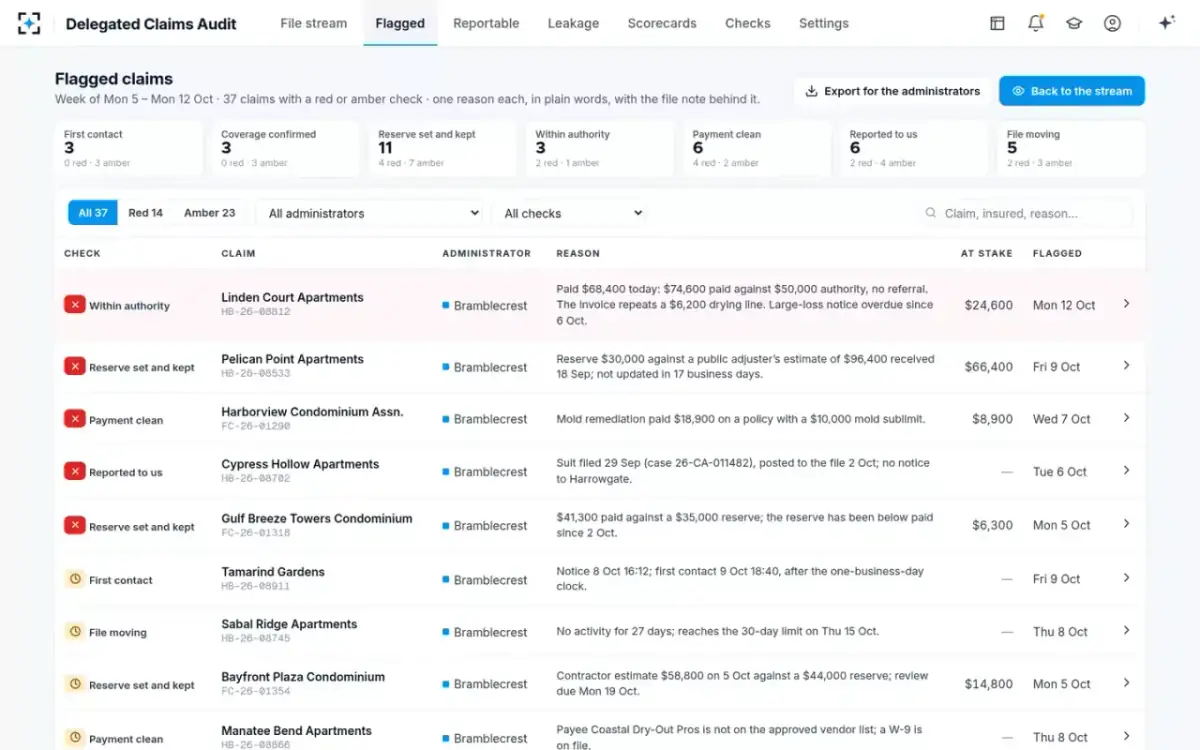
Claire Whitcombe placed a payment hold, so any further payment on the claim needed her approval. She sent Bramblecrest's team lead a request drafted from the file: a written referral, a corrected reserve and a credit for an invoice line the payment check found paid twice. The same file had crossed the binder's $35,000 large-loss threshold on 2 October, and the notice due on 6 October had never come. That went to her desk too.
A week of flags, one reason each
What the seat decides, and what it never hands to software
The oversight manager decides everything that changes money, authority or a customer's position; software, at most, reads and drafts. That division is not a nicety. It follows from the same principle the FCA states for outsourcing: the responsibility does not move because the work does. In Delegated Claims Audit the agents have read-only access to the administrators' systems and cannot place a hold, send a notice or accept a finding.
Who does what on a flagged TPA claim in Delegated Claims Audit
The agents (read and draft): Read the payment, sum paid against the binder’s authority, look for a referral, cite the note.
The oversight manager (decide): Decide whether it is a breach, a late referral or an error in the schedule.
The agents (read and draft): Price each finding: duplicate line, deductible not taken, sublimit exceeded.
The oversight manager (decide): Accept or reject the finding; only accepted findings count toward leakage.
The agents (read and draft): Never holds a payment. Automatic holds are off by policy.
The oversight manager (decide): Places the hold, and lifts it.
The agents (read and draft): Draft the request from the TPA’s own file, with a date to answer by.
The oversight manager (decide): Edits and sends it, or does not.
The agents (read and draft): Start the reporting clock on the trigger date and draft the notice.
The oversight manager (decide): Logs and sends it to claims, reserving and, above the treaty point, the reinsurer.
The agents (read and draft): Apply the authority, clocks and thresholds as configured per binder.
The oversight manager (decide): Changes them as a draft that a second approver must accept.
A test of any oversight tool, ours included, is whether it can show the evidence for each flag and whether its mistakes are visible. How to run that test on one administrator before committing to anything is set out in a one-TPA pilot.
TPA oversight jobs: where the role sits, and what employers look for
There is no official count of TPA oversight managers, because the US Bureau of Labor Statistics does not track the role separately. It sits inside the occupation of claims adjusters, examiners and investigators, which held about 376,100 jobs in 2025, with 29% employed by agencies, brokerages and other insurance-related businesses, the industry group that includes TPAs. The median annual wage for the occupation was $78,000 in May 2025, and BLS projects employment in the wider group, which also counts appraisers, to decline 6% from 2025 to 2035.
BLS's reason for the decline is relevant to anyone hiring for the seat. It expects technology to automate some of the tasks claims staff perform today, and writes that "data processing speed and artificial intelligence (AI) capabilities will continue to increase, which will improve efficiency and make workers more productive." For an oversight team the effect runs in a particular direction: fewer hours reading sampled files, more judgement on the files that have already been found.
Employers hiring a TPA oversight manager tend to look for three things a résumé can show: years handling claims in the lines the TPA administers, so the person can read a reserve or a coverage position and know when it is wrong; experience writing or enforcing claims administration agreements; and the temperament to deliver bad news to a vendor the business relies on. A fourth, increasingly, is the ability to set tolerances and read management information, the area where the FCA found most firms wanting.
Questions people ask
What is TPA oversight?
TPA oversight is the carrier's supervision of claims a third-party administrator handles on its behalf: authority, reserves, payments, reporting and service levels. It exists because the insurer remains responsible for the administrator's acts; the NAIC's TPA guideline says so expressly. It usually combines contract terms, management information, periodic audits and, increasingly, checks on each file event.
What is a claims oversight manager?
It is another title for the same seat: the person at an insurer or managing agent who oversees claims handled by delegates such as TPAs, MGAs or coverholders. The FCA's 2025 review found that 6 of the 23 insurers it examined had no documented oversight framework for claims, which is the gap the role is meant to close.
Who is responsible for TPA claims?
The insurer. The TPA owes duties under its contract, and in many states under its own licence, but regulators hold the carrier accountable for the result. Florida's life and health TPA statute leaves competent administration to the insurer alone.
What does a TPA oversight specialist do day to day?
Mostly reading: authority referrals, reserve changes, large-loss notices, audit findings and the administrator's management information. In the fictional sample, a week produced 37 flagged claims across five administrators, of which 14 failed a check outright. The specialist's job is to decide which matter and to get each one resolved with the TPA.
How often should a carrier review its TPA?
At least as often as its state requires. The NAIC model act asks for an on-site review of an MGA's claims operation at least semiannually, and its TPA guideline asks for semiannual reviews of life and health administrators serving more than 100 people, at least one on site. Many carriers also check claims between reviews, because a claim can breach authority on any day of the year.