Claims oversight software reads what an insurer's delegated claims administrators do on each claim, tests it against the authority, clocks and coverage the insurer granted, and routes the exceptions to the person who answers for them. The best way to choose one is not a demonstration on the vendor's data but a pilot on your own: take one TPA, load its last six months of file events and its binders, run the software beside the audit you already do, and compare what each found, how fast, and with what evidence. Eight weeks is a reasonable plan for that. Botminds' Delegated Claims Audit is a claims oversight solution for carriers that reads every note, reserve change, payment and letter a TPA posts and runs seven checks on each; a check can be tested on last month's events before it runs live, which is what makes a back-tested pilot practical.
The examples come from a fictional sample carrier, Harrowgate Specialty, and its fictional administrator Bramblecrest Claims Services; their figures are sample data. The oversight expectations come from the FCA, the Prudential Regulation Authority and NAIC model laws, linked where they appear.
What one administrator's last audit read, beside what a pilot reads
What is claims oversight software?
It is the insurer's layer over its delegates' claims work: software that takes in what TPAs, claims-handling MGAs and other delegates do on each file and tests it against what they were allowed to do. It differs from a claims administration system, which is where the delegate's adjusters work, and from a bordereau tool, which validates a monthly summary. Good claims oversight software does three things a sample audit cannot: it sees each event the day it happens, it applies the same test to every file, and it shows the evidence for every finding.
The question for a buyer is not whether software can do that in principle. It is whether a particular product does it on your administrators' files, with your binders' terms, at a false-alarm rate your team can live with. That is an empirical question, and a pilot is how to answer it.
How do insurers oversee TPAs today?
With a mix of contract, information and inspection. The model laws ask insurers to review MGAs' claims operations at least semiannually and, for life and health administrators serving more than 100 people, to review TPAs semiannually with one review on site. Between reviews, carriers rely on monthly bordereaux, referrals by email and meetings. The FCA's 2025 review of 23 insurers that outsource claims listed the tools it saw the better firms combine: regular quality assurance checks, customer journey testing, claims sample testing, audits, structured and recorded meetings, and granular, outcomes-focused conduct information. It also drew the conclusion that makes a pilot worth running:
"Firms using a range of tools were more likely to proactively identify issues with their third parties and act."
Financial Conduct Authority, home and travel claims handling arrangements, 2025
The same review found the opposite end of the range. Five insurers, every one of which substantially outsourced its claims handling, "had limited control over their outsourced arrangements or material weaknesses in their oversight of their outsourced arrangements." Five firms acknowledged gaps in their management information, "but few provided clear action plans or timelines." A pilot that ends with an action plan and a date is already ahead of that.
Why pilot on one TPA, beside the audit you already run?
One administrator keeps the data work small and the comparison clean. Choose the TPA with the most claims, or the one whose last audit worried you, and run the software on the same six months your last audit covered. Then you have two reviews of the same files: the auditor's sample and findings, and the software's full read. Where they agree, you learn the software sees what your auditor sees. Where the software finds more, you check whether it is right. Where the auditor found something the software missed, you have the most important finding of the pilot.
Running alongside rather than instead matters for a second reason: nobody has to trust the software during the pilot. The audit programme carries on, the TPA is not told anything has changed, and the carrier's decisions are made as they always were. The pilot measures; it does not yet act.
What data does claims oversight software need?
It needs the administrator's file events and the carrier's rules. Most of it already exists; the work is getting it in a usable form. The NAIC's model act gives the carrier a right to access and copy an MGA's records in a form it can use, and expects the contract to address the timely transmission of electronic claim files; a TPA's agreement usually grants similar access. A pilot is a good moment to find out whether those clauses work in practice.
The data a one-TPA pilot needs, and where it comes from
| Data | From | What the software does with it |
|---|---|---|
| File events: notes, reserve changes, payments, invoices, letters, reports | The TPA’s claims system, by feed or regular export | Reads each event and ties it to claim, policy and binder. |
| Monthly claims bordereaux for the period | The TPA | Reconciles each line to the events behind it. |
| Binders and claims authority schedules | The carrier | Sets indemnity and expense authority, notice thresholds and reporting triggers per binder. |
| Claims administration agreement | The carrier | Sets the clocks: first contact, initial reserve, reserve review, diary limit. |
| Policy forms and endorsements | The carrier | Tests coverage, deductibles and sublimits against each payment. |
| Approved vendor list and rate guidelines | The carrier or TPA | Tests payees and unit rates on invoices. |
| The last audit’s file list and findings | The carrier’s audit team | Becomes the answer key for the comparison. |
How long does a claims oversight pilot take?
Plan on eight weeks, most of it data and comparison rather than software. Two weeks to collect the exports and the rules; two to configure the checks per binder and run them on six months of history; two to compare the results with the last audit, file by file; and two live, on new events as they post, so the team sees the daily rhythm. The timeline is a plan, not a measured average: an administrator that cannot produce a clean export can add weeks at the start.
An eight-week pilot of claims oversight software on one TPA
- Data and rules inWk 1–2
- Checks set, six months re-runWk 3–4
- Compared with the last auditWk 5–6
- Live on new eventsWk 7–8
- Carries on as planned; no decision depends on the pilotWk 1–8
Who sits on the pilot?
Four people, each owning a different question. The head of delegated claims decides whether the findings are the ones that matter. The claims auditor owns the comparison with the last audit. The reserving analyst judges the reserve checks. And the TPA's claims team lead, brought in for the live weeks, says whether the findings are fair, which is the fastest way to find a check that misreads how the administrator records things.
Four seats on a Delegated Claims Audit pilot, and what each must answer
Today
Sees the TPA through its bordereau, referrals by email and the audit letter.
With agents
Judges every flag the pilot raises: is this a finding I would act on?
Still theirs: The go or no-go decision
Today
Read 240 files at the administrator’s last on-site audit.
With agents
Compares those files and findings with the back-run, file by file.
Still theirs: The answer key and the audit opinion
Today
Reviews the TPA’s reserves by programme each quarter.
With agents
Tests whether the reserve checks flag the reserves she would have challenged.
Still theirs: The reserve tolerance and its exceptions
Today
Hears about findings months later.
With agents
Sees the live weeks’ findings, drafted from his own file, and challenges the wrong ones.
Still theirs: His administrator’s file and its corrections
The scorecard: the regulator's oversight tools, used as the test
Score the pilot against the jobs the FCA saw good oversight do, not against a feature list. Each item below turns one of the regulator's tools into a measurable question for the six months of files, so the outcome is a number per question rather than an impression.
Pilot scorecard: the FCA's oversight tools as six measurable questions
- Claims sample testing → full-file testing
Of the last audit’s findings, how many did the software find, and how many more did it find that the auditor confirms are real?
- Quality assurance checks → evidence
For each finding, does it show the file note, payment or invoice and the clause applied? Count the ones that do not.
- Audits → false alarms
How many files did it flag that the auditor rejects on review? Express it per week of live events, the number your team will live with.
- Outcomes-focused information → timing
For each finding, the days between the event and the flag, against the days to the audit that found it.
- Structured meetings → the TPA’s view
In the live weeks, how many findings did the administrator accept, correct or dispute, and on what grounds?
- Tolerances → rules set in advance
Were the pass marks for each check written before the back-run? The FCA found 12 of 23 firms had shortcomings in how they set tolerances.
A planted-error set makes the first two questions sharper: seed twenty known errors in closed files and count what comes back, as described in the TPA claims audit checklist. If the pilot also prices findings, use the accepted-findings method in how to measure claims leakage, so the dollar figure at the end can be defended.
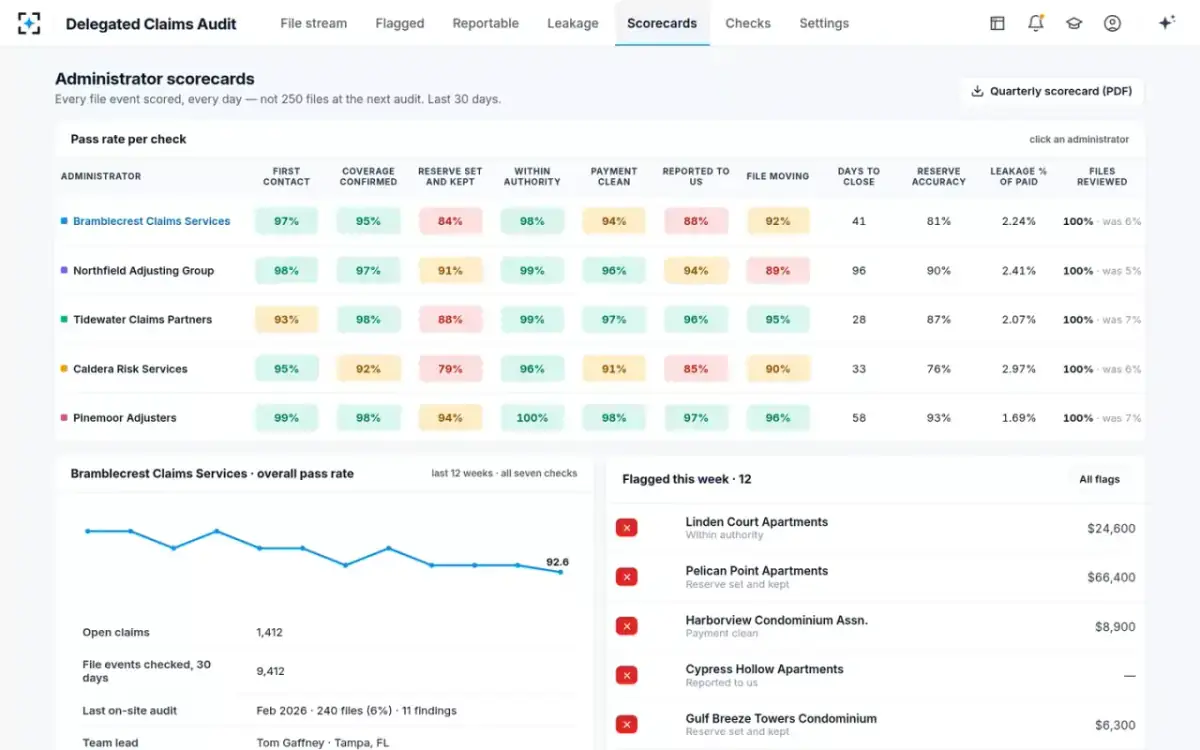
The scorecard a pilot produces for each administrator
What is the best claims oversight software?
The one that scores best on your pilot, at a false-alarm rate your team can absorb, with every finding traceable to the file. Beyond that, five tests separate products that will last from those that will be switched off in a year. Does it run per binder, not per administrator? Does a person make every decision that moves money? Can a rule change be tested on past events before it goes live? Does the administrator see the same reason the carrier sees? And does it leave the audit programme stronger, by sending the auditor to the files that failed, rather than replacing it?
Regulators are moving in the same direction. The PRA told London market insurers in January 2026 that delegated authority business "looks set to grow", raising risks of inadequate pricing and reserving if not properly overseen. The FCA said it would expand its review of how firms oversee outsourced claims to cover delegated authority models, and aims to report in early 2027. Neither prescribes a tool, and a carrier that can show a measured pilot will have an easier conversation than one that can show a purchase order.
Where Delegated Claims Audit fits a pilot, and where it does not
Botminds' Delegated Claims Audit fits the pilot shape directly. Checks are configured per binder from the carrier's own authority schedules and agreements; each can be run on a past month's events before going live; every badge opens the file note and the rule behind it; and the agents have read-only access, so nothing changes at the administrator during the back-run. In the fictional sample, a test of September's 36,904 file events against the 412 files the claims auditor had reviewed missed none and flagged six in error, each a referral sent by email and attached late. That is sample data on invented files; your pilot will produce your own numbers.
One of the first things a pilot turns up: claims that should already have been reported
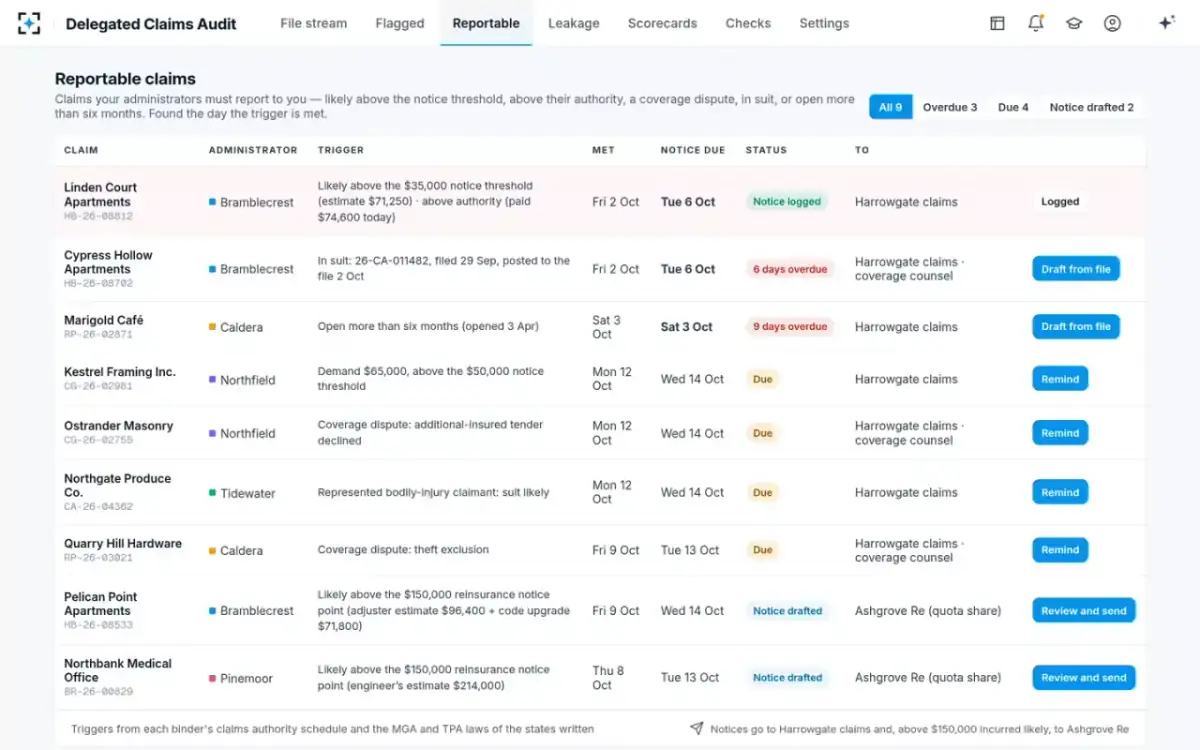
It does not fit everything. The pilot needs each administrator's file events, by feed or export; a TPA that can only send a monthly bordereau limits what any oversight software can see. It does not adjust claims, set reserves or take coverage positions, and it does not replace the semiannual review the law asks for. Its leakage figures count only findings a person accepted, so a pilot that never reviews the flags will show none. Once the pilot shows what it found, the case for moving from a yearly sample to checking every file can be made on your numbers.
Questions people ask
How do you evaluate claims oversight software?
On your own files, against an answer key. Run it on six months of one administrator's events, compare its findings with the last audit's, count false alarms per week, and check that every finding shows its evidence. The FCA found in 2025 that firms combining several oversight tools were more likely to spot problems with third parties and act.
How long does a claims oversight pilot take?
About eight weeks in the plan above: two for data and rules, two to configure and back-run six months, two to compare with the last audit, two live. The data weeks vary most; an administrator without a clean export can double them.
What is a claims oversight pilot?
A limited trial of oversight software on one administrator's real files, run alongside the existing audit programme so no decision depends on it. Its output is a comparison: what the software found that the audit did and did not, how fast, and how many flags were wrong.
Do we need the TPA's permission to run a pilot?
You need its data, which most claims administration agreements and the MGA model act already entitle you to see. Telling the administrator before the live weeks is good practice: its team lead is the best check on whether a finding reflects how it records things.
Can claims oversight software replace the TPA audit?
No. The law asks for periodic reviews, at least semiannually for an MGA's claims operation, and an on-site review looks at people and controls no file shows. Software changes what the auditor knows before arriving, and which files are worth reading.