A claims settlement authority letter, often called a claims authority schedule, is the document in which an insurer tells a delegated claims handler (a TPA, an MGA or a coverholder) how much it may pay or reserve on a claim without asking, what it must refer for the insurer's prior written approval, and which claims it must report or send back. For an MGA that settles claims, the law has written much of it already. The NAIC's model act requires a copy of the claim file to go to the insurer when a claim may exceed the MGA's settlement authority, involves a coverage dispute, is open more than six months, or crosses amount thresholds, and it bars the MGA from paying or committing the insurer to a claim above a specified amount, which may not exceed 1% of the insurer's policyholder surplus, without prior approval. A good letter turns those rules into numbers per binder. Botminds' Delegated Claims Audit is a claims oversight solution for carriers that sums what has been paid and reserved on each claim, compares the total with the authority schedule for that binder, and looks for the referral on the file.
The rules below come from the NAIC's model act and the New York, Florida and Texas texts, each linked. The worked claim comes from a fictional sample carrier, Harrowgate Specialty, and its fictional TPA, Bramblecrest Claims Services.
The five triggers that send a delegated claim file back to the insurer
- The claim may exceed an amount set by the regulator or the insurer
Model #225: the lower of an amount determined by the commissioner and the limit set by the company. New York sets the regulator’s figure at 1% of surplus.
- It involves a coverage dispute
Any disagreement over whether or how far the policy responds, including reservations of rights and declinations.
- It may exceed the delegate’s settlement authority
Note the word may: the file goes back when the claim is likely to exceed authority, not only once it has.
- It is open for more than six months
A plain age trigger, regardless of amount, that catches the slow claims an amount trigger misses.
- It is closed by payment above a set amount
The lower of the regulator’s amount and the insurer’s; in New York, 1% of surplus or the insurer’s figure.
What is a claims settlement authority letter?
It is the part of the delegation that fixes money and escalation. A binding authority or claims administration agreement says what the delegate does; the authority letter or schedule says how far it may go on each claim before the insurer must be asked, and what it must tell the insurer unasked. It usually sets an indemnity limit per claim, a separate expense limit, a notice threshold for large losses, the triggers for reporting, the form a referral takes and who at the insurer may approve one.
The phrase also has an older, internal meaning: the letter that gives an individual adjuster at a carrier authority up to a dollar figure. That sense is covered in what settlement authority means for an adjuster. A delegated authority letter is the same idea one level up, granted to a firm, and it sits inside a regulatory frame the internal letter does not.
What is claims settlement authority, and what is a claims authority limit?
Claims settlement authority is the power to agree and pay a claim on the insurer's behalf; a claims authority limit is the dollar ceiling on it. A usable limit answers four questions. Is it per claim or per payment? Does it count indemnity and expense together or separately? Does it count paid only, or paid plus reserved? And is it the same on every binder the delegate holds?
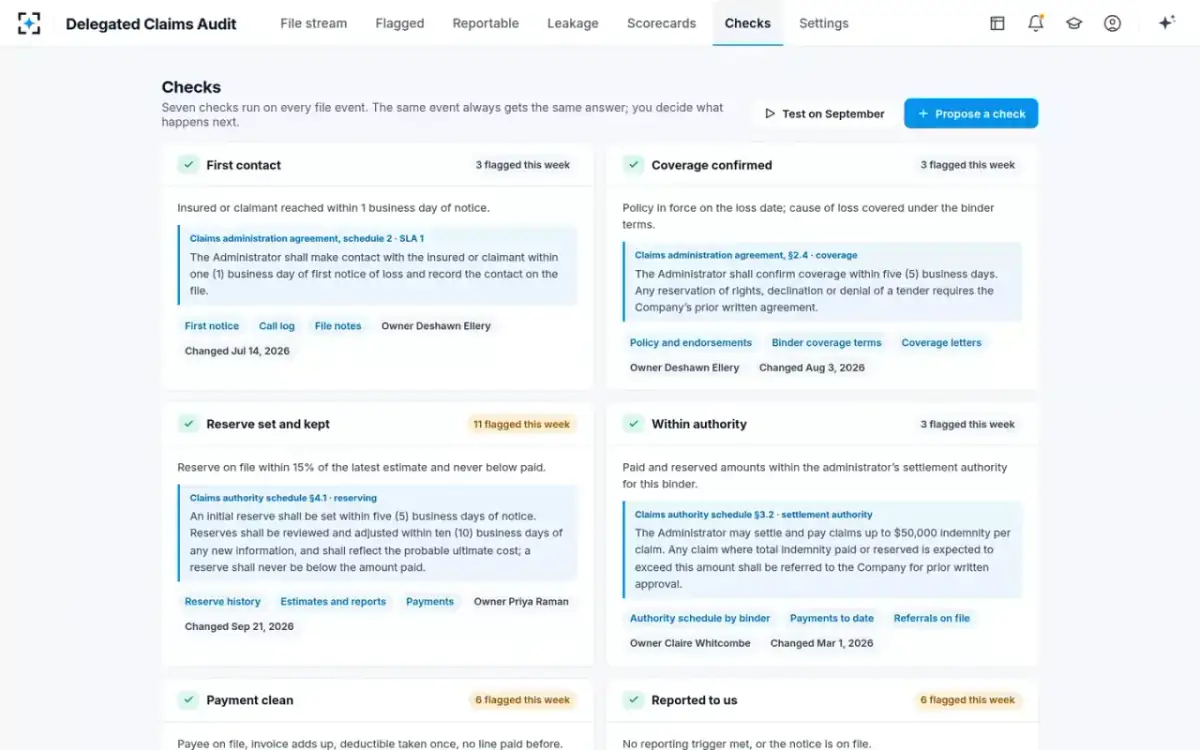
The sample carrier answers them the way a careful schedule should. Authority is per claim, set separately for indemnity and expense, counts what is paid or reserved, and differs by binder: $50,000 of indemnity and $10,000 of expense on Bramblecrest's two property binders, $75,000 and $25,000 on another administrator's general liability binder, $35,000 and $5,000 on a restaurant package programme. The clause the checks apply reads: "Any claim where total indemnity paid or reserved is expected to exceed this amount shall be referred to the Company for prior written approval."
The ceiling the law sets: 1% of surplus
For an MGA, the contract's authority may not exceed a statutory cap. The model act says the MGA shall not, "Without prior approval of the insurer, pay or commit the insurer to pay a claim over a specified amount, net of reinsurance, which shall not exceed one percent (1%) of the insurer’s policyholder’s surplus as of December 31 of the last completed calendar year". New York and Florida carry the same cap in their own rules. For an insurer with $250 million of policyholder surplus, 1% is $2.5 million net of reinsurance (our arithmetic): a ceiling far above most delegated authority, but one a casualty programme with large limits can reach.
The cap is a maximum, not a target. Most delegated authority sits far below it, set by the carrier's appetite and the delegate's track record. Its real force is in the word "commit": an MGA that agrees a settlement above its authority has committed the insurer, whatever the payment date, and the referral must come before the agreement, not before the check.
When must an MGA report a claim to the insurer? How states write the triggers
All claims must be reported "in a timely manner", and the file itself goes to the insurer on the five triggers above. States that enacted the model kept its shape but changed details that matter when drafting. New York fixed the regulator's amount at 1% of surplus. Florida asks for notice rather than a copy of the file, and adds that claims be adjusted by licensed persons. Texas's MGA chapter requires the contract to address claims settlement and asks, at appointment, whether the MGA's claims authority exceeds $25,000 on any one claim.
The claims provisions in the model act and three states
| Provision | NAIC Model #225 | New York 11 NYCRR §33.5 | Florida §626.7451 |
|---|---|---|---|
| What goes to the insurer | A copy of the claim file, at request or when a trigger becomes known | A copy of the claim file, at request or when a trigger becomes known | Notice, as soon as a trigger becomes known |
| Amount trigger | Potential to exceed the commissioner’s amount or the company limit, whichever is less | Potential to exceed 1% of surplus or the company limit, whichever is less (before reinsurance) | Exceeds the limit set by the insurer |
| Other triggers | Coverage dispute; may exceed settlement authority; open more than six months | Coverage dispute; may exceed settlement authority; open more than six months | Coverage dispute; exceeds settlement authority; open more than 6 months |
| Closed above an amount | Commissioner’s or company’s amount, whichever is less | 1% of surplus or company’s amount, whichever is less | Office’s or insurer’s amount, whichever is less |
| Claim payment cap without approval | 1% of surplus, net of reinsurance | 1% of surplus, net of reinsurance | 1% of surplus, net of reinsurance |
| Who owns the files | Joint property of insurer and MGA | Joint property of insurer and MGA | Joint property of insurer and MGA |
| Extra | Electronic files: contract must address timely transmission | Same | All claims adjusted by properly licensed persons |
The difference between "may exceed" and "exceeds" is the most useful line in that table for anyone drafting a letter. A trigger on likely amount sends the file back when an estimate, a demand or a reserve says the claim is heading over authority; a trigger on actual amount sends it back after the money is committed. A carrier can write the stricter version into its contract in any state.
Who owns delegated claim files?
Both parties, under the model act, which makes claim files the joint property of insurer and MGA (the section is quoted in MGA termination notice). On an order of liquidation of the insurer, the files become the insurer's or its estate's alone, with the MGA keeping reasonable access to copy them. New York and Florida carry the same rule. For a TPA, ownership and access are set by the administration agreement and, in TPA acts, by record-keeping rules that give the insurer continuing access.
Joint ownership is the legal hook for oversight that reads the file rather than a summary of it. It is also why the model act requires contracts to address the timely transmission of electronic claim files: a right to a file that arrives months later is a weak right. How much of the file a monthly bordereau line actually conveys is taken apart in what one claims bordereau line can never tell the carrier.
What happens when a TPA exceeds settlement authority?
Under the contract, the insurer can usually suspend or end the authority; under the model act for MGAs, settlement authority may be terminated for cause on written notice, and suspended while a dispute about the cause is pending. In Texas, an MGA must notify the department within 30 days when its "authority to settle claims for an insurer is withdrawn". Before any of that, the carrier has to know the authority was exceeded, and on the files most at risk it often does not. The FCA, reviewing cash settlements in home insurance in 2025, found a gap even more basic:
"A few firms did not have staff authority limits, effectively allowing them to cash settle all types of claims up to high values."
Financial Conduct Authority, home and travel claims handling arrangements (cash settlements), 2025
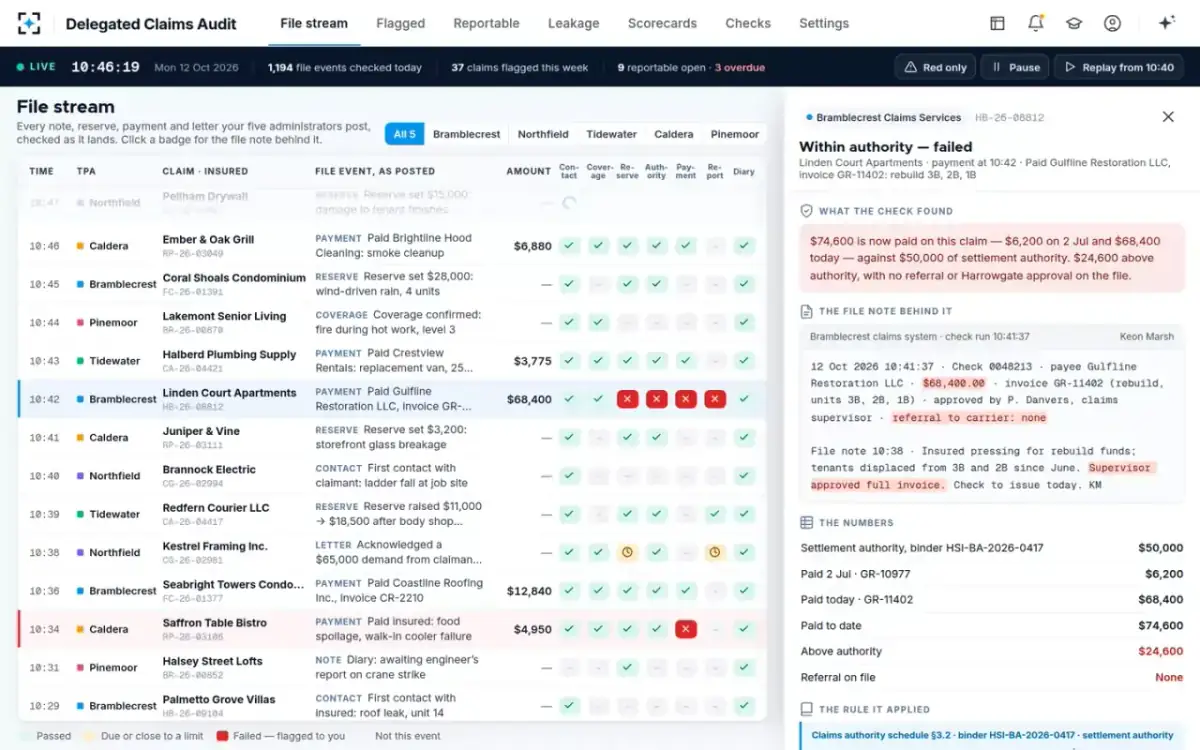
One claim against its letter: $74,600 paid on $50,000 of authority
A letter with limits is the first control; the second is seeing each payment against them. On the morning of 12 October, the sample TPA paid $68,400 on a water-damage claim where $6,200 had already been paid. The authority check in Delegated Claims Audit summed the two: $74,600 paid against $50,000 of indemnity authority, $24,600 over, and no referral or approval on the file. The adjuster's note read "Supervisor approved full invoice": approval inside the TPA, none from the insurer.
One claim against its $50,000 authority: what was within it, and what was not
Paid to date: $74,600
- Within authority $50,000 · 67%
- Above authority, no referral $24,600 · 33%
Incurred implied by the file: $83,650
- Indemnity reserve on file $45,000 · 54%
- Above the reserve $38,650 · 46%
The authority check in Delegated Claims Audit, with the rule it applied
Drafting the letter: what happens on a referral, step by step
A referral clause works only if every step has an owner and a clock. The flow below is the path a well-drafted letter describes, with the checks a carrier can run on each step from the file.
A referral above authority, from the delegate's file to the insurer's decision
A person decides
Delegate’s adjusterSees a reserve, estimate or demand that may take the claim over authority; prepares the referral with the file.
Agent
Authority checkerSums indemnity and expense paid or reserved per claim against the binder’s limits; flags any payment above authority with no referral on file.
Never: approves or releases a payment
Agent
Reportable-claim finderStarts the notice clock on the day a trigger is met and drafts the notice from the file.
Never: sends a notice
A person decides
Insurer’s claims managerApproves, declines or asks for more; places a payment hold where needed; logs the notice to claims, reserving and, above the treaty point, the reinsurer.
A person decides
Second approverApproves any change to the authority, clocks or thresholds in the schedule itself.
Beyond the flow, a letter that survives an audit names the indemnity and expense limits per binder; counts paid plus reserved; triggers on likely as well as actual amount; lists the statutory triggers even for a TPA; says what a referral must contain and who may approve it; sets a clock for the delegate's notice, in business days; and says what happens on a breach, from a hold to suspension. The person who runs that letter day to day is described in the TPA oversight manager's seat, and how each payment is tested against it as it posts in the delegated claims management system trace.
The schedule's own words, quoted on the check that applies them
Questions people ask
What is a claims authority limit?
The highest amount a delegate or adjuster may pay or commit on a claim without the insurer's prior approval. For an MGA, the NAIC model act caps it at 1% of the insurer's policyholder surplus, net of reinsurance. In practice delegated limits sit far lower; the sample carrier's run from $35,000 to $75,000 of indemnity per claim.
How do you set settlement authority for a TPA?
Per binder, from the line's severity and the TPA's track record: separate limits for indemnity and expense, counted on paid plus reserved, with a notice threshold below the authority so large losses reach the insurer before they reach the limit. Review it when the TPA's scorecard or the binder changes.
When must a TPA report a claim to the insurer?
When its contract says. State TPA acts mostly govern life, health and workers' compensation administration; for property and casualty claims, the reporting duty is contractual. Writing the MGA act's five triggers into the TPA's agreement, plus suits and large-loss thresholds, gives the carrier the same view either way.
Can an insurer take settlement authority away?
Yes. The model act lets the insurer terminate an MGA's settlement authority for cause on written notice and suspend it while the cause is disputed. Texas then requires the MGA to notify the department within 30 days that its authority to settle claims has been withdrawn.
Is supervisor approval at the TPA enough to exceed authority?
No. Authority granted by the insurer can only be extended by the insurer. In the fictional sample, the adjuster's note recorded that a supervisor at the TPA had approved the full invoice, but no referral or approval from the carrier was on the file, so the payment was $24,600 above authority.