Claims bordereaux are the reports in which a delegated claims handler, a TPA, an MGA or a coverholder, lists the claims it handles for an insurer, one line per claim, usually every month: the claim and policy references, the insured, the dates of loss and notification, the cause, the amounts paid and reserved for indemnity and expense, and the status. They let the carrier, and through it the reinsurer, account for delegated claims and watch them in aggregate. What a line cannot do is show how the numbers got there. It does not say whether a payment was within the delegate's authority, whether the reserve followed the latest estimate, whether an invoice line was paid twice, or when a reporting trigger was met. Botminds' Delegated Claims Audit is a claims oversight solution for carriers that reads every file event a TPA posts and reconciles the monthly claims bordereau line to the events behind it, so the line and the file tell the same story or the difference is flagged.
The example claim is from a fictional sample carrier, Harrowgate Specialty, and its fictional TPA, Bramblecrest Claims Services. The bordereau line shown is illustrative, built from that sample file. The rules and the binder clause come from the NAIC's model act, a Texas statute and an English court judgment, each linked.
One claim's monthly bordereau line, and the file events behind it
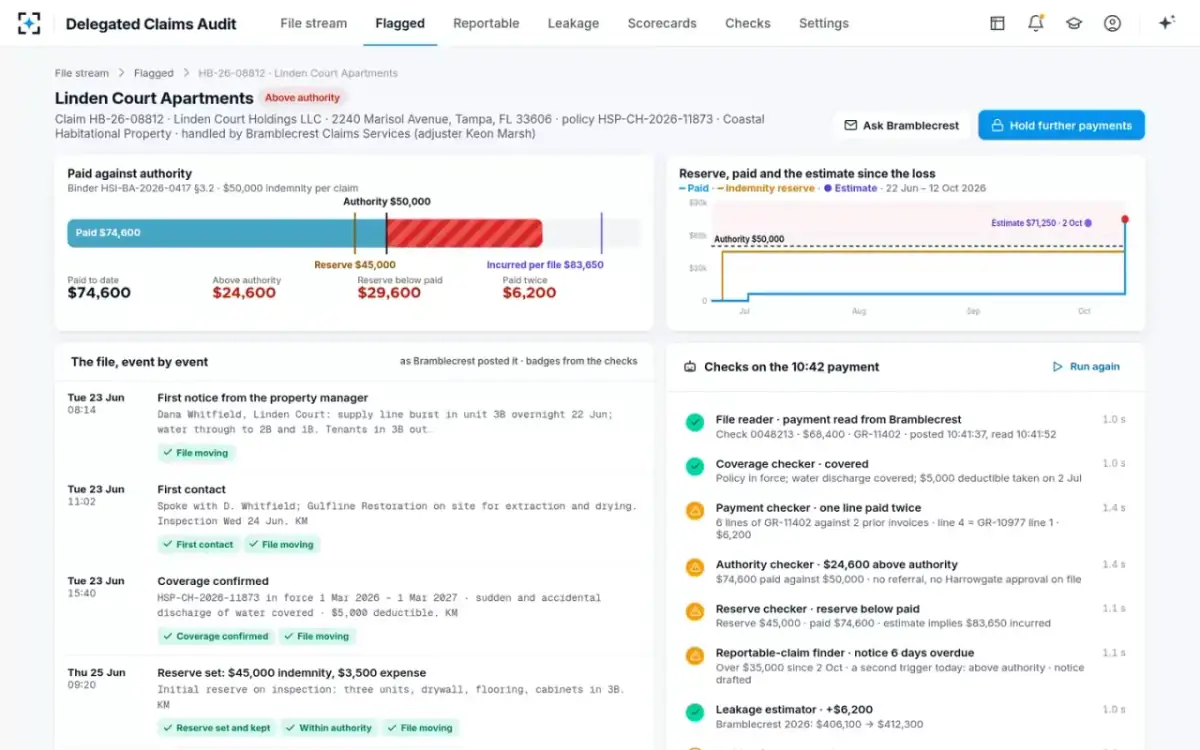
On the October claims bordereau line: Indemnity paid to date: $74,600.
In the file events behind it: Two payments to the same contractor: $6,200 on 2 Jul and $68,400 on 12 Oct; line 4 of the second invoice repeats line 1 of the first.
On the October claims bordereau line: Indemnity reserve: $45,000.
In the file events behind it: Unchanged since 25 Jun, though a $71,250 rebuild estimate posted on 2 Oct; the file implies at least $83,650 incurred.
On the October claims bordereau line: No field.
In the file events behind it: $24,600 above the $50,000 indemnity authority; no referral on file; adjuster’s note: “Supervisor approved full invoice.”
On the October claims bordereau line: Status: open.
In the file events behind it: Passed the $35,000 large-loss threshold on 2 Oct; notice due 6 Oct, never sent.
On the October claims bordereau line: Arrives after month-end.
In the file events behind it: Each event time-stamped as posted; the payment at 10:41:37 on 12 Oct.
What is a claims bordereau?
A claims bordereau is a schedule of claims, sent by whoever handles them under delegated authority to the insurer, the managing agent or a broker, at intervals the contract sets. "Bordereau" is the French word for a list or schedule, and "bordereaux" its plural; the London market uses both, and US carriers increasingly do. A claims bordereau differs from a premium bordereau, which lists risks bound and premium due, and from a loss run, which is an insurer's own history of claims on a policy.
Its legal footing is the delegate's duty to account. The NAIC's model act requires an MGA's contract to provide that it will render accounts to the insurer detailing all transactions at least monthly. A binder considered by the English High Court in 2022 put it in standard market terms: the coverholder had to produce premium bordereaux and, where it owed them, claims bordereaux, in a format the underwriters had agreed in advance (the clause is quoted in bordereaux ingestion).
What does a claims bordereau include?
Whatever the contract says, which is why the contract should say a lot. No allowed public standard prescribes the fields, so the table sets out the fields a carrier should require, each traced to the job it does. Texas's statute for MGAs is a useful floor: its quarterly account report must state losses and loss expenses paid and outstanding and losses incurred but not reported, among other items.
Fields a claims bordereau should carry, and why each matters
| Field | What it lets the carrier do |
|---|---|
| Claim, policy and binder references | Tie the line to the right binder, and so to the right authority and triggers. |
| Insured, risk location, cause of loss | Check coverage at a glance; group losses by event or peril. |
| Dates: loss, notification, first contact, closed | Test service clocks and the six-month trigger. |
| Indemnity paid this period and to date | Account for money out; compare with authority. |
| Expense paid this period and to date | Test expense authority and guidelines separately. |
| Indemnity and expense reserve, and incurred | Reserving, reinsurance notice points and large-loss thresholds. |
| Recoveries: salvage, subrogation, deductibles | See what came back, and what should have. |
| Status flags: litigation, coverage dispute, referral made, large-loss notice sent | See reporting triggers met, and whether the delegate acted on them. |
Even a full field list leaves the bordereau a summary. "Referral made: yes" is the delegate's word, not the referral. "Reserve: $45,000" is the current figure, not the history that shows it ignored an estimate. That is the gap a carrier needs the file to close.
How often are claims bordereaux sent?
Usually monthly, within a set number of days after month-end. The monthly cycle follows the model act's monthly accounts for MGAs and is common in binders, though nothing stops a contract asking for more. Texas's account report for MGAs is quarterly at minimum. The binder in the 2022 English case required bordereaux to be sent within a number of days of each interval's end, as stated in its schedule, and even required the coverholder to say so when there was "no activity" in an interval.
The interval sets the oversight's speed limit. With a deadline of 15 days after month-end, a carrier relying on monthly claims bordereaux sees a payment made on the 2nd about six weeks later, and one made on the 30th about two weeks later. The difference depends only on the calendar, not on any choice about risk.
What one line can never tell the carrier
A line can show a number that is wrong; it cannot show why, or whether anyone at the delegate knew. Five things are lost between the file and the line, and each corresponds to a kind of failure regulators and courts have seen in delegated arrangements.
Five things lost between the claim file and the bordereau line
- The sequence
A reserve that stayed flat for a month after an estimate doubled it looks identical on the line to one that was right all along.
- The authority
Paid to date says nothing about whether each payment was within the limit or referred. The referral is a document in the file, or it is not there.
- The detail of each payment
A duplicate invoice line, a deductible not taken or a payee not on the approved list sits in the invoice and payment entries, not in a total.
- The trigger dates
The day a claim passed the notice threshold, went to suit or turned six months old is what a late notice is measured from; a status field records none of them.
- The delegate’s own words
Adjusters’ notes carry the reasons, the approvals and sometimes the admissions. “Supervisor approved full invoice” never reaches a bordereau.
The FCA's 2025 review of insurers that outsource claims handling made the same point about management information in general. Among its findings on poor practice was a kind of information every bordereau resembles:
"MI that was produced only at product level, which masked actual or emerging issues."
Financial Conduct Authority, home and travel claims handling arrangements, 2025
A bordereau aggregated by programme masks in exactly that way. Even at claim level, a line aggregates every event in the month into a handful of numbers, and the events are where the issues are.
A claims bordereau example: what a month compresses
The sample TPA had 1,412 open claims for the carrier and posted 9,412 file events in a 30-day window: on average between six and seven events behind every line of a month's bordereau. Most are routine. The ones that matter are rare and look routine on the line. The split below shows what the sample carrier's checks made of the events on one week's lines across five administrators.
What one week's flagged claims were flagged for, across five administrators
37 claims with a red or amber check
- Reserve set and kept 11 · 29.7%
- Payment clean 6 · 16.2%
- Reported to us 6 · 16.2%
- File moving 5 · 13.5%
- First contact, coverage and within authority, 3 each · 24.3%
Delegated Claims Audit shows the claim behind the line, event by event
Writing the claims bordereau clause so it supports oversight
A bordereau clause is usually written for accounting and read later by people trying to oversee. Six terms make it serve both. Fix the interval and the deadline in days, and require a nil return when nothing happened, as the 2022 binder did. Attach the field list, including the status flags for referrals, notices and suits, so their absence is a breach rather than a style choice. State that each line must agree with the claim file at the cut-off date, and give the carrier the right to test that agreement on any line.
Then reach past the bordereau. Give the carrier direct, read-only access to the claim files or a regular feed of file events, which the model act already contemplates when it makes MGA claim files joint property and asks contracts to deal with the timely transmission of electronic files. And say what happens when a line is wrong: a corrected bordereau within a set number of days, and repeated errors as a ground for review of the delegate's authority. A clause written this way costs the delegate little that a well-run operation does not already do, and it turns the monthly line from the carrier's only view into a summary it can check.
What is a loss bordereau, and is it the same thing?
Usually, yes: "loss bordereau" and "claims bordereau" are used interchangeably for a schedule of claims. In reinsurance the term often means the cedant's schedule of losses ceded under a treaty, sent to the reinsurer, which may be built from the delegates' claims bordereaux. The fields overlap; the purpose differs. A delegate's claims bordereau is an account to the insurer of claims it handled, while a loss bordereau to a reinsurer supports a recovery. An error on the first flows into the second, which is one reason the carrier's reserving and reinsurance teams care about the delegate's line.
What is a claims bordereaux analyst?
It is the person, usually at the carrier, managing agent or broker, who receives claims bordereaux, checks them for completeness and consistency, loads them, and chases the delegate when they are late or wrong. There is no official occupation of that name; in US labour statistics the work falls within claims examiners and related roles, an occupation group of claims adjusters, examiners and investigators that held about 376,100 jobs in 2025. The job's quality check is usually internal to the bordereau: totals that foot, fields filled, movements that reconcile with last month. The checks that need the file are rarely within reach.
Claims bordereaux processing: reconciling the line to the file
Processing a claims bordereau well means proving each line against the events behind it, not just loading it. When the file events are available, the reconciliation is mechanical, and the exceptions are the findings. The tests below are the ones the sample carrier's file reader runs when the monthly bordereau arrives.
Reconciling a claims bordereau line to the file events behind it
| Test | What a mismatch usually means |
|---|---|
| Paid to date on the line = sum of payments in the file | A payment outside the claims system, a reversal not shown, or a keying error. |
| Reserve on the line = latest reserve event in the file | A reserve change made after the cut-off, or not recorded as an event. |
| Every open claim in the file has a line; every line has a claim | A claim left off the bordereau, or one closed in the file but still reported. |
| Status flags match file events | “Referral made” with no referral in the file; “litigation: no” with a suit on file. |
| Binder on the line = binder on the policy | A claim reported under the wrong binder, and tested against the wrong authority. |
Reconciliation is where a bordereau becomes trustworthy, and also where its limits show. Once the line agrees with the file, the next questions are about the file itself: was the payment within authority, was the reserve right, was the notice sent? Those are the checks traced event by event in the delegated claims management system walk-through. Where the file shows money that should not have gone out, measuring claims leakage prices it. And the triggers a line can never show are set out in the claims settlement authority letter.
Questions people ask
What is the meaning of claims bordereaux?
A claims bordereau is a periodic schedule of claims handled by a delegate for an insurer; bordereaux is the plural. It usually lists each claim with its references, dates, cause, amounts paid and reserved, and status. The NAIC model act requires MGAs to account to the insurer at least monthly.
Who sends claims bordereaux?
The party handling claims under delegated authority: a TPA, an MGA with claims authority, or a coverholder or delegated claims administrator. In the 2022 English case, the binder required the coverholder to produce claims bordereaux, if due from it, in a format agreed in advance by the underwriters.
What is the difference between a premium bordereau and a claims bordereau?
A premium bordereau lists risks bound and premiums due under a binder; a claims bordereau lists claims and their payments and reserves. They are often sent together, but they answer different questions: what the delegate wrote, and what it paid.
Can a carrier rely on claims bordereaux alone?
For accounting, mostly; for oversight, no. A line cannot show whether payments were within authority, whether reserves followed the evidence, or when reporting triggers were met. The FCA found in 2025 that information produced only at product level masked actual or emerging issues; a monthly line has the same weakness at claim level.
What happens when no claims occurred in a month?
The contract should still require a report. The binder in the 2022 English case required the coverholder to advise the London broker within the stated number of days when there was no activity in a bordereau interval, so silence could not be mistaken for a nil return.