How long an insurer has to refund premiums after a cancellation is set by each state, and the answer changes with the line of business, with who cancelled the policy and with whether the premium was financed. Texas gives an insurer until the 15th business day after the cancellation takes effect to refund unearned premium on a personal auto or homeowners policy. Florida gives 15 days when the insurer cancels a motor vehicle policy and 30 when the insured does, and charges 8 percent interest on a late refund. Where a premium finance company paid the premium, the refund goes to the finance company first, within 30 days in Florida and up to 60 days in New York and Texas. Each late day is a measurable cost: interest in some states, a lawsuit in others, and in every state a finding on the next market conduct examination. Botminds' Insurance Billing Exception Management prepares each refund with its worksheet, checks the payee and the state's deadline, and routes it to the person with the authority to release it before the deadline passes.
The worked examples use the solution's sample data, from a fictional carrier, Kestrel Point Mutual, and fictional customers. The statutes, examination reports and complaint figures are real and linked where they are used.
Four refund clocks from three states' statutes
15business days
Texas: personal auto and residential property, after the cancellation takes effect
15days
Florida motor vehicle, when the insurer cancels; 30 when the insured does
60days
New York financed policies: the outer limit for returning premium to the finance agency
8%
interest Florida makes an insurer pay on a late motor vehicle refund
How long does an insurer have to refund premiums?
An insurer has as long as the state's statute for that line allows, which is usually between two weeks and two months after the cancellation takes effect. There is no national rule. A billing team that refunds within the shortest clock it is subject to will meet the others; one that works refunds oldest-first, against no clock at all, will miss the short ones first.
The examination standard is the same everywhere even though the deadlines differ. The NAIC's Market Regulation Handbook asks whether "Unearned premiums are correctly calculated and returned to the appropriate party in a timely manner and in accordance with applicable statutes, rules and regulations" (NAIC examination standards, 2024). Three tests sit inside that sentence: the amount, the payee and the date. A refund can fail any one of them.
The refund clocks, state by state and product by product
The table sets out the clocks in four states whose statutes or examination reports we read in full, plus California's interest rule. It shows how much the answer moves with the line, the canceller and the payee.
Refund clocks: who cancelled, who is paid, and by when
| State and product | Situation | Deadline | If late |
|---|---|---|---|
| Texas · personal auto, residential property | Any cancellation or termination before the end of the term | Not later than the 15th business day after the cancellation or termination takes effect | An examination finding; no interest rate in the section |
| Texas · financed policy | Finance company cancels under its power of attorney | Before the 61st day after the cancellation date, to the finance company | Not stated in the section |
| Florida · motor vehicle | Insured cancels | Within 30 days after the cancellation takes effect or the request arrives, whichever is later | 8% interest; a civil action if not paid within 45 days after the period |
| Florida · motor vehicle | Insurer cancels | Within 15 days after the cancellation takes effect | The same |
| Florida · financed policy | Finance company cancels | Within 30 days of the cancellation date, the unpaid balance to the finance company and the rest to the agent or insured | An examination finding |
| New York · financed policy | Premium finance agency cancels | Within a reasonable time not exceeding 60 days after the cancellation takes effect | An examination finding |
| Illinois · auto, insurer cancels | As applied by examiners in 2025 | Within 30 days from the date of the notice of cancellation | Cited as an examination criticism under 215 ILCS 5/143.12a(b)(1) |
| California · all lines | Insurance Code §481.5 | Set in §481.5 itself | Interest at 10% a year on premium not tendered on time |
Three patterns repeat. The clock starts at different events: the effective date of cancellation in Texas, the later of the effective date and the request in Florida when the insured cancels, the date of the notice in the Illinois finding. Days are counted differently: Texas counts business days, which the section defines as every day except weekends and the state's own holidays, where the others state plain days. And the payee changes the deadline: a financed policy's refund goes to the finance company first, on a clock of its own, which the guide to the premium finance unearned premium refund follows dollar by dollar.
How long does an insurance company have to refund premium in Florida?
For motor vehicle insurance, Florida gives the insurer 30 days when the insured cancels and 15 days when the insurer cancels. When the insured cancels, the insurer "must mail or electronically transfer the unearned portion of any premium paid within 30 days after the effective date of the policy cancellation or receipt of notice or request for cancellation, whichever is later"; when the insurer cancels, it must do so "within 15 days after the effective date of the policy cancellation" (Fla. Stat. §627.7283).
The same section sets the amount and the penalty. Unearned premium is "computed on a pro rata basis". If the insured cancelled, the insurer "may retain up to 10 percent of the unearned premium"; if the insurer cancelled, it refunds all of it. A late refund carries "8 percent interest on the amount due", and if the money still has not gone out "within 45 days after the applicable period, the insured may bring an action against the insurer" under Florida's civil remedy statute. A servicemember who cancels on being called to active duty or transferred gets the full unearned premium back.
For a policy paid through a premium finance company, Florida's clock is 30 days from the cancellation date, whatever the line. The insurer also has to tell the insured and the agent, within the same 30 days, how much went to the finance company and how much unearned commission the agent holds (Fla. Stat. §627.848(1)(e)).
How long does an insurance company have to refund premium in California?
California sets the deadline in Insurance Code §481.5, and the Department of Insurance's own description of a finding under that section states the cost of missing it: unearned premium "that the insurer fails to tender shall bear interest at the rate of 10% per annum" (California Department of Insurance, company complaint data). For the number of days that applies to a given policy, read the current text of §481.5 on the Legislature's site.
Ten percent a year sounds small and is small per refund. On the sample carrier's largest refund that Monday, a $4,118.75 return premium, thirty days late would cost about $33.85 in interest at that rate. The cost that matters is the one that comes with it: a refund late enough to accrue interest is late enough to be counted.
What a late refund costs: interest, lawsuits and examination findings
A late refund costs an insurer in three currencies, and only the first is small. Interest, where a statute charges it, is a few dollars a refund. A civil action, where a statute allows one, turns a refund into legal costs. And an examination finding is counted across the whole population of refunds, so a process that is slow for everyone fails at scale.
When refunds are late, examiners find it in most of the files they read
The Florida case shows how a refund backlog grows. Examiners found that "Four thousand eight hundred fifty-seven (4,857) errors were due to unearned premium refunds not being returned within 30 days", out of 7,903 refunds examined, and traced the delay to a managing general agent whose computer system "was not functioning properly from May 1999 to September 1999" (Florida examination of Gateway Insurance Company). The refunds were all paid eventually; the finding was about time. In Illinois in 2025, examiners criticised a company because "In 9 of 50 files reviewed, for an error rate of 18.00%, the Company failed to provide the unearned premium refund within 30 days from the date of the notice of cancellation by the Company" (Illinois examination report).
Customers notice before examiners do. In our count of the Texas Department of Insurance's complaint data, 1,724 of the 22,564 complaints closed in 2025, or 7.6 percent, cited a refund of premium as a reason, and 533 of those also cited delays in policyholder service (Texas Open Data Portal, TDI complaints; a complaint can cite several reasons). The same regulator ordered a county mutual insurer in its 2025 fiscal year "to pay over $18 million in premium refunds and interest" after it charged auto policyholders for zero-dollar claims (TDI 2025 annual report). That was a rating error rather than a slow refund, but the remedy shows how regulators price premium owed back: with interest.
Unearned premium refund laws: when the clock starts, and what counts as paid
Refund laws differ on two details that decide whether a refund is on time, and a billing team has to model both. The first is the starting event. A refund team that starts the clock when the cancellation is processed, rather than when it takes effect or when the request arrived, will be late on every policy cancelled with a backdated effective date.
Two refund clocks read closely: Texas personal lines and Florida motor vehicle
Texas §558.002(d): The effective date of cancellation or termination.
Florida §627.7283: The effective date, or the receipt of the insured's request if later; the effective date when the insurer cancels.
Texas §558.002(d): Business days, excluding Saturdays, Sundays and Texas holidays.
Florida §627.7283: Calendar days.
Texas §558.002(d): 15 business days, about three calendar weeks.
Florida §627.7283: 30 days if the insured cancels, 15 if the insurer does.
Texas §558.002(d): The insurer has refunded the appropriate portion to the policyholder.
Florida §627.7283: The insurer has mailed or electronically transferred it, or applied it to another policy at the insured's election.
Texas §558.002(d): "The appropriate portion of any unearned premium."
Florida §627.7283: Pro rata; up to 10% retained if the insured cancels.
Texas §558.002(d): Not stated in the section.
Florida §627.7283: 8% interest; a civil action after a further 45 days.
The second detail is what counts as paid. Florida's wording, "mail or electronically transfer", makes the date the refund leaves the insurer the test, which rewards a refund process that releases money promptly. A refund approved on day 14 and printed on day 17 is late in Florida for an insurer-initiated cancellation, however fast the approval was.
Where the days go inside one refund
Most of a refund's time is spent waiting for a person, not for arithmetic. The worksheet takes minutes; the approval, the payee check and the release can take days if the refund sits in one person's queue behind work with no deadline.
A 15-day clock, spent two ways
- Processing2 d
- Waiting for the worksheet6 d
- Waiting for approval6 d
- Printed and mailed3 d
- Worksheet1 d
- Approval2 d
- Sent1 d
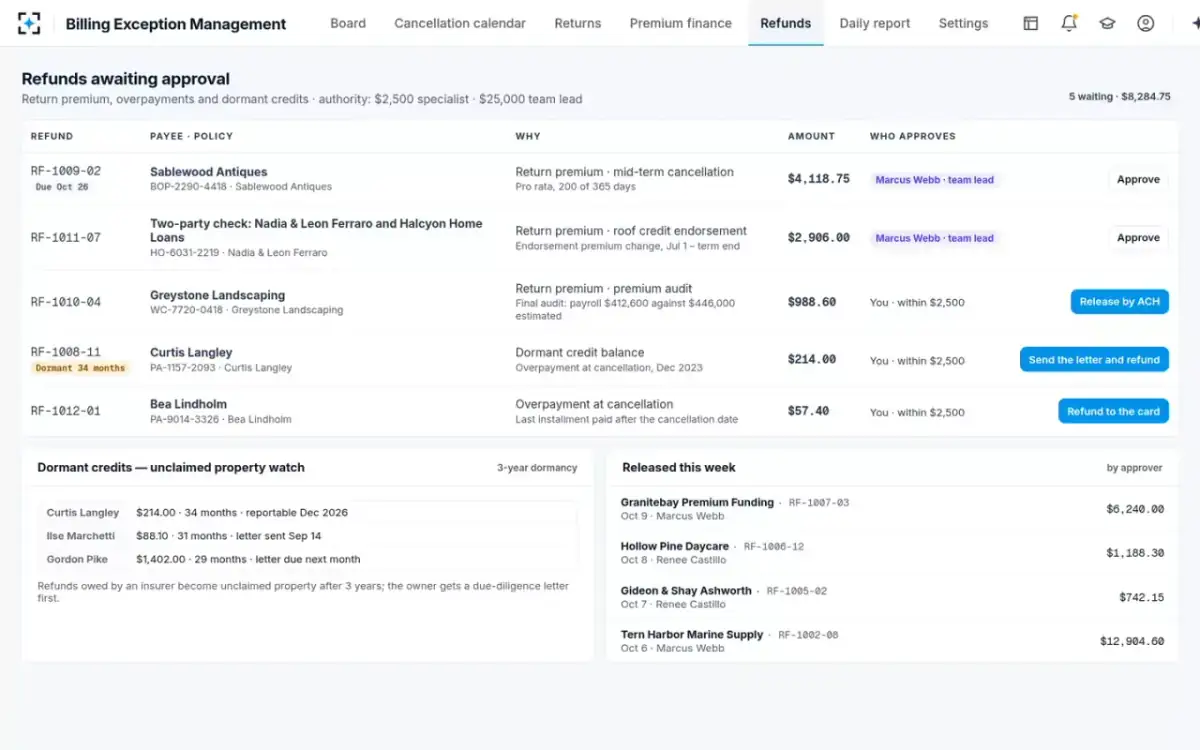
The first lane is how refunds go late in practice: no step is unreasonable and the sum is. The second lane is not faster at any task; it starts each task the day it can start and routes the approval to whoever can sign it. On the sample carrier's Monday, five refunds worth $8,284.75 were waiting, each with its payee, basis, amount and approver shown, and the two above the specialists' $2,500 authority had gone straight to the team lead.
Refunds waiting in Insurance Billing Exception Management: payee, basis, amount, due date and approver
How long does an insurance refund take, from the customer's side?
From the customer's side, an insurance refund takes as long as the state's clock allows plus the time the payment method adds, and a customer can check both. If the policy was financed, the refund goes first to the finance company, which credits the loan and passes on any surplus; in Florida the finance company has 15 days after the account is overpaid to refund the insured. If a mortgage lender is on a homeowners policy, a refund for a coverage change may come as a check payable to both the insured and the lender.
A customer whose refund is late should ask the insurer for the cancellation's effective date, the amount and how it was computed, the payee, and the date it was sent. Those four facts show whether the insurer is late under the state's clock. If it is, the state insurance department takes complaints; refunds of premium are a routine complaint category in Texas's published data.
Turning refund clocks into a work queue in Insurance Billing Exception Management
A refund clock only helps if the queue is sorted by it. In the solution, the refund preparer works out each refund the day the cancellation or change takes effect, with a worksheet that shows the days and the rate, checks the payee against the policy (the finance company up to its unpaid balance, a two-party check where a mortgagee is named, otherwise the insured), and stamps the due date from the carrier's state table. Approval routes by amount. Nothing is released by the agent: a specialist, the team lead or the controller releases it, inside their authority.
The clock table is a setting the carrier maintains by state and line; the sample carrier's table shows Florida at 30 days and New York at 60 days among its rows. Refunds that nobody cashes take a different path, onto an unclaimed property watch, which the premium suspense guide describes. And because a refund on a cancellation often begins as a billing exception, a finance company's request or a returned payment, the refund lane sits on the same board as the others, as billing exception management software, task by task lays out.
Questions people ask
Do I get my full premium back if I cancel my insurance?
Usually you get the unearned part, the premium for the days after cancellation, not the whole premium. Florida computes it pro rata and lets the insurer keep up to 10 percent of the unearned premium on a motor vehicle policy the insured cancels; when the insurer cancels, it refunds all of it.
Does an insurer owe interest on a late premium refund?
In some states. Florida requires 8 percent interest on a late motor vehicle refund, and California's Department of Insurance describes late unearned premium as bearing interest at 10 percent a year under Insurance Code §481.5. Texas's §558.002 itself states no interest rate.
Who gets the refund if my premium was financed?
The premium finance company, first. Florida's insurer returns the unpaid loan balance to the finance company within 30 days and the rest to the agent or the insured; Texas gives the insurer until the 61st day to return unearned premium to the finance company, which refunds any surplus to the insured.
Does the refund clock start when I ask to cancel or when the cancellation takes effect?
It depends on the statute. Texas counts from the effective date of cancellation. Florida, when the insured cancels a motor vehicle policy, counts from the effective date or the receipt of the request, whichever is later, so a backdated request does not shorten the insurer's time.
What can I do if my insurance refund is late?
Ask the insurer for the effective date, the amount and its calculation, the payee and the date it was sent, then compare them with your state's clock. If the insurer has missed it, file a complaint with the state insurance department; in Texas, 7.6 percent of complaints closed in 2025 cited a refund of premium.