Premium suspense is money an insurer has received but cannot yet apply to a specific policy or installment: a lockbox check with no coupon and no policy number, a wire whose reference nobody recognises, a mortgage servicer's escrow check, a premium finance company's remittance that does not tie to an agreement. The state regulators' statement instructions describe exactly this kind of money, cash the company "cannot apply to a specific account when received", and tell insurers to carry it as a liability. The work is hard because the policy behind the money keeps moving. While the check sits unapplied, the installment it was meant to pay still shows as unpaid, and a notice of cancellation for nonpayment can take effect on a customer who paid. Botminds' Insurance Billing Exception Management is software in which six specialist agents read, match and rank that money every morning, so a billing specialist works first the items that could cancel a policy.
The examples on this page come from the solution's sample data: a fictional direct-bill carrier, Kestrel Point Mutual, on a Monday in October. Every person, insured, agency and finance company named here is invented. The rules and figures about the industry come from regulators and are linked where they appear.
Suspense is small money with large consequences
5.8M
homeowners cancellations for nonpayment insurers reported for 2024
90days
past due, after which a premium receivable is nonadmitted on statutory books
3years
before unidentified remittances are reportable to Connecticut as unclaimed property
9items
in unapplied cash on the sample carrier's Monday board, $15,491.88
What is premium suspense? A holding account for money without a home
Premium suspense is a holding account. Money goes in when it has arrived in the insurer's bank but the billing system cannot tell which policy, which installment or which customer it belongs to, and it comes out when someone applies it, refunds it or, years later, reports it to a state as unclaimed. The word "suspense" describes the money's status, not its owner: it is almost always somebody's premium, paid on time, waiting to be recognised.
Most payments never see it. A coupon scanned at the lockbox, an ACH debit the insurer started itself, a card payment on the portal: each carries the policy number with it and posts straight through. On the sample carrier's Monday, 2,422 payments worth $2,609,396.13 arrived and 2,414 applied themselves. The eight that did not, plus one carried from the week before, are the suspense desk's morning. That ratio is typical of the problem's shape rather than any industry average: the volume is small, the dollars are small, and each item is a person's policy.
Suspense is also not the same as the other places a billing team parks money. A payment received before a policy starts is an advance premium. A refund owed after a cancellation is a return premium. An overpayment on a known account is a credit balance. Suspense is the money that cannot yet be put in any of those boxes, because nobody is sure whose it is.
Premium suspense meaning in insurance: a liability and a receivable at once
On statutory books, premium suspense is a liability. The NAIC's Property/Casualty Quarterly Statement Instructions for the 2026 reporting year tell an insurer to report, on the liability line called Remittances and Items Not Allocated, "a liability for cash receipts that the reporting entity cannot identify for a specific purpose or, for other reasons, the reporting entity cannot apply to a specific account when received", and they list one item to include by name: "Items in suspense" (NAIC P/C Quarterly Statement Instructions, 2026).
The awkward part is what happens on the other side of the balance sheet. The installment the money was meant to pay has not been paid as far as the billing system knows, so it stays where it was, among uncollected premiums, an asset. One check produces two entries that describe the same dollars in opposite ways: a liability for cash the company holds and cannot place, and a receivable for premium it believes is still owed. Until someone applies the payment, both are wrong.
Left long enough, the receivable side starts to cost capital. Statutory accounting generally treats premium receivables more than 90 days past due as nonadmitted. The rule is SSAP No. 6, paragraph 9, and it is strict enough that the NAIC issued an interpretation in 2020 allowing such balances to stay "admitted assets even if they are greater than 90 days past due" while COVID-19 disrupted collections (NAIC INT 20-02). A finance controller who explains the suspense balance every month-end is also, indirectly, explaining receivables that may be paid already.
Four boxes for premium money, and why suspense is the only one with no owner
| Where the money sits | What it is | Statutory line (P/C) | What clears it |
|---|---|---|---|
| Premium suspense | Cash received that cannot be applied to a specific account | Remittances and Items Not Allocated, a liability | Identifying the policy, then applying, refunding or reporting it |
| Advance premium | "Premiums received prior to the effective date of the contract" | Advance Premiums, a liability | The policy taking effect |
| Uncollected premium | Premium billed and not yet received; includes "Amounts collected but not yet remitted to home office" | Uncollected Premiums and Agents' Balances in Course of Collection, an asset | The payment being applied; nonadmitted once more than 90 days past due |
| Credit balance or return premium | Money owed back to a known customer | Owed to a known customer, not held as unidentified cash | A refund, by the state's deadline |
The middle row has a detail worth noticing. Money a customer has paid to an agent, which the agent has not yet sent on, is still an uncollected premium in the insurer's books, not suspense. On an agency-billed account the customer has paid and the insurer's billing system may still show the installment as due, which is one reason a cancellation clock should never be run on billing data alone.
Where suspense money comes from
Suspense has a short list of sources, and each one has its own reason for losing the policy number. Knowing which source an item came from usually tells a specialist where to look first.
- Lockbox checks without a coupon. The customer mails a personal check, often from a different bank account or a relative's, and the remittance file holds only an amount and a payer name. On the sample Monday, check #4127 for $1,840.00 came from Rafael Reyes with no coupon; the remittance file held his name and the amount, and the policy number was handwritten in the memo line.
- Mortgage servicers' escrow checks. One servicer check may pay several policies, and it names the loan, not the policy. A billing team that cannot find the loan number on the policy's mortgagee clause has no key to match on.
- Premium finance company remittances. The finance company pays the premium it financed under its agreement number, which the insurer may hold only on the original notice of the agreement.
- Wires and ACH credits from businesses. A commercial insured pays several policies with one transfer and a free-text reference, sometimes net of a bank fee.
- Duplicates and overpayments. A customer pays on the portal and by phone on the same day. The sample carrier's daily report caught one: a card payment that repeated a portal payment made at 08:12 on the same policy.
Each source needs different evidence, which is why the matching problem is worked through separately in insurance unapplied cash payments, and why an amount match is not enough.
Who works the premium suspense account each morning
The premium suspense account is worked by a billing or cash application specialist, usually first thing, from the overnight lockbox and bank files. It is rarely one person's whole job and rarely anyone's title. Around the specialist sit three other people whose day depends on how the suspense desk went: the premium finance coordinator, the billing team lead who signs refunds above a limit, and the finance controller who owns the balance.
Four seats around one suspense desk, at the sample carrier
Today
Starts with the overnight lockbox file and works unapplied cash oldest first, searching accounts by amount and surname.
With agents
Opens a board ranked by the cancellation each item could cause, with the check image read and a match proposed.
Still theirs: Every application below the auto-apply line, and every one on a policy with a notice pending.
Today
Works notices from three finance companies by mail and email, checking every request to cancel against the notice dates before touching the policy.
With agents
Sees each notice matched to its agreement and policy, with its notice period checked.
Still theirs: The decision to cancel, rescind or hold.
Today
Approves refunds above the specialists' limit and hears about a wrong cancellation from the agent.
With agents
Gets the refunds over the specialists' limit prepared, and a list of paid-but-cancelling policies each morning.
Still theirs: Refunds and write-offs inside the lead's authority.
Today
Owns unapplied cash on the balance sheet, a number to explain every month-end.
With agents
Receives a daily report of what came in, what cleared, what is open and who decided each item.
Still theirs: The balance, and anything above the team lead's limit.
The specialist is the seat that matters most and is seen least. A controller notices suspense as a number; an agent notices it as an angry call. The specialist is the only person who sees the check, the policy and the cancellation date in the same ten minutes, and whose decision moves the money.
Why the oldest-first queue is the wrong order
Oldest-first treats every suspense item as equally urgent, and they are not. What makes an item urgent is the clock running on the policy it belongs to. A $5,410 check intended for installments on a business owners policy that renews next month can wait a day. A $1,840 check intended for a homeowners installment whose notice of cancellation takes effect on Friday cannot.
The notice periods are short. Florida requires ten days' written notice, with the reason, before a cancellation for nonpayment (Fla. Stat. §627.4133), and in Texas such a cancellation cannot take effect until the tenth day after the notice is mailed (Tex. Ins. Code §551.104(e)); the policyholder's side of those clocks is in paid insurance but policy cancelled. Against a ten-day clock, a check that spends four days in the mail and three in suspense has used most of it.
One sample check against one cancellation clock: the money arrived with four days to spare
- Due, then mailed1 d
- Notice running10 d
- Left before Oct 164 d
- Before the check4 d
- Mail and lockbox7 d
- Applied09:41
Ranking by consequence turns that arithmetic into an order of work. In the solution, a cancellation clock keeper lines up every pending nonpayment cancellation each morning against the money in suspense, scheduled debit retries and finance company cures, and the board puts any item attached to a policy with a notice pending at the top of its lane. On the sample Monday it found two policies, among 214 cancellations due in the next fourteen days, whose money was already in. Paid insurance but policy cancelled follows that situation from the customer's side.
The Insurance Billing Exception Management board: four lanes ranked by the cancellation each item could cause
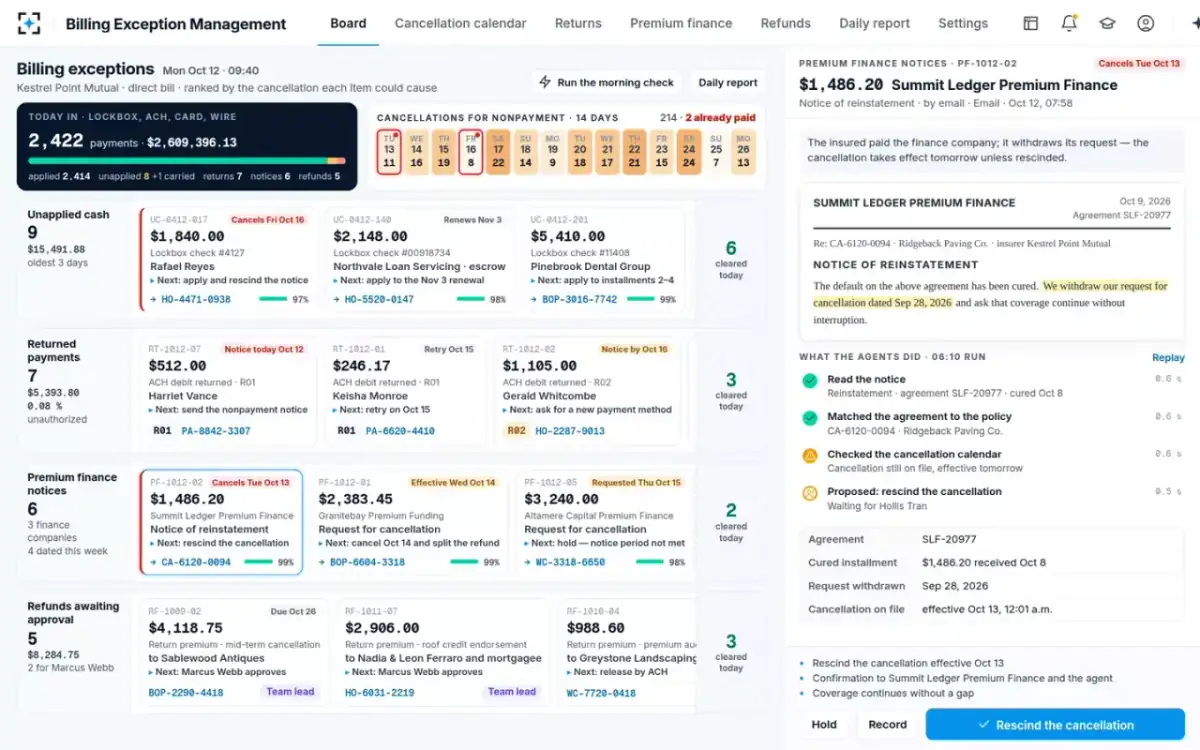
How one sample check leaves suspense in Insurance Billing Exception Management
A suspense item leaves the desk in one of three ways: applied to the right installment, refunded to the payer, or carried with a reason and an owner into tomorrow. Here is the first of those, for the sample check, as the solution's agents and the specialist share it.
Check #4127 from suspense to applied, in four steps
Agent
Remittance readerReads lockbox file 0412, item 17: $1,840.00, no coupon, no policy number. Reads the check image front and back: payer block Rafael Reyes and Marisol Delgado, 7 Larkspur Ct; memo "Delgado HO 4471-0938 Oct", read at 96%.
Never: changes a payment record
Agent
Payment matcherTries the amount alone: four open installments of exactly $1,840.00, none better than 25%. Then memo, payer and address: HO-4471-0938, installment 2 of 4, 97%. The next best, a policyholder with the same surname and a different address, scores 2%.
Never: applies to a policy with a notice pending without a person
Agent
Cancellation clock keeperFinds the notice of cancellation mailed October 2, effective October 16 at 12:01 a.m., and marks the item paid but cancelling.
Never: rescinds a notice by itself
A person decides
Cash application specialistReads the evidence and confirms at 09:41. The payment is applied, the notice rescinded, a "payment received, your policy stays in force" letter queued and the agency told; the decision goes on the audit trail and into the controller's daily report.
The rescission is what makes this a billing exception rather than a bookkeeping entry. Applying the money corrects both sides of the balance sheet; only rescinding the notice keeps the customer insured. Whether that should be a rescission or a reinstatement, and what changes if the effective date has already passed, is set out in how to reinstate a policy cancelled for nonpayment.
What happens to a premium suspense refund?
A premium suspense refund is what happens to money the desk identifies but cannot apply: a duplicate payment, an overpayment, a payment on a policy already cancelled and settled, a check from someone with no policy at all. The money goes back to whoever paid it, and that is less simple than it sounds. A refund to a payer who is not the insured, such as a relative or a mortgage servicer, has to go to the payer, and a refund on a financed policy may belong to the finance company first, as the premium finance unearned premium refund works through dollar by dollar.
Money that cannot be identified at all, or a refund that is never cashed, eventually stops being the insurer's problem and becomes the state's. Connecticut's list of property codes and dormancy periods, in its calendar year 2020 edition, gives "Premium Refunds" a three-year dormancy period, and gives the same three years to a category called "Unidentified Remittances" (Connecticut State Treasurer). Unmatched premium, in other words, is reportable property in its own right. Other states set their own periods, so a billing team needs each state's list, not a single number.
The sample carrier's refund lane shows the end of that road: a $214.00 credit dormant for 34 months, on a watch list, with a due-diligence letter to the customer before it is reported. The solution's setting sends that letter at 30 months; the number is the carrier's choice, not a rule.
What examiners and controllers ask about suspense
Two different people ask about suspense, and they ask different questions. The controller asks how big the balance is, how old, and why. A market conduct examiner asks whether any customer was harmed by it, which in practice means whether a payment that arrived in time was applied in time, and whether any policy was cancelled for nonpayment that had in fact been paid.
The scale of nonpayment cancellations makes the second question worth asking. Insurers reported "5,819,825 cancellations for nonpayment nationwide in 2024" on homeowners policies alone, with rates from 48.5 per 1,000 policies in the Northeast to 65.3 in the Southeast (NAIC MCAS homeowners report). The NAIC is careful to add that these "can be due to a variety of reasons, including the policyholder simply deciding to move to another company". Most are not suspense failures. The ones that are look identical in the data, which is why an insurer has to find them itself, policy by policy, before the effective date.
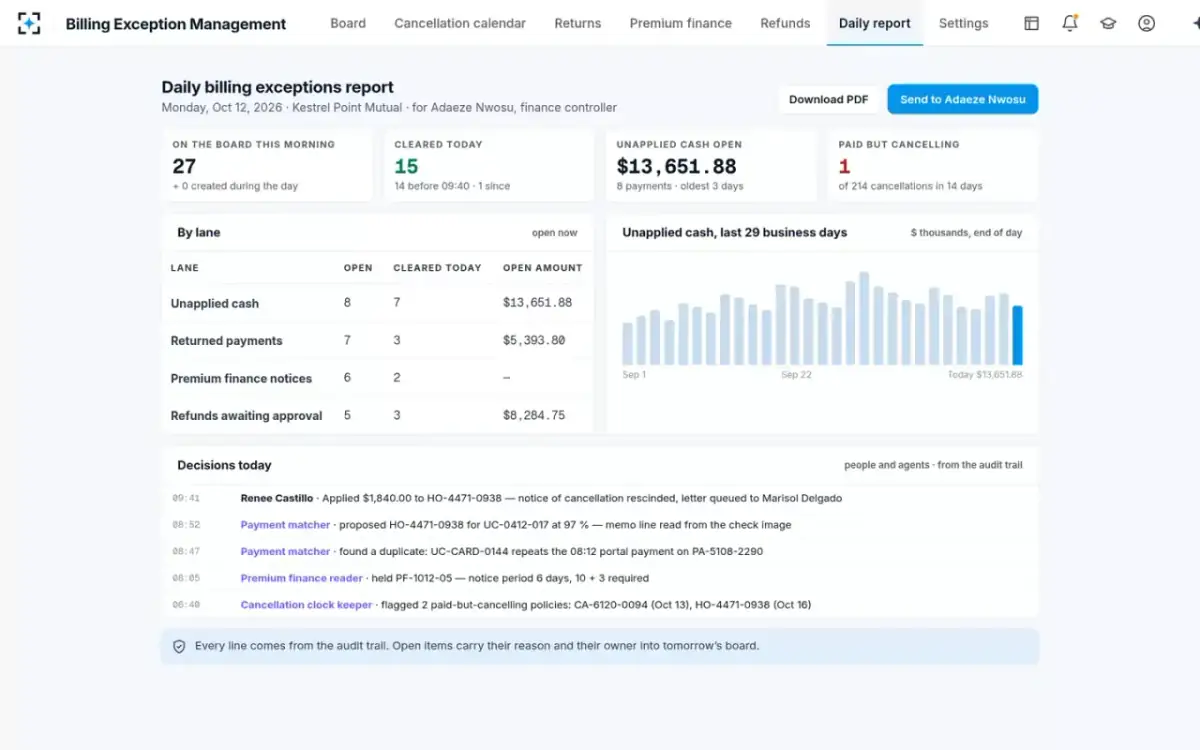
A daily answer to both questions is cheaper than a monthly one. The sample carrier's end-of-day report shows 27 items on the board that morning, 15 cleared, $13,651.88 of unapplied cash still open across eight payments, the oldest three days old, and one of 214 upcoming cancellations still on a paid policy, awaiting the premium finance coordinator's decision.
The daily report: the suspense balance, its age and every decision
Questions people ask
Is premium suspense an asset or a liability?
A liability. The NAIC's property and casualty statement instructions put cash the insurer cannot apply on the liability line Remittances and Items Not Allocated and name "Items in suspense" as part of it. The premium the money was meant to pay usually stays on the asset side as an uncollected premium until the payment is applied.
Is premium suspense the same as unearned premium?
No. Unearned premium is premium already applied to a policy for coverage not yet provided, and it is returned if the policy cancels. Premium suspense is money not yet applied to any policy. A suspense item can become unearned premium the moment it is applied to a future installment.
What does premium suspense remittance mean?
It usually means a remittance, a payment and whatever came with it such as a coupon, a stub or a bank reference, that the billing system could not match and placed in suspense. The fix is to read everything the remittance carries, including the check image, rather than its amount alone.
How long can money stay in premium suspense?
There is no single limit, but three clocks press on it. The policy's nonpayment notice can take effect in ten days in Florida or Texas; the unpaid installment it should have cleared is nonadmitted once more than 90 days past due; and unidentified money becomes reportable unclaimed property, after three years in Connecticut's 2020 list.
What is the difference between premium suspense and advance premium?
Advance premium is money the insurer knows the destination of but cannot earn yet: in the NAIC's words, "Premiums received prior to the effective date of the contract". Suspense is money whose destination is unknown. Both are liabilities; only suspense needs detective work.
Who is responsible for clearing premium suspense?
The billing or cash application specialists clear it, the billing team lead approves refunds and write-offs above their limit, and the finance controller owns the balance. When a suspense item touches a policy with a notice of cancellation pending, the decision to rescind belongs to a named person, never to the system.