However, payment of the premium within the fifteen day "grace period" will reinstate the policy without any lapse in coverage in accordance with § 3425(a)(10).
New York Insurance Department, Office of General Counsel, opinion 05-09-15 (2005)
To reinstate a policy cancelled for nonpayment of premium, the insured pays what is owed and asks the insurer, usually through the agent, to restore the policy; the insurer then decides whether to reinstate it from the cancellation date with no gap, reinstate it from a later date with a lapse in coverage, or decline and offer a new policy. Three dates decide which: the effective date of the cancellation, the date the payment reached the insurer or an agent authorised to take it, and the date coverage would restart. One statement often decides the rest: whether any loss happened in between. Some states take the decision out of the insurer's hands, such as New York, where payment within fifteen days of the notice being mailed restores the policy without a lapse, and Florida, where an insurer must reinstate a homeowners policy retroactively when a mortgage lender's escrow failure caused the default. Botminds' Insurance Billing Exception Management matches late payments and finance company withdrawals to cancelled policies, lays out the dates and the applicable rule, and proposes the outcome to the person who decides.
Examples marked as samples come from the solution's fictional sample carrier and customers. The statutes, regulator opinion and examination report are real and linked.
Three dates and one statement decide every reinstatement
A reinstatement decision is a comparison of dates, and almost every disagreement about one comes from a date nobody wrote down. The first is the effective date and time of the cancellation, from the notice. The second is the date the payment reached the insurer or an agent authorised to receive it, from the deposit or the agent's receipt, not from when it was applied. The third is the date the insurer will restore coverage from. The statement is the insured's confirmation that no loss occurred between the first date and the third.
Insurance policy reinstatement rules as a decision table
| What happened | Outcome | Why |
|---|---|---|
| Payment reached the insurer or an authorised agent before the effective date | Rescind the notice; no reinstatement needed | The policy never stopped; the payment cured the default in time |
| New York: payment within fifteen days after the notice was mailed | Reinstate without a lapse | The payment is timely under N.Y. Ins. Law §3425(a)(10), as the 2005 opinion above reads it |
| Florida homeowners: the lender failed to pay from adequate escrow, premium not more than 90 days overdue | Reinstate, retroactive to the cancellation date | Fla. Stat. §501.137(3)(b) requires it; the lender reimburses the owner's reinstatement fees |
| Florida motor vehicle: the Office of Insurance Regulation finds the cancellation wrongful | Reinstate from the cancellation date, once arrears are paid | Fla. Stat. §627.728 lets the office order it, but not while the insured is in arrears |
| Payment after the effective date, no loss in between, within the insurer's rules | Reinstate with or without a lapse, as the insurer's rules and the state allow | The insurer's decision; write down the dates and the no-loss statement |
| Payment after the effective date, and a loss in between | Decline reinstatement over the gap, or reinstate from after the loss | Restoring coverage over a known loss would insure a loss already suffered |
| The payment was returned by the bank | No reinstatement on that payment | A returned payment is not payment of premium |
| Pennsylvania auto, after a lapse | Expect to cancel and write a new policy | The Insurance Department's position in a 2025 examination, disputed by the company |
The first row is the cheapest outcome and the most often missed. A payment that arrived before the effective date does not need a reinstatement; it needs the notice withdrawn before it takes effect. That is the work paid insurance but policy cancelled describes from the customer's side, and it turns into a reinstatement only when nobody notices in time.
Reinstatement with lapse meaning, and when a lapse is not allowed
Reinstatement with lapse means the insurer restores the same policy, on the same terms, but from a date after the cancellation, so there is a period in between with no coverage. Reinstatement without lapse restores it from the cancellation date, as if it had never stopped. The first protects the insurer from a loss in the gap; the second protects the insured from the gap itself.
A seven-day lapse, drawn to scale
- Covered before cancellationcovered
- Covered again, from the cancellation datecovered
- Covered before cancellationcovered
- Lapse: cancelled until payment and reinstatement7 d
- Covered againcovered
A lapse is not always the insurer's to choose. Where the payment was timely under the state's rule, as in New York within fifteen days of the notice being mailed, the policy comes back without a gap. New York's regulator has also said what an insurer may not do in the other direction: an insurer cannot set a cancellation's effective date back to the renewal date, because "that would constitute a retroactive cancellation in violation of N.Y. Ins. Law § 3425" (opinion 05-09-15). The dates on the notice are the dates that count.
When the law makes the insurer reinstate
Two Florida provisions show the law requiring reinstatement rather than permitting it, and both turn on who caused the default. The first covers the mortgage escrow case. A lender that holds escrow funds must pay premiums "so that insurance coverage on the property does not lapse". If it fails to, through neglect, while there are enough funds in escrow:
If the lender violates paragraph (a) and the premium payment is not more than 90 days overdue, the insurer shall reinstate the insurance policy, retroactive to the date of cancellation, and the lender shall reimburse the property owner for any penalty or fees imposed by the insurer and paid by the property owner for purposes of reinstating the policy.
Fla. Stat. §501.137(3)(b)
Past 90 days, or if the insurer refuses, the lender owes the difference in cost between the old policy and a comparable new one for two years. For an insurer's billing team the practical point is that an escrow check arriving late for a Florida homeowners policy is not just a late payment; it may be a mandatory retroactive reinstatement, and the file should say whose failure it was.
The second covers a wrongful auto cancellation. If Florida's Office of Insurance Regulation finds for the insured, it orders the insurer "to rescind its notice of cancellation or, if the date cancellation is to be effective has elapsed, order the policy reinstated from the date of cancellation", with one condition: "no policy shall be reinstated while the named insured is in arrears in payment of premium on such policy" (Fla. Stat. §627.728). Even a wrongful cancellation is undone only once the premium is paid.
Pennsylvania's view: a lapse can mean a new policy
Not every regulator accepts reinstatement with a lapse at all. In an examination report issued on October 1, 2025, the Pennsylvania Insurance Department recorded that First Acceptance Insurance Company had been allowing an independent agent to "process reinstatements with a lapse in coverage", and that the company later "directed its independent agent to cease reinstating policies with a lapse as it was causing reporting issues with the Pennsylvania Department of Transportation. After August 2024, a new policy was written after the old policy was cancelled" (Pennsylvania Insurance Department, market conduct examination of First Acceptance Insurance Company).
The report then counted the consequences. From 8,567 private passenger auto mid-term cancellations it selected 115 files and recorded 9,392 violations across 1,863 files, on the basis that "these policies should have been cancelled instead of reinstated": no cancellation letter, no notice to the Department of Transportation within ten days, and no fresh tort option, uninsured motorist and stacking forms for what the department treated as new coverage. The company disagreed, saying it was "unaware of any statutory support for such a position", and the consent order directed it to stop and to follow the report's recommendations.
Whatever one makes of the dispute, its lesson for a billing team is concrete. A reinstatement with a lapse is not only a billing event. Where a state treats the gap as a cancellation followed by new coverage, every notice and form owed on a cancellation and on a new policy may be owed again, and the billing system's "reinstated" flag will not send them.
Can you reinstate insurance after cancellation if there was a claim?
Usually not over the period of the loss. A reinstatement that reaches back over a known accident or a known storm would insure a loss already suffered, which is why insurers ask for a statement that no loss occurred between the cancellation and the request. Florida's escrow rule answers the question differently, because the default was the lender's: if the owner suffers a loss as a result, "the lender is liable for the loss", up to "the coverage limits of any insurance policy which has lapsed" (Fla. Stat. §501.137(3)(a)).
For the insurer, the no-loss statement belongs in the case with the three dates. A reinstatement granted without one, and a claim that later turns out to fall in the gap, is the case most likely to end in a dispute about what the insurer knew and when.
What a policy reinstatement letter should say
A policy reinstatement letter should let the insured, the agent and any lender see at once whether there is a gap and what to do about it. Most disputes about reinstatement start with a letter that says "reinstated" without saying from when.
Seven things a policy reinstatement letter should state
- The policy, and the cancellation it undoes
Policy number, the notice date and the cancellation effective date and time.
- The reinstatement effective date and time
The single most important line: from when coverage is restored.
- Whether there is a lapse, and its exact dates
If coverage restarts after the cancellation date, say which days are not covered.
- The payment that supports it
Amount and date received, so the insured can check it against their records.
- Any condition
Such as a statement of no loss, or a fee, and its basis.
- Who else is being told
The agent, a mortgagee or loss payee, a finance company, and, where the law requires, a motor vehicle department.
- What to do if anything is wrong
A contact, and how long the insured has to raise it.
Insurance reinstatement fee: who pays it
Insurers can charge a fee to reinstate a policy, and the insured usually pays it; the exception is a default someone else caused. Florida's escrow statute assumes such fees exist and moves them: the lender "shall reimburse the property owner for any penalty or fees imposed by the insurer and paid by the property owner for purposes of reinstating the policy". A separate fee with a similar name, charged by a state motor vehicle department to reinstate a suspended registration or licence after an insurance lapse, is the state's, not the insurer's.
Who decides, and how Insurance Billing Exception Management prepares it
Reinstatement is clerical work with a judgement at the end. The occupational description that the US Department of Labor's O*NET publishes for insurance policy processing clerks puts it as one task: "Compare information from application to criteria for policy reinstatement, and approve reinstatement when criteria are met" (O*NET, Insurance Claims and Policy Processing Clerks). The comparison is the part software can prepare; the approval is the part a person keeps.
Who touches a reinstatement after a nonpayment cancellation
Today
Finds the late payment by searching, then pieces the dates together from the billing system and the notice.
With agents
Gets the payment matched to the cancelled policy, with the deposit date, the notice dates and the applicable rule laid out.
Still theirs: Applying the payment, and the rescission or reinstatement inside the carrier's rules.
Today
Reads a finance company's notice of reinstatement from the inbox and hunts for the cancellation it withdraws.
With agents
Sees the withdrawal matched to the policy and the cancellation on file, with a proposal to rescind.
Still theirs: The decision to rescind or reinstate at the finance company's request.
Today
Takes the customer's call and collects a no-loss statement by email.
With agents
Is told the outcome and the dates as soon as they are decided.
Still theirs: The customer conversation, and the no-loss statement.
Today
Sees reinstatements only when one goes wrong.
With agents
Owns the rules table: when a lapse is allowed, by state and line.
Still theirs: Any reinstatement over a reported loss, and the state rules.
On the sample carrier's Monday, the clearest case was a withdrawal. A premium finance company emailed at 07:58 that its customer had cured the default, withdrawing its request for cancellation of a commercial auto policy dated September 28. The cancellation was still on file for 12:01 a.m. the next day. The premium finance reader matched the agreement to the policy, found the cancellation on the calendar and proposed rescinding it, so that coverage would continue without a gap. It never reinstates or rescinds anything itself; the coordinator decides. Had the email arrived a day later, the same facts would have needed a reinstatement, and the decision table above.
Insurance Billing Exception Management matches a withdrawal to a cancellation that takes effect tomorrow
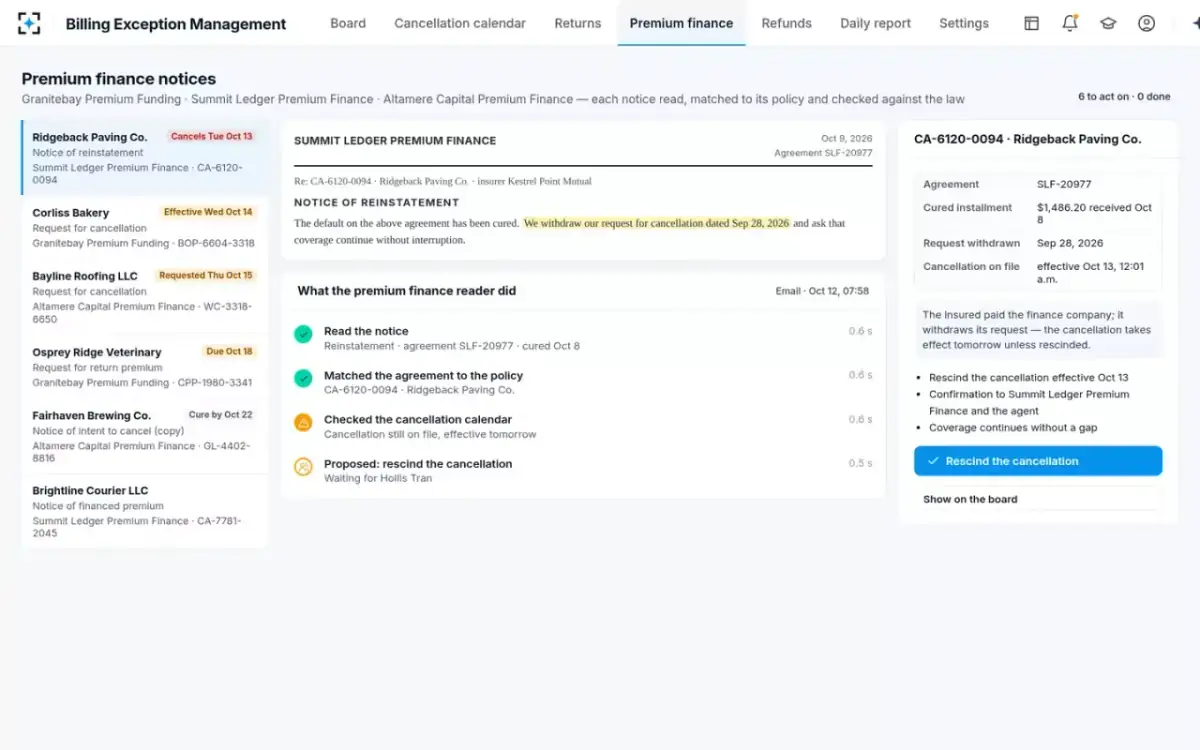
The same comparison runs every morning across all pending cancellations, which is how the solution finds the cases that never need a reinstatement at all. The rules behind the finance company's request are in the premium finance notice of intent to cancel.
Questions people ask
What does reinstated with lapse mean?
It means the insurer restored your policy from a date after it was cancelled, so there is a period with no coverage between the cancellation and the reinstatement. A loss in that period is not covered. Reinstated without lapse means coverage was restored from the cancellation date, with no gap.
Can you reinstate insurance after cancellation for nonpayment?
Often, by paying what is owed and asking the insurer or agent, but after the effective date it is usually the insurer's decision under its rules. Some laws require it: in New York, payment within fifteen days of the notice being mailed restores the policy without a lapse, and Florida requires retroactive reinstatement when a lender's escrow failure caused the default.
How long do you have to reinstate a cancelled policy?
There is no single period. New York's fifteen days after the notice is mailed is a statutory window; Florida's escrow rule applies while the premium is not more than 90 days overdue; otherwise the insurer's own rules set the window, so ask the insurer what its deadline is in writing.
Is a reinstatement the same as a new policy?
No. A reinstatement restores the same policy and terms; a new policy starts again with new terms and, in many states, new notices and forms. Pennsylvania's examiners in 2025 treated auto policies reinstated after a lapse as needing cancellation and new policies, a position the company disputed.
Who has to be told when a policy is reinstated?
The insured and the agent, and any third party that was told of the cancellation: a mortgagee or loss payee, a premium finance company and, for auto in some states, the motor vehicle department. Pennsylvania's examiners cited missing notices to its Department of Transportation within ten days of cancellation.