Billing exception management software works the payments and notices an insurer's billing system cannot finish on its own: unapplied cash with no policy number, returned debits, premium finance company notices and refunds waiting for approval. The question a buyer should ask is not whether it automates those items but which tasks inside each one it takes, because a billing exception is a dozen small jobs, and some of them should never be done by software alone. Applying money to the wrong policy, or letting a cancellation take effect on a customer who paid, is the failure the whole desk exists to prevent. Botminds' Insurance Billing Exception Management gives six specialist agents the reading, matching and checking, and leaves every decision that moves money or changes a policy's status with a named person inside a limit the insurer sets.
The worked examples come from the solution's sample data, a fictional direct-bill carrier called Kestrel Point Mutual on a Monday in October; its people, insureds and finance companies are invented. The task list is the solution's own configuration, and the limits are settings a carrier changes.
What does billing exception management software do?
It does four jobs that a billing system leaves behind, and it does them on one board. Unapplied cash has to be matched to a policy. A returned debit has to be reversed and given the action its return code allows. A finance company's notice has to be matched to its agreement and checked against the notice the law requires before the policy is touched. A refund has to be worked out, routed to the right payee and approved by someone with the authority to release it.
What ties the four together is the cancellation clock. A check in unapplied cash, a debit returned for insufficient funds, a finance company's request for cancellation and a notice of reinstatement can all end in the same place: a policy cancelled for nonpayment, or one that should have been cancelled and was not. Software that works the four lanes separately cannot see that a customer whose debit came back on Tuesday also mailed a check on Wednesday.
Examiners judge the result against plain standards. The NAIC's Market Regulation Handbook, in its 2024 examination standards, expects every policy transaction to be processed both accurately and completely (NAIC Market Regulation Handbook Examination Standards Summary, 2024; the standards and the measures built on them are set out in the guide to policy servicing KPIs and metrics). A payment applied to the wrong policy fails that test twice, on the policy that got the money and the one that did not.
A billing exception management system, task by task
The table is the solution's division of labour. Each row is a task that occurs on real exceptions, and the second column says who does it. Where an agent does the task, the third column gives the limit it works inside; where a person does it, the reason the line sits there.
Twelve tasks on a billing exception, and who does each one in Insurance Billing Exception Management
| Task | Who does it | Limit, or why a person |
|---|---|---|
| Read the lockbox file, the check image front and back, coupons, ACH addenda, wire references | Remittance reader (agent) | Never changes a payment record; quotes the image region and a reading confidence for every value |
| Find and score candidate policies from memo, payer, address, loan or agreement number and amount | Payment matcher (agent) | Shows the amount-only result beside the full one, so the reason for the match is visible |
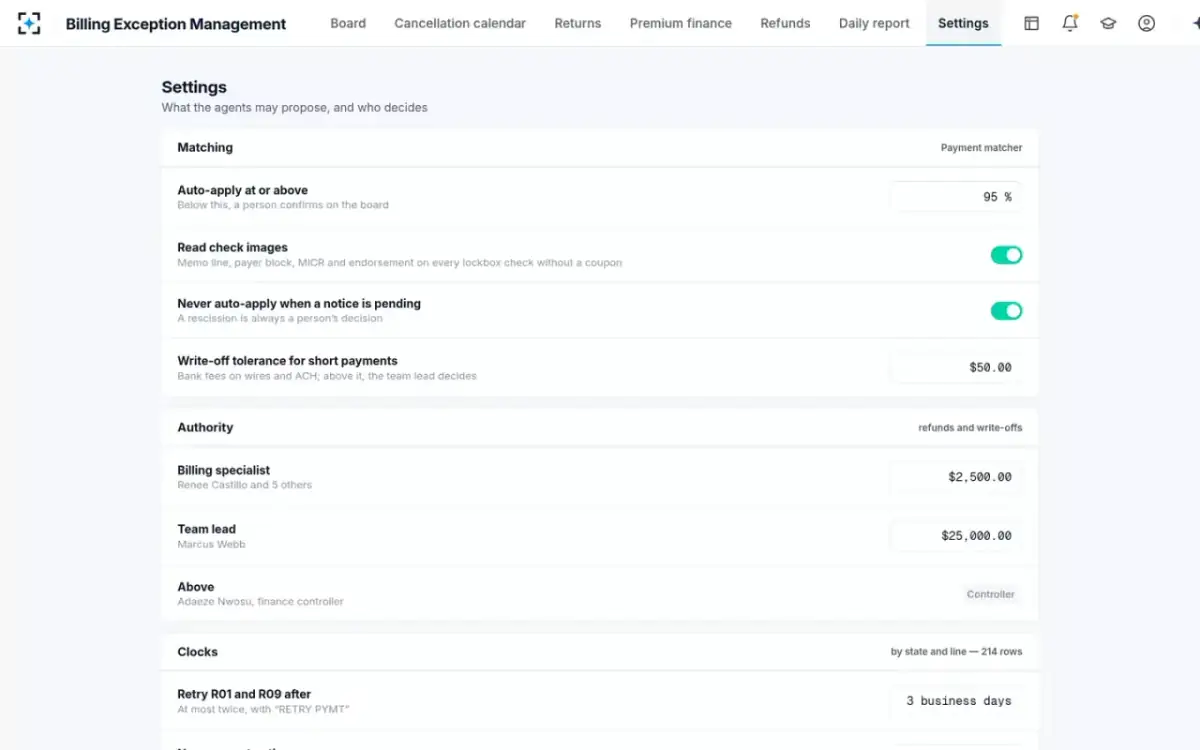
| Apply a payment at or above the auto-apply line, on a policy with no notice pending | Payment matcher (agent) | Auto-apply at 95% confidence in the sample settings; the carrier sets the line |
| Apply below the line, to a cancelled policy, or to a policy with a notice of cancellation pending | Cash application specialist | A wrong application here changes whether someone is insured |
| Split one payment across different insureds | Cash application specialist | The agent never splits a payment across insureds |
| Reverse a returned debit and set the action its return code allows; schedule a permitted retry | Returns handler (agent) | Re-presents only the codes the carrier allows, never more than twice; tracks return rates over 60 days |
| Read a finance company notice, match agreement to policy, check the notice period, work out the unearned premium split | Premium finance reader (agent) | Holds any request with a short notice period |
| Cancel or reinstate a policy at a finance company's request | Premium finance coordinator | The agent never cancels or reinstates; it proposes |
| Line up every pending nonpayment cancellation against money received, retries and cures | Cancellation clock keeper (agent) | Runs every morning; flags "paid but cancelling" |
| Rescind a notice of cancellation | Cash application specialist or coordinator | A rescission is always a person's decision |
| Prepare a refund with its worksheet and check the payee | Refund preparer (agent) | Finance company up to its unpaid balance, a two-party check where a mortgagee is on the policy, otherwise the insured |
| Release a refund or a write-off | Specialist, team lead or controller by amount | Up to $2,500 a specialist, up to $25,000 the team lead, the controller above (sample settings) |
Read down the second column and a pattern appears. The agents read, compare, compute and flag. The people decide whether a policy is in force and whether money leaves the building. The only task in which an agent moves money unaided is applying a payment it is at least 95% sure of to a policy with no notice pending, the easy case, and the line is a setting the carrier can raise.
Which tasks agents should take, and the limit on each
Agents should take the tasks that consume a specialist's hours without needing a specialist's judgement: reading, searching and arithmetic. Each of those tasks is also where a hand process cuts corners under time pressure, which is why giving them to agents changes accuracy as well as speed.
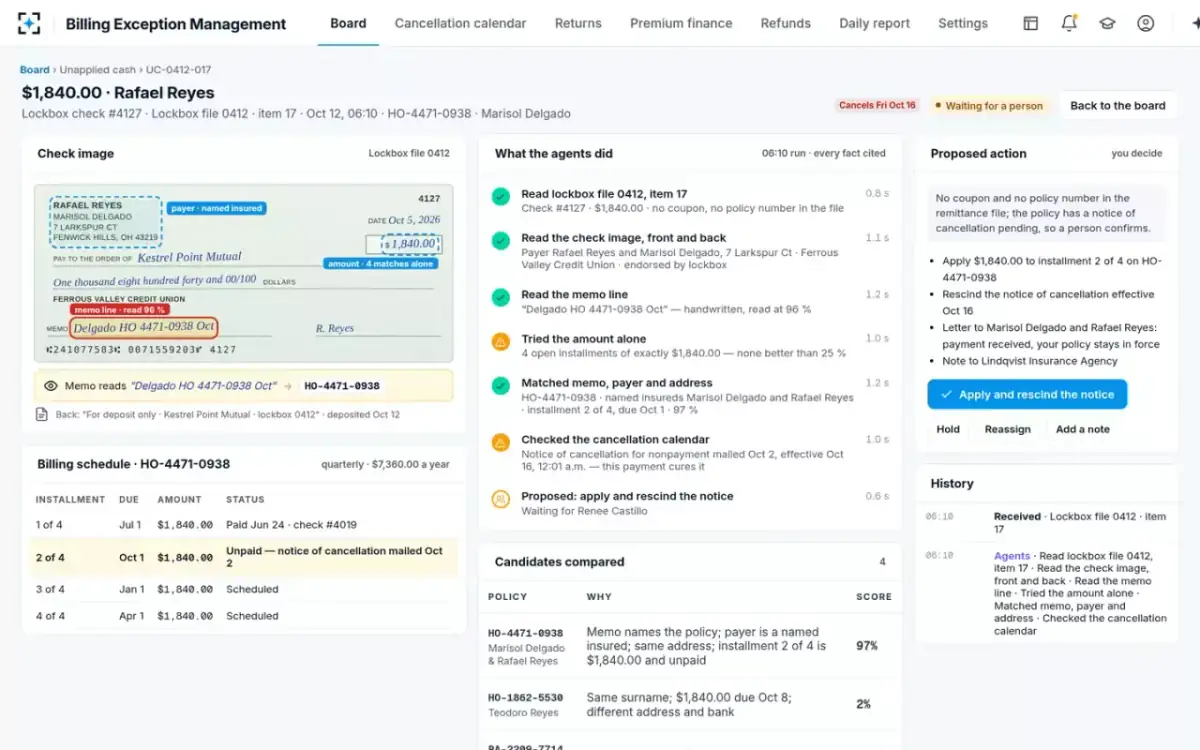
Reading is the clearest case. A remittance file reports an amount and a payer; the check image carries far more, including a payer block with two names and an address, a memo line, a MICR line identifying the bank and account, and an endorsement. On the sample carrier's check #4127 for $1,840.00, the remittance file had no coupon and no policy number. The remittance reader read the handwritten memo, "Delgado HO 4471-0938 Oct", at 96% confidence, and quoted the image region it came from.
Searching is the second. By amount alone, four open installments were exactly $1,840.00 and none scored better than 25%. With memo, payer and address, one policy scored 97% and the nearest alternative, a different customer with the same surname, 2%. A specialist working oldest-first, with a hundred other items waiting, would search by amount and surname, and might stop at the first plausible hit. Why an amount match can be valid and still wrong sets out how to measure that risk.
Arithmetic and calendars are the third. The premium finance reader worked out the sample unearned premium on a business owners policy, 182 of 365 days of $4,780.00, or $2,383.45, and split it between the finance company and the insured. The cancellation clock keeper compared 214 cancellations due in the next fourteen days with the money already received and found two policies already paid. Neither job is hard; both are tedious enough to be skipped on a busy morning.
One exception, with every candidate compared and the proposal waiting for a person
Which tasks stay with people, and why the line sits there
Five tasks stay with people because each one changes something a customer, a regulator or an auditor will hold the insurer to: whether a policy is in force, and whether money has left. A system that does those tasks unaided turns a matching error into a coverage error.
Applying a payment to a policy that has a notice of cancellation pending is the sharpest example. The application itself is easy; the consequence is not. Applying it may cure the default, and the notice has to be rescinded and the customer told, or it may be the wrong policy, and the real customer's notice runs on. The sample settings never auto-apply when a notice is pending, whatever the confidence. Rescinding a notice follows the same logic, and so does cancelling at a finance company's request: in Florida the policy can cancel on the date the finance company names even if the finance company gave too little notice, as the guide to the premium finance notice of intent to cancel explains, so holding a short-notice request is a judgement the insurer makes, not a rule it can delegate.
Releasing money is the other boundary. The refund preparer works out the amount, the basis and the payee, and stops. In the sample settings a specialist can release up to $2,500, the team lead up to $25,000 and the controller above that. On the Monday in the sample, two refunds were over the specialists' limit: a $4,118.75 return premium on a mid-term cancellation, worked pro rata on 200 of 365 days, and a $2,906.00 two-party check to an insured couple and their mortgage lender. Both went to the team lead with the worksheet attached.
Automated cash application software, or exception management?
Automated cash application software and billing exception management overlap on one task and differ on the rest. Cash application tools, including those sold as intelligent or AI cash application, match incoming payments to open invoices, and they are built for accounts receivable, where an unmatched payment is a reconciliation problem. In insurance an unmatched payment is a coverage problem, because the open item is an installment with a cancellation clock attached.
Cash application automation software and billing exception management, on the same unapplied check
Cash application automation: Open invoices or receivables, by amount, reference and customer.
Insurance Billing Exception Management: Policies and installments, by memo, payer against named insureds, address, loan or agreement number and amount.
Cash application automation: The remittance data: amount, reference, sometimes the remittance advice.
Insurance Billing Exception Management: The remittance data and the check image itself: payer block, memo line, MICR line, endorsement.
Cash application automation: Age of the open receivable.
Insurance Billing Exception Management: The notice of cancellation the item could cause or cure.
Cash application automation: Usually out of scope, or a separate module.
Insurance Billing Exception Management: On the same board: returned debits by reason code, finance company notices with notice periods checked.
Cash application automation: Posts the payment.
Insurance Billing Exception Management: Proposes the payment and the rescission together; a person confirms.
Neither column is the wrong tool for its own job. A carrier with a strong cash application tool may need only the parts of exception management its tool lacks: the check-image reading, the cancellation calendar and the notice work. The point of the comparison is the last row. An automated posting that cures a default without rescinding the notice has fixed the books and left the customer cancelled.
Payment exception management: why the four lanes belong on one board
Payment exception management works best on one board because the four lanes share customers and share a clock. On the sample Monday the cancellation calendar showed 214 nonpayment cancellations due in fourteen days. Two of them were on policies that were already paid, one through a check sitting in unapplied cash and one through a finance company that had withdrawn its request for cancellation the week before. Neither would have been found from inside its own lane.
One board also changes what the morning looks like. Instead of four queues worked oldest-first by different people, the board ranks every item by the cancellation it could cause: the $1,840 check against a notice effective Friday sat at the top of its lane, above older items with no clock running. The billing team still works the same items. It works them in a different order, and the order is the point.
Where the hours go: an estimate, task by task
The solution's designers published an estimate of where one direct-bill exceptions team's day goes, by hand and with the agents. It is a design estimate for a single team, not a measured result from any customer, and a buyer should rebuild it from their own queue counts.
An estimated exceptions day: from about eight and a half hours to under three
- Matching unapplied cash3 h
- Returned payments1.5 h
- Finance notices1.5 h
- Cancellation cross-check1 h
- Refunds1 h
- Write-up0.5 h
- Matching 0.75 h, returns 0.5 h, notices 0.5 h1.75 h
- Cross-check, refunds, write-up0.85 h
Two lines in the estimate deserve scepticism and one deserves attention. The write-up time depends on how the controller wants the day reported. The matching time depends heavily on how many payments arrive without a coupon. The cross-check line, one hour by hand, is the one to look at, because it is work many desks never schedule. A team that does not compare every pending cancellation with the money in suspense each morning has an honest "before" of zero hours, and pays for it in the occasional cancellation of a customer who paid.
What to ask before you buy billing exception management software
The questions that separate products are about evidence and authority, not features. A demo on clean data will match payments; the difference shows on a check with no coupon, a policy with a notice pending, and a finance company request that arrived too early.
Eight questions for any billing exception management system
- Does it read the check image, or only the remittance file?
The memo line and payer block are where an uncouponed payment says which policy it is for.
- Does it show the amount-only result beside its own?
If four installments share the amount, you should see that before you trust the match.
- Will it ever apply money to a policy with a notice pending, on its own?
The safe answer is no, whatever the confidence; ask to see the setting.
- Does it compare every pending cancellation with money received, every day?
This is the check that finds a customer who paid before the notice takes effect.
- Which state rules are loaded, and who keeps them current?
Notice periods and refund deadlines differ by state and line; ask for the table and its sources.
- Who can release money, and up to what amount?
Authority by amount and role should be a setting, with every release on the audit trail.
- Can you export every decision with its evidence?
An examiner or auditor will ask what was known when the money was applied or the notice rescinded.
- What do you need from us to start?
Remittance and returned payment files, finance company notices, billing account and policy data, and a sample of last month's exceptions.
Where Insurance Billing Exception Management fits, and where it does not
Insurance Billing Exception Management fits beside a billing system, not instead of one. Billing, installment plans, delinquency notices and payment posting stay where they are. The solution reads the files the carrier already receives, including lockbox and bank remittance files with check images, returned payment files, finance company notices by email and mail scan, and the billing account and policy data, and it hands back proposed actions and a daily report. The first job of any pilot is connecting it to those files on the carrier's own data.
It is not a bank's lockbox service, which captures the checks; not a payment processor, which moves the money; and not a replacement for the billing system's own delinquency process, which keeps running. Where a carrier's billing system already matches most payments well, the gain is in the remainder, and in the morning cross-check that no system usually performs. The design target is zero cancellations of customers whose money is already in, a target and not a measured result; the honest way to test it is to replay a past month's exceptions, which is how P&C insurance billing software and the exceptions it leaves behind suggests drawing the boundary.
The rules the agents work inside are settings the carrier owns
Questions people ask
What is billing exception management in insurance?
It is the work of clearing the payments and notices that do not apply themselves: unapplied cash, returned debits, premium finance company notices and refunds awaiting approval. What makes it different from general accounts receivable is that each exception can cause, or cure, a cancellation for nonpayment.
Can billing exceptions be fully automated?
The reading, matching and arithmetic can be; the decisions should not be. In the solution, five of twelve tasks stay with people, the ones that change whether a policy is in force or release money, and an agent applies money on its own only above a confidence line and only when no notice is pending.
What is intelligent auto cash application software?
The phrase usually describes cash application tools that use machine learning or document reading to match payments to open receivables. For an insurer, the test is whether the tool reads the evidence a policy match needs, such as the memo line and the payer against the named insureds, and whether it knows when a notice of cancellation is pending.
Does billing exception management software replace the billing system?
No. The billing system keeps billing, plans, delinquency and posting. Exception management works the items the billing system could not finish and hands back proposed actions; in Insurance Billing Exception Management a person confirms each one that moves money or changes a policy.
How should we measure a billing exception management system?
By what happened to the customer, not by match rate. Count matches that reached the right policy, cancellations that took effect on policies already paid, and refunds paid after the state's deadline. A match rate counts answers; these three count harm.