An insurance unapplied cash payment is a payment the insurer has received but not yet applied to a policy and installment, usually because it arrived without a coupon, a policy number or a reference the billing system recognises. The fast way to clear it is to search open installments for the same amount, and that is exactly where it goes wrong: personal lines installments are standard amounts, so one check can match several policies equally well. A match on amount is valid, in that the money fits the hole, and can still be inaccurate, in that it fills the wrong hole and leaves the real customer's installment unpaid and their cancellation clock running. Botminds' Insurance Billing Exception Management reads the check itself, scores every candidate policy on the payer, memo, address and amount together, and shows the amount-only answer beside its own so a specialist can see why the match was chosen.
The examples come from the solution's sample data, a fictional direct-bill carrier, Kestrel Point Mutual, and its fictional customers. The examination finding and the federal rule cited are real and linked.
The same $1,840.00 check, matched two ways in Insurance Billing Exception Management
By amount alone: Four open installments of exactly $1,840.00.
By the check itself: One policy named in the memo line: HO-4471-0938.
By amount alone: 25%, and three others close behind.
By the check itself: 97%; the next best candidate scores 2%.
By amount alone: The amount in the remittance file.
By the check itself: Memo "Delgado HO 4471-0938 Oct", payer Rafael Reyes as a named insured, the same address, and the amount of installment 2 of 4.
By amount alone: Indistinguishable from the winner.
By the check itself: A customer with the same surname, $1,840.00 due October 8, a different address and a different bank: 2%.
By amount alone: Not visible: the match is made before anyone looks.
By the check itself: A notice of cancellation was pending, effective October 16, so a person confirmed and the notice was rescinded.
By amount alone: Three customers out of four would be the wrong one, and one of them would cancel.
By the check itself: A wrong match would have to beat a handwritten policy number, two names and an address.
What is an unapplied cash payment in insurance?
In insurance, an unapplied cash payment is premium money in the insurer's bank account that the billing system has not tied to a policy, so the policy still shows the installment as unpaid. It sits in a holding account, usually called premium suspense or unapplied cash, which statutory accounting treats as a liability until it is applied; what premium suspense is, and who works it covers the accounting.
The term covers three different situations, and they need different fixes. Some payments are unidentified: the insurer does not know whose money it is. Some are identified but unapplied: the customer is known but the payment does not fit an installment, because it is short, long, early or covers several policies. Some are applied but wrong: the money reached a policy, just not the right one, and nobody yet knows it is unapplied cash at all. The third kind is the one that does damage, because it does not look like an exception.
Unapplied cash meaning, and why insurance produces so much of it
Unapplied cash means money received that has not yet been matched to what it pays for. Every business has some; insurers have a particular kind, because of who pays and how. Policies are billed in installments of identical amounts, so a quarterly homeowners plan bills the same figure four times and thousands of policies on similar premiums bill near-identical figures. The people who pay are often not the named insured: a partner writes the check, a mortgage servicer pays from escrow, a finance company pays the premium it financed. And the payment methods vary, from lockbox checks to ACH, card payments, wires and escrow checks, each carrying a different kind of reference.
On the sample carrier's Monday, 2,422 payments arrived and 2,414 applied themselves. The eight that did not were a lockbox check with no coupon, a mortgage servicer's escrow check, a dental practice's check covering three installments, a wire short by a bank fee, and others of the same kind. None was unusual; each lost its policy number in a different way.
Why an amount match is valid and still wrong
An amount match is valid when the amount fits an open installment, and accurate only when the installment belongs to the payer. The two come apart whenever more than one open installment has the same amount, which on a book of standard installment plans is most days.
Take the sample check. Lockbox check #4127 for $1,840.00 arrived on October 12 with no coupon and no policy number in the remittance file. Four open installments were exactly $1,840.00, so an amount search returns four answers and the best of them scores 25%. A specialist working a long queue picks the plausible one, perhaps the one whose surname matches the payer. In this case that was a trap: another customer named Reyes had $1,840.00 due on October 8. The check was for a different policy, HO-4471-0938, named in the memo line.
Amount alone cannot separate the candidates; the check can
The cost of the wrong choice is not symmetrical. Applied to the wrong Reyes, the money cures an installment that was not overdue, or overpays one, and the real customer's notice of cancellation for nonpayment, mailed October 2 and effective October 16, runs on. The error surfaces when the customer calls after the effective date, or when they make a claim.
That is not a hypothetical. In a 2025 report on National General Insurance Company, North Carolina's examiners found that one private passenger auto policy "was cancelled for non-payment of premium in error. The insured made the premium payment; however, the Company applied the insured's payment to the wrong policy." In a small review that one file was a 7.1 percent error ratio (North Carolina Department of Insurance, market conduct examination of National General Insurance Company, 2025). It was also the only nonpayment cancellation among the fourteen cancelled auto policies the examiners reviewed.
The evidence on a check: payer, memo, MICR, address
A check carries more evidence than a remittance file reports, and most of it is in the image. Four parts matter for matching.
- The payer block. Printed names and an address. On check #4127 it read Rafael Reyes and Marisol Delgado, 7 Larkspur Ct; both are named insureds on HO-4471-0938, and the address is the policy's.
- The memo line. Often handwritten, often a policy number, sometimes a name and a month. Here it read "Delgado HO 4471-0938 Oct", read at 96% confidence.
- The MICR line. The bank routing and account numbers. A customer who paid by check before usually pays from the same account; a different bank is a signal, as it was for the same-surname candidate.
- The endorsement on the back. Confirms the deposit route and date, which matters when a customer later says they paid in time.
The check, as Insurance Billing Exception Management reads it: the memo line against the amount alone
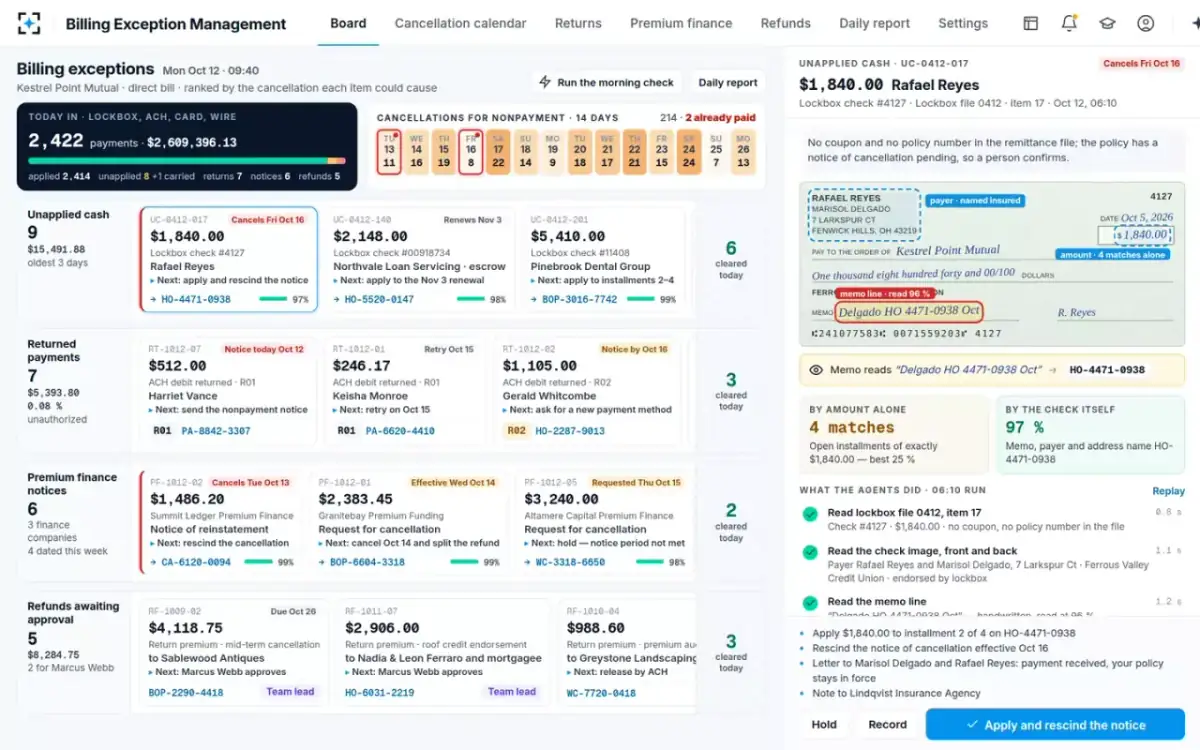
Reading the image is the step most manual processes skip, for a simple reason: it takes a minute per check and the queue is long. It is also the step that turns a guess into a match. The remittance reader in the solution reads every lockbox check without a coupon, front and back, and quotes the region of the image each value came from, so the specialist confirming the match can look at the same pixels.
Escrow checks and finance company remittances carry their own keys
Not every unapplied payment comes from the insured. Two third-party payers are common sources of unapplied cash, and each pays under its own reference, not the policy number.
Mortgage servicers pay homeowners premiums from escrow. Federal rules require it on time: the servicer must pay each bill by the date that avoids a penalty, provided the borrower is no more than 30 days behind (12 CFR 1024.17(k)(1), Regulation X; the servicer's side is in the guide to escrow shortages). The servicer pays by its own loan number, often one check for several properties. The match key is the loan number in the policy's mortgagee clause; a policy without it has no way to be found. On the sample Monday, a $2,148.00 escrow check from a loan servicer was proposed for a homeowners renewal at 98%.
Premium finance companies pay the premium they financed, then send notices if the insured stops paying them. Their remittances carry an agreement number. The insurer learns that number from the finance company's notice of the agreement; Texas, for example, gives the finance company until the 31st day after it accepts the agreement to send that notice (Tex. Ins. Code §651.165). A payment that arrives before the notice has nothing to match. Those notices have their own rules, set out in the guide to the premium finance notice of intent to cancel.
How to measure match accuracy: count the policy the money reached
Match accuracy should be measured on the policy and installment the money reached, checked afterwards against the evidence, not on whether a match was made. A match rate rewards the amount search; an accuracy rate punishes it.
Four measures for unapplied cash matching, and what each one rewards
| Measure | How to compute it | What it rewards | Use it? |
|---|---|---|---|
| Match rate | Payments matched ÷ unapplied payments | Any answer, right or wrong | Only beside accuracy |
| Accuracy on the policy reached | Matches later confirmed to the right policy and installment ÷ matches made | Right answers | Yes: the headline measure |
| Reversal rate | Applications later reversed and reapplied ÷ applications | Catching errors after the fact | Yes: a lagging check on accuracy |
| Paid-but-cancelled count | Nonpayment cancellations that took effect on a policy whose money was already received | Nothing; it counts harm | Yes: the measure the customer feels |
Accuracy needs a test set, and the cheapest one is the insurer's own history. Take last month's payments that applied automatically with a coupon, strip the coupon and the policy number, and run them through the matcher as if they were unapplied. Every one has a known right answer. Add the month's real exceptions with their eventual resolution. The share matched to the right installment is the accuracy rate, and the cases where several installments shared the amount are the ones to read.
Six checks before you trust any unapplied cash match
- More than one open installment with this amount?
If so, the amount is not evidence. Ask what else agrees.
- Is the payer a named insured, a mortgagee or a finance company on the policy?
A payer with no relationship to the policy needs a reason, such as a memo line naming it.
- What does the check image say?
Memo line, payer block and MICR line, read from the image, not the remittance file.
- Is a notice of cancellation pending on the matched policy, or on any candidate?
If so, a person confirms, and the rescission is part of the same decision.
- Does the amount fit exactly?
A short payment by a bank fee is common on wires; a long one may cover two installments or two policies.
- Can someone else see why it matched?
The evidence, the amount-only result and the person who confirmed it should travel with the application.
What an unapplied cash report should show
An unapplied cash report should show what is open, how old, and what each item could cause, not just a total. A controller explaining the balance at month-end needs the first two; the billing team needs the third every morning.
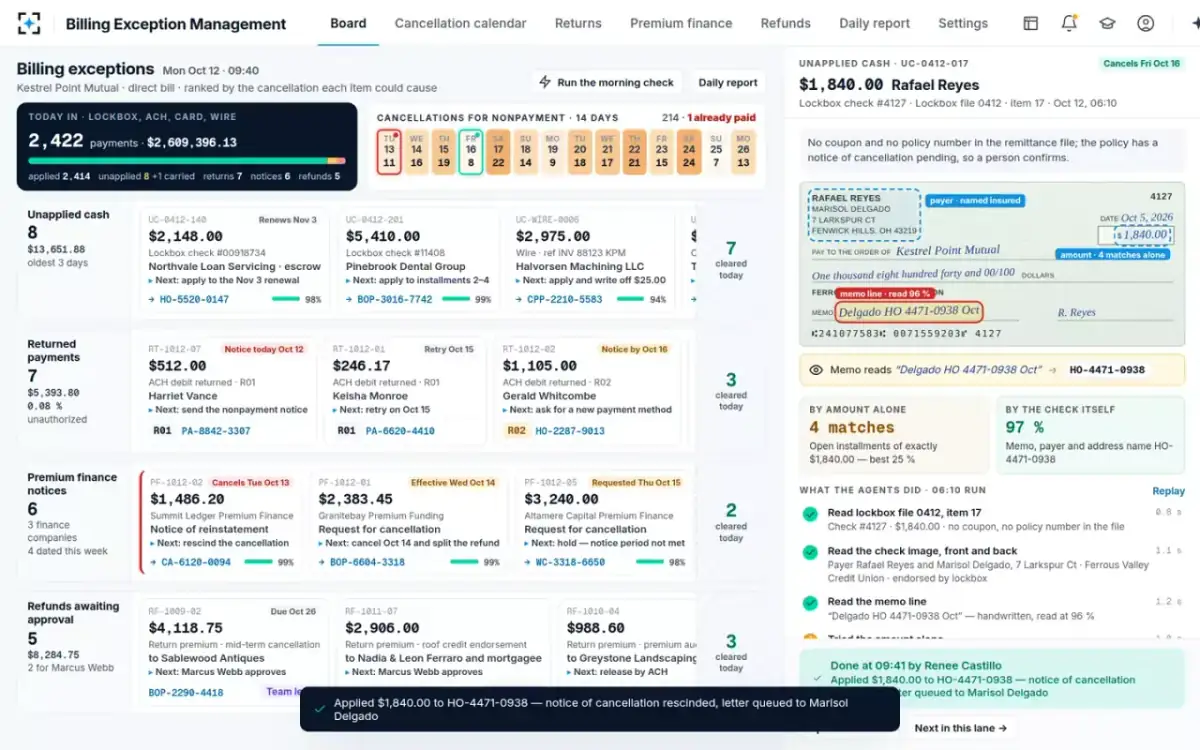
The useful columns are the amount, the date received, the source (lockbox, ACH, wire, escrow, finance company), the best candidate with its confidence and the evidence behind it, and the clock: the effective date of any notice of cancellation on a candidate policy. The sample carrier's end-of-day report on October 12 showed $13,651.88 of unapplied cash still open across eight payments, the oldest three days old, and every decision of the day listed with the person who made it. A report that sorts by age hides the item that cancels on Friday; one that sorts by the clock puts it first.
Applied, rescinded and logged: the check leaves unapplied cash
"Insurance company lost my payments": what usually happened
When a customer says an insurance company lost their payment, the money is rarely lost. It has usually done one of four things: arrived and sat in unapplied cash, reached the wrong policy, come back as a returned debit or check, or gone to an agent or a finance company rather than the insurer. Each leaves a trace, and the customer's evidence finds it faster than a search by amount.
The most useful thing a customer can supply is the cleared check, front and back, or the bank statement line. The front shows the amount, payee and memo; the back shows where and when it was deposited. With that, a specialist can find the deposit in the lockbox file by date and amount, and then see what the billing system did with it. If the check was deposited by the insurer and the policy still shows unpaid, it is in unapplied cash or on the wrong policy. If it was deposited by an agency or a finance company, the payment is real but the insurer may not have it yet. What a customer should do when the payment surfaces after a cancellation is covered in paid insurance but policy cancelled.
Questions people ask
What does unapplied cash mean on an insurance account?
It means the insurer has received money it has not yet applied to an installment, so the account still shows the installment due. The money is held, usually in premium suspense, until someone identifies the policy, or refunds it if it cannot be matched.
Is an unapplied cash payment income for an insurer?
No. Until it is applied, it is a liability: money held for someone, not premium. Once applied, it becomes premium on the policy and is earned over the coverage period like any other premium. Searches for unapplied cash payment income usually come from small-business bookkeeping, where the treatment differs.
Can an insurance payment be applied to the wrong policy?
Yes, and it has led to wrongful cancellations. North Carolina's 2025 examination of National General Insurance Company found an auto policy cancelled for nonpayment although the insured had paid, because the payment went to the wrong policy. Matching on the payer, memo and address, not the amount alone, is the defence.
What is a good auto-match rate for unapplied cash?
No regulator or research body publishes one, and a match rate alone says little. Measure accuracy on the policy the money reached, using last month's payments with the coupons removed as a test set, and track every nonpayment cancellation that took effect on a policy already paid.
How do I find an insurance payment that was not applied to my invoice?
Ask the insurer to search by the deposit date and amount on your bank statement, not by your policy number, and send the cleared check front and back if you paid by check. The deposit record shows whether the insurer received it, and from there where it was applied.