A premium finance unearned premium refund is the money an insurer returns when a policy paid for by a premium finance loan is cancelled, and it does not go straight to the insured. The insurer computes the unearned premium, the part of the premium for the days after cancellation, and sends it first to the premium finance company, up to what the insured still owes on the loan; whatever is left belongs to the insured. In Florida the insurer has 30 days from the cancellation date and must tell the insured and the agent how much went to the finance company; in Texas it has until the 61st day; in New York, no more than 60 days. Then a second set of clocks starts: the finance company refunds any overpayment, the agent returns unearned commission, and a small surplus can disappear for good. That tail is where financed refunds go missing. Botminds' Insurance Billing Exception Management works out the unearned premium, splits it between the finance company and the insured, stamps each part with the state's deadline and routes it to the person who releases it.
The worked example is from the solution's sample data, a fictional carrier, Kestrel Point Mutual, and a fictional finance company and insured. Statutes are quoted from the states' official sites.
One sample refund of $2,383.45 in Insurance Billing Exception Management, split between finance company and insured
Unearned premium on cancellation
- Finance company, up to the unpaid balance: $1,106.40 · 46.4%
- Insured: $1,277.05 · 53.6%
What is a premium finance unearned premium refund?
It is the return of unearned premium on a cancelled policy whose premium was paid by a premium finance company, routed through the lender because the lender paid. When the insured signed the finance agreement, they usually assigned the unearned premium to the finance company as security. Cancellation turns that security into cash: the insurer pays it to the finance company, which applies it to the loan, and only what is left over belongs to the insured.
Three statutes set the order. Florida: the insurer "shall, within 30 days of the cancellation date, return the unpaid balance due under the finance contract, up to the gross amount available upon the cancellation of the policy, to the premium finance company and any remaining unearned premium to the agent or the insured, or both, for the benefit of the insured or insureds" (Fla. Stat. §627.848(1)(e)). Texas: the insurer "shall return all unearned premiums that are due under the contract directly to the insurance premium finance company before the 61st day after the cancellation date" (Tex. Ins. Code §651.162(b)). New York: the insurer, "within a reasonable time not to exceed sixty days after the effective date of cancellation", returns "whatever gross unearned premiums are due under the insurance contract or contracts on a pro rata basis to the premium finance agency for the benefit of the insured or insureds" (N.Y. Banking Law §576).
The states differ on one point that changes the insurer's work. Florida splits at the insurer: the finance company gets its balance and the rest goes to the agent or insured directly. Texas and New York send the unearned premium to the finance company, which must pass any surplus on; Texas says the finance company "shall refund the excess to the insured", except that "If the amount of the excess is less than $5, the insured is not entitled to a refund."
Is unearned premium a refund?
Yes, in the sense that it is money paid for coverage the insured will not receive, which the insurer owes back when the policy ends early. What makes the financed case different is the payee. The unearned premium is the insured's money, but on a financed policy the insured has pledged it to the lender, so the refund settles the loan first. An insured who expected a cheque for the whole unearned premium, and received a notice that most of it went to the finance company, has usually not lost anything; the loan balance fell by the same amount.
How the unearned premium on a financed policy is calculated
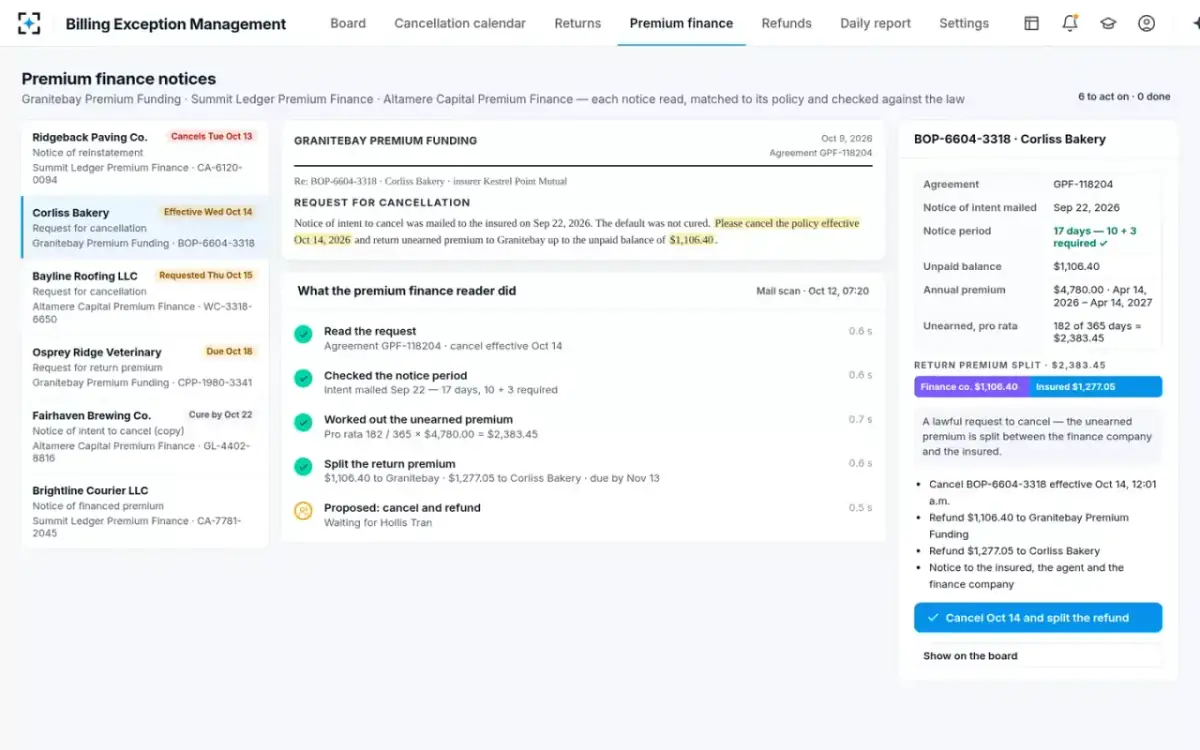
The amount is usually worked pro rata, by days. On the sample business owners policy, cancelled at the finance company's request effective October 14 on a policy running April 14 to April 14, 182 of 365 days were unearned: 182 ÷ 365 × $4,780.00 = $2,383.45. New York's premium finance section names the method outright: the unearned premium is returned "on a pro rata basis".
Who gets which dollar: the finance company, the agent, the insured
Up to three parties take a share, in a fixed order. The finance company is paid first, up to the unpaid balance under the agreement. The agent may hold part of the insured's money in the form of unearned commission, the commission on the premium the insurer is returning. The insured gets the remainder, from the insurer, the finance company or the agent depending on the state.
Worked: the sample refund, and where the remainder goes in each state
| Step | Arithmetic | Result |
|---|---|---|
| 1. Unearned premium | 182 ÷ 365 × $4,780.00 | $2,383.45 |
| 2. Finance company's share | Unpaid balance under the agreement, capped at the unearned premium | $1,106.40 |
| 3. Remainder | $2,383.45 − $1,106.40 | $1,277.05 |
| 4a. Florida | Remainder to the agent or the insured, or both, within 30 days; insurer tells both how much went to the finance company and how much unearned commission the agent holds | Insured receives the remainder, directly or through the agent, with any unearned commission the agent holds |
| 4b. Texas | All unearned premium to the finance company before the 61st day; it refunds the excess to the insured unless under $5 | Insured receives $1,277.05 from the finance company |
| 4c. New York | Gross unearned premium to the finance agency within 60 days, after any minimum earned premium the insurer keeps | The excess is held for the insured's benefit; §576 sets no day count for passing it on |
Insurance Billing Exception Management works out the unearned premium on a lawful request and splits it
The clocks on the way back: insurer, finance company, agent
The tail of a financed cancellation runs on more than one clock, and each belongs to a different party. The insurer's is the one most often measured, but the insured's money can still be weeks from home when the insurer has met it.
How long the money can take to reach the insured, in Florida and Texas
- Insurer pays30 d
- Finance company refunds15 d
- Agent returns15 d
- Insurer to finance companyby day 60
- Agent's commissionby day 90
- Insurer backstopby day 120
Florida's chain is the tightest and the most explicit about the insured's share. After the insurer's 30 days, "The premium finance company shall, within 15 days after the account has been overpaid, either refund to the insured for the insured's benefit any refund due on his or her account or, if the refund is sent or credited to the agent, return or credit to the agent the amount of the overpayment and notify the insured of the refunded amount", and "Within 15 days of receipt of notification from the premium finance company, the agent shall return such amount including any unearned commission to the insured" (Fla. Stat. §627.848(1)(e)).
Unearned commission: the agent's part of the tail
Unearned commission is the commission an agent was paid on premium the insurer is now returning, and on a financed cancellation it is part of what the finance company or the insured is owed. It is the slowest money in the tail, because it sits with a third party the insurer does not control.
Unearned commission on a financed cancellation, Florida and Texas
Florida §627.848(1)(e): The insurer notifies the insured and the agent of "the amount of unearned commission held by the agent", within 30 days.
Texas §651.162(c)–(e): The insurer notifies the agent to return the unearned commission to the finance company.
Florida §627.848(1)(e): The agent, to the insured, with the rest of the refund.
Texas §651.162(c)–(e): The agent, to the finance company, before the 91st day.
Florida §627.848(1)(e): The statute sets the agent's 15-day duty; it names no backstop payer.
Texas §651.162(c)–(e): The insurer "shall remit the unearned commission to the insurance premium finance company before the 121st day".
Florida §627.848(1)(e): The remainder may go "to the agent or the insured, or both".
Texas §651.162(c)–(e): An insurer may return unearned premium to the producing agent, but remains liable to the finance company if the agent has not paid before the 91st day.
The Texas design puts the risk on the insurer: if it deducts the agent's commission from what it sends the finance company, or routes the premium through the agent, it is still on the hook by day 120. An insurer that does either needs a diary entry at day 91 for every financed cancellation, and a way to know whether the agent has paid.
Minimum earned premium in New York: when the refund is smaller
New York lets the insurer keep a floor. On a cancellation by a premium finance agency, "the insurer or insurers shall be entitled to retain a minimum earned premium on the policy of ten percent of the gross premium or sixty dollars, whichever is greater" (N.Y. Banking Law §576). The floor matters only early in the policy term.
Take the sample premium of $4,780.00 and two cancellation dates. Cancelled after 182 days, the earned premium is $2,396.55, well above the floor of $478.00, so the refund is the full pro rata $2,383.45. Cancelled after 20 days, the earned premium would be about $261.92, below the floor, so the insurer keeps $478.00 and returns $4,302.00 rather than about $4,518.08. Our arithmetic, on illustrative dates; a refund worksheet that does not know the floor overpays early cancellations in New York and underpays nobody.
Where premium finance return premiums go missing
Premium finance return premiums go missing in four places, and only the first is the insurer's own deadline. Examiners test both the timing and the payee of every refund under the NAIC's policyholder service standards (NAIC examination standards, 2024), and on a financed policy the right payee changes along the way.
- The wrong payee. A refund sent to the insured when the finance company was owed its balance, or to the finance company in full when Florida required the split. Both need a second payment and a correction to the first.
- The surplus nobody chases. The finance company holds the excess over its balance; in Texas an excess under $5 is not refundable at all, and a larger one depends on the finance company acting.
- Unearned commission. Held by an agent who has no deadline in mind, with the insurer liable in Texas after day 120.
- The cheque nobody cashes. A refund mailed to an insured who has moved becomes a dormant credit, then, after the state's dormancy period, unclaimed property; the premium suspense guide covers that end of the road.
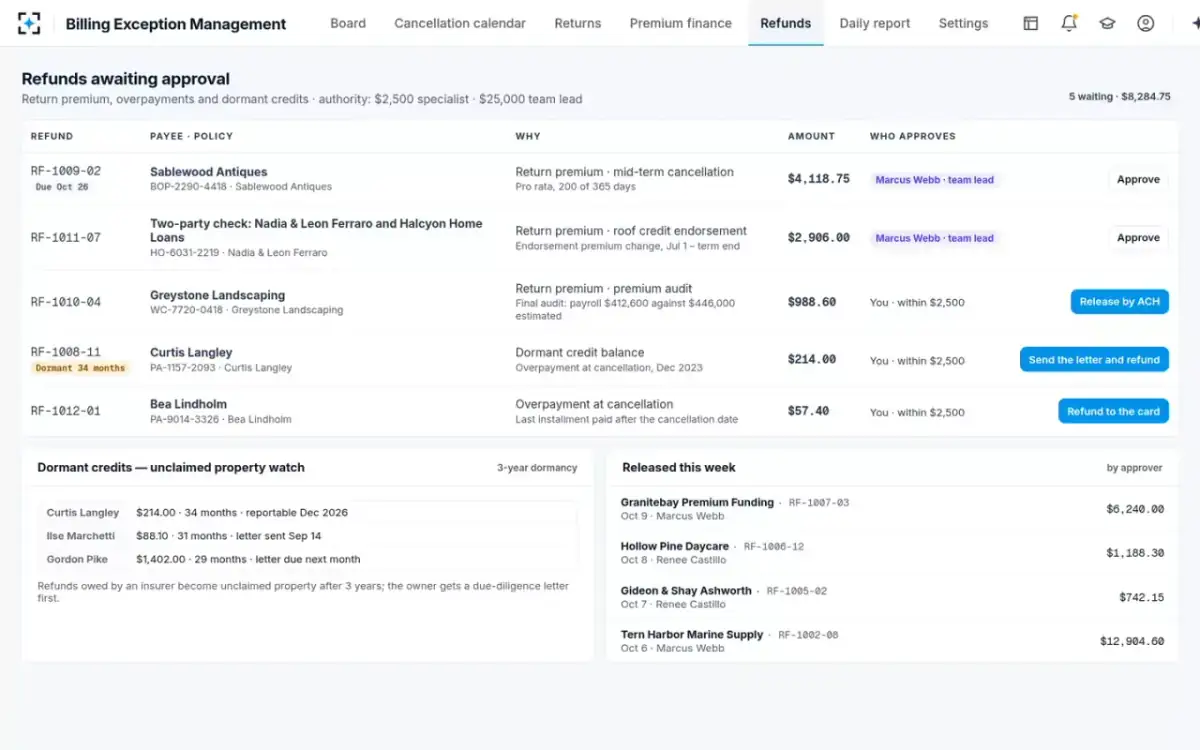
Each of these is visible on the day of the cancellation, which is the argument for preparing the whole tail then. In the solution, the refund preparer checks the payee, the finance company up to its unpaid balance, a two-party cheque where a mortgagee is on the policy, otherwise the insured, and the premium finance reader stamps each part with its state deadline. On the sample Monday, a $6,240.00 refund to one finance company had been released earlier that week by the team lead, inside the $25,000 authority; the agents prepare, and a person releases every dollar. The general refund clocks, for policies with no finance company, are set out in how long an insurer has to refund premiums.
Refunds waiting, with the payee and the person who releases each one
Questions people ask
Why did my unearned premium refund go to the finance company?
Because your premium finance agreement pledged the unearned premium to the lender. When the policy cancels, the insurer pays the finance company up to the unpaid loan balance; Florida requires the insurer to tell you how much went to the finance company, and the rest comes to you.
How long does a premium finance company have to refund the excess?
In Florida, within 15 days after the account has been overpaid. Texas requires the finance company to refund any excess to the insured but sets no day count in §651.162, and an excess under $5 is not refundable.
What does unearned premium refund mean?
It is the part of the premium covering days after the policy ended, which the insurer returns. It is usually computed pro rata by days: on a $4,780.00 annual premium cancelled with 182 days left, $2,383.45. On a financed policy it settles the loan first.
Does the agent have to return unearned commission on a financed cancellation?
Yes, in both states cited here. In Florida, the agent returns the refund including any unearned commission to the insured within 15 days of the finance company's notification; in Texas, the agent returns it to the finance company before the 91st day, or the insurer pays it before the 121st.
Can the insurer keep part of the premium when a finance company cancels?
In New York, yes: on a cancellation by a premium finance agency, the insurer may retain a minimum earned premium of ten percent of the gross premium or sixty dollars, whichever is greater. It matters only when the policy is cancelled early in its term.