If you paid your insurance but the policy was cancelled anyway, start by finding out whether your payment reached the insurer before the cancellation took effect, because that decides almost everything that follows. Most of these cases are not a lost payment but a timing problem: the money arrived and sat unapplied while the notice of cancellation for nonpayment ran out, it was applied to the wrong policy, it went to an agent or a premium finance company rather than the insurer, or the bank returned it. Get proof of the payment's date and destination, the cancellation notice with its mailing and effective dates, and ask the insurer to rescind the notice or reinstate the policy without a gap. State rules on notice and timely payment, such as New York's rule that payment within fifteen days of the notice being mailed is timely, decide whether the insurer has to. For insurers, the same problem is a billing exception, and Botminds' Insurance Billing Exception Management is software that compares every pending nonpayment cancellation with the money already received each morning, so a person can rescind it before it takes effect.
This page explains how the process works for customers and for the agents and service representatives who take their calls. It describes rules and practice; it does not advise on any individual case. Examples marked as samples come from the solution's fictional sample carrier and customers.
After a nonpayment notice is mailed: how many days the law gives in three states
- Fifteen days after the notice is mailed15 d
- The 10th day after the notice is mailed10 d
- Ten days' notice, with the reason10 d
Paid insurance but policy cancelled: what to do first
First, establish the two dates that matter: when your payment reached the insurer, or someone authorised to receive it, and when the cancellation took effect. Then ask the insurer, in writing, to compare them. If the payment arrived first, the cancellation should be undone.
What to gather before you call the insurer
- Proof of payment, with the date
For a check, the cleared check front and back: the back shows when and where it was deposited. For a bank payment, the statement line or confirmation number.
- Who you paid
The insurer directly, your agent, or a premium finance company. Each is a different trail.
- The cancellation notice
The date it was mailed, the effective date and time, and the amount it said was due.
- Anything returned
A notice from your bank that a payment or debit was returned, and the reason.
- Any loss since the effective date
An accident or damage after the cancellation took effect changes what the insurer will offer, so mention it.
- A written answer
Ask for the outcome in writing: rescinded, reinstated without a gap, reinstated with a gap, or declined, and why.
For the agent or service representative on the call, the order of work is the same, with one addition: search for the payment by its deposit date and amount, not by policy number. A payment that lost its policy number is, by definition, not findable by it.
Why a paid policy can still cancel
A paid policy cancels when the insurer's records still show the installment unpaid on the effective date of a nonpayment notice. Five things put a paid customer in that position, and each leaves a different trace.
Five reasons a paid policy cancels, and where to look for each
| What happened | What the records show | Where the money is |
|---|---|---|
| The payment arrived but was not applied in time | Installment unpaid; a deposit on the right date | In the insurer's unapplied cash, waiting to be matched |
| It was applied to the wrong policy | Installment unpaid; another policy overpaid or paid early | On someone else's account |
| It arrived after the effective date | Installment unpaid at the effective date; payment received later | With the insurer, possibly as an offer to reinstate |
| The bank returned it | A payment posted, then reversed | Back in the customer's account, or never left it |
| It went to an agent or a finance company | Installment unpaid; nothing received by the insurer | With the agent, not yet remitted, or with the finance company |
The first two account for most of the cases a customer can do nothing about, and they are the insurer's to find. Insurance unapplied cash payments explains why a payment with no policy number on it ends up waiting, or on the wrong policy, and the examination finding behind the second row.
What happens if an insurance payment is late?
If a premium payment is late, the insurer may start a cancellation for nonpayment, but it cannot end your coverage instantly: state law requires written notice first, and the policy stays in force until the effective date on that notice. In Texas, a cancellation for nonpayment "does not take effect until the 10th day after the date the insurer mails notice of the cancellation to the insured" (Tex. Ins. Code §551.104(e)). In Florida, the insurer must give "at least 10 days' written notice of cancellation accompanied by the reason therefor" (Fla. Stat. §627.4133). In New York, the notice must tell you how much is owed; the full content of a compliant notice is in the insurance cancellation notice template.
A payment that reaches the insurer before the effective date should stop the cancellation. A payment that arrives after it may not, and what happens next is up to the insurer and, in some cases, the state's rules on reinstatement; how to reinstate a policy cancelled for nonpayment covers that decision from the insurer's side.
Is there a grace period for insurance premium payment?
Property and casualty rules mostly work through the notice period before a nonpayment cancellation rather than a fixed grace period of the life insurance kind. New York is the clearest case of a statutory window:
Payment to the insurer, or to an agent or broker authorized to receive such payment, shall be timely, if made within fifteen days after the mailing to the insured of a notice of cancellation for nonpayment of premium.
N.Y. Ins. Law §3425(a)(10)
Two details in that sentence matter to a customer. The fifteen days run from when the notice was mailed, not when it arrived. And payment to an agent or broker "authorized to receive such payment" counts as payment to the insurer, so a customer who paid an authorised agent on day twelve has paid on time even if the agent remits it later. In other states, the effective date on the notice is the deadline, and an insurer may give more time than the minimum.
When a check bounces or a debit is returned
A payment that the bank returns is, in the law's eyes, a payment that was never made. New York's insurance regulator put it plainly in a 2009 opinion: "a dishonored check is not payment of premium." In that case the insurer had received a check before the cancellation date and told the agent it would reinstate, the check bounced, and the regulator concluded that "An otherwise valid notice of cancellation for nonpayment of premium" was "effective under the circumstances presented" (New York Insurance Department, Office of General Counsel opinion 09-12-02).
Florida writes the same idea into its statute and goes further for a first payment. "Nonpayment of premium" there includes "the failure of a financial institution to honor an insurance applicant's check after delivery to a licensed agent for payment of a premium", and if the bounced check was the initial premium, the contract "shall be void ab initio unless the nonpayment is cured within the earlier of 5 days after actual notice by certified mail is received by the applicant or 15 days after notice is sent to the applicant by certified mail or registered mail" (Fla. Stat. §627.4133). A policy void from the start covers nothing, so a customer who learns that a first payment bounced should pay at once.
For returned electronic debits, the bank's notice gives a reason, and it matters. An insurer may present a debit returned for insufficient funds again, as the sample carrier's settings do, but the ACH Network's rules limit reinitiation of a returned debit to two times, and one returned because the customer told the bank it was not authorised cannot be retried without a new authorisation. A customer who receives a cancellation notice after a returned debit should pay by another method, not wait for a retry.
My insurance was cancelled due to nonpayment: rescission, reinstatement or a new policy?
There are three ways back, and they leave the customer in very different places. A rescission withdraws the notice before it takes effect, so the policy never stops. A reinstatement restores the policy after it was cancelled, either back to the cancellation date, with no gap, or from a later date, with a gap. A new policy starts fresh, with new terms and possibly a new price.
The same paid installment, fixed before and after the effective date
Notice rescinded before it takes effect: Continuous; the policy never stopped.
Cancellation took effect, fixed afterwards: Continuous only if reinstated back to the cancellation date; otherwise a gap.
Notice rescinded before it takes effect: Covered on the usual terms.
Cancellation took effect, fixed afterwards: Depends on the reinstatement date; the insurer may ask for a statement that no loss occurred.
Notice rescinded before it takes effect: A letter saying the payment was received and the policy stays in force.
Cancellation took effect, fixed afterwards: A reinstatement notice with its effective date, or an offer of a new policy.
Notice rescinded before it takes effect: Usually nothing to undo.
Cancellation took effect, fixed afterwards: Lenders, agencies or a motor vehicle department may have been told of the cancellation and must be told again.
Notice rescinded before it takes effect: Written confirmation that the notice is rescinded.
Cancellation took effect, fixed afterwards: Reinstatement from the cancellation date, with no gap, if the payment arrived in time.
The Texas Department of Insurance's advice to a driver whose policy is cancelled is short and practical: "Ask your agent or company if they can reinstate your policy. If not, start shopping right away" (Texas Department of Insurance). If the payment reached the insurer in time, the request is not a favour; it is a correction.
What the insurer should check before the cancellation takes effect, as Insurance Billing Exception Management does
An insurer can find almost every paid-but-cancelling policy before the customer does, by comparing each pending nonpayment cancellation with the money it has already received, every morning. The check is simple and easy to skip by hand, because the money and the notices sit in different queues.
In the solution's sample, the cancellation clock keeper ran that check at 06:40 on a Monday across 214 nonpayment cancellations due to take effect in the next fourteen days. It found two on policies already paid: one homeowners policy whose $1,840.00 check was in unapplied cash with the policy number in its memo line, and one commercial auto policy whose premium finance company had withdrawn its request for cancellation. Both were flagged for a person to rescind; the clock keeper never rescinds a notice itself.
The Insurance Billing Exception Management cancellation calendar, with the paid policies ringed
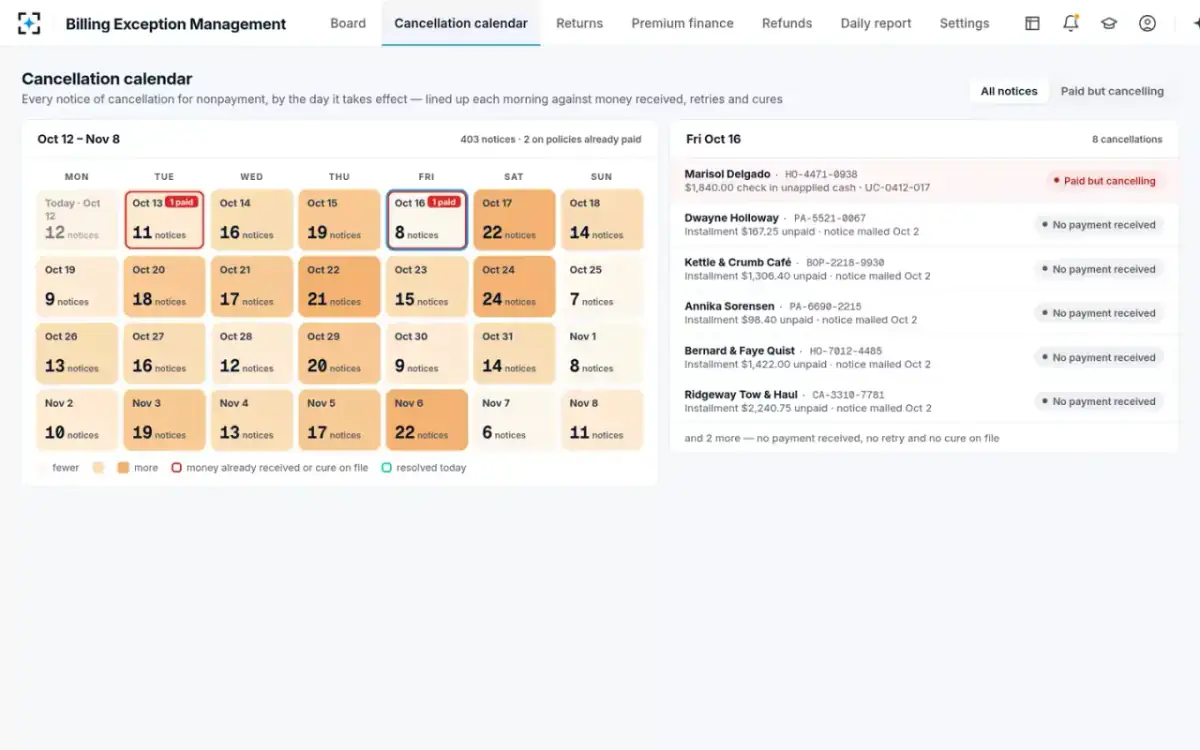
The design target for the solution is zero cancellations of customers whose money is already in, a target rather than a measured result. For a customer, the practical point is that a payment with the policy number written on it, in the memo line of a check or the reference of a bank transfer, is much easier for any insurer to find.
Where to complain if the insurer will not fix it
If the insurer will not rescind or reinstate and you believe the payment arrived in time, file a complaint with your state insurance department, with the proof of payment and the notice attached. State departments investigate these complaints and can recover money. The Texas Department of Insurance reported resolving 19,607 complaints in its 2025 fiscal year, with $89.6 million in additional claim payments and premium refunds to consumers, though the average complaint took 92 days to resolve (TDI 2025 annual report).
Ninety days is a long time to be uninsured, so a complaint is a route to correction, not to cover. If the policy cannot be restored quickly, the safer course is to buy replacement coverage while the complaint proceeds, keeping the records that show the payment was made.
Questions people ask
Can an insurance company cancel my policy if I paid late?
Yes, if the payment arrived after the effective date on a valid nonpayment notice. The insurer must first mail written notice, at least ten days in Texas and Florida, and in New York a payment within fifteen days of the notice being mailed is timely. A payment received before the effective date should stop the cancellation.
Does paying after the cancellation date reinstate my policy?
Not automatically. After the effective date, reinstatement is usually the insurer's decision under its rules and the state's, and it may restore coverage from the cancellation date or from a later date, leaving a gap. Ask in writing, and ask which date applies.
What if I paid my agent and the insurer still cancelled?
Get the agent's receipt showing the date you paid. In New York, payment to an agent or broker authorised to receive it counts as payment to the insurer, so a payment made within fifteen days of the notice being mailed is timely even if the agent remitted it later.
My payment bounced. Is my policy cancelled?
A returned payment is treated as no payment; New York's regulator has said "a dishonored check is not payment of premium". In Florida, a bounced first payment can make the policy void from the start unless cured within the earlier of 5 days after you receive certified notice or 15 days after it is sent. Pay by another method at once.
How do I prove I paid my insurance on time?
With the cleared check, front and back, or the bank statement line, plus any confirmation number. The back of a check shows when and where it was deposited, which is the date that matters, and it lets the insurer find the deposit even if the payment never reached your policy.
Who should I call first, the agent or the insurer?
If you paid the agent, call the agent; if you paid the insurer directly, call the insurer, and copy your agent. Either way, ask for the outcome in writing, and file a complaint with the state insurance department if the payment arrived in time and the insurer will not correct the cancellation.