An insurance cancellation notice template should carry the insurer and policy number; the named insured and the mailing address shown in the policy; the date of mailing; the effective date and time cover ends; what kind of notice it is (cancellation for nonpayment, cancellation on another ground, nonrenewal or conditional renewal); the ground relied on and the specific facts behind it; for nonpayment, the amount due; the statements the state requires, such as California's notice that the policyholder may ask the Department of Insurance to review a cancellation; and the copy list for the agent, broker and any mortgagee or lienholder. But a template is only words. Whether a notice complies depends on the dates, the facts and the receipt filled into it, and those fail far more often than the wording. Botminds' Cancellation & Nonrenewal Compliance checks each filled notice before mailing; the honest way to judge it, or any template, is to run it over 90 days of notices you have already mailed.
“All notices of cancellation shall be in writing, mailed to the named insured at the address shown in the policy, or to the insured's last known address”
California Insurance Code §677(a)
This guide gives a template skeleton for three common notices, then the pilot that tests it. Rules are quoted from statutes and exam reports, linked where they appear; the pilot figures come from a fictional sample carrier, Kestrel Point Insurance Group, and its mail run of 12 October 2026.
Why test a template on the notices you mailed?
Because the exam findings that recur are about dates, reasons and receipts, and none of those live in the template. North Carolina's examiners found that Integon National Insurance Company “did not provide the insured with written notice of cancellation at least ten days in advance of the effective date of cancellation of physical damage coverage on 118 policies”; Illinois's found nonrenewal reasons that named a claim without its date. Neither failure is a wording problem.
A pilot reverses the usual order of evaluation. Instead of reading a template and imagining the notices, take every notice mailed in the last 90 days, run each through the checks it should have passed, and count what would have stopped and why. The scorecard below is the one the sample carrier uses; its right-hand column is one day of its run.
The pilot scorecard: five reasons a notice stops, and one sample day
Short
What it catchesFewer days than the state requires for the notice type, line and policy age
An example of the ruleFlorida 45, 120, 20 or 10 days; Texas 60 for nonrenewal
12 Oct10
Too early
What it catchesMailed before a window opens
An example of the ruleNew York: 60 to 120 days for commercial, 45 to 60 for personal lines
12 Oct2
Reason or wording
What it catchesA category instead of a reason; a missing state statement; the wrong form edition
An example of the ruleTexas reason content; California review statement and Home Insurance Finder notice
12 Oct3
Moratorium area
What it catchesA notice in an area a regulator's emergency order covers
An example of the ruleCalifornia §675.1 and the Commissioner's bulletins
12 Oct5
Mailing
What it catchesA copy holder missing from the list; an address that came back
An example of the ruleNew York agent copy within 7 days; mortgagee and lienholder copies
12 Oct2
What should an insurance cancellation notice template include?
Every field in a good template traces to a statute or an exam finding, and the template should say which. The skeleton below is generic: it shows the fields and the state examples behind them, and a carrier adapts it per state, line and notice type with counsel. It is not a filed form and not legal advice.
Notice of cancellation insurance sample: the skeleton, field by field
[Insurer name and address] · Form [number and edition]
NOTICE OF [CANCELLATION / NONRENEWAL / CONDITIONAL RENEWAL]
Date mailed: [date]
Named insured: [first-named insured] · Mailing address: [address shown in the policy]
Policy: [number] · [line] · Policy period: [dates]
Your coverage ends at [time] on [effective date].
Reason: [the ground relied on, and the specific facts: what, when, how much, and the source]
[Nonpayment only] Amount due: [amount] · Pay by: [date] to [where]
[State statements: department review, insurer telephone number, residual market or Home Insurance Finder notice, appeal rights]
Copies: [agent or broker] · [each mortgagee, lienholder or loss payee]
- Address shown in the policy. California, Florida, Texas and New York each tie notice to the address in the policy.
- Effective date. Count it from the mailing date: Texas makes a personal-lines cancellation effective no earlier than the 10th day after mailing.
- Reason. Texas requires the precise incident or risk factor and the source of the information; California the ground and the specific supporting information.
- Amount due. New York requires a nonpayment notice to inform the insured of the amount due.
- State statements. California's cancellation notices name the Department's website, telephone number and address for review; Florida's auto notices carry residual-market and appeal wording.
- Copies. New York requires the agent's copy within seven days for personal lines; California deems a lienholder's copy mailed if sent electronically with its consent.
Three fields cause most of the trouble. The effective date, because it is computed and the computation depends on the state, line, notice type and policy age. The reason, because underwriters write in the vocabulary of the file rather than the facts the insured can check. And the address, because California allows the insured's last known address as well as the address in the policy while New York's proof rule speaks of the address in the policy, and a returned envelope from the address on file is a warning the template cannot hear.
Nonpayment cancellation notice template: the amount due and the days to pay
A nonpayment notice is the most common cancellation and the simplest, and its template needs three things the others do not: the amount due, the date by which payment keeps the policy in force, and the short clock. New York requires a nonpayment notice to “inform the insured of the amount due”, and treats a payment as timely if made within fifteen days after the notice is mailed. Florida requires at least ten days' written notice of a nonpayment cancellation, “accompanied by the reason therefor”. Texas makes a cancellation for nonpayment effective no earlier than the 10th day after the insurer mails the notice.
The template's danger is the pay-by date. A notice that prints a date fewer than the state's days after the mailing date is short on its face, and a notice printed on Friday for a Monday mailing loses three days before it leaves. Count from the mailing date, not the print date, and print the date the money must arrive.
Commercial nonrenewal notice template: days, reasons and the broker's copy
A commercial nonrenewal template varies most by state, because the days do. Florida requires 45 days' written notice to the first-named insured with the reasons. Texas requires the notice to be delivered or mailed to the first-named insured at the address shown on the policy no later than the 60th day before expiry, and a late one keeps cover in force until the 61st day after it is sent. New York requires a window of 60 to 120 days, a copy to the authorized agent or broker, the specific reasons, the amount of any premium increase on a conditional renewal, and a statement that loss information is available on request; its §3426 also gives the insured the right to receive that loss information within ten days of asking.
The template should therefore carry state-specific blocks rather than one paragraph that tries to satisfy all four. The New York block needs the loss-information line and the broker on the copy list; the Texas block needs a reason that meets §551.055; the Florida block needs the reasons and the 45-day date. For a renewal on worse terms rather than a refusal to renew, the template is a different notice, set out in the conditional renewal notice sample.
Non renewal letter insurance: the personal-lines version
Personal-lines nonrenewal letters carry the most state-required text. In California, a residential nonrenewal mailed at least 75 days ahead, plus the days California's Code of Civil Procedure adds for mailing, must state the specific reasons, display the insurer's telephone number for consumer inquiries prominently, and tell the consumer that if they have contacted the insurer and remain unsatisfied they may have the matter reviewed by the Department of Insurance, with its website, telephone number and address. From July 2021 it must also carry the Department's notice about the California Home Insurance Finder and the FAIR Plan. New York's personal-lines letter goes 45 to 60 days ahead with the specific reasons; Florida's residential letter 120 days ahead with the reason; Texas's 60 days ahead, with a written statement of the reason.
An insurance non renewal letter sample is useful only if it shows those blocks as variables. The letter that is right for a California homeowner is wrong for a Texas one, both in its days and in the paragraphs it must contain. Every field the letter needs, and the statute behind it, is annotated in the notice of nonrenewal, line by line.
Testing the template on 90 days of mailed notices
The pilot is simple to describe and tells a policy services leader more than any demonstration. Take every cancellation, nonrenewal and conditional renewal notice mailed in the last 90 days, with the transaction behind each and its postal receipt. Run each through the checks a notice should pass before mailing: the clock, the reason and wording, the area, the copy list and the receipt. Count the stops by type, and read every one.
Then judge the result against what you already know about those 90 days. Complaints about a notice, notices re-sent, policies that stayed on the books past their intended end, and any exam findings in the period should each appear as a stop. A stop that a person reading the file agrees is not a problem is a false alarm; count those too, because a check that stops too much will be bypassed. The two numbers to decide on are the share of known problems the check would have caught and the number of false stops a cancellation lead would have to clear on a typical day.
Where one sample day's 22 stops came from
22 stopped notices, 12 Oct
- Short · 45.5%
- Moratorium area · 22.7%
- Reason or wording · 13.6%
- Too early or mailing · 18.2%
What one day of the pilot shows
One day of the sample run shows the pattern a pilot usually confirms: most stops are about dates, not words. Ten of the 22 notices were short of their state's minimum and two were too early for a window rule, so twelve of 22 failed on the clock, against three on the reason or wording. Five sat in a moratorium area, where the template is irrelevant and only the date and the address matter. The clock wall below is the same run at 13:42, with every notice drawn as a ring.
One day of notices in Cancellation & Nonrenewal Compliance, with the stops pulled out
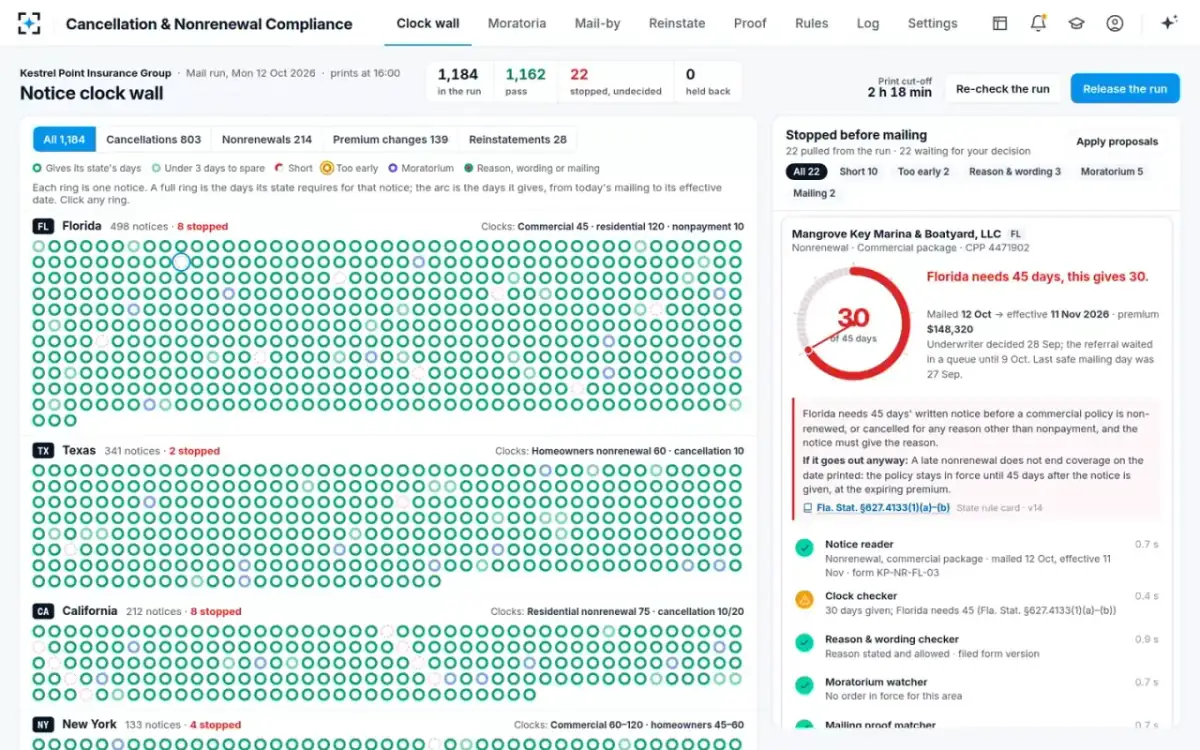
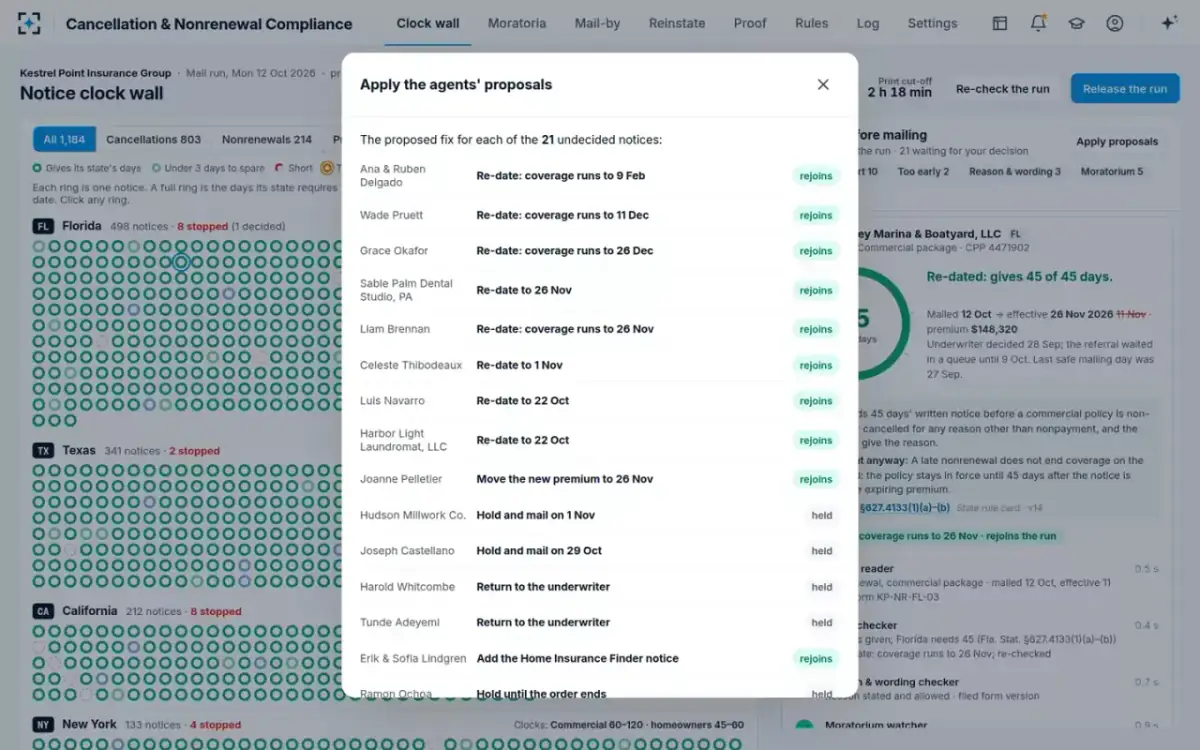
The reason-and-wording stops are where a template change helps. In the sample run one was a homeowners nonrenewal missing the Home Insurance Finder notice, fixed by adding it, and two were stopped on their reasons and proposed for return to their underwriters. A pilot that finds many wording stops points to the template; one that finds many short clocks points upstream, to how late decisions reach the notice queue.
Cancellation & Nonrenewal Compliance proposes a fix for each stop; a person applies it
Who runs the pilot, and what each decides at day 90
Four seats in a 90-day pilot
Today
Keeps the state rules in documents and spot-checks notices after complaints.
With agents
Writes and approves the rule library the pilot runs on, and reads every stop the pilot raises.
Still theirs: whether each stop was a real problem, and every rule change
Today
Spot-checks a handful of notices before each day's cut-off.
With agents
Reads the proposals on each stopped notice and marks whether she would have applied them.
Still theirs: the decision on each notice, in the pilot and after it
Today
Decides nonrenewals and sees the notice only when an insured calls.
With agents
Sees the reasons the pilot judged too thin, and the decisions that reached the queue too late to mail.
Still theirs: the reason and the decision date
Today
“One bad batch to a moratorium ZIP and we are in the paper.”
With agents
Sees the share of known problems caught and the false stops per day, the two numbers the rollout turns on.
Still theirs: the go or no-go, and the staffing that follows
The decision at day 90 is not whether the software is clever; it is whether the stops it raises are the ones the team would have wanted, at a volume one lead can clear before the cut-off. For the requirements behind that judgement, see notice compliance software requirements; for the rules a template's state blocks must carry, insurance cancellation notice requirements by state.
A 90-day pilot, from data pull to decision
- Pull 90 days of mailed notices
Every cancellation, nonrenewal and conditional renewal, with its transaction, the notice as mailed and its postal receipt.
- Load the rules you are examined on
Your states, lines and notice types, written and approved by compliance, each with its source text.
- List what you already know
Complaints, re-sent notices, extended policies and exam findings in the period: the answer key.
- Run every notice, then read every stop
Mark each stop as real or false, and each known problem as caught or missed.
- Measure two numbers
Share of known problems caught; false stops per day for one cancellation lead.
- Separate template fixes from process fixes
Wording stops point to the template; short clocks point to how late decisions reach the queue.
Cancellation & Nonrenewal Compliance is built for this kind of trial: its agents read past notices exactly as they read the day's run, every stop cites its rule, and a person decides each one. It does not write the template, and it does not decide whether to cancel. To run a pilot on a sample of your own notices and state rules, start from Cancellation & Nonrenewal Compliance.
Questions people ask
Is there a standard insurance cancellation notice form?
Not one form for every state. Each state sets the content, days and copies its notices must carry, and carriers use their own forms by state and line, filed where the state requires it. A template should be built from those requirements, for example New York's amount-due statement on a nonpayment notice and California's Department review statement on a cancellation.
How many days' notice does a nonpayment cancellation need?
In the states this guide covers, ten to fifteen days. Florida requires at least ten days' written notice with the reason, Texas makes a nonpayment cancellation effective no earlier than the 10th day after mailing, and New York treats payment as timely if made within fifteen days after a nonpayment notice is mailed.
Does a cancellation notice have to give a reason?
In the four states this guide covers, yes, for insurer-initiated notices. Florida requires the reason on cancellations and nonrenewals; Texas requires a statement that names the precise incident or risk factor and its source; California requires the ground and the specific supporting information; New York commercial notices must specify the grounds and cite the statute where applicable.
Who should receive a copy of a cancellation notice?
The named insured at the address in the policy, and usually the agent or broker and each mortgagee, lienholder or loss payee the policy names. New York requires the agent's copy of a personal-lines notice within seven days of mailing, and Florida's auto statute requires the notice to go to the agent as well as the insured.
How long should a pilot of notice compliance software run?
Long enough to include the notice types and states you mail and a few known problems to catch. Ninety days of mailed notices covers a quarter's renewals and the complaints that followed them; the sample carrier mails about 1,200 notices a day, so 90 days is tens of thousands of notices, enough to measure false stops per day reliably.