Insurance is cancelled for underwriting reasons when the insurer ends a policy before its expiry date because of the risk itself rather than unpaid premium: a misstatement on the application, an inspection requirement the insured never met, or a change in the property or driver that makes the risk materially worse. In the first 60 days the states give an insurer more room; after that, Florida, Texas, New York and California each confine the insurer to a short list of grounds written into statute, and the notice must say which one applies, arrive enough days ahead, and be provably mailed. Botminds' Cancellation & Nonrenewal Compliance is built for that last mile: its agents read every queued cancellation and nonrenewal notice, check the ground, the days and the wording against the state's rule, and hold anything that fails for a person to decide before the print vendor takes the batch.
That last mile is where carriers get caught, because three different people own the three parts of one notice and nobody owns the whole. The examples below come from a fictional sample carrier, Kestrel Point Insurance Group, and its mail run of Monday 12 October 2026; the rules, exam findings and fines come from statutes and regulators, linked where they appear.
Three parts of one notice, three ways to fail an exam
60days
in force, after which Florida, New York and California allow cancellation only on grounds listed in statute
4.65%
of nonrenewal notices in one Illinois exam sample gave no specific reason
4 of 86 files
119
policies in one North Carolina exam with no satisfactory proof of mailing
What does cancelled for underwriting reasons mean?
It means the insurer has decided, mid-term, that it no longer wants the risk on the terms it wrote, and the reason is about the risk rather than the bill. That separates it from the two other ways a policy ends early. A cancellation for nonpayment is about money and runs on a short clock, usually ten days. A nonrenewal ends cover at expiry, which most states treat more leniently than ending it in the middle of a term. An underwriting cancellation sits between them: the insurer is breaking a contract it accepted, so the law asks it to justify the break.
The justification tightens with the age of the policy. Texas lets an insurer cancel a personal auto policy simply because it is less than 60 days old (Tex. Ins. Code §551.104(g); that window is explained in the 60-day underwriting period), and a homeowners policy in the same window only if it finds an undisclosed hazard or rejects a required inspection report. After that window, the list of permitted grounds is short in every one of the four states this guide follows, and the insurer that cannot point to one of them has no valid cancellation. Texas says so in one line: “A cancellation of an insurance policy made in violation of this subchapter has no effect.”
So the phrase on a customer's letter, “cancelled for underwriting reasons”, is not itself a reason. It is a category. The notice that survives an examiner names the ground the statute allows, the specific facts that meet it, and the date it takes effect, and the carrier can show when it was mailed and to whom.
One underwriting cancellation, three owners: the chain of signatures
Today
“I made the call on the 28th. Nobody told me it was going out short.” The decision leaves the desk as a referral and the underwriter never sees the letter.
With agents
Sees the last safe mailing day for every decision still open, and gets the notice back when its reason is too thin to state.
Still theirs: the decision and the reason: what happened, when, and the source relied on
Today
“Examiners pull fifty files and ask for the clock, the reason and the receipt. I want all three in one place.” Rules live in a spreadsheet and a policy system that knows some of them.
With agents
Approves the versioned rule library the agents check against, and co-signs any moved effective date or any stopped notice released unchanged.
Still theirs: the rule: which ground is allowed at which policy age, and how many days it needs
Today
“The print vendor doesn't know Florida from Texas. If a notice is short, it's my name on it.” Spot-checks what she can before the cut-off.
With agents
Decides only the notices that stopped, and nothing prints until each has a decision. Proof of mailing is matched to every notice after the run.
Still theirs: the release, and the receipt that proves the notice went to the address on the policy
Underwriting cancellation reasons for insurance, state by state, after day 60
After 60 days the permitted grounds are written into statute, and they are narrower than most underwriting guidelines. The table sets out the personal-lines lists in the four states, with Texas's commercial list beside them because its structure differs. Each list is the whole list: a reason that fits none of them is not a reason the insurer may act on mid-term, however sound the underwriting.
The grounds each state allows for cancelling after the first 60 days
| State and policy | Grounds the statute allows | What an underwriting reason must fit |
|---|---|---|
| Florida, property and casualty (incl. residential) | Material misstatement; nonpayment; failure to comply, within 60 days of the start of cover, with the insurer's underwriting requirements; substantial change in the risk; cancellation of all insureds in a class | A change in the risk must be “substantial”; an inspection failure counts only inside the 60-day window |
| Florida, private passenger auto | Nonpayment; material misrepresentation or fraud; a suspended or revoked licence or registration in the household | There is no general underwriting ground at all |
| Texas, personal auto and homeowners | Nonpayment; a fraudulent claim; continuation would break the law; an increase in hazard within the insured's control that would raise the rate (not auto); a suspended or revoked licence (auto) | The hazard must be within the insured's control and must move the rate |
| Texas, liability and commercial property | Fraud in obtaining cover; nonpayment; an increase in hazard within the insured's control that would raise the rate; loss of reinsurance | A renewal policy may not be cancelled at all except on these grounds |
| New York, personal lines (not auto) | Nonpayment; conviction of a crime increasing the hazard; fraud or material misrepresentation; wilful or reckless acts increasing the hazard; physical changes making the property uninsurable; a finding by the superintendent | Physical changes are judged by the insurer's objective, uniformly applied standards |
| California, residential property | Nonpayment (including extra premium justified by a physical change); conviction of a crime; fraud or material misrepresentation; grossly negligent acts increasing the hazard; physical changes making the property uninsurable | The occurrence must come after the policy's effective date |
Two patterns run through the table. First, the states reward a change that happened, not a judgement revised: California requires the occurrence of the ground “after the effective date of the policy”, and New York's physical-change ground is measured against standards in force when the policy was written or last renewed. An underwriter who re-reads an old inspection and dislikes it has, in most of these lists, no ground at all. Second, the clock matters as much as the ground: Florida allows a failure to meet underwriting requirements only when it happens within 60 days of the start of cover, so the same finding is a valid ground in week six and an invalid one in week ten.
Home insurance vs car insurance cancelled for underwriting reasons
Car insurance is harder to cancel for underwriting reasons than home insurance in every state here, and Florida shows the gap most clearly. For private passenger auto, Florida's statute lists only nonpayment, material misrepresentation or fraud, and a suspended licence or registration; §627.728 has no ground for a worse risk as such. For a home, Florida allows a substantial change in the risk, but asks for a long notice: 120 days before a residential cancellation or nonrenewal takes effect, unless the cancellation is for nonpayment (10 days) or falls in the first 60 days (20 days).
Texas draws the same distinction differently. A homeowners policy can be cancelled for an increase in hazard within the insured's control that would raise the rate; a personal auto policy cannot, but can be cancelled when a household driver's licence is suspended or revoked, unless the insured agrees to an endorsement excluding that driver. New York separates them by section: personal auto grounds sit in §3425(c)(1) and are three in number, while homeowners and other personal lines get six.
For the customer, the practical difference is that a home policy is more often nonrenewed than cancelled for underwriting reasons, because the insurer can wait for expiry. Why that is happening more often, and how a homeowner can contest it, is covered in what makes a homeowners nonrenewal decision hold.
Signature one: the underwriter's reason, written so it can be checked
The reason is the underwriter's, and the law asks for it in specific terms. Texas requires the statement of reasons to “state the precise incident, circumstance, or risk factors applicable to the applicant for insurance or the policyholder” and to name the source of the information relied on. California requires a cancellation notice to state which permitted ground applies and “the specific information supporting the cancellation”. New York requires every commercial cancellation notice to specify its grounds and, where applicable, cite the paragraph of the statute it rests on.
Examiners read for exactly this. In Illinois's 2025 report on American Freedom Insurance Company, four of 86 nonrenewal notices failed for want of a specific reason: in one, “the Company listed the reason as claims experience with a claim number and did not list the date of loss”, and in three the notice gave operator history or claims experience “without any further explanations”. A claim number without a date is not a reason the insured can test, and neither is a category.
“Three water-intrusion claims in the past 24 months totalling $412,600, and the roof over dry-storage building B rated poor at the July 2026 inspection.”
Reason on the fictional sample carrier's Florida commercial nonrenewal, as mailed
That sample reason passes the tests the statutes set: it names incidents, a period, an amount, a building and an inspection a reader could ask to see. A cancellation for underwriting reasons letter should read the same way. The underwriter owns the words; what the solution's reason and wording checker does is test them against the state's list and its specificity standard, and send the notice back when they fail. It never rewrites the reason: in the sample run, two notices stopped on their reasons were proposed for return to their underwriters, not edited into shape.
Signature two: compliance's rule, the ground, the policy age and the days
The rule is compliance's, and it has three inputs that the underwriter rarely sees together: whether the ground is allowed at this policy's age, how many days of notice the state and line require, and what happens if the notice is short. Florida is the sharpest example. For a commercial property or casualty policy it requires 45 days' written notice of cancellation, ten for nonpayment and 20 in the first 60 days; for residential property, 120. If the 45-day or 20-day notice is short, “the coverage provided to the named insured shall remain in effect until 45 days after the notice is given”, or until replacement cover starts, at the same premium.
A short notice is therefore not a technicality the carrier can fix later; it moves the date the risk leaves the book. The cost of that, worked through on a Florida commercial nonrenewal, is the subject of when coverage runs on under Florida's 45-day statute. For the clocks in all four states side by side, see insurance cancellation notice requirements by state.
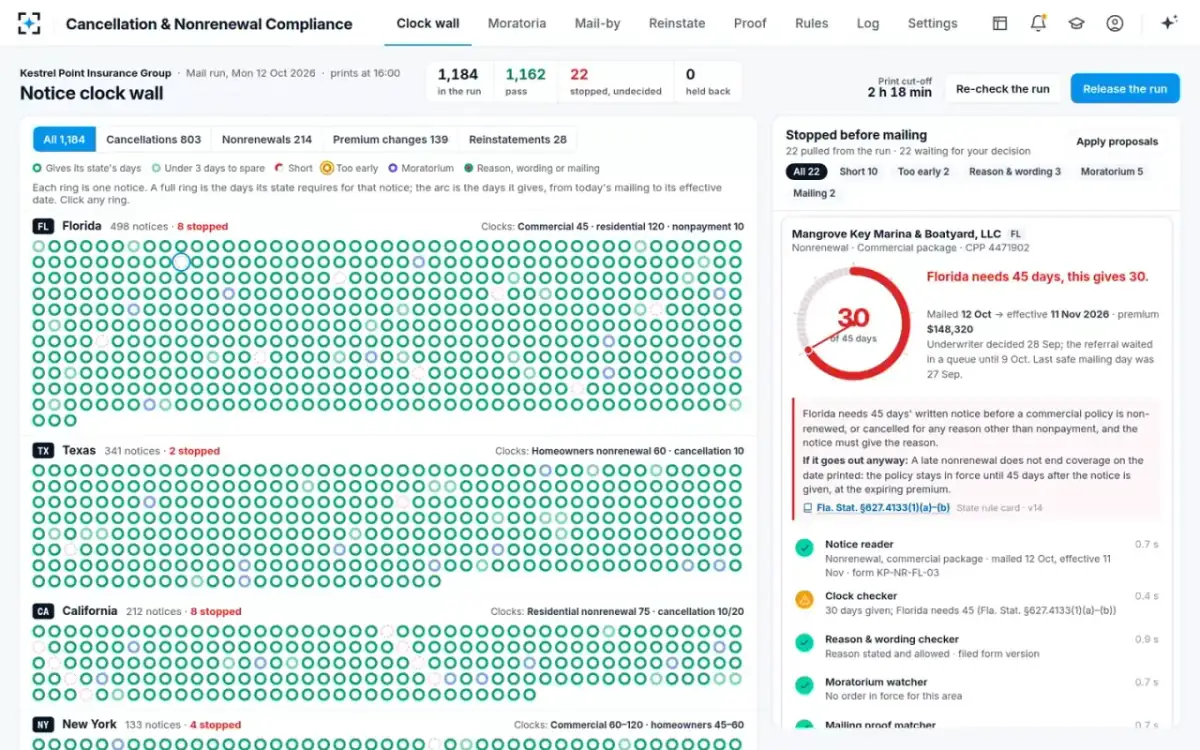
Cancellation & Nonrenewal Compliance measures the rule on every notice in the run
Signature three: the mailroom's receipt, kept for the exam
The receipt is the part that is lost most easily, because it is produced after the notice leaves the building and filed by people who never saw the decision. New York makes proof of mailing the legal test of notice: proof that a cancellation or nonrenewal notice, or its reasons, was mailed to the named insured at the address in the policy “shall be sufficient proof of the giving of notice and the giving of reasons required by this section”. The converse is what the regulator enforced in 2025, when it fined AIG Property Casualty Insurance Company $75,000 for, among other failures, having “failed to maintain proof of mailing of notice of the nonrenewal to the named insured”.
North Carolina's examiners found the same gap at Titan Indemnity Company in 2017, where the company could not produce satisfactory proof of mailing for 119 cancelled policies (North Carolina DOI; the case sits with the other enforcement actions in improper cancellation notices), and directed the company to keep proof bearing the Postal Service's date stamp, or similar proof of mailing. Which postal receipt proves that a particular notice reached a particular address, and which only counts envelopes, is set out in certificate of mailing vs certified mail.
How do examiners test an underwriting cancellation?
They test the three signatures separately, and usually from a data file before they open a single letter. The NAIC Market Regulation Handbook's review procedures for cancellations (2017 edition) direct examiners to “Determine if the reason for cancellation/nonrenewal or declination was valid according to policy provisions and state law”, and suggest an automated first pass: take a file of every cancellation and nonrenewal with the date the notice was generated or mailed and its effective date, compute the days between them, and then “Request documentation that the notice was mailed on the date reported by the regulated entity.”
That procedure tells a carrier what its own pre-mailing check should look like. The days are a calculation; the reason is a reading against a list; the mailing date is a document. A state then decides whether the errors amount to a finding: North Carolina's examiners allowed a 5 percent error rate in areas such as these, measured at 95% confidence (North Carolina DOI; how such samples are drawn and scored is in the transaction quality audit checklist), so a handful of short notices in a sample of fifty is enough.
How Cancellation & Nonrenewal Compliance checks each part of an underwriting cancellation before it prints
Agent
Notice readerReads the notice and its transaction: type, line, reason, mailing and effective dates, policy age, addressees, form number and edition, citing the page for each field.
Never: guesses a date; a missing or unreadable date stops the notice
Agent
Reason and wording checkerTests the reason against the grounds the state allows at that policy age and for specificity; checks required wording and the filed form edition.
Never: rewrites an underwriter's reason; it suggests
Agent
Clock checkerCounts days from mailing to the effective date against the state's minimum, and maximum where there is a window, and proposes the earliest compliant date.
Never: moves a date
Agent
Mailing proof matcherChecks the agent and every mortgagee or loss payee are on the copy list and the address has not come back; after the run, matches each notice to a postal receipt and scan.
Never: marks a notice mailed without a postal receipt
A person decides
Cancellation lead, with compliance co-signingDecides each stopped notice: re-date, hold, fix, return to the underwriter, or release unchanged. A moved date or an unchanged release needs compliance's signature.
Why do insurance companies cancel policies? Mostly for nonpayment
Most cancellations are for nonpayment, and underwriting cancellations are the smaller group that carries most of the legal risk. State regulators' Market Conduct Annual Statement data for homeowners policies show the scale: insurers reported 5,819,825 homeowners cancellations for nonpayment nationwide in 2024 (NAIC MCAS homeowners report; where those begin, in unmatched payments, is the subject of premium suspense). The same NAIC report notes that company-initiated nonrenewals, which had run at 10% to 25% of the nonpayment cancellation rate, “in 2024 they averaged 25% to nearly 50% of nonpayment cancellation rates”. New York's data are not collected in that set, so the national figures leave it out.
Complaints follow the same shape. In our count of the Texas Department of Insurance's open complaint data, 926 of the 22,564 complaints closed in 2025 cited cancellation as a reason (4.1%), and 246 cited nonrenewal (1.1%); a complaint can carry more than one reason. Nonpayment notices are many and simple. Underwriting notices are few, and each one asks the carrier to defend a judgement in writing.
One stopped notice, three signatures: what happened in the sample run
On the sample run, the three signatures came apart in a way that is common on real desks. Leon Prescott, a commercial property underwriter, decided on 28 September not to renew Mangrove Key Marina & Boatyard's commercial package, premium $148,320, for the water-intrusion reason quoted above. The reason passed. The referral then waited in a queue until 9 October, the notice was dated for mailing on 12 October with an effective date of 11 November, and the clock checker measured 30 days against Florida's 45. The last safe mailing day had been 27 September, the day before the decision.
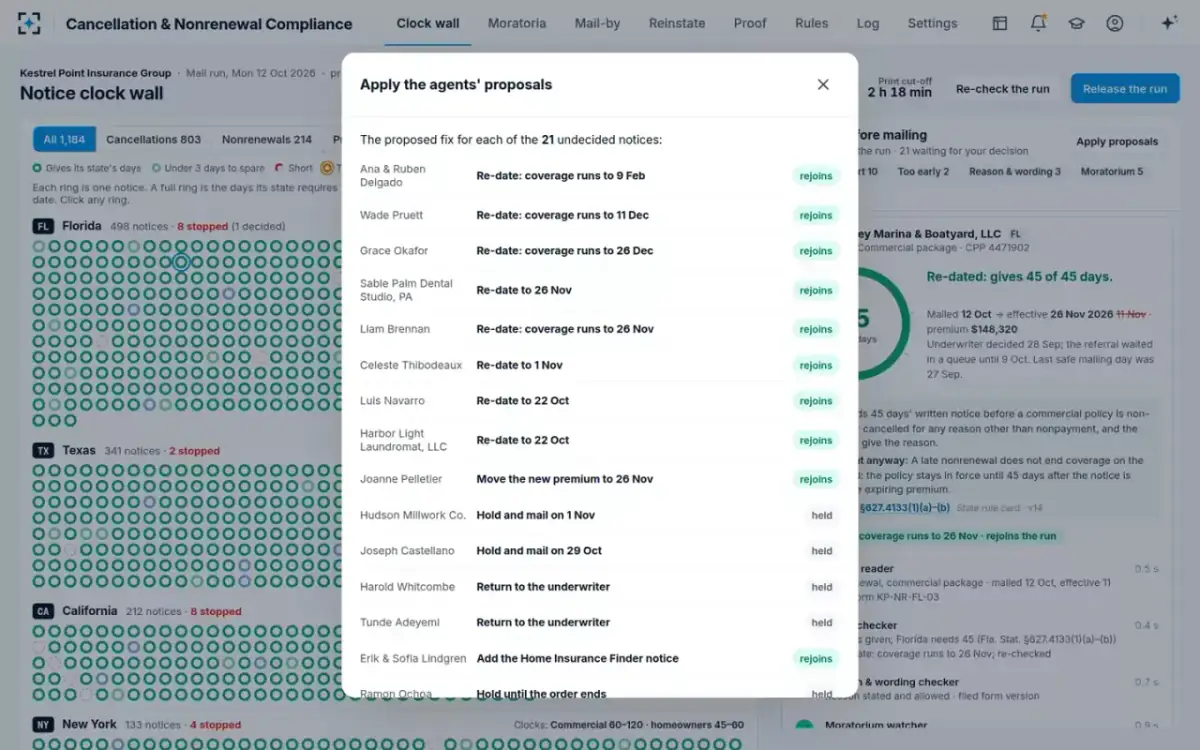
The cancellation lead, Dana Whitfield, re-dated the notice to an effective date of 26 November so it still mailed that day with 45 days' notice. Because an effective date moved, compliance co-signed. The cost was the extension Florida would have imposed anyway: 15 more days of cover at the expiring premium, $6,095.34. Elsewhere in the run, two notices stopped on their reasons were proposed for return to their underwriters, which is the right destination for a reason that fails: back to the person who owns it.
The proposals for the rest of the run, including two reasons sent back
Before an underwriting cancellation leaves the building
- Name the ground, not the category
Match the reason to a ground on the state's list for this policy's age; “underwriting reasons” alone is not one.
- State the facts the ground rests on
Incident, date, amount, source. Texas asks for the source of the information relied on; Illinois examiners faulted a claim number with no date of loss.
- Count the days from the mailing date
Florida 45 for commercial, 120 for residential, 20 in the first 60 days; a short Florida notice extends cover at the same premium.
- Copy everyone the law names
The agent or broker, and every mortgagee or loss payee the policy names, before the notice prints.
- Keep a receipt that names the address
A postal receipt for this piece to the address shown in the policy, filed where an examiner can ask for it by policy number.
To see the clock, the reason and the receipt checked together on a run of your own notices, start from Cancellation & Nonrenewal Compliance; the anatomy of a notice that passes all three is set out line by line in the notice of nonrenewal, annotated.
Questions people ask
Can an insurance company cancel my policy mid-term for underwriting reasons?
Yes, but after the first 60 days only on a ground the state lists. In Florida that means a material misstatement, nonpayment, a failure to meet underwriting requirements within the first 60 days, a substantial change in the risk, or cancelling a whole class of insureds; New York and California have similar short lists. A cancellation on any other ground is not effective, and Texas says so expressly.
How much notice do I get when insurance is cancelled for underwriting reasons?
It depends on the state, the line and the policy's age. Florida requires 45 days for commercial property and casualty policies, 20 in the first 60 days, and 120 days for residential property; Texas makes a personal-lines cancellation effective no earlier than the 10th day after the notice is mailed. New York commercial policies need 15 days after the first 60 days and 20 before.
Does a cancellation for underwriting reasons letter have to give the reason?
Yes, in each of the four states this guide covers, and it must be specific. Texas requires the precise incident, circumstance or risk factors and the source of the information; California requires the ground relied on and the specific supporting information. An Illinois exam faulted notices that cited “claims experience” without a date of loss.
Is cancellation for underwriting reasons the same as nonrenewal?
No. A cancellation ends cover before the policy's expiry date; a nonrenewal ends it at expiry. States restrict cancellations far more tightly, which is why many carriers wait for the renewal date and send a nonrenewal instead, with its own notice period, such as 60 days in Texas and 45 to 60 days for New York personal lines.
Does my agent get a copy of the cancellation notice?
Usually, and some states set a deadline. New York requires a copy or summary of every personal-lines cancellation or nonrenewal notice to go to the insured's authorized agent or broker within seven days of mailing to the named insured, and Florida's auto statute requires the notice to go to the agent as well as the insured.
What happens if the cancellation notice is wrong?
Usually the policy stays in force. Texas gives an improper cancellation no effect, New York treats a notice missing a required provision as no notice, and Florida extends cover on a short notice until 45 days after it is given, at the same premium. The carrier then carries the risk it meant to shed, and the notice becomes an exam finding.