New York's insurance non renewal notice requirements depend on the line. For personal lines (private passenger auto, homeowners on up to four dwelling units, and personal liability), Insurance Law §3425 requires the insurer to mail or deliver a nonrenewal or conditional renewal notice at least 45 but not more than 60 days before the end of the policy period, to the named insured at the address in the policy, stating the specific reasons, with a copy to the agent or broker within seven days; if it does not, the insured may renew by paying the renewal premium. For commercial lines, §3426 sets a window of 60 to 120 days before expiry, sends the notice to the first-named insured and the agent or broker, and requires the specific reasons, the amount of any premium increase and a line on the availability of loss information. Botminds' Cancellation & Nonrenewal Compliance checks every New York notice against those rules before it is mailed; this guide shows how to measure any such check by replaying last quarter's notices, whose outcome you already know.
The rules and fines below are quoted from New York's statutes and the Department of Financial Services' published disciplinary actions. Product examples come from a fictional sample carrier, Kestrel Point Insurance Group, which mailed 133 New York notices in its run of 12 October 2026.
New York's notice rules in four numbers
45–60days
before the end of the policy period: the personal-lines window for a nonrenewal or conditional renewal
60–120days
before expiry: the commercial window (30 to 120 for excess liability and jumbo risks)
7days
to send the agent or broker a copy of a personal-lines notice
2%
cap on private passenger auto nonrenewals per rating territory each calendar year
What are the insurance non renewal notice requirements in New York?
They are two statutes with different readers. Section 3425 protects households: its covered policies are auto insurance on a vehicle used mainly for non-business purposes with a natural person as named insured, and personal lines such as homeowners on residential property of up to four dwelling units, personal property and personal liability. Section 3426 covers commercial risk, professional liability and public entity insurance, and expressly excludes policies that §3425 already governs, along with workers' compensation, surety, excess line policies and several others.
Both statutes do the same three things in different measures. They set a window in days before expiry, they require the reason to be stated specifically, and they decide what happens when the insurer misses: under §3425 the named insured “shall be entitled to renew the policy upon timely payment of the premium billed to the insured for the renewal”; under §3426 cover continues on the expiring terms, for 60 days after a late notice given before expiry, or “for another required policy period” if the late notice comes on or after the expiration date.
New York insurance law 3425: personal lines, 45 to 60 days and a three-year promise
Section 3425's window is narrow: 15 days, between the 60th and the 45th day before the end of the policy period. The notice must state the specific reason or reasons, or be accompanied by them, and a copy or summary must reach the insured's authorized agent or broker within seven days of mailing to the named insured. Missing the agent's copy does not by itself invalidate the notice; missing any other required provision does, because “No notice of cancellation, reduction of limits, substitution of policy form, elimination of coverages, conditioned renewal or of intention not to renew” that lacks a required provision is effective.
Behind the window sits a promise that shapes every homeowners nonrenewal. For personal lines other than auto, the “required policy period” is three years from first issue or voluntary renewal, and a nonrenewal or conditional renewal may not take effect during it “unless it is based upon a ground for which the policy could have been cancelled”. In the first three years, then, a homeowners nonrenewal in New York needs a cancellation ground: nonpayment, fraud or material misrepresentation, a crime that increases the hazard, wilful or reckless acts, a physical change making the property uninsurable, or a finding by the superintendent. For private passenger auto, the limit is a count instead: nonrenewals and conditional renewals that reduce limits or drop coverages are capped each calendar year at two percent of covered policies in each rating territory, with exceptions.
Proof is the last element. Proof of mailing to the named insured at the address in the policy is sufficient proof that notice was given, which is why a missing receipt was one of three failures in the 2025 AIG order below. A replay that cannot find the receipt for a notice has found a failed notice.
New York insurance law section 3426: commercial lines, 60 to 120 days and the loss-information line
Section 3426 applies a wider window with a firm far end. A commercial nonrenewal or conditional renewal must be mailed or delivered no fewer than 60 and no more than 120 days before expiry; for an excess liability policy or a jumbo risk, no fewer than 30. Both the first-named insured and the authorized agent or broker must receive it. The notice must state the specific reasons, give the amount of any premium increase or, where the amount cannot yet be known, a reasonable estimate within the range regulation allows, describe any other changes in plain terms, and tell the insured and the broker that loss information is available on written request.
Two further rules matter for a replay. Every commercial insurer must keep an account of each notice that missed these requirements, recording the expiration date, the date notice should have been sent, the date it was sent, the policy number and the insured's name and address, available to the superintendent on request. And a blanket nonrenewal of more than one percent of a market within six months needs a withdrawal plan filed with the superintendent at least 45 days before the notices go out. Under §3426(i), a notice that leaves out a required provision is not an effective notice.
New York's notice windows, drawn back from expiry
- Too early140–61 days
- Window60–45
- Too late44–0
- Too early140–121
- Window120–60 days
- Too late59–0 days
- Too early140–121
- Window120–30 days
- Late29–0
New York State conditional renewal notice requirements
A conditional renewal is an offer to renew on worse terms, and New York treats it as a notice with the same window and content as a nonrenewal. Under §3425 it is a renewal conditioned on a change of limits or the elimination of any coverage, mailed 45 to 60 days ahead. Under §3426 it is a renewal conditioned on a change of limits, a change in type of coverage, a reduction of coverage, a higher deductible, an added exclusion, or a premium increase of more than ten percent, not counting increases from added exposure units, experience or loss rating, retrospective rating or audit. Which changes trigger it, and what a conditional renewal notice should say, is set out in the conditional renewal notice sample.
Why replay last quarter's New York notices?
Because a notice check is only as good as what it would have caught on notices you have already mailed. A replay takes every New York nonrenewal and conditional renewal mailed in the last quarter, runs the six tests below on each, and compares the result with what you already know: which notices drew complaints, which were re-sent, which policies stayed on the books past their intended end. A check that flags nothing on a quarter that produced re-sent notices is not working, and one that flags a third of a clean quarter will be ignored.
It also anticipates the examiner. The NAIC Market Regulation Handbook (2017 edition) suggests examiners begin with a file of every cancellation and nonrenewal, compute the days between mailing and the effective date, and send the company a list of every notice that appears to miss the state's rules, for it to explain (NAIC Market Regulation Handbook; why examiners test every notice rather than a sample is in 100% inspection vs sampling). A replay is that same report, produced by the carrier first. And for commercial lines it is close to what §3426 already requires the carrier to keep: an account of every notice that missed.
What New York fined insurers for over notices, 2023 to 2026
The orders name the tests. AIG Property Casualty's $75,000 stipulation found that it “failed to send nonrenewal notices to insureds within forty five to sixty days in advance of the expiration of the policies” and failed to keep proof of mailing, along with nonpayment notices not sent before terminating at renewal. New South's $25,000 was for conditional renewal notices never issued. Tokio Marine's notice findings ran from windows to agents' copies, missing reasons, missing premium increases, missing loss-information lines and the records of non-compliant notices. Five orders concerned the auto nonrenewal cap, which no notice-by-notice check can see. Each failure maps to one of the tests below.
Six tests for every mailed New York notice
Each test reads one field or document and compares it with one statutory requirement, so its result can be checked by hand on a sample. Run them in this order: a notice that fails the window rarely needs its wording read.
The replay, test by test
| Test | What to pull from the file | Passes when | Statute |
|---|---|---|---|
| 1. Window | Mailing date, expiry date, line, and excess or jumbo status | Personal: 45 to 60 days before the end of the policy period. Commercial: 60 to 120 (30 to 120 excess or jumbo) | §3425(d)(1); §3426(e)(3) |
| 2. Ground in the required policy period | First issue or last voluntary renewal date; stated reason | A personal-lines (non-auto) notice inside the three-year period rests on a cancellation ground | §3425(a)(7), (e) |
| 3. Specific reason | The reason text as mailed | Names the facts, not a category such as “underwriting” | §3425(d)(1); §3426(e)(2), (h) |
| 4. Content of a conditional renewal | Premium change and coverage changes; the notice text | States the premium increase or a permitted estimate and describes each change; commercial notices add the loss-information line | §3426(e)(2), (g) |
| 5. Copies | Copy list and dates sent | Personal: agent or broker within 7 days. Commercial: first-named insured and agent or broker | §3425(h)(3); §3426(e)(1) |
| 6. Proof of mailing | Postal receipt naming the address in the policy | A receipt exists for this notice to this address, dated on the mailing date | §3425(h)(1) |
Test 3 is the one most often scored generously by the people who wrote the notices. A replay should score it blind: a reviewer who did not write the notice reads the reason and asks whether the insured could check it. To take an invented illustration, “loss history” fails; two water losses on stated dates with the amount paid passes.
What a 3426 notice form must carry, field by field
Section 3426 prescribes what a commercial notice must contain rather than a single form, and regulation sets the permitted range of a premium estimate, which may not exceed five percent of the actual amount, and the methods an insurer may use. Whatever template a carrier files, a replay should find these fields on every notice: the first-named insured and the address shown on the policy; the policy number and expiry date; whether the notice is a nonrenewal or a conditional renewal; the specific reason or reasons; for a conditional renewal, each condition and the amount of any premium increase or the permitted estimate; the availability of loss information; and, for the replay's own sake, the mailing date. A copy goes to the authorized agent or broker.
Where an insurer cannot yet state its renewal terms, §3426 allows an alternative renewal notice: a timely first notice saying the policy may not be renewed on the same terms, followed by a second notice with the terms, with cover continuing on the expiring terms until the later of expiry or 60 days after the second notice. The replay treats the pair as one notice and tests both.
Running a New York replay in a week
- Pull the quarter
Every New York nonrenewal, conditional renewal and alternative renewal notice mailed, with line, mailing date, expiry date and first-issue date.
- Attach the evidence
The notice as mailed, the copy list and the postal receipt for each. A notice without its receipt goes on the list at once.
- Run tests 1 and 2 by calculation
Windows and the three-year period are arithmetic; they need no reading.
- Score tests 3 and 4 blind
A reviewer who did not write the notice reads the reason and the conditions as the insured would.
- Count the auto cap separately
Nonrenewals and qualifying conditional renewals per rating territory against two percent of last year-end covered policies.
- Compare with what you know
Complaints, re-sent notices, policies kept on past their intended end. Each should appear as a failed test.
- Keep the misses
For commercial lines, the result is the account §3426 requires of every notice that missed.
What Cancellation & Nonrenewal Compliance found on a sample New York run
The sample carrier's run of 12 October held 133 New York notices, and the agents stopped four. One shows why the far end of the window matters. Hudson Millwork Co.'s conditional renewal on commercial package CPP 4490336, premium $61,450, expires on 1 March 2027 and had been queued with the week's renewals, 140 days ahead. The clock checker stopped it as too early and proposed holding it until 1 November, the first day inside the 120-day window; the last day inside it is 31 December.
Cancellation & Nonrenewal Compliance stops a New York conditional renewal mailed too early
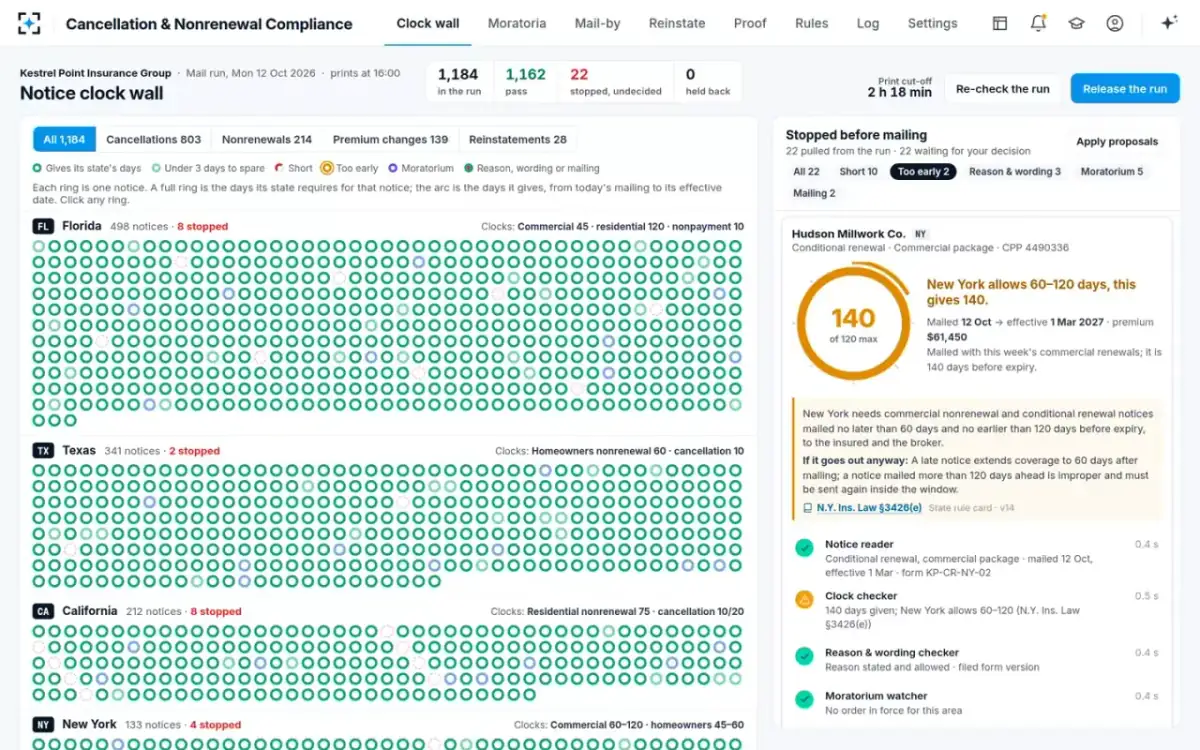
A replay of the same carrier's previous quarter would ask the reverse question: how many New York notices went out at 121 days or more, or at 59 or fewer, and what happened to each policy. Notices mailed too early are the easiest failure to miss by hand, because a reviewer checking for lateness sees a generous date and moves on.
The window is New York's distinctive rule; every other requirement on this page has an equivalent in other states. For the clocks in Florida, Texas and California beside New York's, see insurance cancellation notice requirements by state, and for what regulators have fined elsewhere, improper cancellation notices, case by case. To run the six tests on your own New York notices before they are mailed, start from Cancellation & Nonrenewal Compliance.
Questions people ask
How much notice is required for nonrenewal of a homeowners policy in New York?
At least 45 and no more than 60 days before the end of the policy period, under Insurance Law §3425(d)(1), with the specific reasons stated. In the first three years of a homeowners policy, a nonrenewal must also rest on a ground for which the policy could have been cancelled.
What happens if a New York nonrenewal notice is late?
For personal lines, the named insured is entitled to renew by paying the renewal premium. For commercial lines, cover continues on the expiring terms at the lower of the current or prior rates for 60 days after a late notice given before expiry, or for another required policy period if the late notice comes on or after expiry.
Does New York require nonrenewal notices to be sent by certified mail?
Section 3425 does not require it in the text we read: proof of mailing to the named insured at the address shown in the policy is sufficient proof that notice was given. That makes the postal receipt the critical document, and AIG Property Casualty's 2025 fine included failing to keep it.
Do agents and brokers get a copy of New York nonrenewal notices?
Yes. For personal lines, a copy or summary must go to the insured's authorized agent or broker within seven days of mailing to the insured, though missing it does not invalidate the notice. For commercial lines, the notice itself must be mailed or delivered to both the first-named insured and the agent or broker.
What is New York's two percent rule for auto nonrenewals?
Section 3425(f) limits each insurer's private passenger auto nonrenewals, and conditional renewals that reduce limits or drop coverages, to two percent of its covered policies in force at the previous year-end in each rating territory, with exceptions: an insurer earns extra nonrenewals by writing new policies, and §3425(m) lifts the cap for new auto policies voluntarily written from 30 June 2026. DFS issued consent orders against five insurers or groups in 2025 and 2026 for exceeding it.
Is a conditional renewal notice required for a premium increase in New York?
For commercial lines, yes, when the increase exceeds ten percent, excluding increases from added exposure units, experience or loss rating, retrospective rating or audit, and the notice must state the amount. Personal-lines conditional renewal under §3425 is triggered by a change of limits or the elimination of coverage.