The Florida statute behind the 45-day notice of nonrenewal is §627.4133(1)(a): an insurer writing property, casualty, or workers' compensation and employer's liability insurance, other than private passenger auto, must give the first-named insured at least 45 days' advance written notice of nonrenewal or of the renewal premium, and a nonrenewal notice must state the reasons. If the notice is short, the policy does not end on the date printed: under §627.4133(1)(c) cover remains in effect until 45 days after the notice is given, or until replacement cover starts, at the same premium. Residential property follows a longer 120-day rule in §627.4133(2), and auto a separate 45-day rule in §627.728. Botminds' Cancellation & Nonrenewal Compliance counts every Florida notice's days against the right rule before the print run, and shows what a short notice would cost in extra days of cover; this guide works that cost through on one policy.
The policy is from a fictional sample carrier, Kestrel Point Insurance Group, and its Florida notices in the mail run of 12 October 2026; the arithmetic on it is ours. The statute is quoted from the Florida Legislature's 2026 text.
One Florida commercial nonrenewal: the decision, the queue, and the 15 days the statute added
- Referral in a queue11 d
- Drafted3 d
- Notice as printed30 d
- Cover runs on15 d
- Notice: 45 days45 d
What does Florida statute 627.4133 require for a 45-day nonrenewal notice?
It requires written notice to the first-named insured at least 45 days before expiry, stating why. The statute's words are that the insurer “shall give the first-named insured at least 45 days' advance written notice of nonrenewal or of the renewal premium”, and that if the policy is not to be renewed, the notice must give the reason or reasons. The same 45 days therefore apply to two different notices: a nonrenewal, and the notice of the renewal premium on a policy the insurer will renew.
Three details narrow or widen the rule. It covers workers' compensation and employer's liability, property, and casualty insurance, but not mortgage guaranty, surety or marine, and not motor vehicle insurance subject to §627.728. It applies “only if the insured has furnished all of the necessary information so as to enable the insurer to develop the renewal premium prior to the expiration date”, so a commercial insured who never returns a renewal application cannot rely on it for the premium notice. And it sits beside a separate rule for cancellations of the same policies: 45 days' written notice with the reasons, except ten days for nonpayment and 20 days in the first 60 days.
What happens if a Florida nonrenewal notice is late? Coverage runs on
The policy stays in force. Paragraph (1)(c) says that if the insurer fails to give the 45-day or 20-day notice, the coverage remains in effect until 45 days after the notice is given or until the effective date of replacement coverage the named insured obtains, whichever comes first. The extension is measured from the day notice is given, not from the date printed on it: a notice that gave 30 days adds 15, one that gave a single day adds 44.
The premium does not change for the extra days. The statute says “The premium for the coverage shall remain the same during any such extension period”, with one exception that cuts the other way: on a failed nonrenewal notice, if the rate filing then in effect would have produced a lower premium, the extension is priced on the later filing. A carrier that nonrenews because the risk is underpriced therefore keeps it, at the price it has just decided is too low, for every day the notice was short.
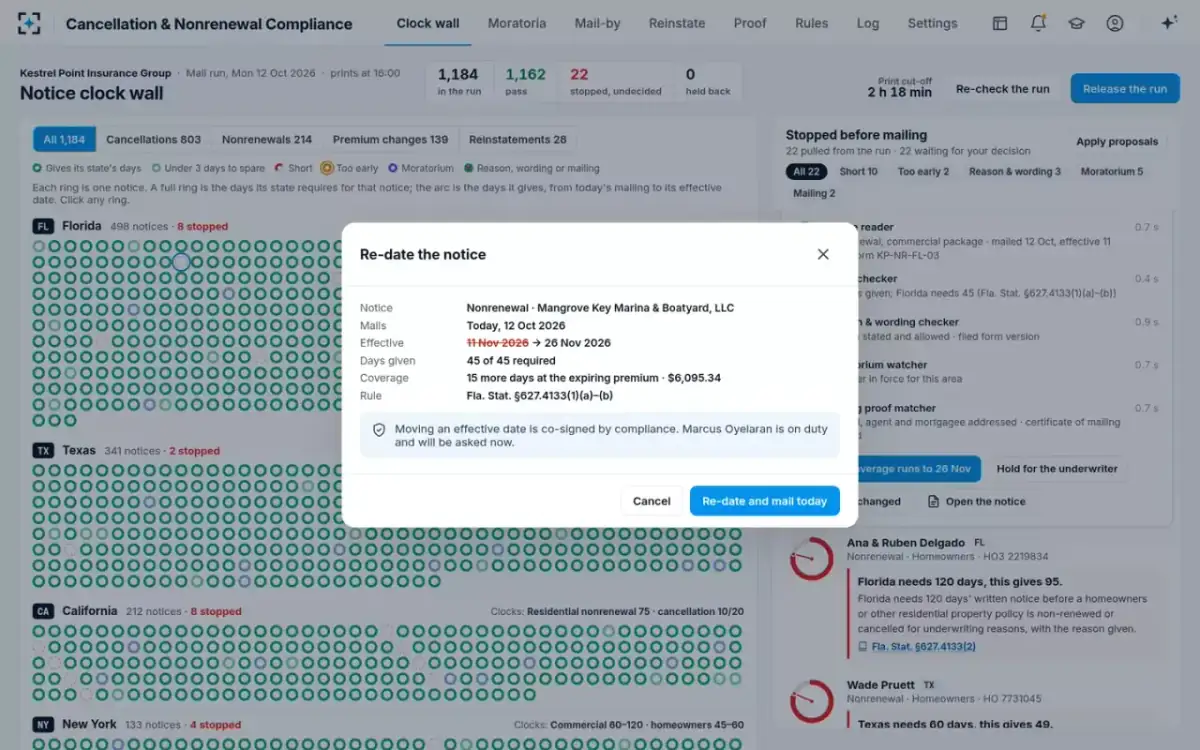
That is why the sample carrier re-dated rather than mailed. The notice to Mangrove Key Marina & Boatyard, on a commercial package with an annual premium of $148,320, gave 30 days. Mailed as printed, the insured would have read 11 November while the law said 26 November. Re-dated to 26 November, the notice told the insured the true date, cost nothing the statute would not have imposed anyway, and still went out that afternoon. Because an effective date moved, the solution required the compliance analyst's co-signature.
Re-dating a short Florida nonrenewal in Cancellation & Nonrenewal Compliance, with the extension priced
The price of a short notice, per policy
The extension has a price that can be computed before anyone decides, and it has two parts. The first is the premium the carrier earns for the extra days at the expiring rate, which is income. The second is the losses the risk produces in those days, which the carrier decided it did not want to carry; for a risk nonrenewed for its loss record, that second term can exceed the first.
What 15 extra days of cover are worth to the carrier, on the sample policy
Premium earned in the extension
expiring annual premium × extension days ÷ 365
$148,320 × 15 ÷ 365 = $6,095.34
priced by the statute: the premium stays the same
Losses the risk produces in the extension
the account's recent losses per day × extension days
$412,600 over 24 months (730 days) is about $565 a day; × 15 ≈ $8,478
the underwriter's own view of the risk
On those illustrative numbers, the 15 extra days cost the carrier roughly $2,400 net, about $8,478 of expected losses against $6,095 of premium, and that is before any single large loss in the extension. The method generalises: days short, times the daily premium, set against the account's expected losses over the same days. A carrier can price its whole book of late decisions this way, because every input is in the policy system and the notice.
On a $148,320 policy, every day short adds about $406 of cover at the old premium
The renewal premium notice: the same 45 days for a renewal that costs more
The 45-day rule is also a premium rule, and it catches more notices than nonrenewals do. Because §627.4133(1)(a) requires 45 days' notice of the renewal premium, and (1)(c) extends cover at the same premium when the 45-day notice is not given, a renewal whose premium notice goes out 30 days ahead does not take its new premium on the renewal date. The expiring premium runs on until 45 days after the notice is given. On a book renewing with rate increases, a late premium notice is the same arithmetic as a late nonrenewal, applied to the difference between the old and new premium.
The sample run had one such case among its proposals: a renewal premium notice that was short, for which the agents proposed moving the new premium's start to 26 November, 45 days after that day's mailing, rather than mailing a notice that announced a premium the statute would not yet allow. For residential property the renewal premium notice is also 45 days, and §627.4133(7) adds content: every residential renewal premium notice must show the dollar amounts recouped for assessments by the Florida Hurricane Catastrophe Fund, Citizens Property Insurance Corporation and the Florida Insurance Guaranty Association, each named next to its amount, and the dollar amount of any increase due to an approved rate increase and the total due to coverage changes.
Florida nonrenewal notice requirements for homeowners: 120 days, and a longer extension
Residential property is the expensive case. For any personal lines or commercial residential property policy, including homeowners, condominium and apartment policies, §627.4133(2)(b) requires written notice of nonrenewal, cancellation or termination at least 120 days before it takes effect, with the reason, except ten days for nonpayment and 20 days in the first 60 days. The renewal premium notice for the same policies is 45 days.
The extension on a short residential notice is also longer. If the insurer fails to give the required notice, other than the ten-day nonpayment notice, cover stays in effect until replacement cover starts or “until the expiration of a period of days after the notice is given equal to the required notice period”, whichever comes first. A residential nonrenewal that gives 95 days therefore runs 120 days from the day it was given, not 95. On the sample run, Ana and Ruben Delgado's homeowners nonrenewal gave 95 of 120 days; the proposal was to re-date it so cover runs to 9 February, 120 days from the 12 October mailing.
Florida adds conditions after storms. A residential cancellation or nonrenewal due to take effect during a hurricane is extended to the end of the hurricane, and a damaged home cannot be cancelled or nonrenewed until it is repaired, within limits; both are covered in cancellation after a hurricane under Florida law.
Commercial, residential and auto: three Florida rules for a late notice
Florida runs three different consequences for a short notice, and a notice checker that applies the commercial rule to all of them will misprice two. Auto is the strictest on content: under §627.728(4) a private passenger auto policy may be nonrenewed only on 45 days' notice to the first-named insured at the address in the policy and to the agent at the agent's business address, with the reasons, and “Unless a written explanation for refusal to renew accompanies the notice of intention not to renew, the policy shall remain in full force and effect.”
A short Florida notice, commercial against residential
Commercial property and casualty: 45 days, to the first-named insured, with the reasons. §627.4133(1)(a)
Residential property: 120 days, with the reason; 45 days for the renewal premium notice. §627.4133(2)(a)–(b)
Commercial property and casualty: 45 days with reasons; 10 for nonpayment; 20 in the first 60 days. §627.4133(1)(b)
Residential property: 120 days; 10 for nonpayment; 20 in the first 60 days. §627.4133(2)(b)
Commercial property and casualty: Cover runs until 45 days after notice is given, or until replacement cover. §627.4133(1)(c)
Residential property: Cover runs until the full required period after notice is given, or until replacement cover; not for the 10-day notice. §627.4133(2)(d)
Commercial property and casualty: The same, unless the current rate filing would lower it on a failed nonrenewal notice
Residential property: The same, with the same exception
A transfer is not a nonrenewal in Florida. An insurer may move a policy at expiry to another insurer in the same group, and the transfer “constitutes a renewal of the policy and may not be treated as a cancellation or a nonrenewal”; it needs its own 45-day notice with the receiving insurer's financial rating, and residential transfers carry further conditions.
Florida non renewal notice insurance: what the policyholder should check
A policyholder holding a Florida nonrenewal notice can test it against four things the statute requires. The days: 45 for a commercial policy, 120 for a home, 45 for a private passenger auto policy, counted from when the notice was given. The reason: every one of these notices must state why. The addressee: the first-named insured, and for auto also the agent. And the date cover really ends: if the notice was short, cover continues for the statutory period after it was given, or until the new policy starts, at the same premium.
For a business, the practical step is the same as for a household: start replacement cover in time, because the extension ends the day replacement coverage takes effect. For an insurer, every one of those four checks is something a policyholder, an agent or an examiner can make from the notice alone, which is why the notice itself, not the decision behind it, is where most findings land. What a notice must carry line by line is annotated in the notice of nonrenewal, annotated.
Why Florida notices go out short: the decision, not the mailroom
A short notice is usually a late decision, and the mailroom is where it shows. On the sample policy the underwriter decided on 28 September, one day after the last safe mailing day for an 11 November expiry; no queue, however fast, could have produced a compliant notice for that date. The referral then spent 11 days waiting to be drafted, which turned a one-day problem into a 15-day one.
The fix is to make the last safe mailing day visible at the point of decision. For a commercial policy it is the expiry date minus 45 days, minus the carrier's own allowance for print and post; for residential it is expiry minus 120. Cancellation & Nonrenewal Compliance shows the underwriter that date for every nonrenewal still undecided and reminds them before it passes, and on the day's run it stops any notice whose clock is short, priced as above, for the cancellation lead to decide. The same check runs against Texas's 60 days and New York's windows; the four states side by side are in insurance cancellation notice requirements by state.
The sample run shows the scale on one day. Of 498 Florida notices, eight stopped, and the agents proposed re-dates for the short ones: the Delgado homeowners nonrenewal to 9 February, Mangrove Key Marina to 26 November, others to their earliest compliant dates. Each re-date was the lead's to make and compliance's to co-sign, which is the safeguard the requirement list in notice compliance software requirements argues for.
The Florida rule as Cancellation & Nonrenewal Compliance shows it, in the statute's own words
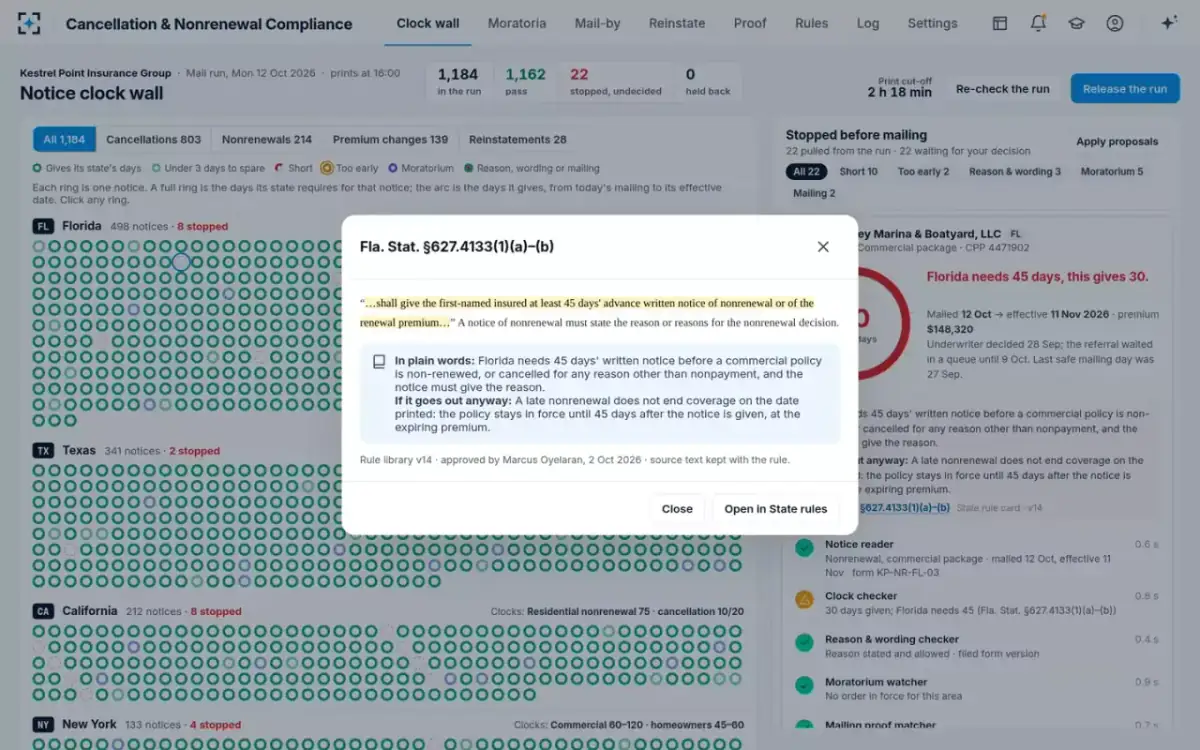
Before a Florida nonrenewal is mailed
- Pick the right rule
Commercial 45 days; residential property 120; private passenger auto 45 under §627.728, to the insured and the agent.
- Count from the mailing date, with your allowance
Add the days your print vendor and the post take; the statute measures the extension from when notice is given.
- State the reasons
Every Florida nonrenewal notice above must give them; an auto notice without a written explanation leaves the policy in force.
- Price a short notice before deciding
Days short × daily premium, against the risk's losses over the same days.
- Re-date rather than mail a false date
The insured should read the date cover actually ends; a moved date needs a second signature.
- Watch for storms
A residential nonrenewal effective during a hurricane is extended to the end of the hurricane.
The decision behind the notice, and who answers for its reason, is the subject of insurance cancelled for underwriting reasons. To see every Florida notice in a day's run measured and priced before it prints, start from Cancellation & Nonrenewal Compliance.
Questions people ask
Does Florida's 45-day nonrenewal notice apply to homeowners insurance?
No. Homeowners and other residential property policies need 120 days' written notice of nonrenewal under §627.4133(2)(b), with the reason. The 45-day period applies to the renewal premium notice on those policies, and to nonrenewals of commercial property, casualty and workers' compensation policies under §627.4133(1)(a).
How much notice is needed to nonrenew auto insurance in Florida?
At least 45 days, under §627.728(4), mailed or delivered to the first-named insured at the address in the policy and to the insurance agent at the agent's business address, with the reasons. Without a written explanation the policy stays in full force, and a nonrenewed policy ends when the insured's new auto liability policy takes effect.
Can the insurer charge more for the extra days if the notice is late?
No. The premium stays the same during the extension. On a failed nonrenewal notice, if the rate filing then in effect would have lowered the premium, the extension is priced on that later filing instead, so the insured can pay less but never more.
When does the extension end if the insured buys new insurance?
On the effective date of the replacement coverage, if that comes first. Under §627.4133(1)(c) cover runs until 45 days after the notice is given or until replacement coverage obtained by the named insured takes effect, whichever occurs first.
Does a Florida nonrenewal notice have to state a reason?
Yes. For commercial and other policies under §627.4133(1)(a), a notice that the policy will not be renewed must state the reason or reasons, and residential nonrenewals under §627.4133(2)(b) must include the reason. Florida also bars using a property claim resulting from an act of God as a cause for nonrenewal unless the insured failed to take reasonable steps the insurer requested to prevent recurrence.