Notice compliance software requirements, for an insurer's cancellation, nonrenewal and conditional renewal notices, come down to five jobs done before the print vendor takes the batch: count the days each notice gives against its state's minimum, and maximum where there is one; test the reason and required wording against the state's rule; confirm every party the law names is on the copy list; tie each notice to a postal receipt after mailing; and keep an account of every check an examiner can sample. Those jobs are hard because every state, line, notice type and policy age has its own rule, and a short notice is not a clerical slip: in Florida it keeps the policy in force at the old premium. Botminds' Cancellation & Nonrenewal Compliance does those five jobs with specialist agents and a person who decides every stopped notice, and its design starts from the requirement most lists leave out: what the software must never do on its own.
This guide is written for the compliance officer or policy services leader drafting that list. Each requirement is tied to a statute or exam procedure, linked where it appears; product examples come from a fictional sample carrier, Kestrel Point Insurance Group, and its mail run of 12 October 2026.
Cancellation & Nonrenewal Compliance, step by step, with the line each agent never crosses
Agent
Notice readerReads every queued notice and its transaction: type, line, reason, mailing and effective dates, policy age, addressees, form number and edition, citing the page for every field.
Never: guesses a date; a missing or unreadable one stops the notice
Agent
Clock checkerCounts days from mailing to the effective date against the state's minimum, and maximum where the state sets a window, for that notice type, line and policy age; proposes the earliest compliant date.
Never: moves a date; a person re-dates and compliance co-signs
Agent
Reason and wording checkerChecks the reason is allowed at that policy age and specific enough, the state's required wording is present, and the form is the filed edition.
Never: rewrites an underwriter's reason, or approves a form
Agent
Moratorium watcherReads regulators' bulletins and emergency orders nightly, maps the areas they name, holds notices in scope and notes those outside it.
Never: releases a held notice, or decides an ambiguous order; it asks compliance
Agent
Mailing proof matcherBefore the run, checks the agent and each mortgagee or loss payee is on the copy list and the address has not come back; after it, matches each notice to a postal receipt and scan.
Never: marks a notice mailed without a postal receipt
A person decides
Cancellation lead decides; compliance co-signsRe-date, hold, fix, return to the underwriter, or release unchanged. Nothing prints while any stopped notice is undecided.
What should notice compliance software do before the print cut-off?
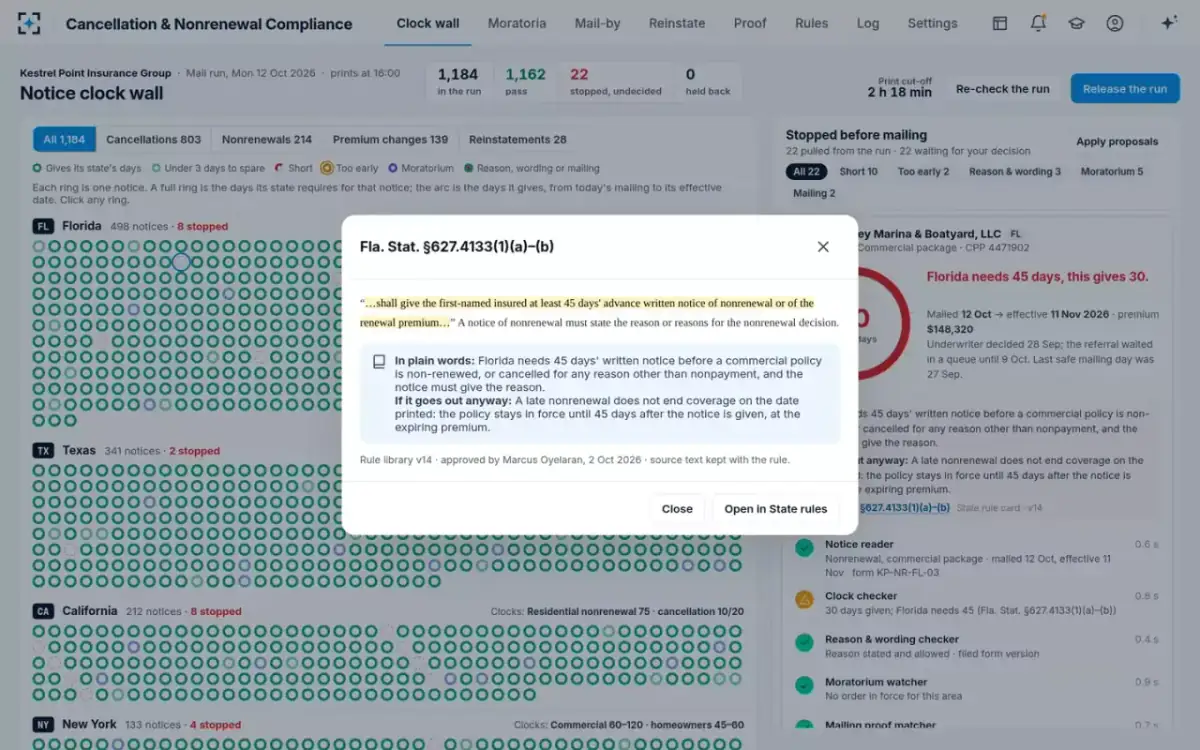
It should stop a non-compliant notice before it is mailed, explain in plain words why, and propose the fix, all inside the hours between the day's decisions and the print vendor's cut-off. Everything else follows from the timing. A defect found after mailing is no longer a draft to correct: in Florida a short 45-day or 20-day notice keeps the policy in force for 45 days from the day the notice was given, at the same premium (the Florida 45-day rule); in New York a personal-lines nonrenewal not mailed in time lets the insured renew simply by paying the renewal bill (New York's notice rules).
So the first requirement is placement. A checker that runs after the batch has gone, or samples one notice in twenty, is an audit tool; useful, but it finds problems the carrier must then live with. The sample carrier runs its checks 30 minutes before a 16:00 print cut-off on every notice in the run, 1,184 on 12 October, and holds the whole run while any stopped notice is undecided.
The negative requirements: what the agents must never do
The safety of notice software depends less on what it can do than on what it is not allowed to do. Four decisions in a cancellation workflow carry legal weight that no rule table can fully capture, and each belongs to a named person.
Moving an effective date. Re-dating a short notice is often the right answer, but it changes how long the carrier stays on the risk and how much premium it earns for the extra days. The sample carrier's software proposes the earliest compliant date; the cancellation lead re-dates and compliance co-signs. Rewriting a reason. The reason is the underwriter's statement of fact, and Texas requires it to name the incident and the source of the information behind it. Software that paraphrases it can change what the insurer is asserting; it should test the reason and send it back. Releasing a hold. Moratorium orders are written in an emergency and can leave lines, reasons and dates open to reading; the watcher holds, and a person releases. Marking a notice mailed. New York treats proof of mailing as enough to show the notice was given (N.Y. Ins. Law §3425), so a notice shown as mailed without a postal receipt is a gap disguised as a pass.
Write those four into the requirements as testable statements: the system cannot change an effective date, a reason text or a hold status without a named user's action, and cannot set a mailed status without a matched postal receipt. Then ask the vendor to show the attempt failing.
Insurance notice compliance requirements the software must encode
The rules the software checks are statutes, and the requirements list should name them rather than describe them. The table below sets out the requirement types that differ most between states, with one example of each, and what each asks of the software. It is a starting list for the four large states this solution's sample covers; a carrier's own list adds its states and lines.
Requirement types a notice checker must encode, with one statute behind each
| Requirement | Example in statute | What it asks of the software |
|---|---|---|
| Minimum days, by line, notice type and policy age | Florida: 45 days for commercial cancellation or nonrenewal, 10 for nonpayment, 20 in the first 60 days, 120 for residential property | Know the policy's age on the date the statute names, and pick the rule from all four keys |
| Maximum days, a window not a floor | New York: personal-lines nonrenewal 45 to 60 days before expiry; commercial 60 to 120 (30 to 120 for excess and jumbo risks) | Stop a notice that is too early as well as too late |
| Days added for mailing | California applies Code of Civil Procedure §1013(a) to mailed nonrenewal notices: five extra calendar days in state, ten if either end is outside it | Add the mailing days to the clock before testing it |
| What a late notice does | Texas commercial: cover runs to the 61st day after a late nonrenewal notice, earned pro rata at the previous year's rate | Show the consequence and its cost beside the stop |
| Reason content | Texas: the precise incident, circumstance or risk factor, and the source of the information | Test specificity, not just presence |
| Required wording | California residential nonrenewal: the Home Insurance Finder notice, the insurer's consumer-inquiry telephone number and the Department's review statement | Check the wording against the filed form edition |
| Who gets a copy, and when | New York personal lines: a copy or summary to the authorized agent or broker within seven days of mailing | Check the copy list before the run; check the copies went after it |
| Proof of mailing | New York: proof of mailing to the address shown in the policy is sufficient proof of notice | Match each notice to a postal receipt that names its address |
| An account of misses | New York commercial: a written or electronic account of every notice that was not compliant, with the date it should have gone and the date it went | Keep the misses, not only the passes |
| Counts across the year | New York private passenger auto: nonrenewals capped at two percent of covered policies per rating territory per calendar year | Count against a cap; a single notice can pass and still breach it |
Two rows are routinely missing from vendors' lists. The mailing-day row matters because California's 75-day nonrenewal clock is, since July 2022, subject to Code of Civil Procedure §1013(a), which extends a notice period served by mail by “five calendar days, upon service by mail, if the place of address and the place of mailing is within the State of California”. A checker that counts 75 days from the mailing date passes a notice five days short. The account-of-misses row matters because New York requires each commercial insurer to “maintain a written or electronic record of any notice not in compliance with such provisions”, with the expiration date, the date notice should have been sent and the date it was. Software that only shows what passed cannot produce that.
Clock rules: the edge cases a requirements list should name
Most failures in notice clocks are edge cases, and a requirements list should name them so a vendor demonstrates each. Policy age is measured on the date the statute names: Florida's auto rule asks whether the policy had been in force 60 days when the notice of cancellation was mailed or delivered, so a notice drafted on day 55 and mailed on day 62 falls under a different rule. A window rule needs both ends: New York's commercial rule is a minimum of 60 days and a maximum of 120, and a conditional renewal mailed with the week's renewals 140 days before expiry fails as surely as one mailed at 50. A mailing allowance should be explicit and visible. The sample carrier's setting is zero extra days, and a carrier that mails through a print vendor with a lag will want more.
The consequence of a short notice belongs on the same screen as the stop. In Texas a late commercial nonrenewal keeps cover in force for 61 days from the day the notice is delivered or mailed (Tex. Ins. Code §551.054), with the extra period's premium computed pro rata on the previous year's rate. The person deciding whether to re-date needs that cost in front of them, and the sample screens show it: the Florida nonrenewal re-dated on 12 October carried 15 more days of cover at the expiring premium, $6,095.34.
The statute behind a stop, one click from the notice
Insurance notice management software, or the policy system's own rules?
A policy administration system can generate notices and enforce basic day counts, and for one state and one line that may be enough. The case for a separate checker grows with states, lines and change. Every rule above is maintained in the policy system's configuration, released on its schedule and tested by its owners; a regulator's emergency order arrives overnight. The comparison below is how the sample carrier's compliance team set out the choice.
Notice rules inside the policy system, or a checker in front of the print run
Rules in the policy system: The day counts and forms configured when each product was built.
A separate checker before the run: Every notice in the run, against a rule library compliance owns, including maximum windows and mailing days.
Rules in the policy system: A configuration release, scheduled with the product team.
A separate checker before the run: A new rule version approved by compliance, in force for the next run.
Rules in the policy system: Rarely modelled; a manual hold list.
A separate checker before the run: Orders read nightly and notices in the named areas held for a person.
Rules in the policy system: Usually a free-text field and a form template.
A separate checker before the run: Reason tested for the ground and its specificity; required wording checked against the filed edition.
Rules in the policy system: Outside the system, with the print vendor.
A separate checker before the run: Each notice matched to a postal receipt and scan; gaps listed by policy.
Rules in the policy system: Does not see the whole run at once or show a decision to anyone.
A separate checker before the run: Another system to connect and run; its rules are only as good as compliance's library.
Is a cancellation notice tracking system enough?
Tracking is necessary but answers a later question. A cancellation notice tracking system records what was sent, when and to whom, and that is what an examiner asks for first; the NAIC Market Regulation Handbook (2017 edition) suggests examiners request a data file with “the policy number, the date the notice was generated/mailed and the effective date” and compute the days for every notice. A carrier that has the same file can find its own short notices in an afternoon.
What tracking cannot do is prevent the notice the regulator later fines. New York's 2023 consent order with Tokio Marine America Insurance Company, a $360,000 fine across several findings, included nonrenewal and conditional renewal notices that gave no specific reason (NY DFS, July 2023; the order is read case by case in improper cancellation notices); the notices were sent, tracked and wrong. Mid-Century Insurance Company's $78,000 fine in 2026 was for exceeding New York's two percent cap on private passenger auto nonrenewals for calendar year 2024, a breach no single notice reveals and only a running count across the year would (NY DFS, September 2026). The requirement is both: check before mailing, and track after it.
What belongs in a nonrenewal compliance policy?
A nonrenewal compliance policy is the carrier's written answer to who decides, who checks and who signs, and the software should enforce it rather than replace it. At minimum it names who may re-date a notice, who must co-sign a moved effective date or a stopped notice released unchanged, who approves a change to the rule library, what happens to the run while any stop is undecided, and how long receipts are kept. The sample carrier's answers sit in the solution's settings: the cancellation and reinstatement leads decide, the compliance analyst co-signs, the rule library is at version 14 approved on 2 October, and the run holds while any stop is open.
The policy, written as settings compliance approves
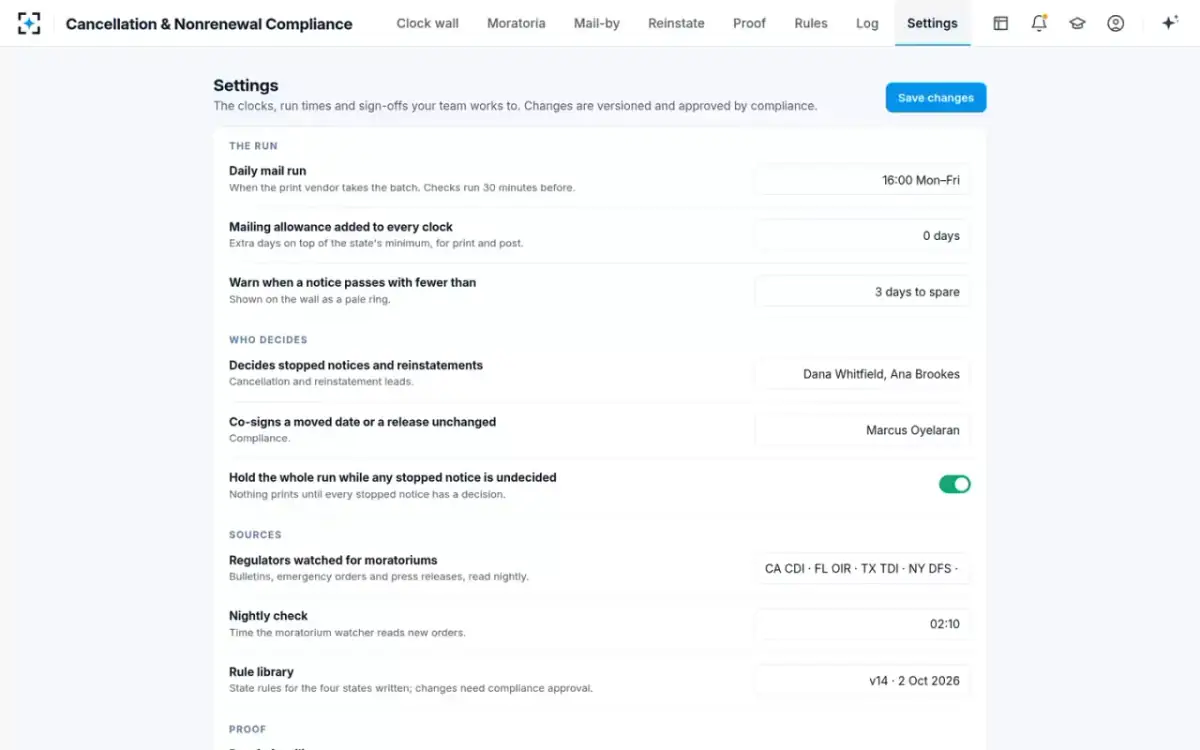
Write the policy before configuring anything. A requirement that compliance co-signs every moved date is a policy decision that the software makes unavoidable; it is not a feature to discover in a demonstration.
What a day of stops looks like, and who decides each
A requirements list should be tested against a realistic day, because the volume of exceptions decides how many people the process needs. On the sample carrier's run of 12 October, the agents checked 1,184 notices at 13:31 and stopped 22: ten short of their state's minimum, two mailed too early for a window rule, three for a reason or wording problem, five inside a moratorium area and two for a mailing problem. That left one cancellation lead with 22 decisions and two hours and eighteen minutes to the cut-off.
The agents' proposals did most of the reading. For the short notices the proposal was the earliest compliant date; for the New York conditional renewal mailed 140 days ahead, a hold until 1 November, the first day inside the 120-day window; for two notices stopped on their reasons, a return to the underwriter; for a homeowners nonrenewal missing the Home Insurance Finder notice, the notice added. The lead applied or changed each one. When every stop was decided, 13 notices rejoined the run and nine were held back, so 1,175 printed at 16:00 and nothing printed while a decision was open.
Those proportions are one sample day on fictional data, not a benchmark, but they show what to ask a vendor: how many exceptions a typical run will raise on your notices, how long each takes to decide, and what the screen shows the person deciding. A checker that stops two hundred notices a day for one lead to clear is a second backlog, not a control.
Where Cancellation & Nonrenewal Compliance fits, and where it does not
It fits a carrier or MGA that mails cancellation, nonrenewal, conditional renewal and premium-change notices every working day across several states, through a print vendor, and wants every notice checked before mailing with a person deciding each exception. Its agents read the notices and transactions the policy system already queues, so the policy system stays the system of record; the solution sits between the queue and the print vendor, and matches postal receipts back afterwards.
It does not decide whether to cancel or nonrenew; that remains underwriting's call, and the solution sends a weak reason back rather than improving it. It does not replace counsel: the rule library is written and approved by the carrier's compliance team, and the sample library covers four states. It is not the place to manage binding restrictions before a storm, which a moratorium ZIP-code map handles upstream. And it cannot make a late decision timely; it can only show, the day the decision is made, the last date a compliant notice could have gone.
Testing a vendor on your own notices is the honest way to buy; a 90-day pilot on mailed notices is set out in an insurance cancellation notice template, tested on 90 days of mail, and the state clocks the rule library starts from are in insurance cancellation notice requirements by state.
A notice compliance requirements list to send to vendors
- Every notice, before mailing
Show the check running on a full day's run inside the time to the print cut-off, not a sample.
- Minimum and maximum
Demonstrate a notice stopped for being too early under a window rule such as New York's 60 to 120 days.
- Mailing days
Show where the mailing allowance and California's §1013(a) days are set, and who approves a change.
- Consequence beside the stop
The extension and its cost at the expiring premium, computed per policy.
- Reason specificity
A reason stopped for being a category; the reason text left unchanged.
- Required wording by state and form edition
A California residential nonrenewal stopped for a missing Home Insurance Finder notice.
- Copies and returned mail
Agent, broker, mortgagee and loss payee checked before the run; returned addresses flagged.
- Proof matched per notice
A postal receipt naming the address for every notice, and gaps listed by policy number.
- Four things it cannot do alone
Attempt to move a date, rewrite a reason, release a hold or mark a notice mailed without a person or a receipt, and watch it fail.
- The exam file
Export every check, decision and signature for a sample of policy numbers, including the notices that failed.
Questions people ask
What is notice compliance software in insurance?
It is software that checks cancellation, nonrenewal and conditional renewal notices against each state's rules for days, reasons, wording, copies and proof of mailing, ideally before they are mailed. Its value lies in the timing: a defect found after mailing can extend cover, as in Florida, or entitle the insured to renew, as in New York personal lines.
Can the software send or re-date notices on its own?
It should not. Moving an effective date changes the period the carrier stays on the risk and the premium it earns, so in the sample carrier's setup the agents propose a date, the cancellation lead re-dates and compliance co-signs. The same applies to reason text, moratorium holds and the mailed status.
What data does a notice checker need?
The queued notice and its transaction (type, line, reason, mailing and effective dates, policy age, addressees, form edition), the state rule library, regulators' current orders, and after mailing the postal receipts and scans. The NAIC handbook's 2017 exam procedure needs only three fields to start: policy number, mailing date and effective date.
How is notice compliance different from a cancellation notice tracking system?
Tracking records what went out; compliance checking stops what should not. New York requires commercial insurers to keep an account of every non-compliant notice, which a tracking system supports, but its fines in 2023 and 2025 were for notices that were sent and recorded with the wrong reasons, windows or proof.
Does notice compliance software handle New York's two percent nonrenewal cap?
It should count against it. New York limits private passenger auto nonrenewals and conditional renewals to two percent of covered policies in force in each rating territory per calendar year, with exceptions, and DFS issued five consent orders for exceeding it in 2025 and 2026. The cap is a running count, so a checker that tests notices one by one will not see it.