An improper cancellation notice is one that fails the state's rules for its type: it arrives too late, or in New York too early; it rests on a ground the state does not allow at that policy age; it gives a category instead of a specific reason; it leaves out content the statute requires, such as the amount due, the premium increase or the loss-information line; it misses someone who must get a copy; or the carrier cannot prove it was mailed. In the states on this page such a notice generally does not do its job: Texas gives an improper personal-lines cancellation no effect, New York treats a notice missing a required provision as no notice, and Florida keeps the policy in force at the same premium. Regulators find these notices in market conduct examinations and fine them in consent orders, and the cases cluster on four failures. Botminds' Cancellation & Nonrenewal Compliance checks for each of them on every notice before the print run; the cases below show why each check exists.
Every case is taken from the regulator's own published order or examination report, linked in the table. Where an order covered more than notices, the table says so. Product examples are from a fictional sample carrier, Kestrel Point Insurance Group.
Seven cases on cancellation and renewal notices, and what each found
AIG Property Casualty Insurance Company
Regulator and dateNY DFS · stipulation approved 6 May 2025
What was foundNonrenewal notices outside the 45-to-60-day window; no proof of mailing kept; nonpayment notices not sent before terminating policies at renewal (2021–22)
RuleN.Y. Ins. Law §3425
Outcome$75,000 fine
Tokio Marine America Insurance Company
Regulator and dateNY DFS · consent order approved 1 May 2023
What was foundNonpayment notices under 15 days; conditional renewals not sent, or outside 60 to 120 days to insureds and agents; no specific reasons; no premium increase amounts; no loss-information line; no records of non-compliant notices (2014–16), with findings beyond notices
RuleN.Y. Ins. Law §3426
Outcome$360,000 fine, all findings
Regulator and dateNY DFS · consent order approved 26 May 2023
What was foundConditional renewal notices not issued (2018–19)
RuleN.Y. Ins. Law §3426(e)
Outcome$25,000 fine
Regulator and dateNY DFS · consent order approved 8 July 2026
What was foundPrivate passenger auto nonrenewals over the two percent annual cap (2024)
RuleN.Y. Ins. Law §3425(f)
Outcome$78,000 fine
Regulator and dateNorth Carolina DOI · target exam, 2017
What was foundProof of mailing not kept for 119 cancellations; the notice gave no effective date showing ten days' notice
RulePolicy provisions; refund rules
OutcomeFindings and directives
Integon National Insurance Company
Regulator and dateNorth Carolina DOI · exam, 2016
What was foundNo written notice ten days before cancelling physical damage cover, 118 policies
RulePolicy cancellation provisions
OutcomeFindings
American Freedom Insurance Company
Regulator and dateIllinois DOI · exam report, 2025
What was foundNonrenewal notices without a specific reason, 4 of 86 files (4.65%)
Rule215 ILCS 5/143.17(e)
OutcomeCriticism in the report
What makes a cancellation notice improper?
A notice is improper when any one of its required parts fails, and the parts are the same across states even when the numbers differ. The days must meet the state's minimum for the notice type, line and policy age, and in New York stay inside a maximum. The ground must be one the statute allows; after about 60 days in force the lists are short. The reason must be specific enough for the insured to check. The content must include what the state requires, from the amount due on a nonpayment notice to the loss-information line on a New York commercial nonrenewal. The notice must reach the named insured at the address on the policy and the people the law names, such as the agent or broker. And the carrier must be able to prove it was mailed.
The seven cases map onto those parts. Four involve the days or the window, three the proof or records, three notices that were required but never sent, two the reason, one the required content, and one a portfolio cap. Some cases appear in several rows because one order found several failures.
What went wrong in the seven cases, by failure
Improper cancellation notice requirement: what the law does with a bad notice
The usual answer is that the policy stays in force, which is why an improper notice costs more than a fine. In Texas, a cancellation made in violation of the personal-lines subchapter has no effect, and a personal-lines insurer that misses the 60-day nonrenewal notice must renew if the insured asks. In New York, a personal-lines notice that leaves out a required provision is not an effective notice, and the commercial statute says the same.
“No cancellation, conditional renewal or nonrenewal notice that fails to include a provision required by this section shall be an effective notice for purposes of this section.”
New York Insurance Law §3426(i)
Florida prices it instead. A short commercial notice keeps cover in force until 45 days after the notice is given, at the same premium; a short residential notice, for the whole 120-day period after it is given. California keeps a residential policy unchanged for 75 days from a late nonrenewal notice. In each case the carrier carries a risk it meant to shed, at a price it meant to change, and the notice becomes evidence in the next examination. How that extension is priced on one Florida policy is worked through in the Florida 45-day statute guide.
Late and early windows: the failure examiners compute first
Days are the first thing examiners test, because they need no reading: two dates and a subtraction. The NAIC Market Regulation Handbook's 2017 procedure has examiners compute, for every cancellation and nonrenewal in a data file, the days between mailing and the effective date, and send the carrier the list that fails. AIG Property Casualty's 2025 order found nonrenewal notices sent outside New York's 45-to-60-day window; Tokio Marine's 2023 order found nonpayment notices given fewer than the 15 days New York requires, and conditional renewals mailed outside the 60-to-120-day window to insureds and agents.
North Carolina's cases show the same failure in another form. Integon National's examiners found 118 policies where physical damage cover was cancelled without written notice ten days ahead; at Titan Indemnity, the physical damage cancellation notice “did not state an effective date indicating the insured had at least ten days' advance notice” on 119 policies. A notice without a clear effective date fails the days test by default, because nobody can show it passed.
Missing reasons and missing figures
The second cluster is content: what the notice says. Tokio Marine's notice findings included that it “failed to state specific reasons on non-renewal and conditional renewal notices”, left out the amount or percentage range of the premium increase on conditional renewals, and left out the availability of loss information on nonrenewal and conditional renewal notices; New York's §3426 requires all three. Illinois's 2025 examination of American Freedom criticised four of 86 nonrenewal notices for giving a claim number without a date of loss, or naming claims experience or operator history with nothing more.
Reasons fail for a structural reason. The person who writes the reason, the underwriter, writes for the file, where “claims experience” is a complete thought; the person who reads it, the insured, needs the claim, the date and the amount. Who should own each part of the notice is the subject of insurance cancelled for underwriting reasons.
Proof of mailing: the failure found after the fact
Proof is the failure most often discovered too late to fix, because the receipt either exists from the day of mailing or does not exist at all. New York makes proof of mailing to the address in the policy sufficient proof of notice, and fined AIG Property Casualty in part for failing to keep it. North Carolina's examiners found proof of mailing “was not satisfactorily maintained for 119 policies” at Titan Indemnity and directed that the company “must maintain proof of mailing bearing the date stamp of the United States Postal Service (or similar proof of mailing)”.
Records fail in the same way. Tokio Marine's order also found it “failed to maintain proper records containing pertinent information of cancellation” and renewal notices that did not comply with §3426, which requires every commercial insurer to keep an account of each non-compliant notice. Which postal receipt shows that a particular notice went to a particular address, and which only counts envelopes, is set out in certificate of mailing vs certified mail.
Market conduct cancellation rules: how examiners sample and judge
Examiners work from samples and tolerances. North Carolina's reports state that the Department applied a zero tolerance to unfiled forms and rates and a five percent tolerance to everything else, at a 95% confidence level, so a few failures in a sample of fifty can become a finding. Illinois reports each criticism as files in error over files reviewed, as in its four of 86. The NAIC handbook's 2017 procedures direct examiners to check the reason was valid under the policy and state law, and to “Review notice of cancellation/nonrenewal to determine that it was mailed or delivered by the insurer to the first named insured's last known address”.
Examiners also test the counts carriers report. Florida's 2016 data review of First Protective Insurance Company found errors in the Market Conduct Annual Statement lines for company-initiated nonrenewals and for cancellations by policy age, the same counts regulators use to compare insurers. A carrier whose notice data and reported counts disagree has a finding before any letter is read.
Insurance cancellation rescind notice: withdrawing a notice the right way
A rescind notice, in servicing usage, withdraws a cancellation notice already mailed, so the policy continues as if the cancellation had never been sent. It most often follows a payment: New York treats a payment as timely if made within fifteen days after a nonpayment notice is mailed, so a payment inside that period should stop the cancellation, and the insured should be told it has. It is not the same as rescinding the policy itself, which treats the contract as void from the start; Florida, for example, makes a policy void from inception when the initial premium check is dishonoured and not made good within the period the statute sets.
Rescind notices also follow regulators' orders. After a declared emergency, a carrier may have to withdraw notices it already mailed into an affected area, and California's Bulletin 2026-6, issued after the Gann Fire, required insurers to offer to rescind notices of cancellation or nonrenewal issued due to wildfire risk since the 6 August 2026 emergency declarations, in the ZIP codes it lists; how that works is set out in the California moratorium nonrenewal notice guide. A rescind notice is itself a notice, and it needs the same care: the right policy, the right address and proof it was sent.
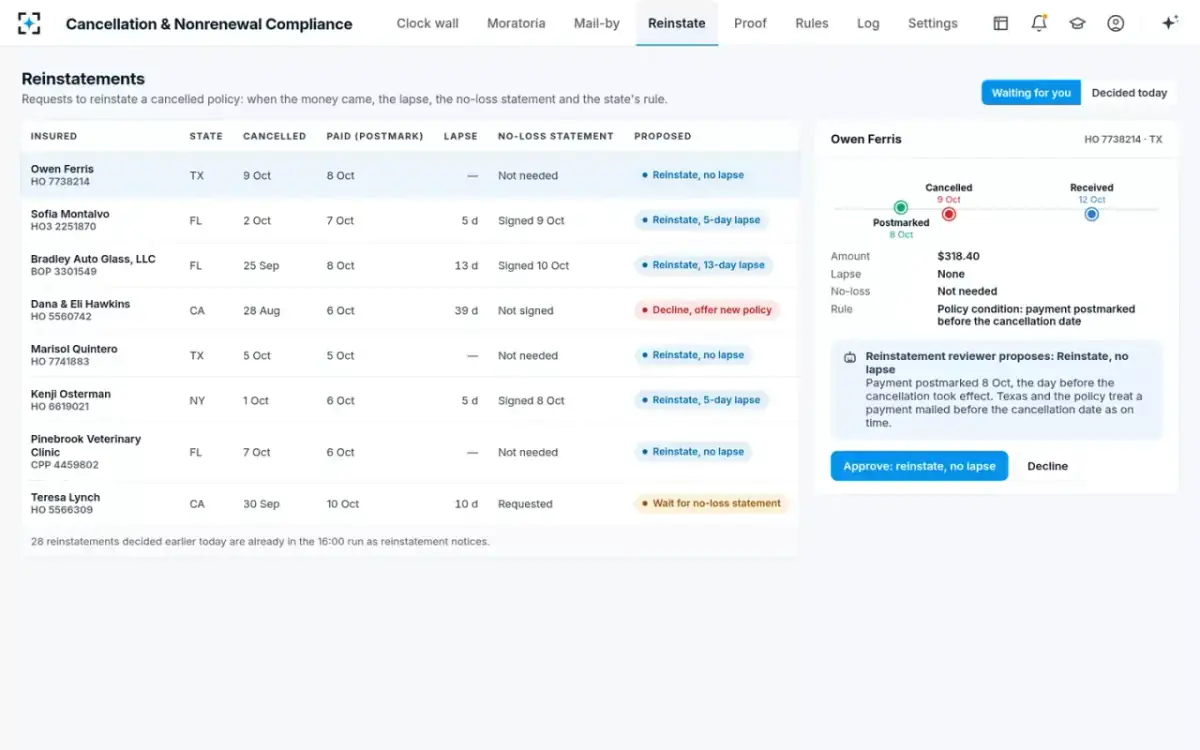
In Cancellation & Nonrenewal Compliance, a payment postmarked before the cancellation date and the proposal that follows
Insurance company cancelled my policy: what to check first
A policyholder whose policy has been cancelled can check the notice against the same four failures. Was it received with enough days for the state, line and policy age, counted from the mailing date on the notice? Does it give a specific reason, and is that reason one the state allows at this point in the policy? Does it say what is owed and by when, if the reason is nonpayment? And did the agent or broker hear about it? Florida's auto statute also gives a policyholder the right to appeal a cancellation other than for nonpayment to the Office of Insurance Regulation, if filed at least 20 days before the cancellation takes effect.
The state insurance department takes complaints, and they are counted. In our count of the Texas Department of Insurance's open complaint data, 926 complaints closed in 2025 cited cancellation and 246 cited nonrenewal, of 22,564 in all; a complaint can cite more than one reason. A complaint is often how an improper notice first reaches a regulator.
Which of these failures can be stopped before mailing?
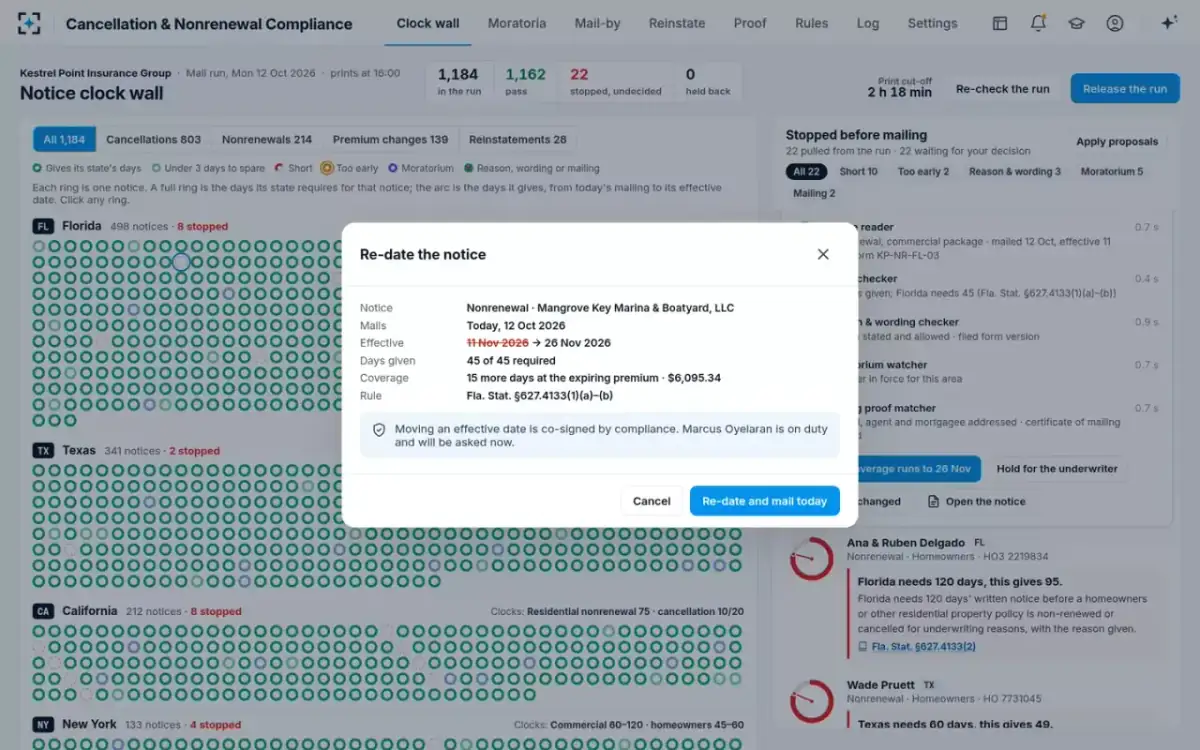
All of them except the annual cap can be caught on the notice itself, before it is mailed, and the cap can be counted as notices are queued. The sample carrier's agents count the days against each state's minimum and maximum, test the reason and required wording, check the copy list and returned-mail history, and hold anything that fails for a cancellation lead; after the run they match every notice to a postal receipt and list the gaps by policy. A stopped notice is re-dated, held, fixed or returned to the underwriter, and a moved effective date needs compliance's co-signature.
A short notice caught by Cancellation & Nonrenewal Compliance before mailing, re-dated with a second signature
The four failures, and the check that stops each before mailing
- Window
Days from the mailing date to the effective date against the state's minimum, and maximum where there is one; an effective date printed on every notice.
- Reason
A ground the state allows at the policy's age, stated with the facts: what, when, how much.
- Content
Amount due on nonpayment notices; premium increase and loss-information line on New York conditional renewals; each state's required statements.
- Proof
A postal receipt for this notice to the address in the policy, matched the day after mailing, with gaps listed by policy number.
- And the count
New York auto nonrenewals and qualifying conditional renewals per rating territory against the two percent cap, as they are queued.
To see the four checks run on a day of your own notices, start from Cancellation & Nonrenewal Compliance; for a way to test last quarter's New York notices against them, see New York's non renewal notice requirements, replayed.
Questions people ask
Is an improperly sent cancellation notice valid?
Generally not, in the states covered here. Texas gives an improper personal-lines cancellation no effect, New York treats a notice missing a required provision as ineffective, Florida keeps cover in force until the required period after notice has run, and California keeps a residential policy unchanged for 75 days from a late nonrenewal notice.
What is a market conduct examination of cancellations?
It is a regulator's review of a sample of an insurer's cancellations, nonrenewals and declinations against state law and the insurer's own guidelines. Examiners compute notice days from data, read reasons and notices, and ask for proof of mailing; North Carolina, for instance, judges results against a five percent error tolerance.
How large are fines for improper cancellation notices?
In the New York orders on this page, from $6,000 to $360,000. AIG Property Casualty paid $75,000 in 2025 for nonrenewal windows, proof of mailing and nonpayment notices; New South $25,000 in 2023 for conditional renewal notices not issued; Tokio Marine $360,000 for notice failures together with other findings.
What does a cancellation rescind notice mean?
It means the insurer has withdrawn a cancellation notice it mailed earlier, so the policy continues. It usually follows a payment made in time or a correction, and sometimes a regulator's order after an emergency. It is different from rescinding the policy, which treats the contract as void from the start.
Can a policy be cancelled without proof of mailing?
The carrier may mail the notice, but without proof it may not be able to show the notice was given. New York makes proof of mailing to the address in the policy sufficient proof of notice, and fined AIG Property Casualty in part for failing to keep it; North Carolina directed Titan Indemnity to keep proof bearing the Postal Service's date stamp.