A certificate of mailing is a receipt the Postal Service postmarks at the counter to show that an individual piece, addressed to a named addressee, was presented for mailing on that date: PS Form 3817 for fewer than three pieces, or a PS Form 3665 firm sheet for three or more. It records no delivery, and the Postal Service keeps no copy. Certified Mail gives the sender a mailing receipt and, on request, electronic verification that the piece was delivered or a delivery attempted, and the Postal Service keeps the delivery record; a firm sending many certified pieces lists them on a PS Form 3877 firm mailing book. For an insurer's cancellation or nonrenewal notice, the statutes on this page ask for proof of mailing, not proof of delivery, so an itemised certificate of mailing is usually enough, while a certificate of bulk mailing, which counts identical pieces, proves nothing about any one address. Botminds' Cancellation & Nonrenewal Compliance matches every notice in a mail run to its postal receipt and scan, and lists the gaps by policy.
The postal rules below are quoted from the U.S. Postal Service's PostalPro page on certificates of mailing and its Domestic Mail Manual; the insurance rules from state statutes and exam reports, linked where they appear. Product examples come from a fictional sample carrier, Kestrel Point Insurance Group.
Certificate of mailing vs certified mail, for an insurance notice
Certificate of mailing (PS Form 3817 or 3665): The piece, addressed to the person and address written on the form, was presented to the Postal Service on the postmarked date.
Certified Mail (firms list pieces on PS Form 3877): A mailing receipt, plus electronic verification that the piece was delivered or a delivery attempted.
Certificate of mailing (PS Form 3817 or 3665): None.
Certified Mail (firms list pieces on PS Form 3877): Yes; the Postal Service keeps a delivery record, and a return receipt can be bought at mailing.
Certificate of mailing (PS Form 3817 or 3665): The mailer. The Postal Service keeps no copy of either form.
Certified Mail (firms list pieces on PS Form 3877): The mailer keeps the receipt; delivery information is retrieved by article number.
Certificate of mailing (PS Form 3817 or 3665): As ordinary mail with a postmarked receipt.
Certified Mail (firms list pieces on PS Form 3877): Dispatched and handled in transit as ordinary mail.
Certificate of mailing (PS Form 3817 or 3665): Meets a proof-of-mailing rule, if each line names the addressee and the address in the policy.
Certified Mail (firms list pieces on PS Form 3877): Meets the same rule and adds delivery evidence; a few statutes name it for specific notices.
What is a certificate of mailing?
It is a mailer's receipt, completed by the mailer and postmarked by the Postal Service when the mail is presented, and it is valid only at that moment. The Domestic Mail Manual says certificates of mailing “may be presented only at the time of mailing and provide evidence that individual mailpieces have been presented to the USPS for mailing”. The form must show the names and addresses of the sender and each addressee; entries are typed, printed in ink or computer-generated, alterations are initialled by the mailer and the accepting employee, and unused addressee lines are struck through with a diagonal line.
What it does not do matters as much. PostalPro is direct: “Certificate of Mailing does not provide a record of delivery, and the Postal Service does not retain copies of either form.” The postmarked form is the only evidence, and the insurer is its only keeper. A certificate lost in a print vendor's files is proof that never existed.
Three numbers behind a proof-of-mailing file
3pieces
or more for a PS Form 3665 firm sheet; fewer go on PS Form 3817
0
copies of certificate-of-mailing forms the Postal Service keeps
119
policies in one North Carolina exam with no satisfactory proof of mailing
Certificate of mailing firm sheet: PS Form 3665 for three or more pieces
A carrier mailing a day's notices uses the firm sheet. PostalPro lists the variations: “Form 3665 (firm sheet) is available for three or more pieces.” Each sheet is postmarked at the time of mailing and returned to the mailer as its receipt, and the sheet can be submitted electronically through PostalOne! and processed at a Business Mail Entry Unit. Hard-copy sheets for fewer than 50 pieces and 50 pounds go to a retail Post Office; larger mailings to a Business Mail Entry Unit or an authorised detached unit. A mailer may use privately printed facsimiles with approval.
For an insurer, the firm sheet's value is that it is itemised. Each line names one addressee and one address, so the sheet can be matched to the notice file line by line: this notice, to this first-named insured, at the address shown in the policy, on this date. That is exactly what a proof-of-mailing statute asks for, and exactly what an examiner will sample.
PS Form 3877 firm mailing book: for accountable mail, not certificates
PS Form 3877 is a different document for a different service. PostalPro describes it as a bound book whose sheets list article numbers “for accountable mail such as Certified Mail, COD, Priority Mail Express® and insured mail pieces”, and adds that it is “not technically a Certificate of Mailing form”. Its own note is plain: for listing certificates of mailing, use PS Form 3665 or PS Form 3606-D. A carrier that sends notices by Certified Mail and lists them on a postmarked 3877 has a receipt for each certified piece; a carrier that sends ordinary mail with certificates of mailing needs 3665 firm sheets, not a 3877.
The confusion is common enough to search for: “PS Form 3817 or PS Form 3877”. The answer is that they belong to different services. Form 3817 is the single-piece certificate of mailing, for fewer than three pieces at a retail counter. Form 3877 is the firm book for accountable mail. A notice procedure should name the form that matches the service it buys, and the proof file should hold that form.
Five postal records a notice file might hold, and what each proves
| Record | Service | Proves | Does not prove |
|---|---|---|---|
| PS Form 3817 | Certificate of mailing, fewer than three pieces | This piece, to this named addressee, was presented on this date | Delivery; the Postal Service keeps no copy |
| PS Form 3665 firm sheet | Certificate of mailing, three or more pieces | Each listed piece, to each named addressee, was presented on the postmarked date | Delivery; the Postal Service keeps no copy |
| PS Form 3606-D | Certificate of bulk mailing | The number of identical-weight pieces mailed | That any piece went to any particular address |
| PS Form 3877 firm mailing book | Accountable mail: Certified, COD, Priority Mail Express, insured | Each listed accountable piece was accepted; delivery is then tracked by article number | Nothing for pieces sent without an accountable service |
| Intelligent Mail barcode scans | Tracking on barcoded mail | Where the Postal Service scanned a barcoded piece | Acceptance on a date as a postmarked receipt does, unless a statute accepts tracking |
Certificate of bulk mailing (USPS Form 3606-D): why it does not prove a notice
A certificate of bulk mailing counts envelopes; it does not name anyone. PostalPro says Form 3606-D “is used to specify only the number of identical-weight pieces mailed; it does not provide evidence that a piece was mailed to a particular address.” It adds that the form cannot be used as a certificate of mailing of individual pieces or itemised lists, and that the Postal Service keeps no copies.
That makes it useless as proof for a cancellation or nonrenewal. A notice rule asks whether the notice to this insured went to the address in this policy; a bulk certificate for 1,200 pieces answers a different question. A carrier whose print vendor returns only bulk certificates has proof that a run was mailed and no proof that any particular notice was.
Proof of mailing cancellation notice requirement: what the states accept
The states on this page ask for proof of mailing and say so in their own words. New York makes proof of mailing of a cancellation, nonrenewal or conditional renewal notice, or of its reasons, to the named insured at the address shown in the policy sufficient proof of the giving of notice. Florida's auto statute names the acceptable methods: “United States postal proof of mailing, certified or registered mailing, or other mailing using the Intelligent Mail barcode or other similar tracking method used or approved by the United States Postal Service”, to the first-named insured at the address shown in the policy. North Carolina's examiners directed Titan Indemnity to keep proof bearing the Postal Service's date stamp, or similar proof.
Examiners test it on paper. The NAIC Market Regulation Handbook's property and casualty procedures (2017 edition) direct examiners to “Review the notice and the certificate of mailing to ensure that adequate notice of cancellation/nonrenewal was provided to the insured and any mortgagees or lien holders.” The mortgagee's copy needs its own receipt line. And the cost of not keeping the receipt is on the record: New York's 2025 order against AIG Property Casualty, a $75,000 fine, included a finding that it had not kept proof of mailing of nonrenewal notices to the named insured.
Certified mail is required in some specific places. Florida, for instance, ties the cure period for a dishonoured first-premium cheque to notice by certified mail: the contract is void from inception unless the nonpayment is cured within the earlier of five days after the applicant receives actual notice by certified mail or 15 days after the insurer sends that notice by certified or registered mail (Fla. Stat. §627.4133; the policyholder's side is in paid insurance but policy cancelled). A notice procedure should list those exceptions rather than send everything certified.
Does certified mail prove more than a cancellation notice needs?
Usually, yes, and the extra proof has limits of its own. Certified Mail adds a delivery record, which helps when an insured says the notice never came; but the statutes here make mailing, not receipt, the test, so the delivery record is evidence the law does not require. It also travels as ordinary mail: the Domestic Mail Manual says Certified Mail “is dispatched and handled in transit as ordinary mail.”
The important point is the same for both services: the Postal Service will not hold the insurer's receipts. The manual says that, apart from Registered Mail and COD, “the USPS keeps no mailing records for mail pieces bearing extra services.” Certified or not, the carrier's proof is the receipt it keeps, matched to the notice it mailed.
What to require of a print vendor that mails your notices
Most carriers do not stand at the post office counter; a print vendor does, and the contract decides what proof comes back. Five terms cover it. The vendor presents each day's notices with itemised certificates of mailing, PS Form 3665 firm sheets or their approved electronic equivalent through PostalOne!, or with a postmarked PS Form 3877 where the carrier has bought Certified Mail. Every line carries the policy number or another reference the carrier can match, which the Postal Service allows: the mailer “may also place identifying invoice or order numbers on the certificate as a reference”. The postmarked sheets, or their electronic receipts, come back within an agreed time.
Two more terms protect the clock. The postmark date must be the mailing date printed on the notice, because every state clock on these pages is counted from mailing; a run printed on Friday and posted on Monday is three days short before it leaves the building. And any piece pulled from the run after printing, misprinted or rejected at acceptance, is reported by policy number the same day, so the carrier knows which notices were never mailed while it can still re-send them inside the window. A certificate of bulk mailing alone, however convenient for the vendor, meets none of these terms.
Building a proof file for every notice
A proof file is complete when an examiner can pick any policy number and see, in one place, the notice as mailed, the postal receipt line naming that insured and address, any tracking scans, and the copies to the agent and every mortgagee or loss payee, each with its own receipt. Returned mail belongs in the file too: a notice returned as undeliverable is still a notice mailed, but the next one should go to a better address. On the sample carrier's run, one notice was returned from a prior run marked moved, left no address, and the next notice went to the new address from the post office's change-of-address file.
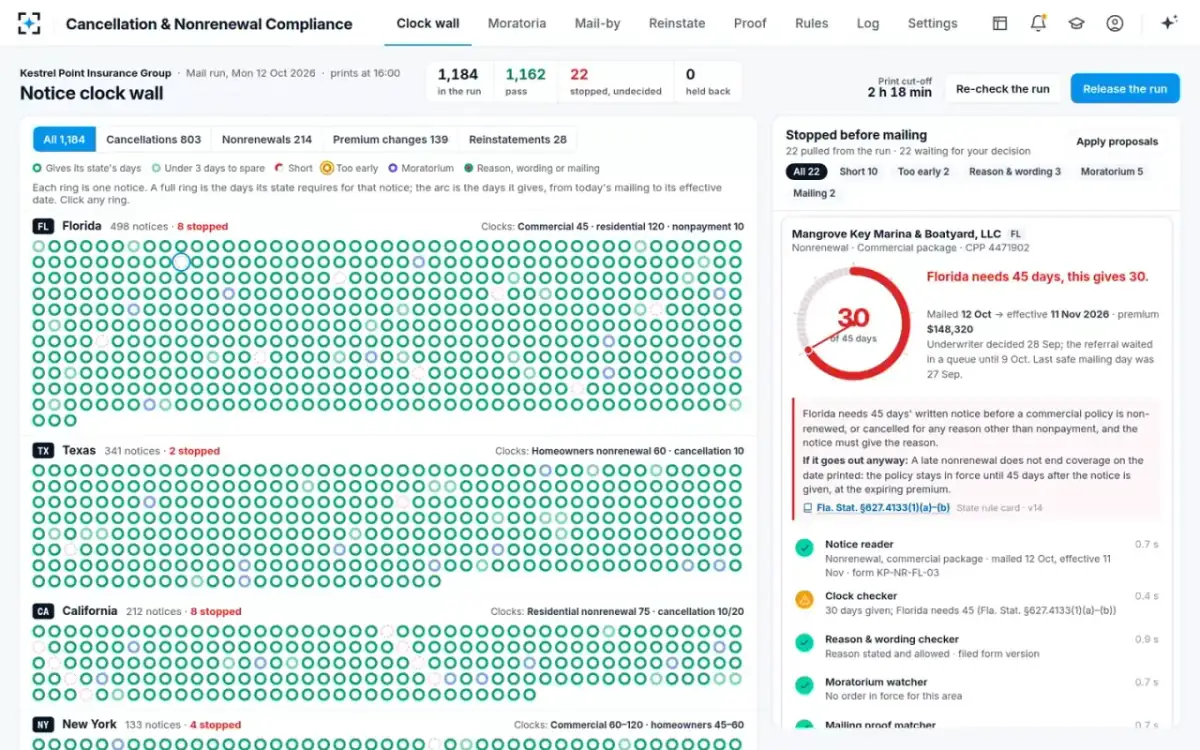
The sample carrier's solution splits the work in two. Before the 16:00 run, the mailing proof matcher checks that the agent and every mortgagee or loss payee are on the copy list and that the address has not come back; two notices stopped on 12 October for mailing problems. After the run, it matches each notice to its postal receipt line and Intelligent Mail scan, counts the agent and mortgagee copies, and lists any notice without a receipt by policy number the next morning, while the receipt can still be found. It never marks a notice mailed without a postal receipt.
Cancellation & Nonrenewal Compliance stops mailing problems before the run, beside the clock checks
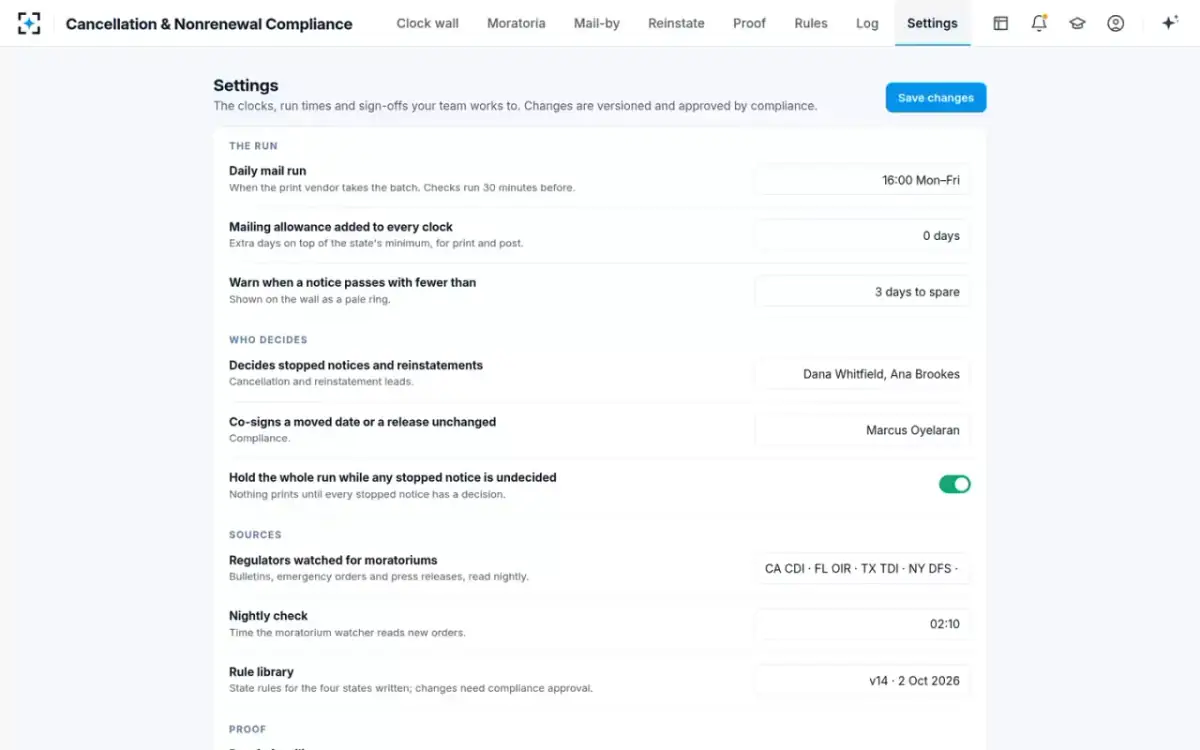
Who signs, and when the run prints, in Cancellation & Nonrenewal Compliance
A proof file an examiner can sample by policy number
- Use an itemised receipt
PS Form 3665 firm sheets for certificates of mailing, or a postmarked PS Form 3877 for certified pieces; never a bulk certificate alone.
- One line per addressee
The first-named insured at the address shown in the policy, and separate lines for the agent and each mortgagee or loss payee.
- Match the receipt to the notice
Same name, same address, same date as the notice file; flag any mismatch the next morning.
- Keep the scans with the receipt
Intelligent Mail scans support the file and, for Florida auto notices, are a listed method of proof.
- File returned mail
Note the return reason and use the corrected address for the next notice.
- Hold the receipts yourself
The Postal Service keeps no copy of certificate-of-mailing forms; the print vendor's copy is not yours until it is in your file.
Proof is the part of a notice most often lost after the fact, as the cases in improper cancellation notices show. For the full list of what notice software should check and never do on its own, see notice compliance software requirements. To see every notice in a run matched to its receipt, start from Cancellation & Nonrenewal Compliance.
Questions people ask
Is a certificate of mailing proof of delivery?
No. It proves that a piece addressed to the named addressee was presented to the Postal Service on the postmarked date. PostalPro states that a certificate of mailing does not provide a record of delivery, and that the Postal Service keeps no copies of the forms.
Do insurance cancellation notices have to be sent by certified mail?
Not under the general rules on this page. New York makes proof of mailing to the address in the policy sufficient proof of notice, and Florida's auto statute accepts postal proof of mailing, certified or registered mail, or Intelligent Mail tracking. A few specific notices, such as Florida's notice on a dishonoured first-premium cheque, are tied to certified mail.
What is the difference between PS Form 3817 and PS Form 3665?
Both are certificates of mailing. Form 3817 is for fewer than three individual pieces presented at a retail counter; Form 3665 is a firm sheet for three or more pieces, and can be submitted electronically and processed at a Business Mail Entry Unit.
Can a certificate of bulk mailing prove an insurance notice was sent?
Not for a particular insured. Form 3606-D specifies only the number of identical-weight pieces mailed and, in PostalPro's words, does not provide evidence that a piece was mailed to a particular address. It also cannot be used as a certificate of mailing of individual pieces or itemised lists.
How long should proof of mailing be kept?
At least as long as the policy records it supports, because examiners sample notices from the examination period. Texas, for example, requires insurers to keep cancellation and nonrenewal information in line with their ordinary practice for records of expired policies and to make it available to the department on request.