A conditional renewal notice tells the insured that the policy will renew only on changed terms, and states those terms: lower limits, a coverage removed or narrowed, a higher deductible, an added exclusion, or, under New York's commercial statute, a premium increase of more than ten percent after exposure and rating changes are set aside. It must go out on the state's clock with the specific reasons and each change described, and in New York commercial lines the amount of the premium increase and a line on the availability of loss information. Texas calls the same event a material change at renewal and requires a conspicuous, plain-language notice 30 days ahead; California requires the renewal offer itself to name each limit reduced or coverage removed, 45 days ahead. Botminds' Cancellation & Nonrenewal Compliance checks conditional renewals, material change notices and renewal offers against those rules before they are mailed, like any nonrenewal; this guide sets out what triggers one and gives a sample to adapt.
“describe in plain and concise terms the nature of any other proposed changes”
New York Insurance Law §3426(e)(2), on what a conditional renewal notice must do
The rules are quoted from the statutes, linked where they appear; the sample notice is our own skeleton, not a filed form. Product examples are from a fictional sample carrier, Kestrel Point Insurance Group, and its mail run of 12 October 2026.
What is a conditional renewal notice?
It is a notice that the insurer will renew, but not on the same terms. In New York the term is statutory. For commercial lines, §3426 requires written notice before the insurer may condition renewal upon “change of limits, change in type of coverage, reduction of coverage, increased deductible or addition of exclusion”, or upon a premium increase of more than ten percent, not counting increases from added exposure units, experience rating, loss rating, retrospective rating or audit. For personal lines, §3425 requires the notice before the insurer may condition renewal upon a change of limits or the elimination of any coverage.
So the conditional renewal meaning, in practice, is a renewal on worse terms that the law treats almost like a nonrenewal: same window, same need for specific reasons, and the same consequence if it is late. The insured keeps the choice. They can accept the new terms by paying, or place the risk elsewhere, and the notice exists so that they have time to decide.
When a renewal is really a change: what each state calls it, by type of change
Lower limits
New York commercialConditional renewal
New York personalConditional renewal
Texas personalMaterial change notice
California residentialRenewal offer must name the limit cut
Coverage removed or narrowed
New York commercialConditional renewal
New York personalConditional renewal, if a coverage is eliminated
Texas personalMaterial change notice
California residentialRenewal offer must name the coverage removed
Higher deductible
New York commercialConditional renewal
New York personalNot named in §3425(d)(1)
Texas personalMaterial change notice, where it reduces cover or changes its conditions
California residentialNot named in §678(a)
Added exclusion
New York commercialConditional renewal
New York personalConditional renewal, if it eliminates a coverage
Texas personalMaterial change notice
California residentialRenewal offer, if it eliminates coverage
Premium up more than 10%
New York commercialConditional renewal, net of exposure, experience, retrospective rating and audit
New York personalNot a §3425 trigger
Texas personalNot a §551.1055 trigger
California residentialNot a §678 trigger
New duties for the insured
New York commercialNot named in §3426(e)(1)
New York personalNot named
Texas personalMaterial change notice
California residentialNot named
Conditional renewal notice insurance rules in New York: the ten percent line
New York's commercial rule is the most demanding, and the premium trigger is where carriers trip. The ten percent is measured after removing increases from added exposure units, experience or loss rating, retrospective rating and audit, so a renewal premium up 18% on a payroll increase may owe no notice, while one up 11% on rate alone does. The notice must state the specific reasons, the amount of any premium increase, or a reasonable estimate where the amount cannot yet be known, within a range regulation caps at five percent of the actual amount, describe each other change in plain terms, and tell the insured and the broker that loss information is available on request. It goes to the first-named insured and the authorized agent or broker, 60 to 120 days before expiry.
Lateness has a specific cost. If a late conditional renewal is given before expiry, cover continues on the expiring terms, at the lower of the current or prior rates, for 60 days after the notice; if the insured then elects to renew on the conditional terms, those terms apply only after that 60-day period, unless the notice was given at least 30 days before expiry, in which case they apply from the renewal date. If the late notice comes on or after expiry, the expiring terms run for another full policy period. In 2023 New York fined New South Insurance Company $25,000 because it “failed to issue conditional renewal notices”, and Tokio Marine America's $360,000 order included conditional renewals that omitted the amount or percentage range of the premium increase. How to test a quarter of New York notices against these rules is set out in New York's non renewal notice requirements, replayed.
Texas: a material change at renewal is not a nonrenewal, if the notice is right
Texas reaches the same place by another road. For the personal lines in Chapter 551, Subchapter C (personal auto, homeowners, farm and ranch owners and certain dwelling policies), an insurer that cuts coverage without the insured's consent has cancelled the policy, because the statute counts a reduction or restriction of coverage, by endorsement or any other route, as a cancellation (Tex. Ins. Code §551.103; the same rule seen from the endorsement desk is in policy change vs endorsement). The exception is §551.1055: a change made at renewal is not a cancellation or nonrenewal if the insurer gives proper notice of each material change, meaning one that reduces coverage, changes the conditions of coverage or changes the insured's duties.
The notice must appear in a conspicuous place in the renewal notice, “clearly indicate each material change to the policy being made on renewal”, be written in plain language and reach the insured at least 30 days before the renewal date. Agents get their own notice of each material change to a form at least 30 days before the first renewal that uses it, and may receive one summary across similar forms. For personal auto, the insurer must also meet the 60-day nonrenewal rule. Get the notice wrong and the change may be treated as a cancellation, which brings Texas's cancellation grounds and clocks into play.
California conditional renewal notice: the renewal offer that names each cut
California builds the notice into the renewal offer. For residential property and personal liability policies, at least 45 days before expiry the insurer must deliver or mail either a notice of nonrenewal or an offer of renewal that states any reduction of limits or elimination of coverage, and “shall identify the specific limits being reduced or coverage being eliminated by the offer of renewal”, with the insurer's consumer telephone number displayed prominently. Removing the peril of fire is subject to a separate statute. Since July 2022, a mailed offer gets the extra days of Code of Civil Procedure §1013(a): five within California, ten across state lines.
If the insurer gives neither the offer nor the nonrenewal notice in time, the existing policy continues with no change for 45 days from the date the offer or notice is delivered or mailed, and the insurer must tell the insured so. A renewal offer that lists a new premium but does not identify the coverage removed is, in California, an offer that has not done its job.
Conditional renewal notice sample, for a commercial policy
[Insurer] · Form [number and edition]
NOTICE OF CONDITIONAL RENEWAL
Date mailed: [date, 60 to 120 days before expiry]
First-named insured: [name] · [address shown on the policy]
Policy: [number] · [line] · Expires: [date]
We will renew your policy on [renewal date] only on the following changed terms:
1. [Change, e.g. the deductible for wind and hail on Building B increases from [amount] to [amount].]
2. [Change, e.g. an exclusion for [named exposure] is added by endorsement [form number].]
Premium: your renewal premium will be [amount], an increase of [amount], or [estimated amount] if the final figure is not yet known.
Why: [the specific reasons for each condition, with the facts behind them]
Loss information: you or your broker may request your loss information in writing; we will send it as the law requires.
Your coverage: [what continues, and until when, if you do not accept]
Copy: [authorized agent or broker]
- Window. New York commercial: 60 to 120 days before expiry (30 to 120 for excess liability and jumbo risks).
- Each change. Name every condition in plain terms; New York requires the nature of each change described.
- Premium. The amount of the increase, or an estimate within the range regulation allows.
- Reasons. Specific to this insured: New York requires the specific reason or reasons for each conditional renewal.
- Loss information. New York commercial notices must say it is available on written request.
- Copy. The authorized agent or broker receives the notice too.
Conditional non renewal notice: when the condition decides the outcome
Some conditional renewals turn into nonrenewals by their own terms. New York allows an insurer to condition the renewal of an excess liability policy on requirements for the underlying coverage, and if those requirements are not met by the later of the expiration date or 60 days after the notice, the conditional renewal notice “shall be treated as an effective notice of nonrenewal”. A conditional non renewal notice, in that sense, is a conditional renewal written so that it can become a nonrenewal without a second notice, and it must therefore meet the nonrenewal rules from the start: window, specific reasons and copies.
New York also allows a two-step route when an insurer cannot yet state its renewal terms: a timely alternative renewal notice saying the policy may not be renewed on the same terms, followed by a second notice with the terms. Cover then continues on the expiring terms, conditions and rates until the later of expiry or 60 days after the second notice. Either way, the notice that carries the conditions is the one tested.
Notice of policy conditional renewal: who receives it, and when
The recipients and clocks differ by state, and a renewal team that sends every conditional renewal at the same point in the cycle will be early in one state and late in another. New York commercial notices go to the first-named insured and the broker, 60 to 120 days ahead. New York personal-lines notices go to the named insured 45 to 60 days ahead, with a copy to the agent or broker within seven days. Texas material change notices reach the insured 30 days before the renewal date, and agents get form-level notice 30 days before first use. California's renewal offer reaches the named insured 45 days before expiry, plus the mailing days. Florida, for commercial and residential policies alike, requires 45 days' notice of the renewal premium.
When a conditional renewal or change notice may be mailed, counted back from renewal
- Window120–60 days
- Too late59–0
- Too early120–61
- Window60–45
- Too late44–0
- Allowed120–50 days
- Too late, mailed in state49–0
- Allowed120–30 days
- Too late29–0
The same timetable is why a renewal desk works backwards from the notice date, as described in the commercial insurance renewal timeline: the underwriting decision has to be made before the notice window opens if the notice is to carry the terms.
Who owns a conditional renewal: four seats
The people behind one conditional renewal notice
Today
Sets the renewal terms and the premium, often late in the cycle, and leaves the notice to the renewal team.
With agents
Sees, for each renewal still undecided, the last day a conditional renewal could be mailed in its state.
Still theirs: the conditions and the reasons for them
Today
Drafts notices from templates, one paragraph for every state.
With agents
Drafts from state-specific blocks; the agents check each notice's window, content and copies before it prints.
Still theirs: the notice text and the copy list
Today
Answers questions about the ten percent rule one renewal at a time.
With agents
Approves the rule library that encodes the triggers and windows, and co-signs any moved date.
Still theirs: the rules and the exceptions
Today
Learns of the conditions when the client calls.
With agents
Receives the notice with the insured, in time to market the risk or negotiate the terms.
Still theirs: the client's choice to accept or move
How Cancellation & Nonrenewal Compliance handled a sample New York conditional renewal
The sample run held one New York commercial conditional renewal that shows the far end of the window at work. Hudson Millwork Co.'s conditional renewal on commercial package CPP 4490336, premium $61,450, expires on 1 March 2027 and was queued with the week's renewals on 12 October, 140 days ahead. The clock checker stopped it as too early, and the agents proposed holding it and mailing on 1 November, the first day inside the 120-day window; it can go as late as 31 December. The cancellation lead accepted the hold, and the notice stayed out of the 16:00 run.
Held, not re-dated: Cancellation & Nonrenewal Compliance keeps a conditional renewal for its window
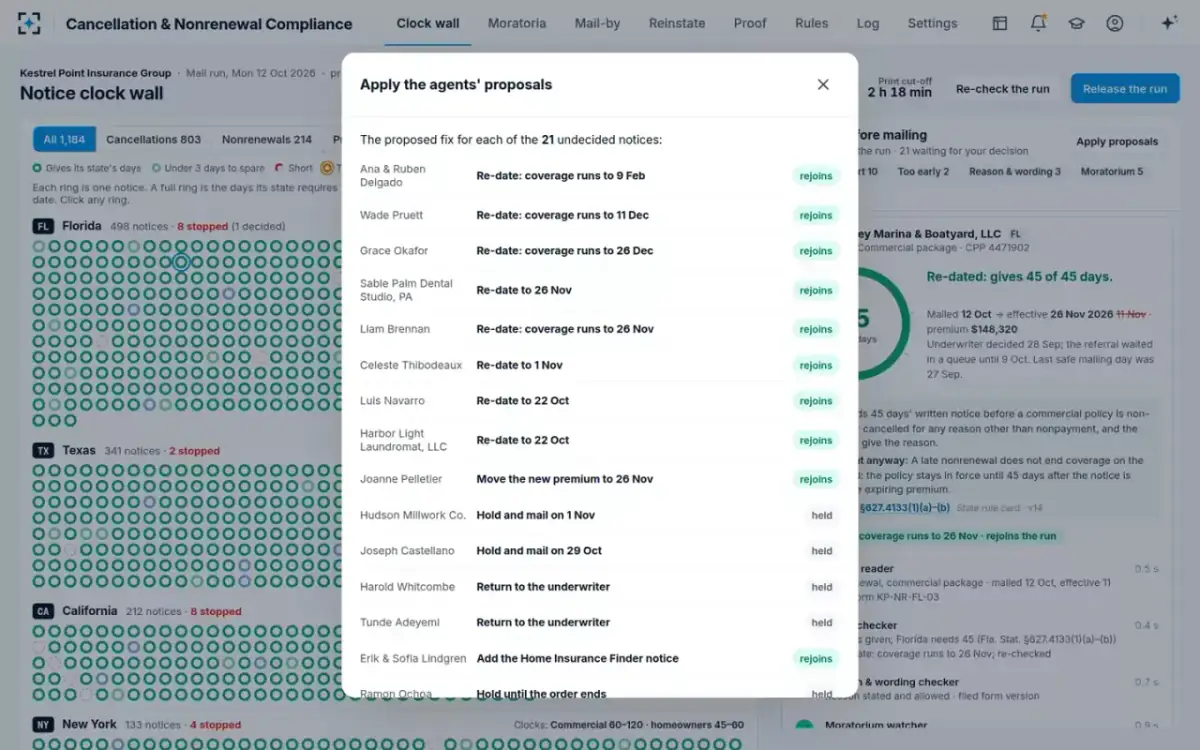
The same checks apply to the content: the reason and wording checker looks for the specific reasons, the premium increase or estimate, and the loss-information line on a New York commercial notice, and for each named limit or coverage on a California renewal offer. What every nonrenewal and conditional renewal notice must carry, line by line, is annotated in the notice of nonrenewal, annotated, and the four states' clocks for every notice type are in insurance cancellation notice requirements by state. To check your own conditional renewals before they are mailed, start from Cancellation & Nonrenewal Compliance.
Questions people ask
Is a conditional renewal the same as a nonrenewal?
No, but New York treats it much the same way. Both need the same window (45 to 60 days for personal lines, 60 to 120 for commercial), specific reasons, and the same late-notice consequences. The difference is that the insured can keep the policy by accepting the new terms.
Does a premium increase require a conditional renewal notice?
In New York commercial lines, yes, when it exceeds ten percent after excluding increases from added exposure units, experience or loss rating, retrospective rating or audit. It is not a trigger under New York's personal-lines §3425, Texas's §551.1055 or California's §678, though those states have other premium-notice rules, such as Florida's 45-day renewal premium notice.
What happens if a conditional renewal notice is sent late in New York?
For commercial lines, cover continues on the expiring terms at the lower of the current or prior rates for 60 days after a late notice given before expiry, or for another full policy period if the notice comes on or after expiry. For personal lines, the insured is entitled to renew on payment of the premium.
Does California require a conditional renewal notice?
California requires the renewal offer itself to state any reduction of limits or elimination of coverage and to identify the specific limits or coverage affected, at least 45 days before expiry, plus mailing days. If neither the offer nor a nonrenewal notice is given in time, the existing policy continues unchanged for 45 days from when one is delivered or mailed.
Can an insurer add an exclusion at renewal in Texas without notice?
Not for the personal lines Subchapter C covers. Adding an exclusion reduces coverage, so it is a material change that needs a conspicuous, plain-language notice at least 30 days before the renewal date; without it, a reduction of coverage without the insured's consent can count as a cancellation.