Policy change vs endorsement is mostly a difference of vocabulary: a policy change is the transaction that alters an in-force policy, such as adding a vehicle, removing a location or raising a limit, and an endorsement is the written form, issued by the insurer, that makes the change part of the contract. Many carriers title the document itself a "policy change" endorsement. The distinction with legal weight is a different one: whether the change was asked for by the insured or imposed by the insurer. In Texas, for personal auto, homeowners, dwelling fire and public-entity policies, an insurer that reduces or restricts coverage by endorsement without the insured's consent has, in law, cancelled the policy, with the cancellation rules attached. Botminds' Policy Endorsement Processing reads every change request for what was asked and by whom, so that the two kinds of change never travel through the desk as one.
The desk examples on this page are fictional sample data from a commercial package policy issued by an invented carrier, Bracken Hill Mutual. The statutes and the court decision are real and linked.
Policy change vs endorsement: what is the difference?
The change is what happens; the endorsement is the evidence that it happened. A policy's own changes clause usually says that its terms change only by an endorsement the insurer issues and attaches (the clause, and who may ask for a change, are read in who has authority to make changes to an insurance policy), so until the endorsement is issued, a requested change, however clearly agreed by email, is not part of the policy. In practice, carriers and agencies use "policy change," "endorsement," "mid-term change" and "mid-term adjustment" for the same thing.
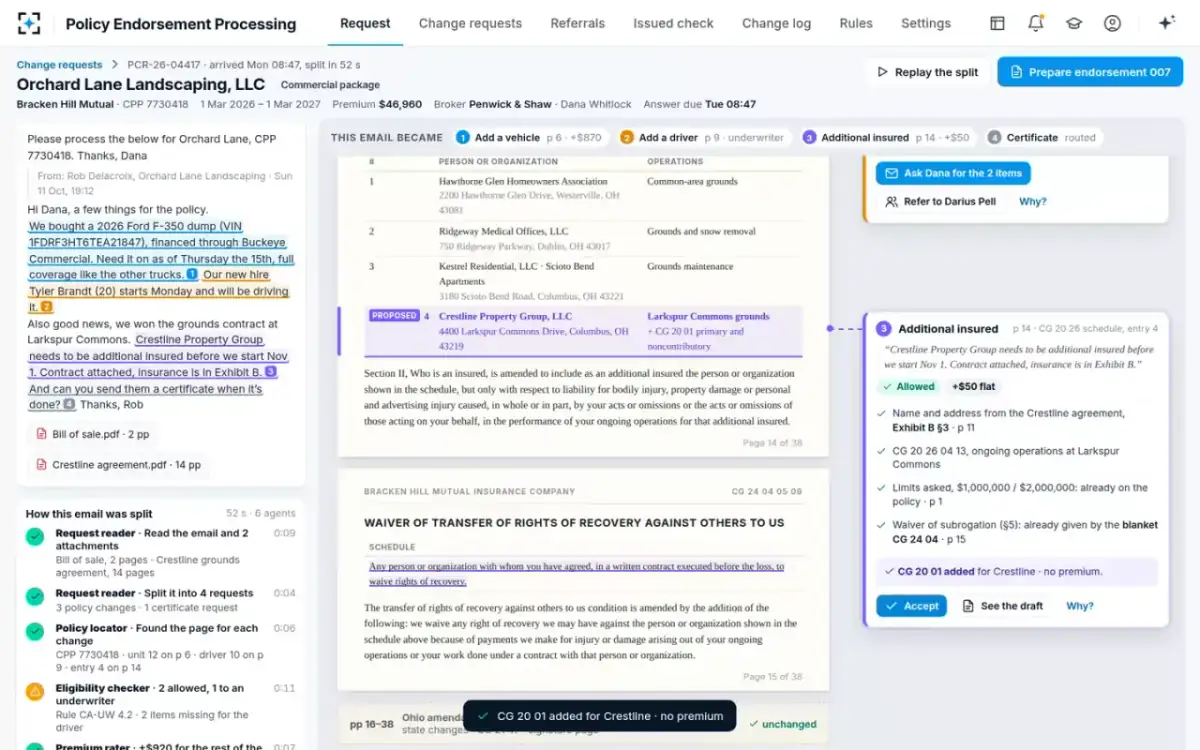
The sample endorsement shows the overlap. It is headed "Policy changes — endorsement 007," and it records two changes requested in one broker email: a truck added to the schedule of covered autos, and a client added as an additional insured with the primary and noncontributory wording its contract required. What an endorsement is as a coverage document, and why its edition matters on a claim, is covered from the claims side in what insurance policy endorsements are; what a year of them does to underwriting is in the commercial renewal guide to mid-term endorsement meaning.
What is a policy change endorsement in insurance?
It is the form that carries one or more mid-term changes into the policy, with the policy number, the named insured, the effective date and time of the change, each change described against the schedule or coverage part it alters, and the premium effect. Some changes need their own standard forms in addition, such as an additional insured endorsement or a loss payable clause, and the policy change endorsement lists or attaches them.
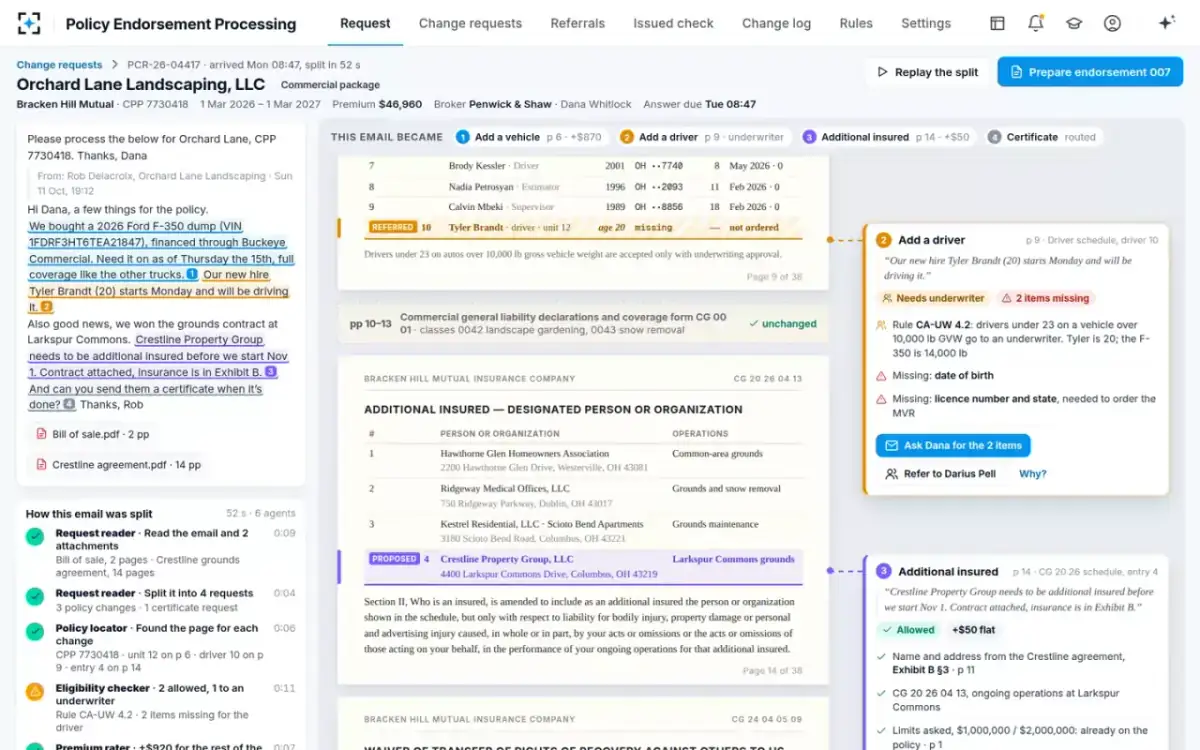
On the sample policy the endorsement names the business auto schedule item it amends, lists the loss payable form for the lender, names the additional insured on its schedule with the primary and noncontributory form, and shows $920 of additional premium and the policy's new total of $47,880. A change the underwriter had not yet decided, a new 20-year-old driver, appears on the draft as "Not on this endorsement — with the underwriter." The endorsement is the policy's answer to the request; anything it does not say, the policy does not say.
A change the customer asked for, plus one the contract required
Who started the change decides what kind of change it is
An insured's request to add a vehicle and an insurer's decision to exclude a hazard both end as endorsements, but they are different acts with different rules. The first needs the insurer's consent and, usually, nothing more than an issued endorsement. The second takes something away that the insured bought, and states that regulate it treat it as a cancellation, a nonrenewal or a noticed change, depending on when it happens.
Two endorsements, two different acts: requested change vs insurer-imposed reduction
Requested by the insured: Add a truck; add an additional insured; raise a limit; delete a sold vehicle.
Imposed by the insurer: Exclude a hazard; lower a sublimit; restrict a coverage part; drop a driver.
Requested by the insured: The insurer, by issuing the endorsement.
Imposed by the insurer: The insured, or the law treats it as something else.
Requested by the insured: An ordinary endorsement.
Imposed by the insurer: A cancellation under §551.103(3) unless the insured consents.
Requested by the insured: An ordinary change.
Imposed by the insurer: Allowed with a written notice of each material change, 30 days ahead (§551.1055).
Requested by the insured: An ordinary endorsement.
Imposed by the insurer: A reduction needing 45 days’ notice on an approved form (§27-613).
Requested by the insured: The request, its date and who sent it.
Imposed by the insurer: The insured’s consent, or the notice and its proof of mailing.
In Texas, an endorsement that cuts coverage can be a cancellation
For the policies it covers, Texas defines cancellation to include more than ending the policy. Under §551.103, an insurer has cancelled a policy if, without the insured's consent, it terminates coverage, refuses additional coverage the insured is entitled to under the policy, or, except at renewal under §551.1055:
"reduces or restricts coverage under the policy by endorsement or other means."
Tex. Ins. Code §551.103(3)
The scope matters as much as the rule. Subchapter C of chapter 551 applies only to personal automobile policies (other than those written through the state's assigned risk plan), homeowners and farm and ranch owners policies, standard fire policies on one-family dwellings, duplexes and their contents, and property and casualty policies for the state and its political subdivisions (§551.102). Within that scope, a cancellation is allowed only on the listed grounds, such as non-payment, a fraudulent claim or, for policies other than personal auto, an increase in hazard within the insured's control that would raise the premium rate (§551.104).
So a Texas homeowners carrier that decides mid-term to exclude a hazard cannot simply issue an endorsement and send it. It has either cancelled the policy, which requires a permitted ground and the cancellation notice, or it must wait for the renewal and give notice of the change. The notice clocks are a cancellation desk's business; for a service desk the point comes earlier. The request to issue that endorsement came from the insurer's own underwriting, not from the insured, and the desk has to recognise it as a different kind of transaction before anyone keys it.
Material change endorsements: changes made at renewal, with notice
Texas carves renewal out of the cancellation rule, on conditions. A "material change" is one that "reduces coverage," "changes conditions of coverage" or "changes the duties of the insured" (§551.1055(a)). A change to a policy provision on renewal is not a cancellation or nonrenewal if the insurer gives the insured written notice of each material change in each form, which must appear in a conspicuous place in the renewal notice, be in plain language, and reach the insured no later than the 30th day before renewal; the insurer must also tell its agents of each material change at least 30 days before the first renewal using the new form (§551.1055(b)–(d)).
That is the legal meaning behind the phrase "material change endorsement" in a Texas personal lines file: a renewal form change that cuts or conditions coverage, delivered with its own notice. A desk handling mid-term requests meets it from the other side, when an insured asks mid-term to restore something a renewal form took away. The answer may be an endorsement, at a premium worked out as in how to calculate additional premium for endorsements, rather than a reversal of the renewal.
Maryland: a reduction in coverage needs its own notice
Maryland regulates the reduction directly for private passenger auto. For a policy, or a binder that has been in effect at least 45 days, an insurer that intends to "reduce coverage under the policy" must send written notice at least 45 days before the proposed effective date, by a first-class mail tracking method, on a form approved by the Commissioner, stating "the proposed action to be taken, including for a reduction in coverage, the type of coverage reduced and the extent of the reduction", the actual reason, and the insured's right to protest to the Commissioner within 30 days. If the insured protests, the insurer must keep the current insurance in effect until the Commissioner decides (§27-613).
The Maryland rule exempts reductions that are part of a general reduction in coverage approved by the Commissioner, and it does not cover the Maryland Automobile Insurance Fund. Like Texas, it targets the insurer's unilateral act. A Maryland insured who asks to drop collision on an old car is making an ordinary change; an insurer that drops it on its own initiative is taking a regulated action.
When a coverage reduction is more than an endorsement: three rules compared
| Rule | Policies covered | What triggers it | What the insurer must do |
|---|---|---|---|
| Tex. Ins. Code §551.103(3) | Personal auto (not assigned risk), homeowners, farm and ranch owners, dwelling fire, public entities | Reducing or restricting coverage by endorsement or other means, without the insured’s consent, mid-term | Treat it as a cancellation: a permitted ground under §551.104 and the cancellation notice |
| Tex. Ins. Code §551.1055 | The same policies | A material change to a policy form on renewal | Conspicuous plain-language notice of each change, 30 days before renewal; notice to agents |
| Md. Code, Insurance §27-613 | Private passenger auto policies, and binders in effect 45 days | Reducing coverage under the policy (other than a general reduction approved by the Commissioner) | 45 days’ notice by first-class tracking on an approved form, with the reason and protest rights |
Consent turns a cancellation into an endorsement
The same reduction is an endorsement if the insured agrees to it. Texas shows this most clearly with drivers. An insurer may cancel a personal auto policy if a household member's driver's licence is suspended or revoked, but under §551.104(d) it "may not cancel a policy under this subsection if the named insured consents to an endorsement terminating coverage under the policy for the person whose license is suspended or revoked." The excluded-driver endorsement is a reduction in coverage, and the insured's consent is what makes it lawful as an endorsement rather than a cancellation.
Consent also binds others. In CX Reinsurance v. Johnson (2022), Maryland's highest court considered settlements in which insurers and their insured landlords agreed to reduce or eliminate lead paint coverage. It held that tort claimants without judgments at the time could not enforce the old terms, provided the settlements were made in good faith, noting that nothing in the policies required the consent of anyone other than the insurer and the first named insured to "agreeing to a change in terms". For a desk, consent is therefore something to capture, not assume: who agreed, when, and to what wording. Who may give it is covered in who has authority to make changes to an insurance policy.
A requested change the desk may not accept alone, flagged by Policy Endorsement Processing
What is a change in risk, and can an insurer act on it mid-term?
A change in risk is a change in the thing insured, such as a new operation, a new driver or a building put to a new use, that alters the hazard the premium was set for. An insurer can price an added exposure mid-term by endorsement when the insured asks for it. Acting on a change the insured did not ask about is narrower: in Texas, outside personal auto, a mid-term cancellation is allowed when the insured, by something within their control, has raised the hazard enough to raise the premium rate (§551.104(c)), and a coverage cut short of cancellation is itself a cancellation under §551.103.
In commercial lines a materially changed risk is often a renewal question, handled through conditional renewal or nonrenewal. How that works for a year of commercial changes, including New York's rule on mid-term premium increases, is explained in the guide to mid-term endorsements at renewal.
How a desk sorts requested changes from imposed ones
By reading each request for who is asking and what for, before anyone keys anything. A broker's email asking to add a truck and an underwriter's note asking the desk to restrict a coverage part both arrive as work items; only the first is a request the desk can process as an endorsement. In Policy Endorsement Processing the request reader quotes the sentence each change came from and marks requests that are not ordinary policy changes, such as certificates, billing questions and cancellations, for their own queues. A request that leaves out who is asking, or what exactly should change, goes back with one drafted reply, as described in the endorsement request email and what sends it back.
Sorting a change before it is keyed, in Policy Endorsement Processing
Agent
Read and splitEach change in the message, with the sentence it came from and who sent it.
Never: merging an insured’s request with an insurer’s instruction.
Agent
ClassifyAdded or reduced coverage, and requested by the insured or initiated by the insurer.
Agent
Check the rulesEligibility and authority for requested changes; the referral rule that applies, cited.
Never: approving a referral.
A person decides
Insurer-initiated reductionsUnderwriting and compliance decide whether it is a cancellation, a renewal change with notice, or a change the insured will consent to.
A person decides
Requested changesThe representative accepts within authority and issues the endorsement.
Agent
Read backThe issued endorsement against the request, field by field.
Never: closing a mismatch on its own.
Questions people ask
Is a policy change endorsement form the same as an endorsement?
Yes, in most carriers' usage: it is the endorsement that records one or more mid-term changes, often titled "policy changes." It may attach other standard endorsements, such as an additional insured form or a loss payable clause, that the change requires.
What is a change endorsement in insurance?
An endorsement issued during the policy term to change what the policy covers, who it covers or on what terms, effective from a stated date. Whether it needs anything beyond the insurer's issue depends on who asked: a reduction the insurer imposes can be a regulated cancellation or a noticed change.
What is a material change endorsement?
In Texas personal lines, a material change is one that reduces coverage, changes conditions of coverage or changes the insured's duties (§551.1055). Made at renewal with conspicuous written notice 30 days ahead, it is not a cancellation; made mid-term without consent, a reduction is treated as one.
What is a general change endorsement?
It is the name of the National Flood Insurance Program's form for changing a flood policy during its term. Under 44 CFR 61.11, added or increased flood coverage is prorated at the rates in force and, outside listed exceptions, takes effect 30 days after the endorsement request and premium.
Can an insurer reduce my coverage in the middle of the policy?
For Texas personal auto and homeowners policies, not without your consent unless it treats the reduction as a cancellation on a permitted ground; Maryland requires 45 days' notice for a reduction in private passenger auto coverage, with a right to protest. Commercial policies follow other rules, usually applied at renewal.