If an insurance agent fails to add a vehicle to the policy, three questions decide who pays for a crash in it. Does the policy cover the vehicle anyway, typically through an after-acquired or newly acquired auto clause and a notice given in time? If not, is the insured left uncovered? And if so, did the agent breach a duty of care to the customer who asked? Courts answer the first from the policy's words, and they have come out both ways on details that look alike. Pricing the miss therefore means pricing the claim, not the keystroke: a few minutes saved on a change request against a liability limit and a vehicle's value. Botminds' Policy Endorsement Processing exists to make a requested change impossible to lose between the email and the issued endorsement, and the cases below show why that gap is where the money goes.
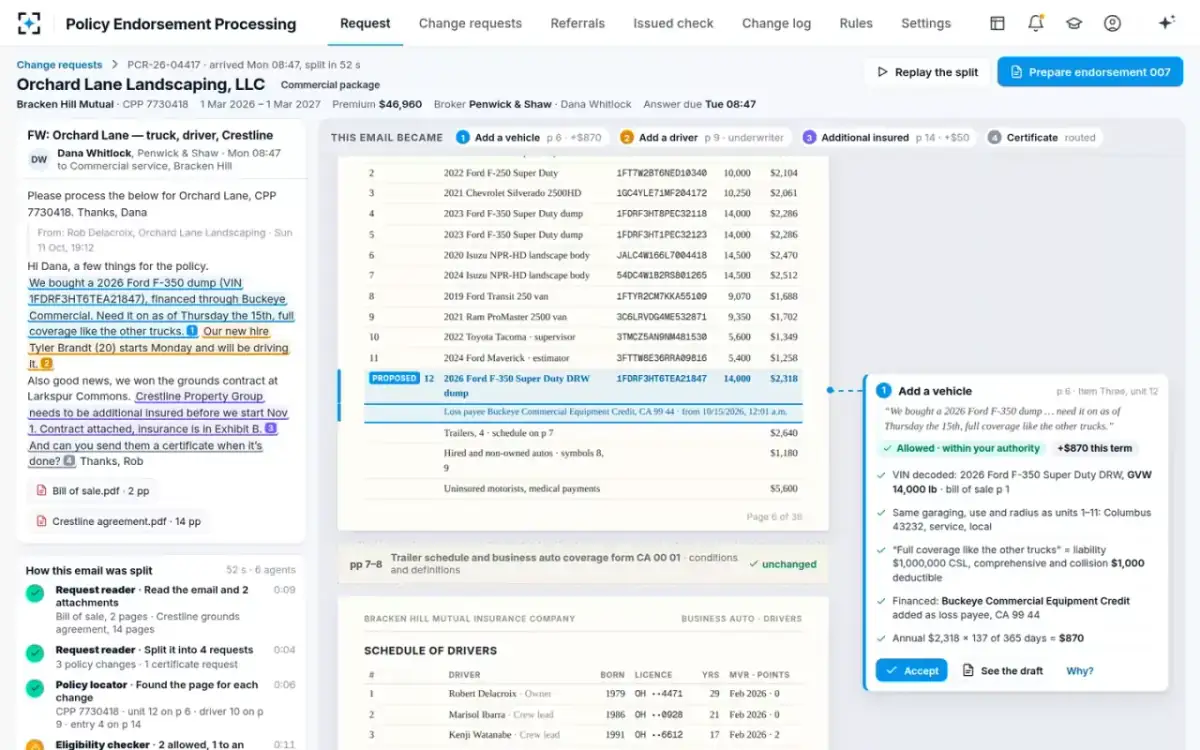
Where this page uses a desk's own figures, they come from a fictional sample: Bracken Hill Mutual, an invented carrier, and its insured Orchard Lane Landscaping, adding a 2026 Ford F-350 dump truck mid-term. The cases, statutes and complaint data are real and linked.
One truck added mid-term, and what rides on the change
$870
premium to add the sample F-350 for the 137 days left in the term
$1M
combined single limit of liability the change puts on that truck
30days
notice window in the after-acquired auto clause one appeals court enforced in 2025
152
Texas complaints closed in 2025 with the keyword “driver not covered”
What happens if an insurance agent fails to add a vehicle to the policy?
The vehicle is covered only if the policy says so without the change. If the policy lists covered autos by description and has no clause that reaches a vehicle bought mid-term, the vehicle is uninsured until an endorsement adds it, and a crash in the meantime falls on the insured. If the policy has an after-acquired auto clause and its conditions were met, usually that the insurer already covers all the insured's autos or the new one replaces one, and that the insured gave notice within a set window, the insurer may owe coverage even though no endorsement was ever issued.
Either way, the agent's position turns on what was asked and when. A request that reached the agent and went nowhere can make the agent liable to the insured for the uncovered loss; a request never made usually cannot. That is why the paper trail of a change request, which most desks treat as administration, is the evidence that decides the claim.
The email that never became an endorsement
In Markel Insurance Co. v. Rau, decided by the Seventh Circuit in 2020, an ambulance company asked its agency at renewal to take an ambulance, Ford #4497, off its fleet policy while it was repaired. Weeks later the company emailed the agency to put it back. Nothing came of the email: no endorsement, no reply. Nine months later #4497 crashed into a car and the driver of the car died of his injuries.
The policy's changes clause was the standard one: the insured could make changes with the insurer's consent, and the policy's "terms can be amended or waived only by endorsement issued by [Markel] and made a part of this policy." The court held that it did not need to decide what happened to the email. Whether or not it was sent or received, no endorsement had been issued, and the vehicle was not covered. The ambulance company's own claim against the agency was still pending in the trial court when the appeal was decided.
"Markel did not endorse any such change to the Policy, and so Ford #4497 was not covered."
Seventh Circuit, Markel Ins. Co. v. Rau (2020)
Two details in the opinion are worth a service manager's attention. The agency had mistakenly sent the insured six ID cards at renewal, including one for #4497, the vehicle that had just been removed. And the insured's own email said the program did not like vehicles added and removed "like musical chairs," which the court read as showing he knew someone reviewed changes before they took effect. The ID card, the email and the habit of easy changes all pointed one way; the policy pointed the other, and the policy won.
When the policy covers the vehicle anyway: the after-acquired auto clause
In Prime Property & Casualty v. Kepali Group, decided by the Eleventh Circuit in May 2025 under Florida law, the outcome went the other way. Kepali bought a Toyota (VIN ending 3985) on 30 September 2019 and, through its agency, asked the insurer within days to add it to its commercial auto policy. The insurer sent a quote for a $2,391 premium and said the endorsement could not be processed without a signed quote and payment. The agency never sent the quote on, no premium was paid, and no endorsement was issued. The Toyota crashed on 6 December 2019.
The policy's after-acquired auto provision made a newly acquired auto covered if the insurer already covered all the autos the insured owned, or the new one replaced one it had covered, and if the insured gave notice: "You tell us within 30 days after you acquire it that you want us to cover it for that coverage." Kepali insured its whole fleet with the insurer and had given notice within 30 days, so the court held the insurer owed a defence. Payment of the quoted premium was not a condition of coverage, because the policy did not make it one; quoting a Florida decision, the court said that the coverage "is not 'free'; the insurer may adjust the premium retroactively to the date of acquisition."
Two appeals courts, two answers on a vehicle that was never endorsed
Markel v. Rau (7th Cir. 2020, Indiana law): Email to the agency asking to put a repaired ambulance back on the policy.
Prime v. Kepali (11th Cir. 2025, Florida law): Request through the agency to add a newly bought Toyota, within days of purchase.
Markel v. Rau (7th Cir. 2020, Indiana law): Nothing; the court did not decide whether the agency got the email.
Prime v. Kepali (11th Cir. 2025, Florida law): The request, within 30 days; it sent a quote and asked for payment.
Markel v. Rau (7th Cir. 2020, Indiana law): No.
Prime v. Kepali (11th Cir. 2025, Florida law): No.
Markel v. Rau (7th Cir. 2020, Indiana law): None applied; the changes clause required an endorsement.
Prime v. Kepali (11th Cir. 2025, Florida law): After-acquired auto clause: all autos insured, notice within 30 days.
Markel v. Rau (7th Cir. 2020, Indiana law): Not covered; no duty to defend or indemnify.
Prime v. Kepali (11th Cir. 2025, Florida law): Covered for the defence; premium can be charged for the period.
Markel v. Rau (7th Cir. 2020, Indiana law): The insured, with a claim against its agency pending.
Prime v. Kepali (11th Cir. 2025, Florida law): The insurer, for a vehicle it had never endorsed.
Read together, the cases say that a missed vehicle is never just a processing delay. It is a coverage question settled after the loss, on the policy's wording and on whoever can prove what was asked and when. The insurer in Kepali lost because a request reached it in time and sat; the insured in Markel lost because a request may never have reached anyone who could act on it.
Who pays for a missed change: the insured, the agent or the insurer
The size of the bill is set by the claim, and the order in which it falls is set by the documents. On the sample policy, adding the F-350 for the rest of the term costs $870. Leaving it off risks a physical damage loss up to the truck's value, which the insured carries, and a liability claim up to the $1,000,000 limit the policy would have provided, which falls on the insured unless a clause or a court moves it to the insurer, and then on to whichever producer failed to place the change.
One missed F-350 on a sample policy: what the change costs against what it leaves exposed
Two things make this arithmetic sharper on commercial auto. A financed truck carries a loss payee, here Buckeye Commercial Equipment Credit, whose finance agreement may require physical damage cover; an unendorsed truck can then leave the insured in breach of its finance terms as well as uninsured. And commercial vehicles bring liability claims from third parties who are owed nothing by the policy's paperwork: the estate in Markel had no part in the email that went missing.
Can you file an E&O claim against an insurance agent for not adding a vehicle?
Yes, where the agent owed and breached a duty to the customer and the breach caused the loss; that claim is what an agency's errors and omissions insurance responds to. Illinois has written the duty into statute: "An insurance producer, registered firm, and limited insurance representative shall exercise ordinary care and skill in renewing, procuring, binding, or placing the coverage requested by the insured or proposed insured." In Skaperdas v. Country Casualty (2015) the Illinois Supreme Court applied it to a captive agent whose customer had asked for his fiancée to be covered after an accident, and whose policy left her off as a named insured.
The court also drew the line that matters most to a service desk: "Section 2-2201(a) only imposes a duty of ordinary care after a specific request is made." A vague wish to be fully covered is not enough. A specific request, such as an email naming a truck and a date, is. The case reached the court on a motion to dismiss, so it decided that the claim could proceed, not that the agent was negligent. The statute is Illinois's; the constant across these cases is that a request, once specific, is the agent's to place.
That is also why the carrier's records matter to the agency and the other way round. In Markel the agency said it had never seen the email; the insured produced a copy from its own server. A desk that acknowledges every request, with the changes it found listed back, removes that argument before anyone needs it.
The certificate that said the truck was covered
Documents issued before the endorsement can make the gap worse. In Kepali, while the Toyota was still unendorsed, the agency, "without authority from Prime to do so, issued a certificate of insurance and auto id cards" for it. In Markel, the agency's stray ID card described an ambulance the policy did not list. Neither document changed the policy; each made it likelier that the insured, a lender or a client believed a vehicle was covered when it was not.
The fix is an order of operations, not a new document. A certificate or ID card for a newly added vehicle should follow the issued endorsement, never precede it. In the sample request in Policy Endorsement Processing, the certificate the insured asked for was routed to its own queue and held until the endorsement adding the additional insured was issued at 09:12; it was released at 09:14. Who may issue which document, and on whose authority, is set out in who has authority to make changes to an insurance policy.
In Policy Endorsement Processing the truck goes on the schedule as a redline, with its evidence beside it
Pricing the miss: the claim, not the keystroke
A desk that prices endorsement processing by handling time will always find the check too expensive, because the check costs minutes on every change and the miss costs money on very few. The honest comparison is per change: the minutes to acknowledge, split, check and read back, against the share of changes that go wrong times what a wrong one costs when it meets a claim. On the sample desk, reading back 212 endorsements in a week found six that did not match their requests; none of the six was a vehicle left off, but each was the kind of error that decides a claim when one arrives.
Complaints give a floor, not a total. In our count of the Texas Department of Insurance's complaint data, 152 complaints closed in 2025 carried the keyword "driver not covered," 101 of them alongside a denied claim; 190 named an endorsement or rider as a reason (TDI open data, our count). Most missed changes never become complaints: they become a coverage dispute, a lawsuit like Markel, or an E&O claim the public never sees.
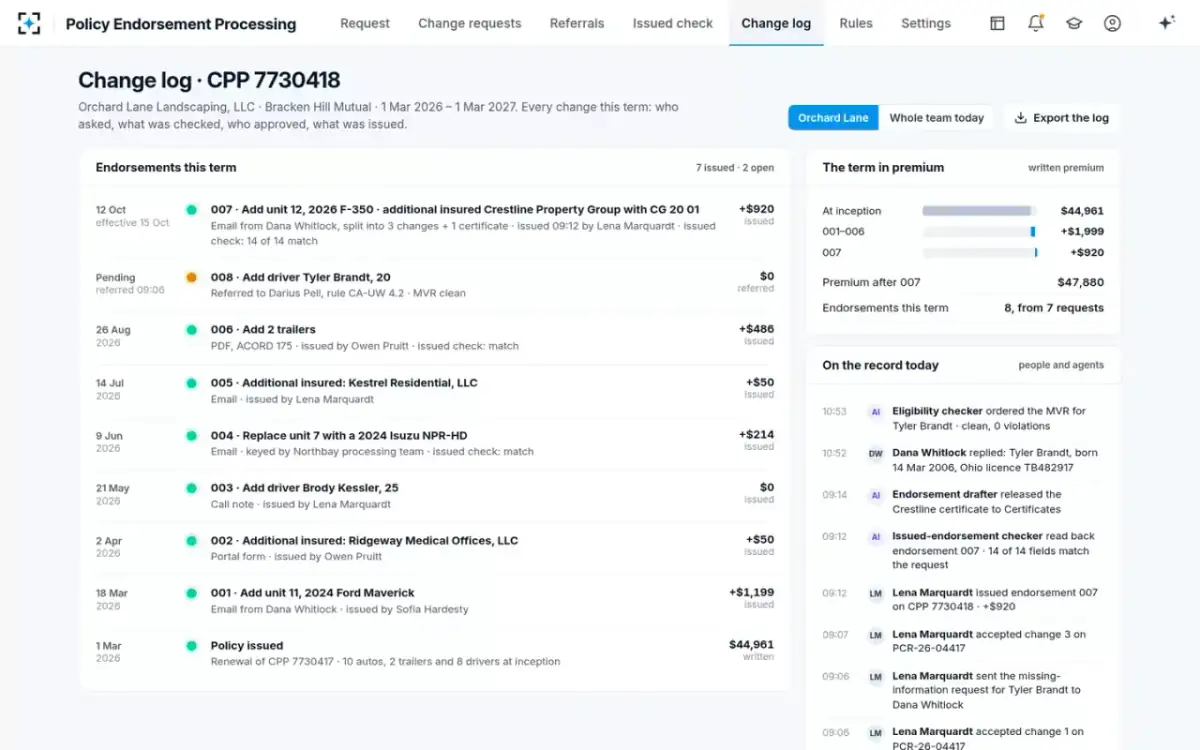
Every change this term, who asked, who approved and what was issued
How to make sure a requested vehicle reaches the policy
Every control below targets one of the failures in the two cases: a request that was never acted on, a request acted on too late for a clause, or a document that ran ahead of the policy. In Policy Endorsement Processing the request reader logs every change found in an email, the drafter writes the missing-information letter with a reminder after two business days, and the issued-endorsement checker reads each endorsement back within 10 minutes of issue. A desk without software can run the same list by hand.
Closing the gap between a vehicle request and an issued endorsement, as Policy Endorsement Processing does
- Acknowledge every change request the day it arrives, listing each change found
The acknowledgement is the proof of what was asked; in Markel nobody could show the request had been received.
- Split multi-change emails into separate changes
A vehicle and the driver who will drive it are two decisions; one can wait while the other is issued.
- Date the clock from acquisition, not from the email
Where the policy has an after-acquired auto clause, its notice window runs from when the insured acquired the vehicle.
- Ask for missing items in one message, with a reminder
VIN, garaging, the lender for the loss payee clause. Never key a guessed value.
- Issue no certificate or ID card ahead of the endorsement
Route the request, hold it, and release it when the endorsement is issued.
- Read back every issued endorsement against the request
The right VIN on the right unit, from the right date, with the loss payee.
- Keep a change log a stranger could follow
Who asked, what was checked, who approved, what was issued, and the premium.
The order matters as much as the items. The vehicle and its paperwork move together: request acknowledged, change checked and priced, endorsement issued and read back, then the certificate. On the sample request the two changes inside the representative's authority went from the broker's email to an issued, read-back endorsement in 25 minutes. How a desk splits a four-job email like that one is covered in the change request form and the email that isn't.
Questions people ask
What is an example of an E&O claim against an insurance agent?
A customer asks the agent to add a vehicle or a driver, the change never reaches the policy, and a loss follows that the policy does not cover; the customer then sues the agent for the uncovered loss. Skaperdas v. Country Casualty (Illinois, 2015) arose from a request to cover a fiancée who was never made a named insured, after her son was injured.
What are common agency E&O claims examples?
Failing to place a requested change, such as a vehicle, driver, location or limit; placing it wrongly, for example in the wrong role or on the wrong unit; and issuing certificates or ID cards that describe coverage the policy does not give. In Prime v. Kepali an agency issued a certificate and ID cards for a vehicle the insurer had not endorsed.
How do E&O claims against insurance agents and brokers usually turn?
On whether a specific request was made, when, and what the agent did with it. Illinois's statute imposes "ordinary care and skill" in placing "the coverage requested", and its Supreme Court has held the duty arises only after a specific request. An acknowledged, dated request is the strongest evidence on either side.
Is a new vehicle automatically covered on a commercial auto policy?
Only if the policy says so. Some commercial auto policies, like Kepali's, extend coverage to vehicles acquired mid-term if the insurer already covers all the insured's autos or the vehicle replaces one, and the insured gives notice within a window; in Kepali it was 30 days. If the policy covers only specifically described autos with no such clause, the vehicle is uncovered until endorsed.
How do I add a vehicle to a policy mid-term?
Send the agent or insurer the VIN, the date you acquired the vehicle and want coverage from, where it will be garaged and how it will be used, any lender for the loss payee clause, and who will drive it. Ask for written confirmation, and check that the issued endorsement lists the right VIN from the right date before relying on it.
Does the insurer still charge premium if it covers an unendorsed vehicle?
Yes. In Kepali the Eleventh Circuit agreed the insured was "not entitled to free coverage for an additional vehicle" and pointed to the policy's premium audit provision as the way to collect it. Coverage and premium are separate questions: a court can find the first without excusing the second.