To calculate additional premium for an endorsement, find the difference between the annual premium with the change and without it, multiply that difference by the number of days from the change's effective date to the policy's expiry, divide by the number of days in the policy term, and then add any flat charges the carrier's filing applies to the change. That is pro rata additional premium, and it is how most mid-term changes are charged. A $2,318-a-year vehicle added with 137 of 365 days left costs $870 this term. The difficult parts are not the formula: they are counting the days correctly, knowing which charges are flat and which are prorated, applying the carrier's minimums, and showing the working so that the bill does not become a complaint. Botminds' Policy Endorsement Processing has a premium rater agent that calls the carrier's rating engine and shows every line.
The example worked through on this page is fictional sample data: a commercial package policy, CPP 7730418, issued by an invented carrier to Orchard Lane Landscaping for 1 March 2026 to 1 March 2027, and a new 2026 Ford F-350 dump truck added from 15 October. The rules quoted from regulations, statutes and the Casualty Actuarial Society are real.
Endorsement 007 on the sample policy, in four numbers
$2,318
annual premium of the added truck, from the rating engine
137of 365
days of the term left on the effective date
$870
the truck’s pro rata premium for this term
$920
total additional premium, with a $50 flat charge
How do you calculate additional premium for an endorsement?
Additional premium = (annual premium after the change − annual premium before it) × (days from the effective date to expiry ÷ days in the term) + flat charges. For a vehicle or location added, the "before" premium for that item is zero, so the first bracket is simply the item's annual premium. For a limit increase or a deductible decrease, it is the difference between the two annual premiums for the coverage. The result is the premium for the part of the term the change is in force.
Actuaries describe the same thing from the other side. The Casualty Actuarial Society's ratemaking text works an example in which a policy running from 1 July to 30 June is changed on 1 January and its full-term premium rises from $400 to $800; "This policyholder will ultimately pay $600 (=$400 x 0.5 + $800 x 0.5)." That is the pro rata method stated as a blend: each premium for the share of the term it applied to. The additional premium on the endorsement is the $200 difference.
The worked example, line by line
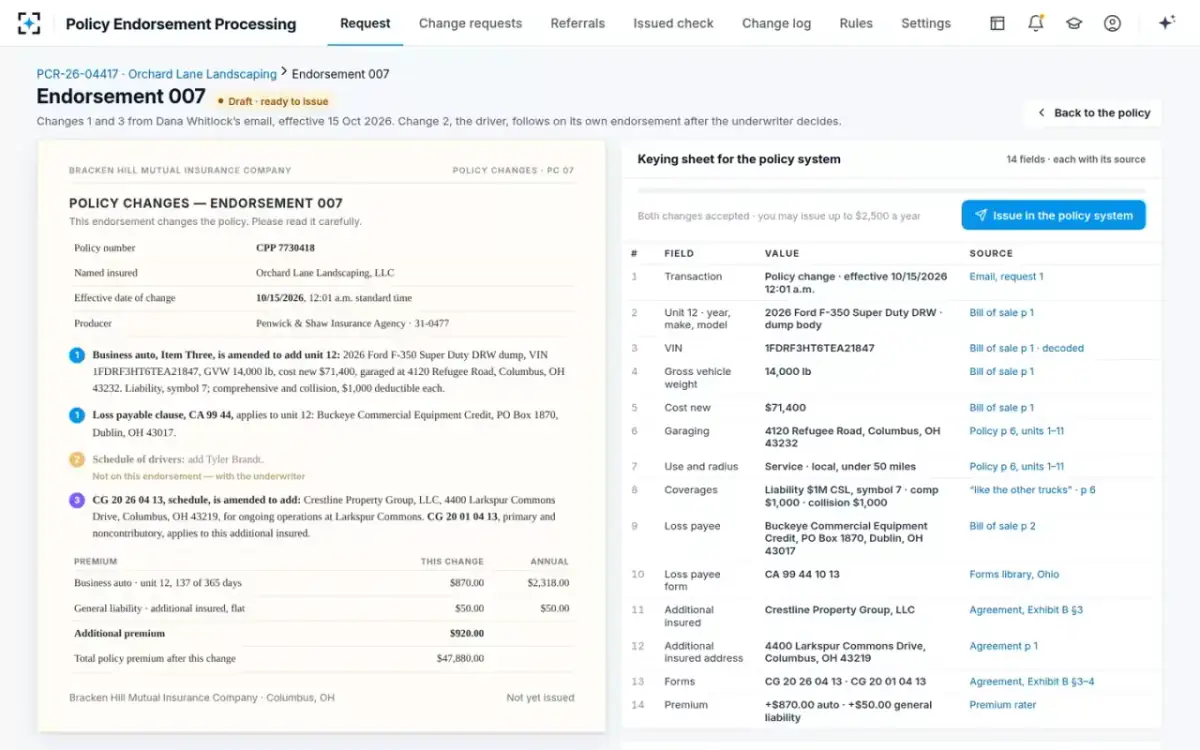
The sample endorsement adds a truck and an additional insured on the same effective date, so it shows both a prorated charge and a flat one. Each line below is a line the premium rater shows on the endorsement it drafts; the annual premium comes from the carrier's rating engine, which prices the new truck the way it prices units 4 and 5, the other F-350 dump trucks on the policy.
Endorsement 007 in Policy Endorsement Processing, worked to the dollar
1
Annual premium of the change
Liability $1,402 + comprehensive $318 + collision $598, rated like units 4 and 5
$2,318.00
2
Days left in the term
15 Oct 2026 12:01 a.m. to expiry, 1 Mar 2027 12:01 a.m.
137 days
3
Days in the term
1 Mar 2026 to 1 Mar 2027
365 days
4
Pro rata factor
137 ÷ 365
0.37534
5
Pro rata premium for the truck
$2,318 × 0.37534 = $870.04, rounded to whole dollars
$870.00
6
Flat charge: additional insured on CG 20 26
Filed as a flat charge, not prorated
$50.00
7
Primary and noncontributory, CG 20 01
No premium on this policy
$0.00
8
Additional premium, endorsement 007
Lines 5 + 6 + 7
$920.00
9
Total policy premium after the change
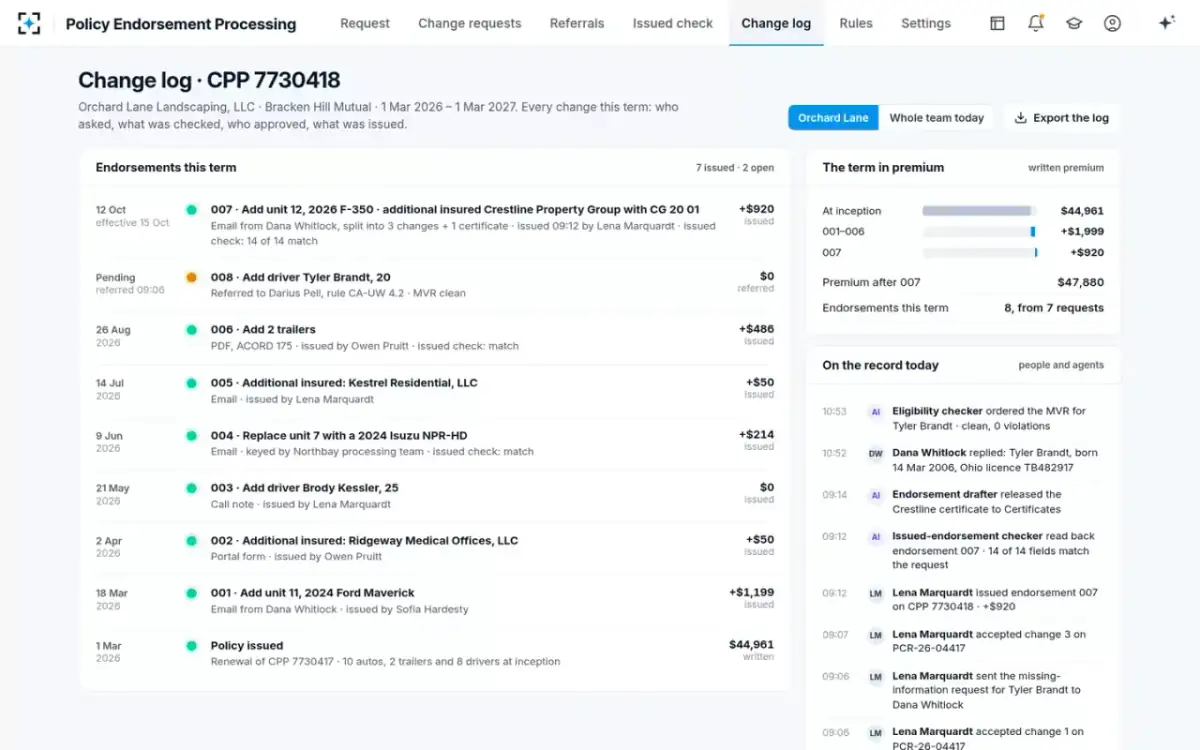
$46,960 before + $920
$47,880.00
Three details in that table are where hand calculations go wrong. The rounding happens once, at the end of the prorated line, not on the factor; $2,318 × 0.375 would give $869.25. The flat charge is not prorated, because the filing makes it a flat charge; prorating it would bill $18.77 instead of $50. And the authority check runs on the annual change, not the pro rata one: the sample representative may issue premium changes of up to $2,500 a year, and this endorsement's annual effect is $2,368, so it stayed with her even though only $920 is billed this term.
The endorsement as the insured reads it, with the premium lines Policy Endorsement Processing shows
How to count the days: effective time, expiry and leap years
Count from the effective date of the change to the expiration date, treating both as the same time of day, usually 12:01 a.m. standard time, and divide by the number of days in the term. A change effective 15 October on a policy expiring 1 March has 137 days left: 17 in October counting the 15th, 30 in November, 31 each in December and January, and 28 in February. Counting both end dates, or neither, moves the answer by a day, which on a large premium is real money and on any premium is an error an auditor will find.
The term length is not always 365. A term that includes 29 February has 366 days, and using 365 as the denominator then overcharges slightly. The same truck added on the same date a year later shows the effect.
The same change in a normal year and a leap year
| Term | Effective date | Days left | Days in term | Pro rata premium | With 365 used by mistake |
|---|---|---|---|---|---|
| 1 Mar 2026 – 1 Mar 2027 | 15 Oct 2026 | 137 | 365 | $870.04 | $870.04 |
| 1 Mar 2027 – 1 Mar 2028 | 15 Oct 2027 | 138 | 366 | $874.00 | $876.39 |
Short terms and odd terms work the same way. A six-month policy divides by the days in its six months; a policy extended by endorsement to a new expiry date has a new term to divide by. The one thing that should never change is the convention: the rater, the policy system and the person checking the bill must all count days the same way.
How to calculate pro rata additional premium when the rate changes mid-term
Prorate each rate over the part of the term it applies to, using the rates in force under the carrier's filing for that change. Which rates those are, the ones in effect when the policy began or the ones in effect on the endorsement date, is set by the filed rules, not by the person calculating. The federal flood program writes its version into regulation: for new or increased coverage during the term, "The additional premium for any new coverage or increase in the amount of coverage will be calculated pro rata in accordance with the rates currently in force."
For a private carrier the rating engine already knows which rate table applies on which date, which is the main reason a premium rater should call it rather than hold a copy of the rates. The rater's own job is the proration and the presentation. The Casualty Actuarial Society's $400-to-$800 example is the general case: the policyholder pays each premium for its share of the term, and the endorsement bills the difference for the share remaining.
Same change, different date: why timing moves the bill
The annual premium of a change is fixed by the rate; what the insured pays for it this term is set by the date. The same $2,318 truck costs anywhere from the full $2,318 on the first day of the term to $178 a month before expiry. That is why an effective date keyed wrong is a premium error as well as a coverage error, and why the effective date is the field the sample desk's read-back finds wrong most often.
One $2,318-a-year truck, added on five dates in the same term
Flat charges, minimum premiums and no-premium forms
Not everything on an endorsement is prorated. Flat charges, such as the sample policy's $50 for adding an additional insured, are billed in full whatever the date, because the filing says so. Some forms carry no premium at all: on the sample policy the primary and noncontributory endorsement the client's contract required, CG 20 01, was added at $0. And minimum premium rules can lift a small prorated charge, or a whole policy's premium, to a floor.
The reason for minimums is expense. The Casualty Actuarial Society explains that a minimum premium requirement "is intended to ensure that, on an individual risk basis, premium covers the expected fixed expenses plus some minimum expected loss, as determined by the company." Minimums live in the carrier's rating manual and vary by carrier and line, so a calculation that leaves them out is incomplete and one that invents them is wrong. The sample premium rater applies minimums as filed and never waives one; a waiver, where a carrier allows it, is a person's decision.
Return premium: the same arithmetic in reverse
A change that removes exposure, such as deleting a vehicle or lowering a limit, returns the unearned share of its annual premium by the same formula. If the sample insured had deleted unit 10, a $1,349-a-year pickup, on 15 October, the return would be $1,349 × 137 ÷ 365 = $506.34. A replacement, one vehicle off and another on the same day, nets the two: the sample policy's endorsement 004 replaced a unit with a newer truck for a net $214.
Return premium is where processing errors become regulatory findings, because the money belongs to someone else. New Jersey's examiners, in a 2005 report on a medical liability insurer, described the mechanism plainly: "Negative endorsements result in credit balances and occur as a result of changes in risk or timing in posting premium to the account." They tested whether those credit balances were refunded within the state's 60-day guideline and cited the files where they were not. That report is old, but the NAIC's current examination standards still test whether unearned premium is calculated correctly and returned on time.
Short rate vs pro rata: which applies to a mid-term change?
Pro rata applies to mid-term endorsements in the ordinary case, and to cancellations by the insurer. Short rate, where a policy or filing allows it, applies when the insured cancels early: the insurer keeps more than the pro rata share of the premium. The Casualty Actuarial Society's text puts it this way: a short rate table "entitles the company to retain an amount of premium that is greater than the pro rata amount of premium for the time expired on the coverage period", to cover expenses incurred at the start of the policy or a risk concentrated in part of the year.
Pro rata and short rate, side by side
Pro rata: Exactly the share of the term in force: days in force ÷ days in term.
Short rate: More than the pro rata share for the time expired, per a table or rule.
Pro rata: Mid-term endorsements; insurer-initiated cancellations.
Short rate: Cancellation requested by the insured, where the filing allows it.
Pro rata: Premium follows exposure day by day.
Short rate: Expenses incurred at inception; seasonal risk.
Pro rata: Some statutes require it outright, such as Florida for motor vehicle refunds.
Short rate: Florida motor vehicle: the insurer may keep at most 10% of the unearned premium when the insured cancels.
Pro rata: Used: $2,318 × 137 ÷ 365.
Short rate: Not relevant: nothing was cancelled.
Florida's motor vehicle statute shows how a state can combine the two. When the insured cancels, the insurer may keep no more than a tenth of the unearned premium and refunds the rest (Fla. Stat. §627.7283; the deadlines for that refund are in how long an insurer has to refund premiums); when the insurer cancels, it refunds all of it; and either way the unearned premium is computed pro rata. A desk that writes in several states needs each state's rule and each filing's, which is one more reason the calculation belongs in a system that knows both.
Showing the working stops the bill becoming a complaint
A mid-term bill with no working invites the question "why this amount?", and the question costs more than the answer. In our count of the Texas Department of Insurance's complaint data, 190 complaints closed in 2025 named an endorsement or rider as a reason; 63 of them also named premium and rating, and 35 a refund of premium (TDI open data, our count). A bill that states the annual figure, the days and any flat charge answers most of those questions before anyone asks.
The same working is what an examiner checks against the filed rates and what a broker forwards to the insured. In Policy Endorsement Processing the premium rater shows it on every change, and the agents' answers point to it: asked how the $870 was worked out, the sample answer gives the three coverage premiums, the 137 of 365 days and the $50 flat charge. Who may accept a change once it is priced is covered in who has authority to make changes to an insurance policy, and how the rater fits a carrier's own rating engine in an endorsement automation tool that fits the policy system you keep.
The term in premium: inception, six endorsements, and the seventh
Questions people ask
What is the pro rata premium calculation formula?
Pro rata premium = annual premium × (days the coverage is in force ÷ days in the policy term). For an endorsement, use the change in annual premium and the days from the effective date to expiry; on the sample truck, $2,318 × 137 ÷ 365 = $870.04.
Is there a pro rata endorsement premium calculator?
Any spreadsheet will do the arithmetic: annual change × days left ÷ days in term, plus flat charges. The risk is in the inputs, the day count, the right annual premium and the carrier's flat charges and minimums, which is why a carrier's own rating engine should supply the annual figure.
Are mid-term endorsement premium rates the same as at inception?
That depends on the carrier's filed rules: some changes are rated at the rates in effect when the policy began, others at the rates in force on the endorsement date. The federal flood program, for one, prorates increases at "the rates currently in force," under 44 CFR 61.11(e).
Is additional premium charged from the request date or the effective date?
From the effective date of the change, which the request should state and the endorsement records. A request received after the date it asks for raises a separate question, whether the carrier will backdate cover at all; on the sample desk an effective date more than 15 days back goes to an underwriter.
What is an example of a return premium endorsement?
Deleting a vehicle mid-term. On the sample policy, removing a $1,349-a-year pickup with 137 of 365 days left would return $506.34. Examiners test that unearned premium is calculated correctly and returned to the right party on time.
Does a representative's authority limit apply to the annual or the pro rata premium?
It depends on how the carrier writes its authority matrix; the sample carrier sets it on the annual change, up to $2,500 a year. Measuring authority on the pro rata amount would let a large change through late in the term simply because little of the term was left.