An endorsement request email should identify the policy and the first named insured, give the effective date, and describe each change with the details it needs: for a vehicle, the VIN, garaging, use and any lender; for a driver, the date of birth and licence number and state; for an additional insured, the exact legal name and address and the contract that requires it. Requests stall on a short list of missing items, and each missing item costs a round of email between insured, broker and carrier while the change, and sometimes the coverage, waits. The loop is shortest when whoever reads the request names every missing item in the first reply, explains why it is needed, and says what is being done meanwhile. Botminds' Policy Endorsement Processing drafts that reply for the service representative to read and send, with a reminder if the answer does not come.
The desk, broker and policy on this page are fictional sample data: a commercial service desk at an invented carrier, Bracken Hill Mutual, and a request from the broker Penwick & Shaw for its insured, Orchard Lane Landscaping. The court decisions, regulation and complaint data are real and linked.
What should an endorsement request email include?
Everything an underwriter would need to accept the change without asking a question. In practice that is the policy number and insured, who is asking, the effective date and time, each change listed separately, and the details specific to each kind of change. Attachments help when they are the source: a bill of sale for a vehicle's VIN and cost, a contract for an additional insured's name and wording, a statement of values for a location.
What it should not do is rely on the reader to fill gaps. A request that says "add our new hire to the policy" without a date of birth cannot be underwritten; one that says "add the client as additional insured" without the contract cannot be issued correctly, because the contract decides which form, and sometimes which extra wording, the endorsement needs. The sample request below shows both kinds of gap in one message, and how they were closed.
What is an endorsement request in insurance?
It is a request to change an in-force policy by endorsement: to add, remove or alter a vehicle, driver, location, insured, coverage, limit or deductible from a stated date. It can come from the insured, usually through an agent or broker, as an email, a portal form, a phone call or a standard change request form; it becomes part of the policy only when the insurer issues the endorsement. The policy's changes clause usually reserves the right to request changes to the first named insured.
The request is also evidence. Illinois's Supreme Court held in Skaperdas v. Country Casualty (2015) that a producer's statutory duty of ordinary care arises once a specific request is made, and that a vague request to make sure the insured is covered does not create it. A specific, dated request is what both sides point to when a claim arrives and the change is not on the policy.
The rework loop: how a change request goes back and forth
The loop starts when a request arrives incomplete and ends when every item needed to decide it is in hand. Each pass through it costs at least one email in each direction and often a call, and it can repeat when the first reply asks for one missing item and the answer reveals another. On the sample request, the driver's date of birth and licence number were missing; the reply asking for both went out at 09:06, 19 minutes after the request arrived, and the broker answered at 10:52.
The rework loop on one change request in Policy Endorsement Processing
Agent
Read and splitEach change in the email and attachments, with the sentence it came from.
Never: guessing a value the request does not give.
Agent
Check what is missingEach change against what its type needs and against the policy and attachments, which often answer half the questions.
Agent
Draft one replyEverything already being done, every missing item numbered, why it is needed, and what to do meanwhile.
Never: sending anything; a person reads and sends.
A person decides
Representative sendsReads the draft, edits if needed, sends it to the broker.
Agent
RemindA reminder to the broker after two business days without an answer, then the team lead.
A person decides
Decide and issueWith the answer in, the change is accepted within authority or decided by an underwriter, then issued.
Agent
Read backThe issued endorsement against the request, field by field.
Never: closing a mismatch on its own.
Two things make the loop long, and neither is the broker's slowness. The first is asking piecemeal: a reply that asks for the date of birth, followed by another asking for the licence once the date arrives, doubles the loop. The second is asking for what the carrier already has: garaging that matches the other vehicles on the policy, or limits already on the declarations. Checking the request against the policy before writing the reply removes both.
The items that send a request back
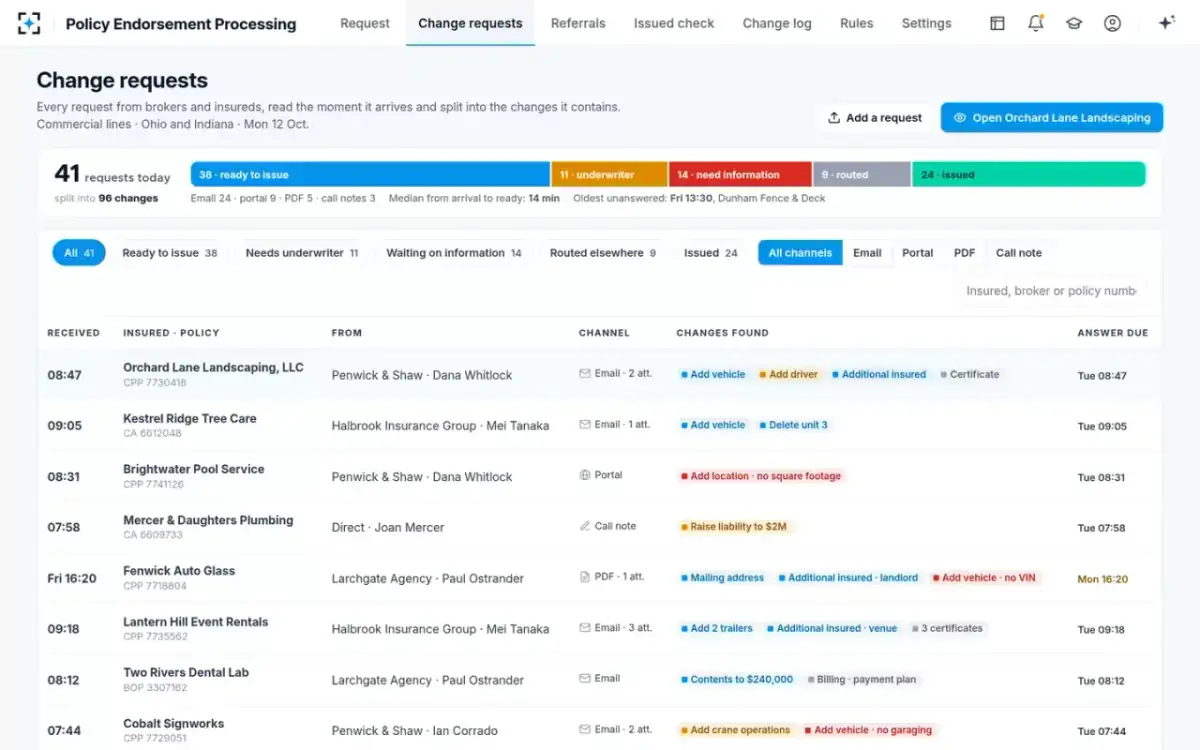
The same few details account for most returned requests, and each is predictable from the type of change. On the sample desk's Monday, the requests waiting on brokers included a vehicle with no VIN, a location with no square footage, a vehicle with no garaging address and a driver with no date of birth or licence number. Fourteen changes in twelve requests were waiting on information that morning.
The items that send an endorsement request back, by type of change
- Effective date
Written, not implied. “Thursday the 15th” can be resolved against the email’s date; “as soon as possible” cannot.
- Vehicle: VIN and lender
The full 17-character VIN from the title or bill of sale, and the lienholder for the loss payee clause if it is financed.
- Vehicle: garaging and use
Where it is kept and what it is used for, if different from the vehicles already on the policy.
- Driver: date of birth, licence number and state
Without them the motor vehicle record cannot be ordered and the driver cannot be underwritten.
- Additional insured: exact legal name, address and the contract
The contract’s insurance exhibit decides the form and any extra wording, such as primary and noncontributory.
- Location: address, construction, square footage, values
The rating and inspection details for a new site.
- Limit change: the amount and the reason
Often a contract requirement; limit increases usually need an underwriter.
- Who is asking
The first named insured, directly or through its broker; a lender or client asking on its own is routed back through the insured.
The queue shows what each request is waiting for
One reply, not five: writing the missing-information letter
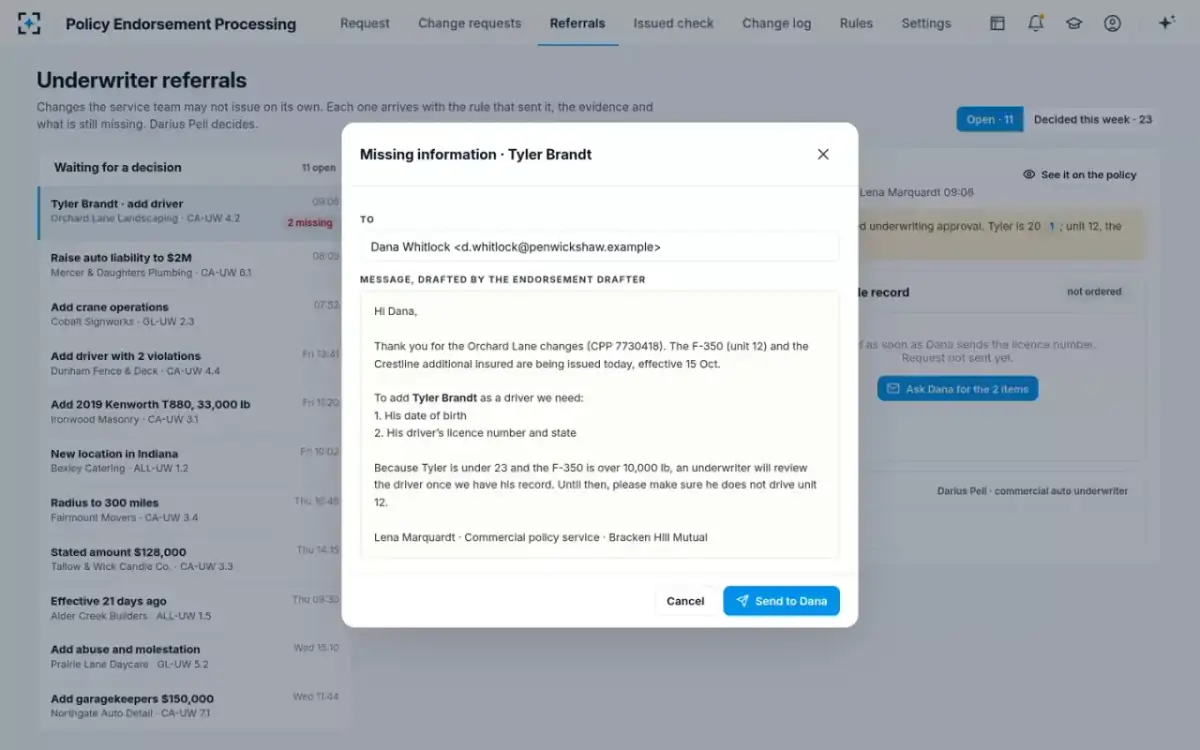
The first reply should do four things: say what is already being done, list every missing item, say why the items matter, and say what the insured should do meanwhile. The sample letter, drafted by the endorsement drafter and sent by the representative at 09:06, does all four in five lines.
A missing-information reply from Policy Endorsement Processing that ends the loop in one round
To Dana Whitlock, Penwick & Shaw · from Lena Marquardt, Commercial policy service · 09:06
Thank you for the Orchard Lane changes (CPP 7730418). The F-350 (unit 12) and the Crestline additional insured are being issued today, effective 15 Oct.
Says what is done first, with the policy number and the effective date, so the broker can tell the insured.
To add Tyler Brandt as a driver we need: 1. His date of birth 2. His driver’s licence number and state
Every missing item, numbered, in one message. Nothing that the policy or the attachments already answer.
Because Tyler is under 23 and the F-350 is over 10,000 lb, an underwriter will review the driver once we have his record.
Why the items matter, in plain words, so the broker does not send half of them.
Until then, please make sure he does not drive unit 12.
What the insured should do meanwhile: the driver is not yet on the policy.
The last line matters more than it looks. The driver was not on the policy, and the truck he was hired to drive was. A reply that asks for his details without saying he is not yet covered leaves the insured to assume he is. Two other changes in the same email were issued that morning, so the letter also stops the broker from chasing them.
The reply, drafted for the representative to read and send
Why the date a request arrives matters
Because coverage, premium and liability can turn on it. Under the federal flood program's rule, for example, coverage added by endorsement takes its waiting period from the request date only if the endorsement and premium reach the insurer within ten days, or are sent by certified mail within four; otherwise it runs from the date of receipt (44 CFR 61.11(f)). Private auto policies with an after-acquired vehicle clause can make cover depend on the insurer being told within a set period after purchase.
Arrival also matters when nobody acts. In Markel Insurance Co. v. Rau, an insured emailed its agency to put an ambulance back on its fleet policy; the agency said it never saw the email, no endorsement was issued, and the ambulance was uncovered when it crashed nine months later. Market conduct examiners look at the same thing from the regulator's side: one review procedure in the NAIC Market Regulation Handbook (2017 edition) is to "Ensure that policyholder requests are processed as soon as reasonably possible." An acknowledgement that lists each change found, sent the day the request arrives, is the cheapest protection a desk has. Who pays when it does not happen is set out in insurance agent failed to add a vehicle to the policy.
What the delay costs: when changes wait, complaints follow
Complaints about endorsements are rarely only about the endorsement. In our count of the Texas Department of Insurance's complaint data, 190 complaints closed in 2025 named an endorsement or rider as a reason; most named something else as well, and policyholder service led the list.
What else 190 Texas endorsement complaints named, 2025
The shape of that list is the argument for a short loop. Service and delay complaints are about the conversation, and a request that comes back once, with every item asked and the meanwhile stated, is a shorter conversation. Premium complaints are about the bill, which a change that is explained line by line, as in how to calculate additional premium for endorsements, answers in advance. The claim-related reasons are the endorsements that reached a loss before anyone noticed what was missing.
How the sample desk keeps the loop short
With three settings and a read-back. The desk promises an answer to every request within one business day, where an answer means issued, referred, or asked for what is missing. A broker who has not supplied missing information gets a reminder after two business days, then the team lead is told. And every issued endorsement is read back against the request before the documents go out, so a request completed in a hurry is not issued wrongly. On the sample Monday, the median time from a request's arrival to ready was 14 minutes, and the oldest unanswered request was from Friday afternoon.
None of that removes the broker's part. The details only the insured has, a new driver's licence number or a new client's contract, still have to come from the insured. What a desk can do is ask once, ask for all of it, and make the first reply useful enough that the broker can forward it unchanged. The same discipline applied to the request form itself is covered in the change request form and the email that isn't.
Questions people ask
How do I write an endorsement request letter?
Name the policy and insured, give the effective date, list each change separately with its details, and attach the documents that are the source, such as a bill of sale or contract. Ask for written confirmation listing each change. A letter that covers the checklist above will rarely come back.
Is there an endorsement request form?
Yes: agencies and carriers use standard change request forms, including the ACORD forms used in commercial lines, and carriers may have their own portal forms. The federal flood program publishes its own general change endorsement form. A form helps by leaving blanks visible; it does not read the contract behind an additional insured.
What should a policy change request template include?
Policy number, first named insured, who is asking, effective date and time, and one section per change: vehicle (VIN, year, make, model, garaging, use, lender), driver (name, date of birth, licence number and state), additional insured (name, address, contract), location (address, construction, area, values), limit or deductible (coverage, amount, reason).
How should an insurance agent write a policy change letter to the carrier?
As the insured's request, made specific: what changes, from when, with the details and documents, and with anything the agent knows the carrier will ask. Keep the insured's own words for anything ambiguous, such as "full coverage like the other trucks," so the carrier can resolve it against the policy rather than the agent's paraphrase.
How long does an endorsement request take?
As long as the slowest missing item. On the sample desk, two changes from one email were issued and read back 25 minutes after it arrived, while the third waited 106 minutes for the broker's reply about the driver and then went to an underwriter. The desk's promise is an answer, issued, referred or asked, within one business day.