Authority to make changes to an insurance policy is split three ways. The first named insured is the party entitled to ask for changes; the insurer is the party that agrees to them, and it does so by issuing an endorsement; and in between, only people licensed and authorised for that kind of change may accept it on the insurer's or agency's behalf. An agent or customer service representative who takes a request does not, by taking it, change the policy, and in Texas the insurance code says in so many words that the agent's role does not include altering a policy's terms. For a commercial service desk, the practical question is which changes each person may accept, which go to an underwriter, and how that is recorded. Botminds' Policy Endorsement Processing checks every change request against the carrier's rules and each representative's authority before anyone accepts it.
The desk examples on this page come from a fictional sample carrier, Bracken Hill Mutual, and its invented staff and insureds. The policy clause, court decisions and statutes are real and linked.
Five questions that decide who may accept a policy change
1
Does the request come from the first named insured?
YesDirectly, through its broker or from someone it has authorised: go on.
If notTake the request, but route it back: the change needs the first named insured’s instruction.
Insured
2
Does it change coverage, limits, insureds or terms?
YesThen only an endorsement issued by the insurer makes it.
If notA correction of a typo or an address may still need an endorsement; check the policy system’s rules.
Insurer
3
Does accepting it bind coverage or advise on its terms?
YesThe person accepting must hold the licence the state requires.
If notClerical intake, by an unlicensed employee within the state’s exemption.
Licensed person
4
Is it inside that person’s written authority?
YesThe representative accepts and issues.
If notIt goes to an underwriter with the rule that sent it.
Representative or underwriter
5
Is the effective date in the past?
YesBackdating follows the carrier’s filed rules; on the sample desk, more than 15 days back goes to an underwriter.
If notEffective from the date requested, once accepted.
Per the rules
What the policy itself says: the changes clause
Most commercial policies answer the question in a short clause in their common conditions. The version quoted by Maryland's highest court in 2022 reads: "This policy contains all the agreements between you and us concerning the insurance afforded. The first Named Insured shown in the Declarations is authorized to make changes in the terms of this policy with our consent. This policy's terms can be amended or waived only by endorsement issued by us and made a part of this policy."
Three rules sit in those three sentences. Only the first named insured, the insured listed first on the declarations, may ask for changes. The insurer must consent. And consent takes one form: an endorsement the insurer issues. The Maryland court also observed that nothing in the policies before it required the insurer or the first named insured "to obtain the consent of any other Named Insured or any other person or entity before exercising the right of cancellation or agreeing to a change in terms." In that case, settlements between insurers and landlords that reduced lead paint coverage bound tort claimants who did not yet hold judgments, provided the settlements were made in good faith.
Who may ask for a change? The first named insured, and everyone else
The first named insured may ask; everyone else can only tell the insured, or its broker, what they need. A request from a second named insured, a subsidiary's office manager, a lender or a client holding a certificate may be entirely sensible, but the policy gives the first named insured the right to make it. A desk that acts on anyone's email is relying on the insurer's consent to cure an instruction the policy did not authorise.
In practice most requests reach a commercial desk through the broker, quoting the insured. On the sample request, Crestline Property Group needed to be an additional insured because its contract with Orchard Lane said so, but the request came from Orchard Lane's owner, through the broker, with the contract attached. That is the right shape: the party with the contractual need supplies the document, and the party with the right to change the policy asks. When a lender writes directly to add itself as loss payee, or a client writes to be added as an additional insured, the safe answer routes the request back through the insured and records that it did.
The rule cuts the other way too. Because only the first named insured and the insurer are needed to change the policy, a change that reduces coverage, agreed between them in good faith, can bind others who relied on the old terms, as the tort claimants in the Maryland case found. When a reduction is the insurer's idea rather than the insured's, some states treat it as something else entirely.
Who can alter an insurance policy? Not the agent, on its own
An agent can take and pass on a request, and in some cases bind coverage under a binding authority, but altering the terms of an issued policy is the insurer's act. Texas writes this into its code twice. The section that makes a person the insurer's agent for receiving applications and premiums adds that it "does not authorize an agent to orally, in writing, or otherwise alter or waive a term or condition of an insurance policy or an application for an insurance policy" (Tex. Ins. Code §4001.051(c)); the next section repeats that the soliciting agent "may not alter or waive a term or condition of the application or policy" (§4001.052(b)).
Courts read the changes clause the same way. In Markel Insurance Co. v. Rau, the Seventh Circuit noted that the agency had to send a written request to the insurer to initiate a change and that the agency "did not itself have the authority to make changes"; a vehicle the insured had asked the agency to add was not covered because the insurer never endorsed it. In Prime v. Kepali, an agency issued a certificate and ID cards for a vehicle with no authority from the insurer to do so; the court found coverage through the policy's after-acquired auto clause, not through the agency's documents. What happens to the insured when a requested change never arrives is the subject of who pays when an agent fails to add a vehicle.
Who can make changes to an insurance policy in Texas?
The first named insured asks, the insurer endorses, and anyone in between who handles the request for the insurer is treated as its agent for the code's duties and liabilities, without the power to alter the policy. Texas defines that agency broadly: a person who receives or transmits an application or a policy, or receives, collects or transmits premium, for an insurer is its agent for the code's purposes (§4001.051(b)). Purely clerical salaried staff in an agent's office are exempt from licensing if they take no commission and are not involved in soliciting or negotiating insurance (§4001.002(b)(5)).
For personal auto and homeowners policies Texas adds a rule about what kind of change the insurer may make without the insured's consent: reducing coverage by endorsement counts as a cancellation, with the cancellation rules attached. That is covered in the guide on policy change vs endorsement.
Who can make changes to an insurance policy in Florida?
The same parties, with a sharper rule about binding: an unlicensed agency employee may not bind coverage, and the clerical exemption covers incidental quoting and premium-taking on incoming inquiries in the office, for salaried staff paid no commission. A licensed customer representative works inside the agency's office, and the agency answers for what the representative does within the appointment.
Texas and Florida on the people between the insured and the insurer
Texas Insurance Code: Anyone who, among other acts, receives or transmits an application or policy, or collects premium for the insurer (§4001.051(b)).
Florida Statutes: An agency is responsible and accountable for its customer representatives’ acts within their appointment (§626.7354).
Texas Insurance Code: Not authorised for an agent, orally or in writing (§4001.051(c), §4001.052(b)).
Florida Statutes: By endorsement from the insurer, under the policy’s changes clause.
Texas Insurance Code: Follows the agent’s licence and the binding authority the insurer gives it.
Florida Statutes: An agency employee “may not bind insurance coverage unless licensed and appointed as an agent or customer representative” (§626.0428(2)).
Texas Insurance Code: Full-time salaried clerical and administrative staff, incidental information-taking and premium receipt, no commission (§4001.002(b)(5)).
Florida Statutes: Full-time salaried clerical staff with incidental applications, quotes or premiums on incoming inquiries, no commission (§626.0428(1)).
Texas Insurance Code: Unlicensed: intake and administration. Licensed: within appointment and authority.
Florida Statutes: Unlicensed: no binding. Licensed customer representative: within the agency’s office and authority.
The NAIC's model producer licensing act draws a similar line. It exempts insurer and producer employees whose activities are clerical and "only indirectly related to the sale, solicitation or negotiation of insurance", and separately those whose function relates to underwriting or to processing claims, provided they take no commission (Model #218, §4B(1)). Underwriting staff deciding a referral are inside that exemption; a service representative explaining what a new endorsement covers may not be.
Can a CSR bind coverage?
Only if licensed for it and authorised to. Binding is licensed activity: in Florida an unlicensed agency employee may not bind coverage at all, and a clerical exemption anywhere covers taking information, not committing the insurer. A licensed CSR binds within the agency's binding authority from the insurer, or, at a carrier, accepts changes within the authority matrix the carrier gives each role.
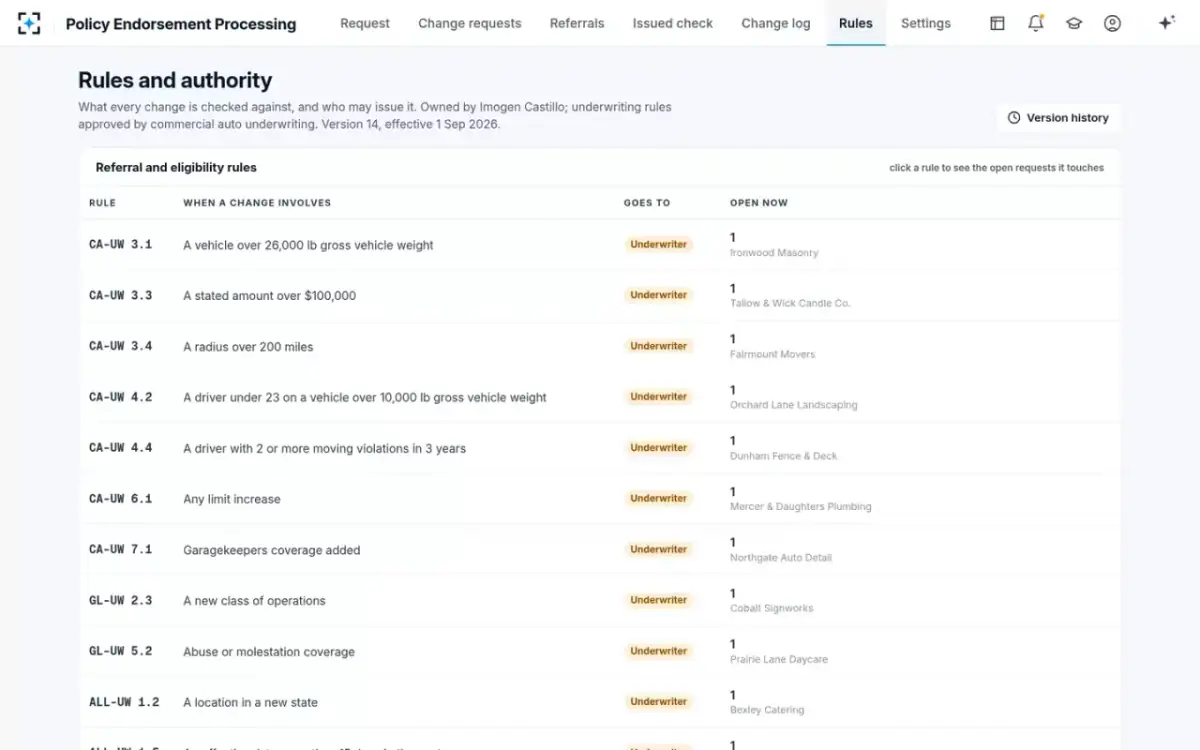
Authority matrices are written in limits and rules. The sample carrier lets a commercial service representative issue premium changes of up to $2,500 a year and sends a list of changes to an underwriter by numbered rule: a vehicle over 26,000 pounds, a stated amount over $100,000, a radius over 200 miles, a driver under 23 on a vehicle over 10,000 pounds, a driver with two or more moving violations in three years, any limit increase, garagekeepers coverage, a new class of operations, abuse or molestation coverage, a location in a new state, and an effective date more than 15 days back. In Policy Endorsement Processing the eligibility checker applies those rules to each change and cites the one that applies; it never approves a referral.
Rules and authority in Policy Endorsement Processing: each rule, where it sends the change
Effective date: when does a policy change bind?
When the insurer, or someone with authority to bind for it, accepts the change, from the effective date the change states. The effective date belongs in the request; a desk that guesses it creates coverage nobody asked for, or none where someone did, which is why the sample request reader never supplies an effective date the request does not contain. Receipt matters too: a request sitting with an intermediary has not reached the party who can accept it.
The federal flood program shows how much turns on receipt. For coverage added by endorsement, a payment to an agent "does not constitute payment to the NFIP"; if the endorsement and premium reach the insurer within ten days of the request, the waiting period runs from the request date, and if not, from the date of receipt (44 CFR 61.11(f)). Private policies set their own rules, but the logic is the same: the date that counts is the one on which a party with authority had the request.
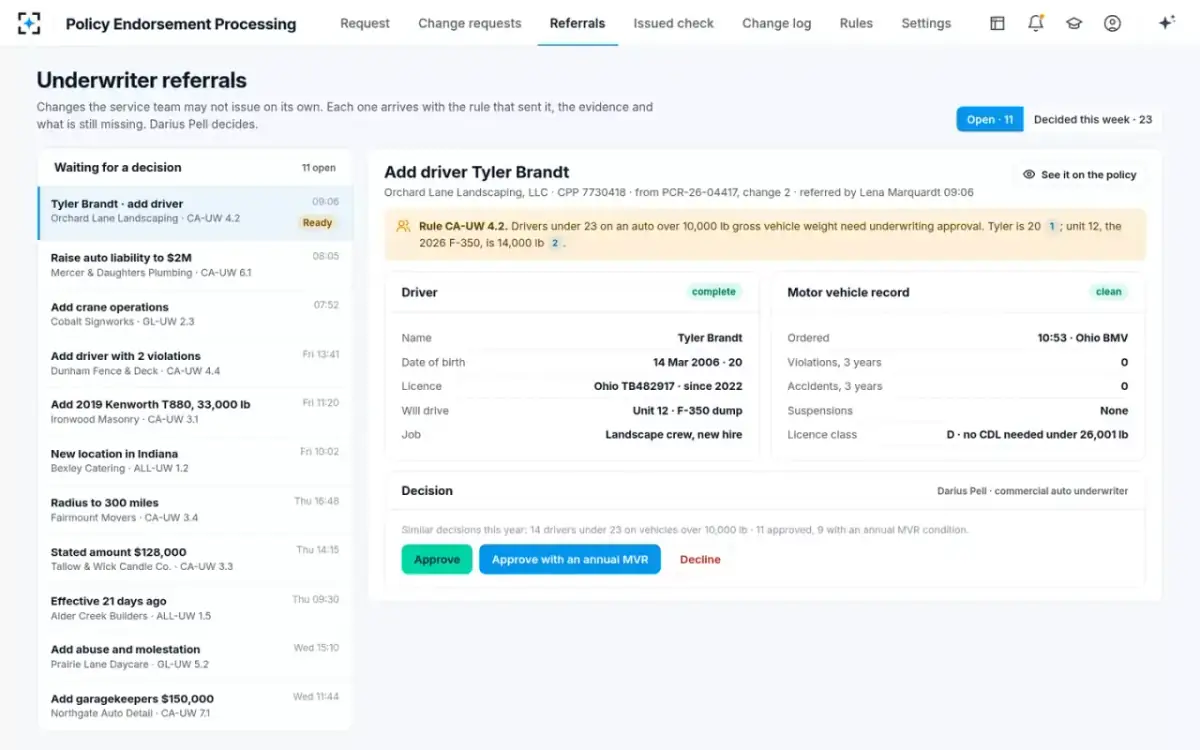
Backdating, making a change effective before the date it was requested, follows the carrier's filed rules and state law, and it is a decision for someone with authority, not a keying choice. On the sample desk, an effective date more than 15 days in the past goes to an underwriter under rule ALL-UW 1.5; one of the open referrals in the sample queue is exactly that, a change effective 21 days ago.
A referral arrives with the rule, the driver, the vehicle and the record
Writing the authority matrix down
An authority matrix that exists only in senior staff's heads cannot be applied consistently, examined or automated. Writing it down means stating, for each role, the changes it may accept, the premium change it may issue, the rules that send a change elsewhere and to whom, and who owns each rule. The table below shows the roles on a typical commercial change, with what each may do.
Who does what on a commercial policy change
| Role | May | May not | Rests on |
|---|---|---|---|
| First named insured | Ask for changes; agree to reductions in coverage. | Make the change itself. | The policy’s changes clause. |
| Other named insureds, lenders, certificate holders | Tell the insured or agent what they need. | Instruct a change on their own. | The changes clause; their own contracts with the insured. |
| Agent or broker | Take and pass on requests; bind where licensed and given authority. | Alter or waive policy terms (Texas, in terms). | Licence, appointment, binding authority. |
| Unlicensed service staff | Take information and handle paperwork within the state’s clerical exemption. | Bind coverage (Florida, in terms) or negotiate terms. | State clerical exemption; no commission. |
| Licensed service representative | Accept and issue changes inside the authority matrix. | Approve a referral. | Licence and the carrier’s written authority. |
| Underwriter | Decide referrals: approve, approve with a condition, decline. | Waive filed rates or use unfiled forms. | Underwriting authority and filed rules. |
An authority matrix Policy Endorsement Processing can apply and an examiner can follow
- Name the roles and the licence each must hold
Unlicensed intake, licensed representative, team lead, underwriter.
- Set premium limits on the annual change
The sample matrix: up to $2,500 a year for a representative, above that the team lead.
- List the referral rules with numbers and owners
Driver age and vehicle weight, limit increases, new states, new operations, backdated effective dates.
- Say who may ask
The first named insured, or a named contact it authorises; route other requests back through it.
- Version every change to the matrix
So the rule applied to any change can be shown as it stood on that day.
- Cite the rule on every referral
The underwriter sees why the change came up, not just that it did.
A matrix written this way is what makes software useful at all: the eligibility checker can only apply rules that exist in writing. On the sample desk, the representative accepts and issues inside the matrix, an underwriter decides everything that falls outside it, and the agents' part is to check, cite and draft. How that plays out on one broker email, with one change inside authority and one outside, is traced in insurance policy processing automation software, step by step.
Questions people ask
Can an insurance endorsement be backdated in Florida?
That depends on the carrier's filed rules and the policy, and on whether a loss has already happened, since cover cannot sensibly be bought for a known loss. Treat any backdated effective date as a decision for someone with authority, documented with the reason; on the sample desk anything more than 15 days back goes to an underwriter.
Can another named insured stop the first named insured from changing the policy?
Not under the standard changes clause. In CX Reinsurance v. Johnson, Maryland's highest court noted that nothing in the policies required the insurer or the first named insured to obtain any other named insured's consent before agreeing to a change in terms.
What is the first named insured?
The insured listed first on the declarations page. Common policy conditions give that insured the right to request changes, with the insurer's consent, and usually the right to cancel and the duty to pay premium, on behalf of all insureds.
Can my agent change my policy over the phone?
An agent can take the request by phone, and a licensed agent with binding authority may bind some changes, but the policy changes only when the insurer issues an endorsement. Texas law says an agent may not orally or in writing alter or waive a policy's terms; ask for written confirmation and check the endorsement.
Who signs an insurance endorsement?
The insurer issues it, usually without a wet signature, under the policy's changes clause; the person who accepted the change inside the carrier is recorded in its system. On the sample desk, endorsement 007 shows "Issued 10/12/2026 · L. Marquardt" in its footer, and the change log records who asked, who approved and who issued.