An ACORD policy change request form is the standard industry form an agent or insured uses to ask an insurer for a mid-term change; for commercial policies people search for it as the ACORD 175, the commercial policy change request. Which fillable version to use depends on what your agency and carrier accept, and this page does not reproduce it. What the form does well is make a request complete: one policy, one effective date, each change described against the coverage it alters, with the details an underwriter needs. The trouble is that most change requests do not arrive on it. They arrive as an email from a business owner to a broker, forwarded to the carrier, holding a vehicle, a driver, an additional insured and a certificate in four sentences. Botminds' Policy Endorsement Processing reads that email, splits it into the separate requests a form would have produced, and asks for what is missing.
The desk, the email and the policy on this page are fictional sample data: a commercial package policy issued by an invented carrier, Bracken Hill Mutual, to Orchard Lane Landscaping. The federal flood rules and court decision cited are real.
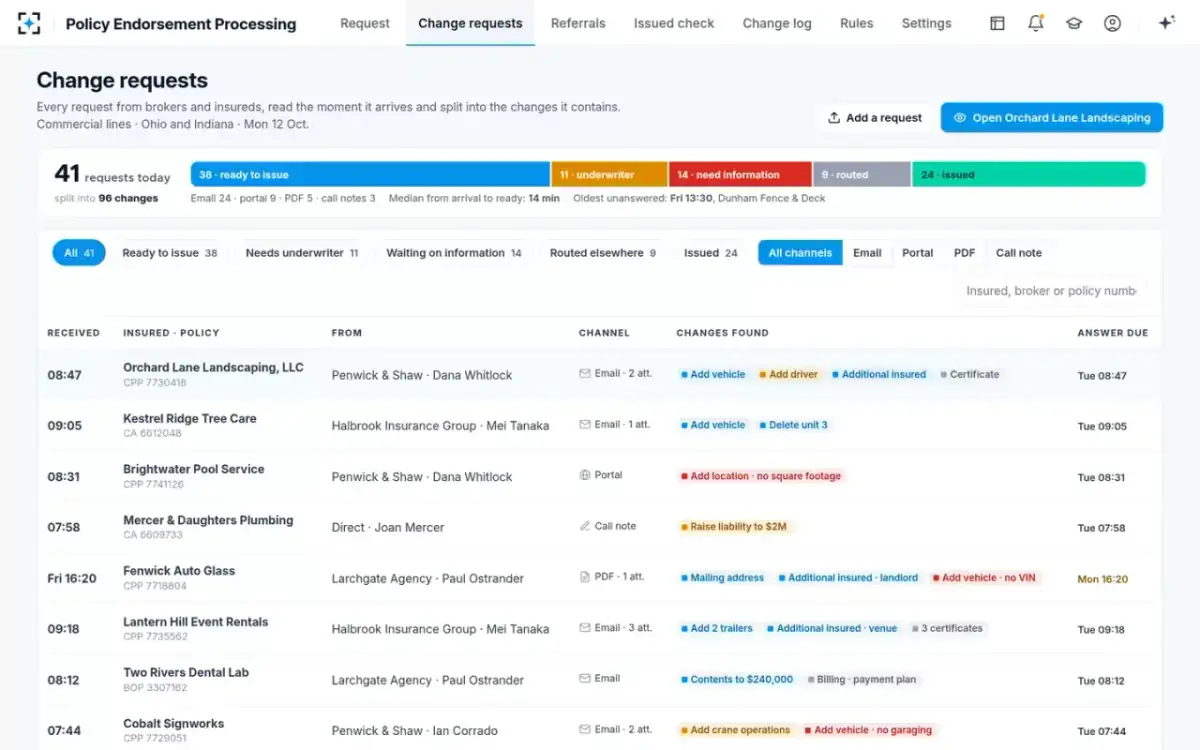
How change requests reached one sample desk
24of 41
requests on a Monday arrived by email, not on a form
9of 41
came through the broker portal’s change form
1of 7
requests behind this policy’s endorsements this term came on an ACORD 175
4
separate jobs in one four-sentence email
What does a policy change request form ask for?
A complete change request, on any form, identifies the policy and the first named insured, states the effective date and time of the change, and describes each change against the coverage part and schedule it alters, with the details that change needs to be rated and underwritten. For a vehicle that means the VIN, year, make, model, garaging address, use and any lienholder; for a driver, the name, date of birth and licence number and state; for an additional insured, the exact legal name, address and the contract that requires it. It also says who is asking, because only the first named insured is entitled to request changes under the usual policy terms.
A form enforces that list by leaving a blank where something is missing. That is its value, and it is why searchers look for a fillable one. The same list can be enforced without a form if whoever reads the request checks each change against it and asks for the gaps in one reply. The checklist further down sets out the items by type of change.
Why most change requests never arrive on the form
Because the people who need the change are not the people who fill in forms. A business owner who has just bought a truck writes to the broker the way he would write to anyone, and the broker, busy, forwards it. On the sample desk's Monday, 24 of 41 requests came by email, against 9 through the broker portal's change form. On the sample policy, one request in seven this term arrived as an ACORD 175 PDF.
An email is not a worse request in every way. It often carries the documents a form would only refer to: here, a two-page bill of sale and a 14-page services contract. And it says things a form has no box for, such as "full coverage like the other trucks," which a reader can resolve against the policy and a blank cannot. What the email lacks is structure: it holds several changes in one message, gives some details and not others, and mixes requests that are not policy changes at all.
One email, four jobs: the request a form would have split
The Orchard Lane email, written on a Sunday evening and forwarded by the broker at 08:47 on Monday, is four requests in four sentences. Split, each becomes what a form would have made it: one change, placed on the page of the policy it alters, with its status and what it still needs.
One annotated email split into four requests by Policy Endorsement Processing
From Rob Delacroix, Orchard Lane Landscaping · Sun 11 Oct, 19:12
Hi Dana, a few things for the policy.
1We bought a 2026 Ford F-350 dump (VIN 1FDRF3HT6TEA21847), financed through Buckeye Commercial. Need it on as of Thursday the 15th, full coverage like the other trucks.
2Our new hire Tyler Brandt (20) starts Monday and will be driving it.
3Crestline Property Group needs to be additional insured before we start Nov 1. Contract attached, insurance is in Exhibit B.
4And can you send them a certificate when it’s done?
Attached: Bill of sale.pdf · 2 pp · Crestline agreement.pdf · 14 pp
1Add a vehicle
Business auto schedule, page 6, unit 12
Allowed · +$870 this term
VIN, weight and cost new from the bill of sale; garaging and use as units 1–11; “full coverage” read as the other trucks’ coverages; Buckeye as loss payee on CA 99 44.
2Add a driver
Driver schedule, page 9, driver 10
Needs an underwriter · 2 items missing
Rule CA-UW 4.2: under 23 on a vehicle over 10,000 lb. Missing date of birth, and licence number and state for the motor vehicle record.
3Additional insured
CG 20 26 schedule, page 14, entry 4
Allowed · +$50 flat
Name and address from Exhibit B §3. Limits in §2 already on the policy; waiver in §5 already given by a blanket form; §4 asks for primary and noncontributory wording: CG 20 01 added.
4Certificate
Not a policy change
Routed · held for change 3
Sent to the certificates queue and released once the additional insured is issued.
Three things in that split would have been hard for a form. The driver's age is in the email, but his date of birth and licence number, the two details the motor vehicle record needs, are not; a form would have shown blanks, but only someone who knows the carrier's rules would see that a 20-year-old on a 14,000-pound truck needs an underwriter. The contract's section 4 asks for primary and noncontributory wording that the email never mentions; a form has a box for an additional insured, not for reading a 14-page agreement. And the certificate is not a policy change; on a form it would be a different form, and here it has to be routed and held until the additional insured exists. How the split runs step by step, in 52 seconds, is in insurance policy processing automation software, traced.
The email beside the policy, with each request numbered and pinned to its page
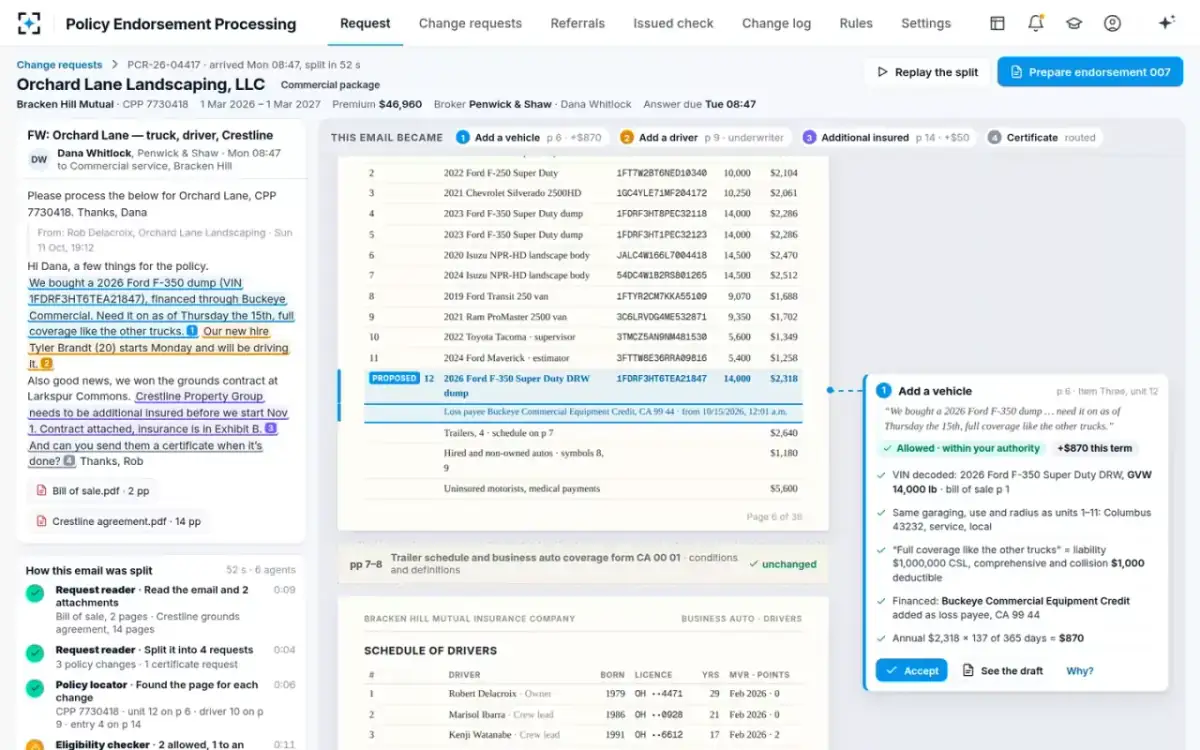
What the form would have caught, and what it would have missed
A form would have caught the missing details and missed the reading. That is a fair summary of the comparison, and it is why a desk that insists on forms still needs someone who reads.
The same four changes, on a form and in an email
On a change request form: One section per change, if the sender fills them in.
In the Orchard Lane email, read and split: Four requests found and numbered, each quoting its sentence.
On a change request form: A required field.
In the Orchard Lane email, read and split: “Thursday the 15th,” resolved against the email’s date to 15 October.
On a change request form: Blank boxes, visibly missing.
In the Orchard Lane email, read and split: Listed as missing, with a drafted letter asking the broker.
On a change request form: Each coverage ticked and limits written.
In the Orchard Lane email, read and split: “Full coverage like the other trucks,” read against units 4 and 5.
On a change request form: Usually not asked; the contract may not be attached.
In the Orchard Lane email, read and split: Exhibit B read: primary and noncontributory wording added.
On a change request form: A different form, sent separately.
In the Orchard Lane email, read and split: Routed to its own queue and held until the endorsement is issued.
Auto policy change request form: what to include for a vehicle or a driver
For a vehicle, the identity, use and finance of the vehicle and the date cover should start; for a driver, the identity and licence needed to order a motor vehicle record. Everything else the carrier can usually take from the policy. Two items deserve care in any request. The VIN should be copied from the title or bill of sale, not typed from memory, because a wrong VIN describes a different vehicle. And the date the vehicle was acquired matters separately from the date cover is wanted, because some policies extend cover to a newly acquired vehicle only if the insurer is told within a set period.
A driver's licence number is also personal information that brings data security duties with it. The NAIC's data security model law treats a consumer's name with a driver's licence number as nonpublic information, which is a reason to send it through a portal or secure channel rather than in an ordinary email chain where possible, and for the carrier to know where in its systems such emails end up.
What a change request needs, by type of change
- Every request
Policy number, first named insured, who is asking, the effective date and time, and each change listed separately.
- Add or replace a vehicle
VIN from the title or bill of sale, year, make, model, gross vehicle weight for trucks, cost new, garaging address, use and radius, coverages wanted, lienholder for the loss payee clause, date acquired.
- Add a driver
Full name, date of birth, licence number and state, and which vehicle they will drive; the carrier orders the motor vehicle record.
- Add an additional insured
Exact legal name and address, the operations or premises involved, and the contract that requires it, including its insurance exhibit.
- Add a location
Address, construction, occupancy, square footage, values, and protection such as sprinklers and alarms.
- Change a limit or deductible
The coverage, the new amount and the reason, often a contract; limit increases usually go to an underwriter.
- Remove a vehicle, driver or location
The item, the date, and why: sold, retired, left the company. A reduction the insured asks for is still a change to record carefully.
- Certificates
Ask separately, and only after the change it depends on is issued.
Commercial policy change request form: additional insureds and the contract
For a commercial additional insured, the contract is the request. The insured's email names who must be added; the contract says how. In the sample, the Crestline agreement's insurance exhibit set the additional insured's exact name and address in section 3, the limits in section 2, primary and noncontributory wording in section 4 and a waiver of subrogation in section 5. Read against the policy, two of those were already in place, one was the change asked for, and one, the primary and noncontributory endorsement, was missing from the request altogether.
A form with a box for "additional interest" would have captured the name and probably not the rest. That is the case for attaching the contract to every additional insured request, whatever the format, and for a desk to read it rather than take the email's summary. The primary and noncontributory endorsement cost nothing on the sample policy; leaving it out would have left the insured short of what its contract with Crestline required.
Policy Endorsement Processing queue: requests from four channels, split into changes
The one change form anyone can fill in: the NFIP general change endorsement
Most private carriers' change forms are reached through agencies; the federal flood program publishes its own. FEMA's Flood Insurance General Change Endorsement is a fillable PDF on FEMA's website. It opens with a "reason for change" section with boxes for, among others, increasing coverage, a mortgagee change, the mailing address, building information and the agent, and it asks the requester to pick the waiting period that applies: the standard 30 days, none for a loan transaction, one day for a map revision.
The waiting periods come from regulation. Under 44 CFR 61.11, added or increased flood coverage generally takes effect at 12:01 a.m. on the 30th calendar day after the request and the premium, the additional premium is prorated at the rates in force (the arithmetic is worked in how to calculate additional premium for endorsements), and if the endorsement and premium reach the insurer more than ten days after the request date, without certified mail sent within four days, the waiting period runs from receipt instead. The flood form shows what a well-designed change form does: it makes the requester state the reason, the date and the rule they think applies.
Splitting at intake decides everything after
Whatever the format, the step that turns a message into separate changes decides what happens to each. A request merged with another gets one decision where it needed two; a request left in an email that nobody acknowledged may never be made at all. In Markel Insurance Co. v. Rau, an emailed request to put an ambulance back on a fleet policy produced no endorsement, and the court held the ambulance uncovered when it crashed nine months later; the court did not need to decide whether the agency had received the email.
In Policy Endorsement Processing the request reader splits each message into separate requests, quotes the sentence each came from and never merges two into one; requests that are not policy changes, such as certificates, billing and cancellations, are routed to their own queues. Accepted changes that share an effective date are then combined into one endorsement, as the sample's truck and additional insured were in endorsement 007. What the reply looks like when something is missing, and how to keep it to one round, is covered in the endorsement request email.
Questions people ask
Is there a fillable ACORD 175?
Ask your agency or carrier which version they accept; carriers may also take changes through their own portal forms, as the sample carrier does. This page does not reproduce the ACORD form. Whatever version you use is only as complete as the details entered; the checklist above lists what each kind of change needs.
What is an ACORD 175 change request used for?
For asking an insurer to change a commercial policy mid-term: adding or removing vehicles, drivers, locations or additional interests, or changing coverages and limits, with an effective date. On the sample policy, one of seven change requests this term arrived on one, to add two trailers.
Is a policy change request on an ACORD form binding?
No. A request, on a form or in an email, asks for a change; the policy changes when the insurer issues an endorsement, under the usual changes clause. Some policies cover a newly acquired vehicle for a period if the insurer is told in time, which makes the date the request reached the insurer important.
What is the NFIP general change endorsement form used for?
For changing a federal flood policy during its term: adding or increasing coverage, changing a mortgagee, the mailing address, building information or the agent. It asks the reason for the change and which waiting period applies, from none for a loan transaction to the standard 30 days.
Can a commercial policy change request be made by email?
Usually yes, through the agent or broker, but the change is made only when the insurer issues an endorsement. Ask for written confirmation listing each change found in the email, and check that the endorsement matches it.