Insurance endorsement errors are mistakes in a policy change as issued: a field keyed wrong, the wrong vehicle or person added, a requested change never made, or a form attached that was never filed. Typical examples are a VIN with two digits transposed, a driver's date of birth keyed as 1998 instead of 1989, an effective date keyed as 10/19 instead of 10/09, an additional insured's name cut short, and a $1,000 deductible keyed as $500. Each reads correctly to the person who typed it, which is why most surface only when a claim is filed against a policy that does not say what the customer asked for. The only honest way to measure a checker for them is to plant known errors in real issued endorsements and count how many come back. Botminds' Policy Endorsement Processing reads every issued endorsement back against its request, and this page shows how to test that claim, or any vendor's.
Where this page shows a desk's own numbers, they come from a fictional sample carrier, Bracken Hill Mutual, and its invented insureds and staff as they run through the solution. The court cases and regulatory actions are real and linked.
Where 31 keying mismatches fell in 90 days on a sample Policy Endorsement Processing desk
What are the most common insurance endorsement errors?
Transcription errors in a handful of fields: dates, vehicle identification numbers, names, and amounts. They are common because they are where a person copies a long string from one document into another system, and they are dangerous because each one changes who or what is covered. On the sample desk above, effective dates and VINs together made up nearly half of the mismatches; names and additional insureds came third.
A second family of errors is not typing at all. The wrong item is changed, a requested change is never made, or a person is added in a role that does not give the coverage that later matters, for example as a listed driver when the claim turns on being a named insured. These do not show up as a typo on any field, and that difference decides which check can catch them, as the matrix further down shows.
The third family is forms. An endorsement can be keyed perfectly and still be wrong because the form attached is not the one filed for that state, or the one required is missing. In 2023 New York's Department of Financial Services fined Tokio Marine America Insurance Company $360,000 after findings that included that it "failed to attach appropriate filed and approved endorsements to relevant policies pursuant to Insurance Law Section 2307".
Three endorsement mistakes that reached an appeals court
The cases show the same pattern: a small processing error, discovered after a loss, decided by what the documents say. They are useful to anyone designing checks because each failed at a different step.
Endorsement mistakes in the courts: what went wrong, and where a check could have caught it
| Case | What was asked | What happened | Where it went wrong |
|---|---|---|---|
| Prime Property & Casualty v. Kepali Group (11th Cir. 2025) | Add two Mercedes and renumber an insured Toyota (VIN ending 0079); separately, add a newly bought Toyota (VIN ending 3985). | The carrier endorsed the already-insured 0079 Toyota as an addition; the 3985 Toyota was quoted but never endorsed, and the agency issued a certificate and ID cards for it without authority. The court held the policy’s after-acquired auto clause covered it anyway. | Reading the request: a renumbering read as an addition. Then no one compared the issued endorsement with what was asked. |
| Skaperdas v. Country Casualty (Ill. 2015) | Cover the insured’s fiancée, whom the carrier had required be added after an accident. | The policy named only the insured; the declarations listed a driver “female, 30-64.” Underinsured motorist coverage for her injured son was denied because neither was a named insured. | The role: what the change gave her was not what the coverage turned on. |
| Markel Ins. Co. v. Rau (7th Cir. 2020) | Put an ambulance back on a fleet policy, by email to the agency. | No endorsement was ever issued. The ambulance crashed nine months later and the court held it was not covered. | Intake: an emailed request that was never acknowledged or acted on. |
Kepali is the closest to a pure endorsement error. According to the Eleventh Circuit, the carrier's employee included the 0079 Toyota in an endorsement "based on her mistaken belief that Kepali's request that the 0079 Toyota be amended from vehicle #00002 to vehicle #00001 on the Policy was a request to add that vehicle to the Policy." The insured paid a $2,457 premium that, the court noted, covered a vehicle already insured. The court went on to find coverage for the other Toyota through the policy's after-acquired auto clause, so the carrier carried the defence of a crash on a vehicle it had never endorsed.
Skaperdas is a role question. The declarations page showed a driver, "female, 30-64," so the request reached the policy in some form; the claim turned on named insured status, which the policy did not give her. The Illinois Supreme Court held that a producer's statutory duty of ordinary care applies once a specific request is made. Markel is the other end: the change was never made at all. Both are taken up in who pays when an agent fails to add a vehicle to the policy.
Wrong VIN on an insurance policy: what the check digit catches
The ninth character of every VIN is a check digit computed from the other sixteen under a federal formula, so a VIN keyed with one wrong digit, or with two neighbouring digits swapped in the serial number, fails the check and can be stopped at entry. It cannot tell a valid VIN of the wrong vehicle from the right one, and it misses substitutions between characters the formula values the same.
The formula, in 49 CFR 565.15(c), gives every character a value (digits keep their own; each letter gets one from a table), multiplies each by a weight for its position, adds the products and divides by 11. Two properties follow, and we checked both by computation. First, because no position other than the ninth has a weight that is a multiple of 11, changing any one digit to another digit always changes the remainder: a single wrong digit outside position 9 always fails. Second, in positions 10 to 17, where most serial numbers are digits, neighbouring weights differ by one, so swapping two different digits always fails too. Across 20,000 random valid VINs, adjacent swaps of any two different characters failed the check 91% of the time; the misses were swaps of two characters the formula values the same, such as A and 1, or swaps involving the check digit itself.
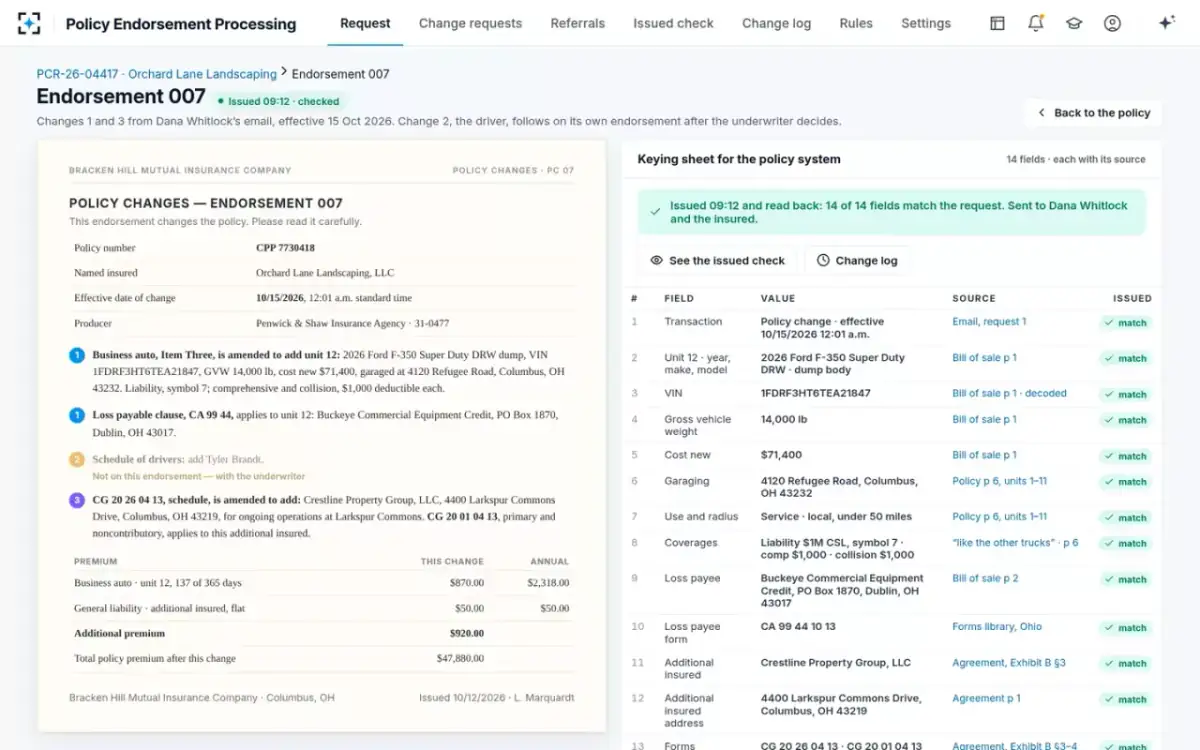
Take the sample F-350 on the Orchard Lane policy, VIN 1FDRF3HT6TEA21847. Keyed as 1FDRF3HT6TEA12847 or 1FDRF3HT6TEA21874, it fails. Keyed with an H for the 8 (both are valued 8) or a J for the A (both valued 1), it passes, and so would the correctly formed VIN of a different truck. That is why the check digit is a first filter, not a test of the right vehicle. How the formula works character by character is set out in a fleet underwriting guide to GVWR classes and the VIN.
Why a valid-looking field can still be wrong
Because validity and accuracy are different tests. A date of birth of 03/22/1998 is a valid date; it is only wrong because the driver was born in 1989. An additional insured named "Wexford Development LLC" is a real-looking name; it is only wrong because the contract says "Wexford Development Partners, LLC." No format check, picklist or check digit can see these errors, because there is nothing wrong with the value in isolation. They are visible only when the issued value is compared with its source.
That gives two kinds of comparison worth building. One compares a value with the document it came from: the VIN decoded and compared with the bill of sale's year, make, model and weight, or the additional insured's name compared with the contract. The other compares the issued endorsement with the request and the keying sheet, field by field, after issue. The first catches a wrong source reading; the second catches a wrong keystroke. Policy Endorsement Processing does both: the keying sheet cites a source for every field, and the issued-endorsement checker reads each issued endorsement back within 10 minutes and compares every field.
A clean read-back: each keyed field, its source, and whether the issued value matches
The seeded-error test: plant 20 and count the catches
Every vendor of endorsement checking will quote an accuracy figure, and none of those figures means anything until it is measured on your own issued endorsements with errors you planted yourself. The test is simple. Take recently issued endorsements, plant known errors in copies of a fixed share of them, mix them back in, run the checker blind, and count what it returns and what it misses. The matrix below is a design for a 20-error test and shows, for each error type, which kind of check can see it at all.
A 20-error seeded test, and which check can see each error
| Error planted | How many | Check digit | VIN decode vs bill of sale | Read-back vs request | Rule and authority check |
|---|---|---|---|---|---|
| VIN: two digits swapped in the serial (positions 10–17) | How many4 | Check digit✓ | VIN decode vs bill of sale— | Read-back vs request✓ | Rule and authority check— |
| VIN: a letter keyed for a digit of the same check value (J for 1, B for 2) | How many2 | Check digit— | VIN decode vs bill of sale~ | Read-back vs request✓ | Rule and authority check— |
| VIN: a valid VIN of a different vehicle on the schedule | How many2 | Check digit— | VIN decode vs bill of sale~ | Read-back vs request✓ | Rule and authority check— |
| Driver date of birth: digits reversed (1989 keyed 1998) | How many3 | Check digit— | VIN decode vs bill of sale— | Read-back vs request✓ | Rule and authority check~ |
| Effective date: one digit wrong (10/09 keyed 10/19) | How many3 | Check digit— | VIN decode vs bill of sale— | Read-back vs request✓ | Rule and authority check~ |
| Additional insured name cut short or mis-entity | How many3 | Check digit— | VIN decode vs bill of sale— | Read-back vs request✓ | Rule and authority check— |
| Deductible or limit keyed at the wrong value | How many2 | Check digit— | VIN decode vs bill of sale— | Read-back vs request✓ | Rule and authority check~ |
| Form edition not the one filed in the state | How many1 | Check digit— | VIN decode vs bill of sale— | Read-back vs request✓ | Rule and authority check✓ |
Two things stand out. The read-back column is the only one with no gaps, because it compares the issued value with what was asked, whatever kind of value it is. And every other check catches only some types. A desk that relies on validation rules alone will catch the swapped VIN digits and miss the reversed birth year, which on a commercial auto policy can decide whether a young driver needed an underwriter at all.
The read-back column has a condition, though: the request itself has to be right. If the request was misread upstream, as in Kepali, the issued endorsement matches a wrong request and the read-back passes it. That is why the test should also include a few planted misreadings in the requests themselves, scored against the split and the eligibility check rather than the read-back.
How to score the test honestly
Score it the way an examiner would read it: by error type, with a denominator, and with the false alarms counted. Examiners sample files and set a tolerance before they look; North Carolina's in its 2017 examination of Titan Indemnity, for instance, was zero for forms and rates that had not been filed and 5 percent for everything else, at a 95% confidence level. A checker that catches 19 of 20 planted errors but raises 40 false mismatches on 200 clean endorsements will be ignored within a week.
Running a seeded-error test on your own issued endorsements
- Take 200 recently issued endorsements across your lines and keyers
Include work keyed by any outsourced team; that is often where volume, and errors, concentrate.
- Plant 20 known errors in copies of 20 of them
Spread them across the types in the matrix. Record each planted error before the run and keep the list from the people running the checker.
- Add a few misread requests
For example, a renumbering written as an addition, or a driver added where a named insured was asked for. These test the reading and splitting, not the read-back.
- Run the checker blind on all 200
No hints about which files were changed.
- Count catches by error type, with a denominator
"Caught 4 of 4 VIN swaps, 2 of 3 birth dates" tells you more than "95% accurate."
- Count false alarms on the 180 clean endorsements
Every false mismatch is a minute of someone’s day and a reason to stop trusting the tool.
- Time the return
A catch matters only if it reaches the person who keyed it before the documents reach the insured.
- Repeat each quarter with new plants
Error patterns move with staff, systems and products; so should the test.
What a week of read-backs found on the sample desk
On the fictional sample desk, the issued-endorsement checker read back 212 endorsements in seven days and found six that did not match their requests. Each was caught before the insured received the documents and went back to whoever keyed it: a VIN with two digits transposed for Varga Hauling, a driver's birth year keyed 1998 instead of 1989 for Pell Street Bakery, a loss payee ZIP code with its last two digits swapped, an effective date of 10/19 instead of 10/09 for Ashby Court Florist, a collision deductible of $500 instead of $1,000, and an additional insured keyed as "Wexford Development LLC" instead of "Wexford Development Partners, LLC."
Policy Endorsement Processing’s issued check: six mismatches in 212 endorsements, and who keyed them
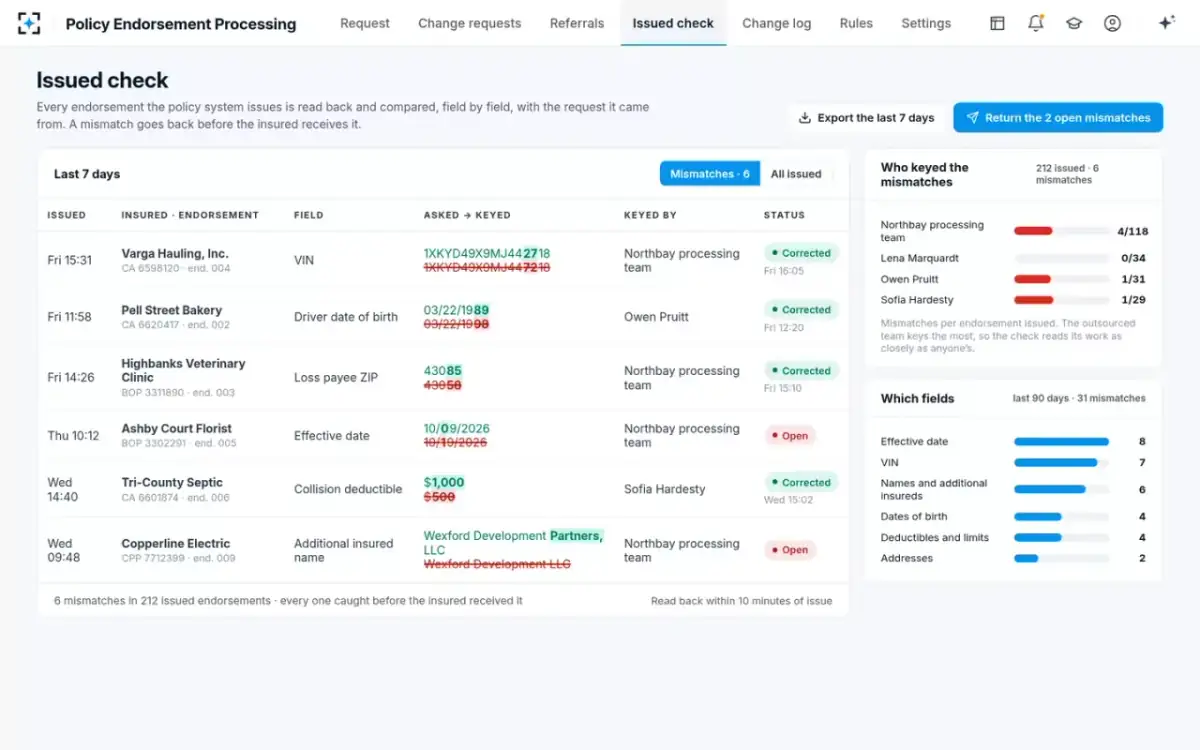
The per-keyer view is the part a team lead uses. The outsourced team keyed 118 of the 212 and produced four of the six mismatches; in-house staff keyed 94 and produced two. Per endorsement, that is 3.4% against 2.1%, which on a sample this small is a reason to look, not a conclusion. Over 90 days, effective dates were the field most often wrong, which is where a team lead would look first, for example at whether requests and the policy system write dates in different formats.
Endorsement errors that reach complaints are a small but telling slice. In our count of the Texas Department of Insurance's complaint data, 190 complaints closed in 2025 named an endorsement or rider; 13 of them carried the keyword "driver not covered," and 24 were confirmed (TDI open data, our count).
Endorsement errors a read-back cannot catch
A read-back compares what was issued with what was asked, so it cannot see three kinds of error. A request misread before keying, as in Kepali, produces an endorsement that faithfully matches the misreading. A request never turned into a change, as in Markel, produces no endorsement to read back at all. And a change that was asked for correctly but should have gone to an underwriter is a rule error, not a keying error. Each needs its own control: a split that quotes the sentence each change came from, an acknowledgement for every request so that none can sit unanswered, and a rule check that cites the rule. What makes a change request come back, and how to stop the back-and-forth, is covered in the endorsement request email and what sends it back.
Questions people ask
What happens with an endorsement mistake on an insurance claim?
The claim is decided on what the policy says, read with any clause that extends coverage, and the mistake is argued afterwards. In Kepali the policy's after-acquired auto clause covered a vehicle never endorsed; in Markel no clause helped and the vehicle was uncovered. Where coverage fails, the insured may turn to the producer, whom Illinois holds to ordinary care once a specific request was made.
How do you fix a VIN error on an insurance policy?
By a correcting endorsement that replaces the wrong VIN with the one on the title or bill of sale, keyed and then read back. Before keying, test the new VIN's check digit under 49 CFR 565.15 and decode it to confirm year, make and model match the vehicle; a check-digit pass alone does not prove it is the right vehicle.
Does a wrong VIN on an insurance policy void coverage after an accident?
Not automatically; it depends on the policy's wording, the state's law and whether the vehicle was otherwise a covered auto. In Kepali, the Eleventh Circuit found a vehicle covered through the after-acquired auto clause even though the endorsement listed a different Toyota. Check the policy's definition of covered autos and talk to the insurer early.
What is an example of an endorsement mistake on an insurance policy?
A birth year keyed as 1998 instead of 1989, which can change whether a driver needs underwriting approval; an additional insured's name cut short, which can leave the real contracting entity uninsured; or an effective date one digit off, which leaves days uncovered. On the sample desk, effective dates were the most frequent of 31 mismatches in 90 days.
Who is responsible for an endorsement error?
Whoever made it, and whoever was supposed to check it. Courts look at the producer's duty of care for requests that were never placed correctly, and regulators hold the insurer to issuing endorsements accurately and completely. A read-back that records who keyed each mismatch puts the correction, and the coaching, with the right person.