A commercial lines CSR, or customer service representative, services business insurance policies after the sale. The job description, in practice, is this: read change requests from brokers and insureds, find the policy and the page each change alters, check the change against the underwriting rules and your own authority, price it, key it into the policy system, and confirm that the issued endorsement says what was asked. What makes the seat hard is that requests rarely arrive one change at a time. One email can carry a new truck, a new driver, a new additional insured and a certificate, and a field keyed wrong today usually surfaces only when a claim is filed. Botminds' Policy Endorsement Processing is software in which agents do the reading, splitting, checking and drafting, so that the CSR's hours go to the decisions only a person can make.
To show the day rather than describe it, this page follows a fictional sample desk: Lena Marquardt, a commercial policy service representative at Bracken Hill Mutual, an invented carrier writing commercial packages in Ohio and Indiana. The broker, the insured, the underwriter and every policy, vehicle and premium on this page are sample data. The rules quoted from statutes, regulators and the Labor Department are real, and linked where they appear.
Monday 12 October on the sample service desk
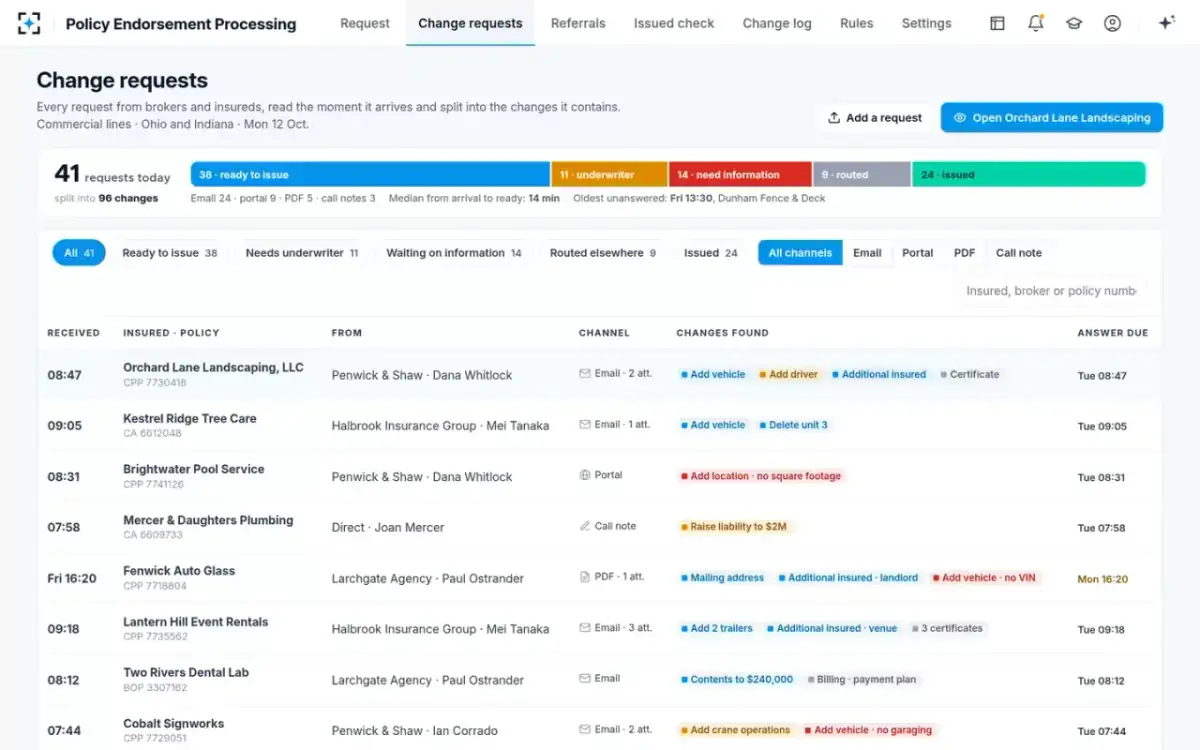
41
change requests on the desk’s queue that Monday
96
separate changes inside those 41 requests
24of 41
requests that arrived as email, not on a form
11
changes the desk may not issue alone: they need an underwriter
What is a CSR in insurance, and what does commercial lines add?
A CSR in insurance is the person who services a policy once it is in force: changes, questions, certificates, billing queries and the paperwork that keeps the policy matching the risk. The federal occupational system has no title called "commercial lines CSR"; the closest is Insurance Claims and Policy Processing Clerks, which the Labor Department's O*NET database describes as people who "Process new insurance policies, modifications to existing policies, and claims forms." A CSR at an agency and a policy service representative at a carrier do the same core task from two sides of the transaction.
O*NET's task list for the occupation names that task exactly: "Examine letters from policyholders or agents, original insurance applications, and other company documents to determine if changes are needed and effects of changes." The commercial lines version is harder for three reasons. A commercial package holds several coverage parts at once, typically business auto, general liability and property, each with its own schedules. The changes come with documents attached, such as a bill of sale or a 14-page services contract, which decide what the change has to say. And the insured is a business whose contracts with its own customers often require specific endorsements, which the insured may not mention.
The job description says "process endorsements". The inbox says something else
The work arrives as prose, not as transactions. At 08:47 on the sample Monday, Dana Whitlock, an account manager at the broker Penwick & Shaw, forwards an email from Rob Delacroix, who owns Orchard Lane Landscaping. He has bought a 2026 Ford F-350 dump truck, financed, and wants it on "full coverage like the other trucks" from Thursday. A new hire, Tyler Brandt, aged 20, will drive it. A new client, Crestline Property Group, must be an additional insured before a grounds contract starts on 1 November; the contract is attached. And could they send a certificate.
That is four jobs, each of a different kind. The truck is a rating and keying job. The driver is an eligibility question, because the carrier's rules send young drivers on heavy vehicles to an underwriter. The additional insured is a contract-reading job: the contract's insurance exhibit decides which forms must be attached, whatever the email says. The certificate is not a policy change at all and belongs to another queue. A job description that says "process endorsements" covers the first. The other three are where the hours and the risk sit. How to split such a message into separate requests is covered in the change request form and the email that skips it.
One request across a CSR's morning, hour by hour
The four jobs in the Orchard Lane email finish at four different times, and only two of them are in the CSR's hands. In Policy Endorsement Processing the agents read the email and both attachments and split them into three policy changes and one certificate request in 52 seconds, with each change pinned to the page of the policy it alters. Lena's morning then runs on four separate clocks.
One email, four clocks: the Orchard Lane request across Lena's morning
- Lena reviews, issuesissued 09:12
- CG 20 01 added, issuedissued 09:12
- Held for change 3released 09:14
- Letter to brokersent 09:06
- Waiting on the broker for date of birth and licencereply 10:52
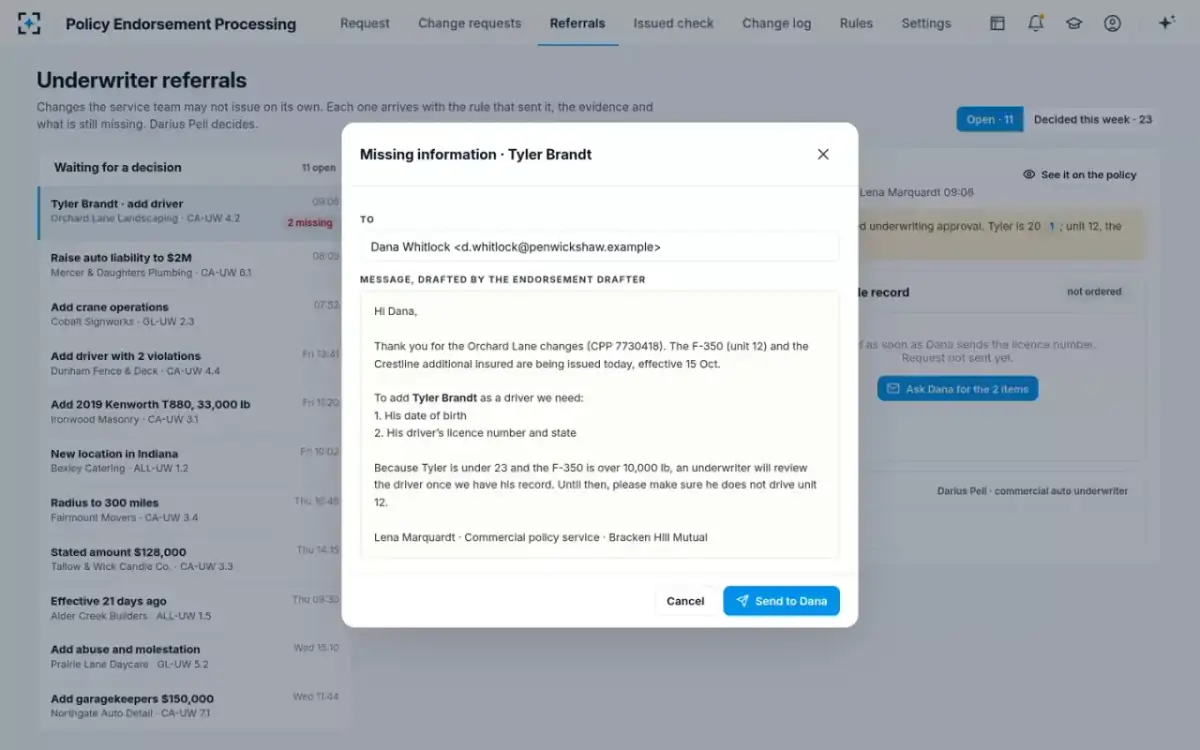
The two changes inside Lena's authority were issued at 09:12, 25 minutes after the email, and read back against the request: 14 of 14 fields matched. The certificate waited for the endorsement it evidences, which is the right order: a certificate issued before the additional insured is on the policy describes coverage that does not yet exist. The driver is the long clock, and not because of the desk. The email gave his age but not his date of birth or licence number, so the motor vehicle record could not be ordered. The drafted request for those two items went out at 09:06; the broker answered at 10:52.
The interesting minutes are not the 52 seconds. They are Lena's 24: checking that the truck is priced like units 4 and 5, the other F-350 dumps, accepting the contract's demand for primary and noncontributory wording that Rob never mentioned, and sending the letter that tells the broker the truck is on, the driver is not, and he should not drive unit 12 until he is.
Where the hours go on a multi-change request
By hand, the mechanical steps take most of the time. Botminds estimates that a commercial request with more than one change takes about four hours of handling when a person does every step, and that half of it goes to two things: checking rules, authority and missing items, and keying the change into the policy system. The other half is spread across reading the request, finding the policy page, rating the change and comparing the issued endorsement with the request.
Where four hours go on a multi-change commercial request, done by hand
By hand, about 4 hours (Botminds’ estimate)
- Read, split, find the page · 25%
- Rules, authority, missing items · 25%
- Rate pro rata · 12.5%
- Key into the system · 25%
- Compare issued with request · 12.5%
Two of those slices deserve separate treatment in a job description. Keying is transcription, and transcription errors are where the cost hides: a VIN with two digits swapped or a birth year reversed reads perfectly well to the person who typed it. Checking is judgment, and it is the slice that grows when a desk is under pressure, because the quickest way through a queue is to skip it. A desk that treats both as "processing" will staff for the first and lose the second. The kinds of keying error that slip through, and how to measure them, are set out in insurance endorsement errors, with a test that counts them.
Which changes may a commercial lines CSR make alone?
A CSR may make the changes the carrier's authority matrix allows, provided the CSR holds the licence the state requires for what the change involves. The two limits are different and both bind. Licensing law decides whether a person may bind coverage or discuss its terms at all; the carrier's or agency's authority letter decides which changes, of what size, that person may accept.
On licensing, states draw the line in slightly different places. Texas exempts from its agent licensing rules a salaried employee "who is not involved in soliciting or negotiating insurance in the office of an agent and who devotes the employee's full time to clerical and administrative services," provided the employee receives no commission and pay is not varied by premium volume (Tex. Ins. Code §4001.002(b)(5)). Florida is blunter about binding: an agency employee who is not licensed and appointed as an agent or customer representative cannot bind cover at all (Fla. Stat. §626.0428(2)). The NAIC's model producer licensing law exempts employees whose work is clerical or administrative and touches the sale of insurance only indirectly (Model #218, §4B(1)). The three rules are set side by side in who has authority to make changes to an insurance policy.
On authority, the sample carrier's matrix is typical in shape. A representative may issue a premium change of up to $2,500 a year; above that, the team lead decides. A driver under 23 on a vehicle over 10,000 pounds gross vehicle weight, any limit increase, a new class of operations, a location in a new state and an effective date more than 15 days back all go to an underwriter, each under a numbered rule. That is why Tyler Brandt went upstairs while the truck he will drive did not. The full question of who may change a policy, and under which law, is worked through in who has authority to make changes to an insurance policy.
The CSR's queue in Policy Endorsement Processing: requests split into changes, against a one-day promise
What examiners check on the desk's work
State market conduct examiners test the CSR's output directly, not just the underwriter's. One of the NAIC's underwriting and rating standards expects policies and endorsements to be issued and renewed accurately, on time and in full (NAIC examination standards, 2024; the standards turned into measures are in policy servicing KPIs and metrics). The review procedures behind it, in the 2017 edition of the NAIC Market Regulation Handbook, tell the examiner to "Determine if policies and endorsements are issued in appropriate time frames" and to "Review new issues prior to mailing to ensure correct procedures, forms, disclosures, etc., are used" (2017 edition, Chapter 16).
Read as a job description, those two lines say a CSR is accountable for speed, accuracy and the right forms, and that someone should look at what was issued before it goes out. Complaints show what happens when that fails. In our count of the Texas Department of Insurance's complaint data, 190 complaints closed in 2025 named an endorsement or rider as a reason; 73 of them also named policyholder service, and 78 also named a claim-handling reason, such as a denied claim, an unsatisfactory offer or a claims delay (TDI open data, our count). The endorsement was keyed months earlier. The complaint arrived with the claim.
Commercial insurance customer service representative job description: a version that matches the work
A job description that matches the commercial service desk names the reading, the checking and the read-back as duties, not just the keying, and states the authority limits up front. The list below is written from the sample desk's work and the rules above; adapt the limits to your own authority letter and state licensing.
A commercial lines CSR job description example, duty by duty
- Read change requests in any form and split them into separate changes
Email, broker portal, PDF forms, call notes and scanned mail. One message can hold a vehicle, a driver, an additional insured and a certificate; each becomes its own change.
- Match each change to the policy, coverage part and schedule it alters
Business auto schedule of covered autos, driver schedule, additional insured schedule, location schedule. Quote the request sentence each change came from.
- Check eligibility rules and your authority before accepting
Accept what is inside the authority letter; refer the rest to an underwriter with the rule that applies and the evidence.
- Ask for every missing item in one message
VIN, date of birth, licence number and state, garaging address, square footage, the contract requiring an additional insured. Set a reminder; never guess a value.
- Read the contract when a client requires coverage
Additional insured, primary and noncontributory wording and waiver of subrogation are set by the contract, not by the email.
- Rate the change pro rata and explain the charge
Annual premium difference times the share of the term left, plus flat charges as filed. Never override a rate or waive a minimum.
- Key the change and read back what was issued
Compare every field of the issued endorsement with the request before it goes to the insured.
- Route what is not a policy change
Certificates, billing questions and cancellation requests go to their own queues, in the right order.
- Hold the licence your state requires for what you do
Binding, quoting and discussing coverage terms may require an agent or customer representative licence; clerical work may not.
What changes in the CSR's day when agents do the reading
The CSR keeps every decision and loses most of the transcription. In Policy Endorsement Processing six agents read, split, locate, check, rate, draft and read back; the representative accepts and issues, and an underwriter decides referrals. Nothing is issued or sent by an agent. The same request, seen by the four people who carry it, looks like this.
Four seats on one change request, before and after Policy Endorsement Processing
Today
Reads each email, finds the policy, re-keys every field and hopes the issued endorsement matches.
With agents
Opens each request already split and pinned to the policy page, checked and priced, with a keying sheet whose every field cites its source.
Still theirs: accepting each change, adding what a contract requires, sending letters, issuing.
Today
Gets forwarded email chains and works out which rule applies and what is missing.
With agents
Gets each referral with the rule that sent it, the driver, the vehicle and the motor vehicle record on one screen.
Still theirs: approve, approve with a condition, or decline.
Today
Finds out a change was keyed wrong when the claim comes in.
With agents
Sees every issued endorsement read back against its request, and who keyed each mismatch.
Still theirs: the rules, the authority matrix and the one-day promise.
Today
Forwards what insureds send and chases the answer.
With agents
Gets one letter asking for exactly what is missing, and the issued endorsement the same morning.
Still theirs: the relationship with the insured and the answers only the insured has.
The letter the CSR reads and sends, drafted for her
Measured as a job, the seat changes from throughput to judgment. A team lead can see the median time from arrival to ready (14 minutes on the sample Monday), the oldest unanswered request, how many changes wait on brokers, and mismatches per endorsement issued by each person or team who keyed them. On the sample desk over seven days, Lena keyed 34 endorsements with no mismatch, while an outsourced processing team keyed 118 with four. Those are sample figures, but they are the right ones to put in a CSR's objectives: answered on time, referred correctly, read back clean.
Questions people ask
What are an insurance CSR's duties and responsibilities?
Servicing policies after the sale: processing changes and endorsements, answering policyholder and agent questions, issuing certificates where authorised, and routing billing and cancellation requests. O*NET lists, among the policy processing tasks, "Modify, update, or process existing policies and claims to reflect any change in beneficiary, amount of coverage, or type of insurance." On a commercial desk the duties include reading the contracts that require specific endorsements.
Do commercial lines CSRs need an insurance license?
It depends on the state and on what the CSR does. Purely clerical work is generally exempt, as in Texas §4001.002(b)(5) and the NAIC model's §4B(1), but binding coverage is not: in Florida an agency employee may not bind coverage unless licensed and appointed as an agent or customer representative. A CSR who binds coverage for a Florida agency therefore needs one.
Can an unlicensed commercial lines CSR be paid commission?
Generally not in the states quoted here. Texas's clerical exemption applies only if the employee receives no commission and pay "is not varied by the volume of premiums taken and received"; Florida's requires pay with no commission and no link to the business the employee brings in (the Florida licence that changes this is covered in the Florida 4-40 customer representative license). Commission pay usually comes with a licence.
What does an insurance claims and policy processing clerk do?
In the Labor Department's classification (SOC 43-9041), these clerks process new policies, changes to existing policies and claims forms. Their tasks include examining letters from policyholders or agents to decide whether changes are needed and what they affect, and notifying agents and accounting of cancellations. A commercial lines CSR does the policy side of that work, usually with more contact with brokers.
How many changes are in a typical commercial change request?
More than one, often. On the fictional sample desk, 41 requests in one morning held 96 separate changes, and the Orchard Lane email alone held three policy changes and a certificate request. Counting requests rather than changes understates a desk's workload, which is why a queue should show both.
What should a team lead measure for the CSR seat?
Timeliness and accuracy, which are what examiners test: time from arrival to answer, the oldest open request, changes waiting on brokers, referrals sent with the right rule, and mismatches between issued endorsements and requests. Mismatches per endorsement issued, by person or team, is the fairest accuracy measure because it scales with volume.