The Florida 4-40 customer representative license is a state insurance licence for a salaried employee of a property and casualty agency. In the words of the Florida Department of Financial Services, the holder is "A salaried employee of the general lines (property and casualty) agent or agency that may transact automobile, water craft, home, motorcycle, and pet insurance under the supervision of a licensed and appointed general lines agent." The "4-40" is the department's code for the licence type and class. It sits between unlicensed agency staff, who may do clerical work and take premiums incidentally, and a general lines agent, licensed as a 2-20. This guide reads the statute section by section: who qualifies, what a 4-40 may do, what they may not, and how the licence line plays out on a real service call. It also shows how Botminds' Real-Time Agent Assist for Insurance, a contact-centre solution that answers coverage questions from the customer's own forms during the call, keeps licensed answers with licensed representatives.
The statutes quoted are the 2026 Florida Statutes. This guide explains the rules; it is not legal advice, and an agency with a specific question should ask the department or its counsel.
The Florida 4-40 licence in four numbers
18yrs
minimum age of an applicant
4yrs
window in which a qualifying designation must have been earned
9credit hours
of insurance instruction in a degree that qualifies instead
48months
unappointed before the licence expires
What the Florida 4-40 customer representative license is
A 4-40 is a licensed employee, not an independent agent. The statute requires that "A customer representative shall be a salaried employee of the agent or agency." and that pay "shall not be primarily based on commissions or the production of applications, insurance, or premiums." The licence does not cover life insurance, or any line the appointing agency is not itself licensed for.
Every 4-40 is tied to one agency and one supervising agent. The applicant must be employed by only one agent or agency, and the agency must appoint one designated agent to supervise their work and conduct (§626.7351(5)). That agent signs the appointment form, obligating himself or herself to supervise the representative's conduct and business (§626.7353). The department's licensing FAQ adds a practical detail: unlike agents, who must be appointed by insurers, customer representatives can be appointed through the agency's own online account (Florida DFS).
Customer representative license Florida requirements
The 4-40 is earned through a designation or a degree, not an exam. The department's sheet says plainly that the "state licensing examination is no longer a way to qualify". An applicant must instead show one of a list of approved industry designations earned within the four years before applying, a qualifying insurance and personal finance course completed in a Florida high school, or a degree that includes at least nine credit hours of insurance instruction covering property, casualty and inland marine insurance.
How a Florida 4-40 customer representative qualifies
- Be a natural person at least 18 years old.
§626.7351(1).
- Be a US citizen or authorised to work, and a Florida resident.
Or a resident of a bordering state who has worked at least six months for a Florida resident general lines agent and will work only inside that agent’s office (§626.7351(2)).
- Hold a qualifying designation earned in the last four years, or a qualifying degree or high-school course.
The statute lists designations such as ACSR, AINS, CIC, CISR, CPSR and others; the department’s sheet also lists CPCU. A degree needs nine credit hours of insurance (§626.7351(3)).
- Work for one agent or agency only, under a designated supervising agent.
And spend all business time in that employment, housed in the appointing office (§626.7351(5)).
- Apply online, send proof of the prerequisite and be fingerprinted.
The department’s steps 3 to 5 on the 4-40 sheet.
- Be appointed by the agency or its general lines agent.
A licence left unappointed for 48 months expires, per the sheet.
4-40 license Florida: what the holder may do
A 4-40 may transact insurance, which is more than unlicensed staff may do and less than an agent. The statute says a customer representative "may engage in transacting insurance with customers who have been solicited by any agent or customer representative in the same agency", and with other customers to the extent the licensing law and the insurer's contract with the appointing agent allow. In practice that can include quoting, taking applications, explaining coverage and handling changes for the agency's customers, always in the agency's name.
Florida's own definition of solicitation explains why the licence matters on a service call. It counts as solicitation, among other things, describing the benefits or terms of coverage, recommending products, completing applications, and comparing products, advising on insurance matters or interpreting policies and coverages (§626.112). Those are the acts a service caller asks for when they ask whether something is covered or whether they should add a policy. A 4-40 may do them; an unlicensed colleague may not.
What can a 4-40 customer representative not do?
Three limits define the licence: the office, the agency and the lines. On the office, the statute is categorical:
"A customer representative shall not engage in transacting insurance outside of the office of his or her agent or agency."
Fla. Stat. §626.7354(4)
The office rule is reinforced elsewhere. A customer representative must be housed wholly within the actual confines of the appointing office, may not keep books, records or equipment for the business at any other address, and may not be employed from any location except where a licensed agent spends full time in charge (§626.7352). Business is done in the agency's name, never the representative's own. And the licence covers only the lines the appointing agency is licensed for, never life insurance.
The office rule raises an obvious question for contact centres that have moved staff home. The statute's text speaks of the office's "actual confines" and does not address remote work; we found no departmental statement on it in the sources we read. An agency considering remote 4-40 representatives should ask the department directly rather than infer an answer.
What is a licensed customer service representative, compared with unlicensed staff and an agent?
Florida recognises three kinds of person on an agency's phones, and the differences are in what they may say and who answers for them.
Unlicensed staff, a 4-40 customer representative and a general lines agent in Florida
| Unlicensed salaried staff | 4-40 customer representative | General lines agent (2-20) | |
|---|---|---|---|
| What they may do | Full-time clerical work, with incidental taking of applications or quoting or receiving premiums on incoming inquiries in the office | Transact insurance for the agency’s customers, in the agency’s name | Solicit, negotiate and transact general lines insurance |
| Pay | Salary; no commission at all, and pay not related to production | Salary; not primarily commission or production | Not restricted by these sections |
| May bind at an agency branch | No | Yes, if licensed and appointed | Yes, if licensed and appointed |
| May initiate contact to solicit, at a branch | No | Yes | Yes |
| Where | Agency office | Only inside the appointing agency’s office | Not limited to one office by these sections |
| Who answers for them | The agent in charge of the location | The appointing agent or agency, for all acts within the appointment | Themselves, and the agency they work for |
The left-hand column is narrower than many agencies assume. An unlicensed salaried employee is not deemed an agent or customer representative only if they devote full time to clerical work and their compensation "does not include in whole or in part any commissions on such business and is not related to the production of applications, insurance, or premiums". A bonus tied to policies written puts that exemption at risk. And at a designated branch, an unlicensed employee may neither bind coverage nor initiate contact to solicit insurance (§626.0428(2)–(3)).
Where the line falls on a service call
The licence line runs through the middle of ordinary service calls. Take the solution's fictional sample call, where a policyholder rings about a cancellation letter and, in five minutes, also asks about a renewal increase, a stolen laptop and a new boat. Imagine it reaching a Florida agency.
The same call, taken by unlicensed staff and by a 4-40 representative
Unlicensed salaried staff: May read the billing record and the notice, and take the overdue payment
4-40 customer representative: The same
Unlicensed salaried staff: May read the figures on the renewal worksheet; explaining what they mean for the policy is safer passed to a licensed colleague
4-40 customer representative: May explain the reasons and what changed in the policy
Unlicensed salaried staff: Interpreting coverage is solicitation under §626.112: transfer
4-40 customer representative: May explain the clause and limit, and start the claim report; the adjuster decides the claim
Unlicensed salaried staff: May not initiate a sales conversation: transfer
4-40 customer representative: May describe the gap and quote, for lines the agency is licensed for, from the office
The Compare shows why a service floor in Florida usually mixes licences. The first question on the sample call is service; the last three are, or can become, licensed activity. A floor staffed only with unlicensed representatives will transfer most coverage calls, and its customers will notice. The general version of this boundary, in Texas and California as well, is set out in what an unlicensed insurance CSR can do.
What Real-Time Agent Assist has to respect on a Florida call
An assistant cannot hold a licence, so it has to know who holds one. In Real-Time Agent Assist the setting is plain: coverage answers and life-event offers can be restricted to licensed representatives, and others get a warm transfer. Each offer the assistant shows is logged with the guards it passed, including the representative's licence. On the sample call the boat card lists four guards checked before it appeared: the reason for the call resolved first, no complaint words, marketing consent on file, and the representative licensed for property and casualty in his state.
Real-Time Agent Assist logs every offer with the guards it passed, licence included
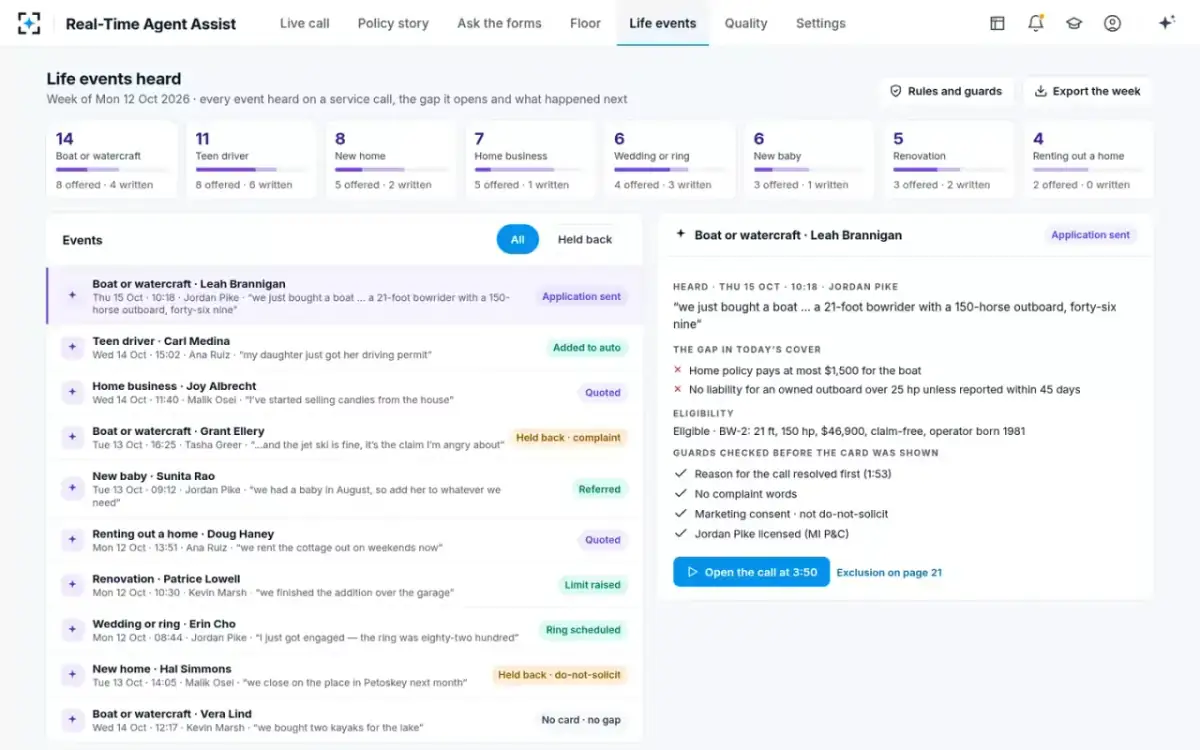
For a Florida agency, two more settings follow from the statute. The assistant should know which representatives are 4-40s and which lines their agency is licensed for, so that it never shows an offer for a line the representative cannot transact. And it should never be the thing that initiates a sale: the solution's life-event card waits until the caller raises the event and the reason for the call is resolved. The representative decides whether to mention it at all.
4-40 license jobs: where the licence is used
A 4-40 works for a property and casualty agency, inside its office, on its customers' personal lines. Because the licence is tied to one agency and one supervising agent, it moves with the job: a new employer means a new appointment, and a licence left unappointed for 48 months expires. Insurer-run service centres are a different case, since the 4-40 is appointed by a general lines agent or agency rather than by an insurer; a carrier staffing a Florida service line should confirm with the department which licence its representatives need.
For the representative, the licence changes the job description more than the title. It is the difference between transferring every coverage question and answering it. What that rewritten job looks like, seat by seat, is in the insurance customer service representative job description.
Questions people ask
What does a Florida 4-40 license allow you to do?
Transact property and casualty insurance for the customers of the one agency that appoints you, in its name and inside its office, under a supervising general lines agent. The department's sheet lists automobile, watercraft, home, motorcycle and pet insurance; the licence never covers life insurance.
Is there an exam for the 4-40 license in Florida?
No longer. The Department of Financial Services sheet says the state licensing examination is no longer a way to qualify; applicants show an approved designation earned in the last four years, a qualifying degree with nine credit hours of insurance, or a qualifying Florida high-school course.
Can a 4-40 customer representative work from home?
The statute says a customer representative shall not transact insurance outside the office of the appointing agent or agency, and must be housed within its actual confines. It does not address remote work directly, so an agency should ask the department before relying on any reading.
Can a 4-40 earn commission?
A customer representative must be salaried, and pay may not be primarily based on commissions or production. Unlicensed clerical staff face a stricter rule: their pay may include no commission at all on the business and may not be related to production.
What is the difference between a 4-40 and a 2-20 in Florida?
A 2-20 is a general lines agent licence; a 4-40 is a customer representative licence for a salaried agency employee. A 4-40 works only for one appointing agency and inside its office, and that agency answers for all of the representative's acts within the appointment.
Can unlicensed staff at a Florida agency give quotes?
Only incidentally: a full-time clerical employee may take applications or quote or receive premiums on incoming inquiries in the office without being deemed an agent, if paid no commission. At a branch they may not bind coverage or initiate contact to solicit.