Real time agent assist software is a tool that listens to a customer call as it happens, transcribes it, works out what the customer is asking, and puts the answer, the source and the next step in front of the representative while the caller is still talking. Most products on the market are general-purpose: they suggest replies and surface knowledge articles. An insurance service call needs something narrower, because the answer usually lives in one customer's policy, and because some answers are licensed insurance activity. Botminds' Real-Time Agent Assist for Insurance is built as six agents, each with one job and a short list of things it must never do. This guide walks through those six, the limit each one carries, and the questions a contact-centre technology leader should ask any vendor before buying.
The worked example is a fictional sample call in the solution: a policyholder calls a fictional mutual insurer about a cancellation letter, asks why her renewal went up, reports her son's stolen laptop and mentions a new boat. All names and amounts are invented. Six agents touch that call; none of them speaks to her.
What is agent assist, and what makes the insurance kind different
Agent assist is software that helps a human representative during a conversation rather than replacing them: it listens, retrieves and suggests, and the person decides what to say. The idea has been measured. In a field study of 5,179 support agents published by the NBER, a generative AI tool watched customer chats and proposed responses, and its design put the human firmly in charge: "The output is shown only to the agent, who has full discretion over whether to incorporate (fully or partially) the AI suggestions." Access to it raised issues resolved per hour by 14% on average, with the largest gains among newer agents.
Three things make insurance different from the software support desk that study observed. The answer to "am I covered?" is in a specific contract, with its own forms and endorsements, not in a shared knowledge base. Describing that contract can be licensed activity under state law. And the call itself carries regulated data, from card numbers to the record a market conduct examiner may later read. Assist software built for insurance has to treat each of those as a hard limit, not a setting someone forgets to turn on.
Six agents on one call: who does what
The six agents split the call the way a well-run desk already splits the work: one listens, one knows the history, one reads the contract, one notices new needs, one starts the paperwork, one writes the record. Splitting them matters because each can then be held to a rule that fits its job.
One service call through the six agents of Real-Time Agent Assist
Agent
Call listenerTranscribes both speakers live and marks each question, account fact, life event and complaint word.
Never: Speaks to the caller; stores card numbers or security codes.
Agent
Policy story builderBefore the call connects, lays policy transactions, billing, notices and past calls on one timeline and lights the events behind each question.
Never: Shows an event it cannot trace to a system record.
Agent
Coverage answererAnswers from this customer’s declarations, forms and endorsements, with the clause, page, numbers and words to say.
Never: Says a loss is covered; answers without a clause.
Agent
Life-event checkerHears a life event, finds the gap in today’s cover, checks eligibility and pre-fills a quote when the guards allow.
Never: Appears before the reason for the call is resolved, on a complaint call or to a do-not-solicit customer.
A person decides
Service representativeSays every word, decides what to offer and what to start, and confirms the notes.
Agent
Service request starterStarts what the call asked for: payment and autopay, claim report, application for e-signature, callback.
Never: Binds, cancels or changes coverage on its own.
Agent
Call notes writerDrafts the notes with the numbers said on the call, disposition codes and follow-ups.
Never: Saves without the representative; writes what was not said.
The limits matrix: what each agent may do and must never do
A buyer should be able to read an assist product as a matrix: for each component, what it is allowed to do on its own and what it must never do whatever the configuration. If a vendor cannot fill in the right-hand column, the limits live in a policy document rather than in the product.
The limits matrix, agent by agent
| Agent | May do on its own | Must never do | Why the line sits there |
|---|---|---|---|
| Call listener | Transcribe, mark questions and complaint words, pause on card phrases | Speak to the caller; store card digits or security codes | A card number with its code is protected customer information; the caller is talking to a person |
| Policy story builder | Read policy, billing, document archive, correspondence and notes; build the timeline | Show an event it cannot trace to a system record | A remembered event is not evidence; the representative repeats what the screen shows |
| Coverage answerer | Quote the clause, page and limits from forms attached to this policy | Say a loss is covered; answer without a clause; read a generic form | The adjuster decides claims; describing coverage can be licensed activity |
| Life-event checker | Find the gap, check eligibility, pre-fill a quote | Appear before the reason for the call is resolved, on a complaint call, for a do-not-solicit customer, or to an unlicensed representative | Offering cover is solicitation; a complaint call is the wrong moment |
| Service request starter | Start payments, claim reports, applications and callbacks with the facts from the call | Bind, cancel or change coverage | Those are underwriting and policy decisions with their own authority |
| Call notes writer | Draft notes, dispositions and follow-ups | Save without the representative; write what was not said | The record is the representative’s; examiners read it |
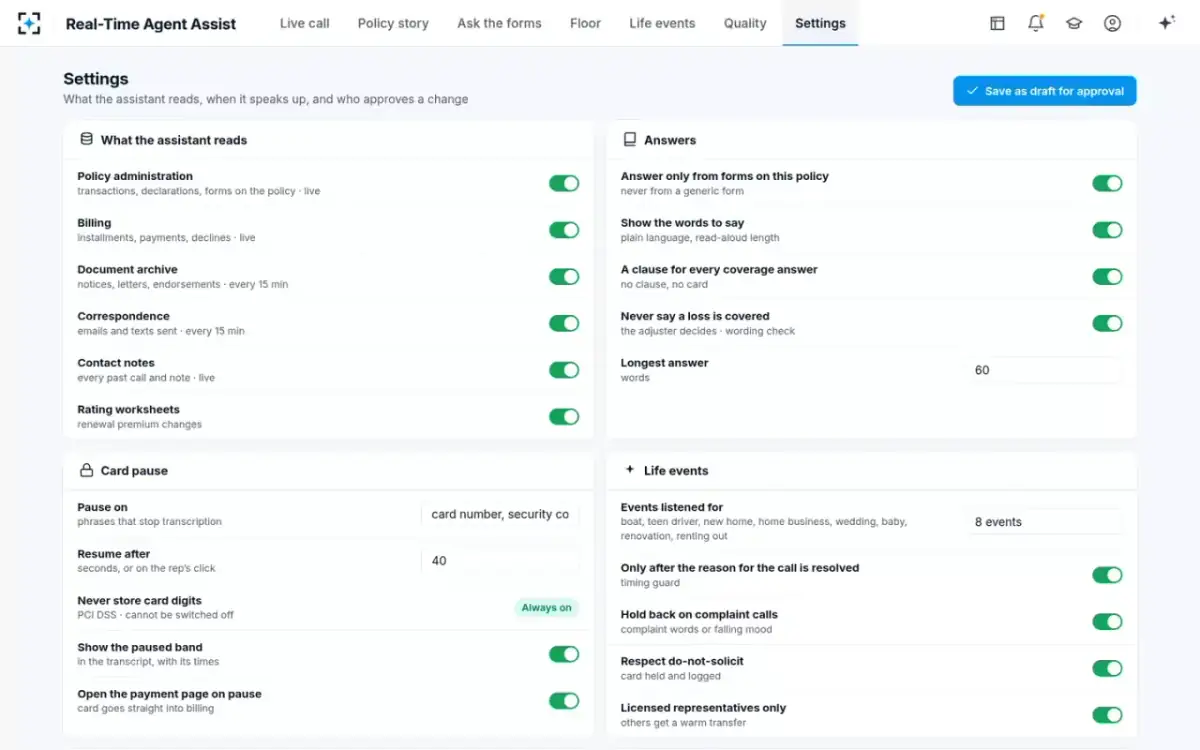
The matrix is also how to read the settings screen. In the solution, "Answer only from forms on this policy", "A clause for every coverage answer" and "Never say a loss is covered" sit together under answers; card pause has its own panel with "Never store card digits" marked always on; and the life-event guards are four switches. A rule change is saved as a draft and approved by the quality analyst and compliance together, after a test on recorded calls.
Where the limits live: the rules, as settings that need two approvers
The coverage answerer: why it never tells a caller a loss is covered
The most important limit sits on the agent that reads the policy, because coverage answers are where service shades into licensed advice and into claim decisions. The NAIC's model producer licensing law, the template state regulators wrote for licensing codes, treats conferring with or advising a purchaser about "any of the substantive benefits, terms or conditions of the contract" as negotiation, one of the three acts that need a licence. A claim decision is a separate act again, made by the adjuster on facts the service call does not have.
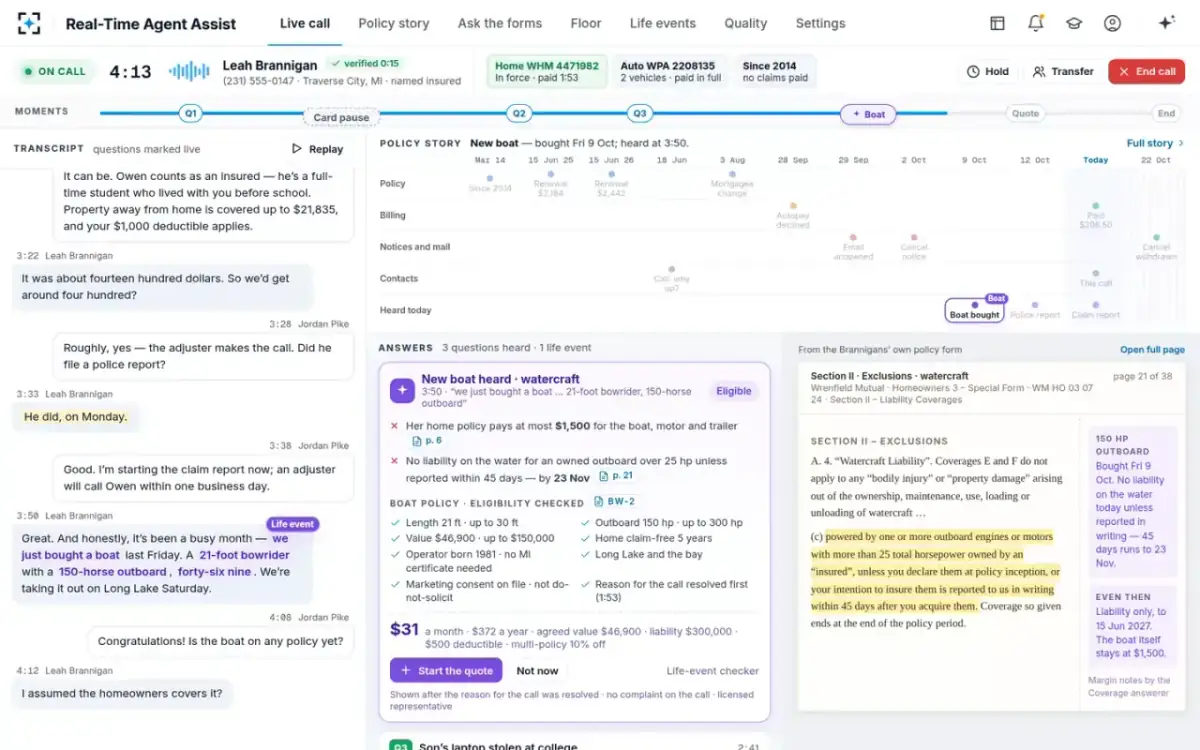
So the answer the agent produces is built to stop at the policy. On the sample call the customer asks whether her son's laptop, stolen from his college dorm, is "on our policy". The agent answers from the household's own homeowners form: the son counts as an insured as a full-time student under 24 who lived at home before school; property at another residence is limited to 10% of personal property coverage, $21,835; the $1,000 deductible applies; and "The adjuster decides the claim." Page 5 of the form opens beside it with the clause highlighted, and the representative starts the claim report from the call. How to score answers like that across a whole floor is the subject of insurance coverage questions answered live.
One screen: transcript, timeline, answers and the clause on its page
The call listener: the one that stops writing
The listener is the agent that hears everything, so its most important behaviour is what it refuses to keep. When a caller reads a card number, the transcript pauses on phrases such as "card number" and "security code", shows a band with the times it stopped, and resumes after 40 seconds or when the representative clicks. On the sample call the band runs from 1:14 to 1:52, and the payment of $206.50 is confirmed at 1:53.
The reason is not only payment-industry practice. The NAIC's model data security law counts a card number, and any security code that would open a customer's financial account, among the details that make customer information nonpublic. A transcript that never contains them is a smaller thing to protect. The consent and disclosure side of recording, which applies to the transcript as much as to the audio, is covered in the call recording disclosure statement guide.
The life-event checker: offers that wait their turn
The life-event checker is the agent most likely to be misused, because cross-selling is where contact-centre revenue targets press hardest. Its four guards are therefore not preferences: the card appears only after the reason for the call is resolved, never on a call with complaint words or falling mood, never for a customer marked do-not-solicit, and only for licensed representatives, with others offered a warm transfer. Florida shows why the last guard exists: its statute requires a licence for the solicitation of insurance, and defines solicitation as trying to persuade someone to buy by, among other things, describing the benefits or terms of coverage or recommending a product (Fla. Stat. §626.112). A boat quote offered on a service call is exactly that.
On the sample call the customer mentions at 3:50 that the family has bought a 21-foot bowrider with a 150-horsepower outboard. The card shows the gap in today's cover, read from the homeowners form: at most $1,500 for the boat, and no liability on the water for an owned outboard over 25 horsepower unless it is reported within 45 days, by 23 November. Every eligibility rule for the boat policy is already checked. In the sample week, 61 life events were heard across the floor, 38 offered and 19 written; 23 were held back with a reason. A tool that cannot show you its held-back list cannot show you it respects the guards.
The notes writer and the request starter: the record stays the representative's
The last two agents act after the conversation, and both stop one step short. The request starter fills in the claim report, the payment, the application for e-signature and the callback with the facts from the call, but it does not bind, cancel or change coverage. The notes writer drafts the record in full sentences with the numbers that were said, and then waits. State examiners test whether a company's records are adequate, accessible, consistent and orderly (NAIC Market Regulation Handbook), and the person accountable for that record is the representative who took the call.
On the sample call the draft is ready as the call ends at 5:22, and the representative spends 0:41 reading and confirming it, against a centre average of 4:30 for a similar call typed by hand. What the draft has to contain to be worth that saving is the subject of how to reduce after call work time.
What is an agent assist tool worth buying? Questions to ask any vendor
The test of an assist product is not the demo answer but the answer it refuses to give. The checklist below is what we would ask of any vendor, including us. Each question has a yes-or-no answer a vendor can show on its own product.
Questions to ask before buying real time agent assist software
- Does it answer from this customer’s policy, or from a knowledge base?
Ask to see an answer that cites a clause and page from the customer’s own form and endorsement, not a generic specimen.
- What happens when there is no source?
The right answer is silence or a referral. An assistant that improvises a coverage answer is a liability.
- Can it be stopped from saying a loss is covered?
Ask for the wording check and for a test call where the representative asks it directly.
- Does it ever speak to the customer?
For an assist product, the answer should be never. A bot is a different product with different rules.
- What does it keep, and what does it refuse to keep?
Ask where card numbers go when a caller reads them out, and whether that can be switched off. It should not be.
- Can offers be limited to licensed representatives?
And held back on complaint calls and for do-not-solicit customers, with a log of every hold-back.
- Who saves the notes?
Drafts are fine; a note written to the account without the representative’s confirmation is not.
- Who can change the rules, and how is a change tested?
Look for a draft, a test on recorded calls and two approvers.
Where Real-Time Agent Assist fits, and where it does not
Real-Time Agent Assist fits a service floor where representatives take policyholder calls about billing, notices, renewals, coverage and changes, and where the policy forms, billing history, correspondence and contact notes can be read by the agents. It connects to the phone system for the live audio, to policy administration, billing, the document archive and contact notes, and to claims intake and e-signature for the requests started on a call.
It is not a self-service bot: it never talks to the customer, so it does not reduce call volume, and if deflection is the goal another category is the right one. It is not a dialer or a workforce-management tool. And it is not, on its own, a compliance monitoring programme, although its quality view checks every call against a fixed list; banks running formal call monitoring will recognise the problem from AI call monitoring with a second agent that checks every flag. How the three categories compare on the same call is set out in contact center AI software.
General agent assist against an insurance assist on the same question
General-purpose agent assist: A shared knowledge base or FAQ article
Real-Time Agent Assist for Insurance: The declarations, forms and endorsements attached to this policy
General-purpose agent assist: A suggested reply
Real-Time Agent Assist for Insurance: The words to say, the numbers worked out, the clause on its page
General-purpose agent assist: May suggest “that should be covered”
Real-Time Agent Assist for Insurance: States the limit and deductible; the adjuster decides
General-purpose agent assist: Prompts on keywords
Real-Time Agent Assist for Insurance: Waits for resolution; held back on complaints, do-not-solicit and unlicensed reps
General-purpose agent assist: A summary
Real-Time Agent Assist for Insurance: A drafted note, dispositions and follow-ups that wait for the representative
Questions people ask
What is agent assist software?
Software that helps a human representative during a live conversation by listening, finding information and suggesting what to say, while the representative stays in charge. In the NBER field study of such a tool, suggestions were shown only to the agent, who was free to use or ignore them.
What is the difference between real time agent assist and a co-pilot?
Mostly the name. Both describe an assistant beside the representative rather than in front of the customer. What matters is not the label but the limits: whether it answers from the customer's own records, whether it can speak to the caller, and who saves what it drafts.
Is AI agent assist software the same as an AI coach?
They overlap. A coach scores how the representative handled calls and suggests improvements; an assist tool helps during the call. The solution does both on one record: answers and alerts during the call, and a check of every call afterwards against the same list, with the failures sent to coaching.
Can agent assist software tell a customer their claim is covered?
It should not. Coverage on a loss is decided by the adjuster on the facts of the claim, and advising a purchaser on the substantive terms of a contract is licensed activity under the NAIC's model law. The solution's coverage answer gives the clause, limit and deductible and says the adjuster decides.
Does real time agent assist record card numbers?
A well-built one does not. In the solution, transcription pauses when a card number or security code is read, shows the paused band with its times, and resumes after 40 seconds or on the representative's click. Never storing card digits cannot be switched off.
What systems does insurance agent assist need to connect to?
At minimum the phone system for live audio, policy administration for transactions and forms, billing, the document archive and correspondence, and contact notes. To start requests from the call it also needs claims intake and e-signature.