AI call monitoring uses speech recognition and language models to review recorded calls and chats for the things a bank must act on: a customer disputing a charge, a complaint, a misstated fee, a missing disclosure. Its promise is coverage, every call instead of the small sample a QA team can hear. Its failure is noise. A model that flags every mention of a fee or a charge hands reviewers thousands of harmless phrases, they start to skim, and the one dispute that matters goes by. The design that works in a bank splits the job in two: one agent flags, a second agent re-reads each flag against the whole call and the bank's own documents, and a person decides before anything is opened. Botminds' Call Compliance Monitoring is built that way, with seven agents and a QA analyst who confirms or dismisses every finding.
The figures below come from a fictional sample bank, Corvane National Bank, running the solution on a month of its own sample data: 4,800 bankers and about 2.5 million calls and chats. Nothing from Corvane is a customer's result.
AI call monitoring at a sample bank: most flags never reach a person
100%
of September's 2,104,380 calls and 381,920 chats reviewed
30,926
flags raised by the first agents
21,880
removed by the verifier agent, each with a written reason
6,412
confirmed by people, 70.9% of the 9,046 they saw
How does AI call monitoring work in a bank contact center?
AI call monitoring works in five steps: transcribe and redact each call, work out what kind of call it was, check it against the rules for that call type, verify each flag, and route what a person confirms. Each step has its own failure, and a buyer should ask about each one separately rather than about "accuracy" in general.
Transcribe and redact. The audio becomes a transcript with speakers separated, so the system knows whether the banker or the customer said "there's no fee". Card numbers, security codes and Social Security numbers are removed from the transcript and from the copy of the audio reviewers hear. Every later step inherits the transcript's mistakes, which is why testing transcripts by speaker group comes before any other accuracy claim.
Classify the call. A debit card servicing call, a collections call and a wire question carry different rules. Corvane runs six call types with 6 to 14 rules each, from required statements to referral cues.
Check the rules against the bank's own records. A rule about fees is only checkable against the fee schedule; a statement about when a deposit will be available, only against the hold notice the customer received. The agent that checks rules reads those records, read-only, and flags; it never decides.
Verify, then decide. A second agent re-reads every flag and a QA analyst decides what remains. Only a confirmed finding opens a case, and the case is dated from the call.
Call Compliance Monitoring: one agent flags, another re-reads, a person decides
Agent
Listening agentTranscribes every call and reads every chat, separates the speakers, records the call type and whether the recording notice played, and redacts card numbers, codes and SSNs.
Never: alters the original recording
Agent
Complaint and Rules agentsFind dissatisfaction the complaint policy counts, and check each call against the rules for its type: notices of error, required statements, fees, holds, referrals.
Never: decide a finding or log a complaint
Agent
Verifier agentRe-reads every flag against the whole call and its sources on a second model family, and keeps it, removes it with a written reason, or disagrees.
Never: hides a removal; 2% of removals go to QA
A person decides
QA analystReads the excerpt, the rule and the verifier's re-read, then confirms or dismisses each finding with a reason code.
Agent
Case agentOn confirmation, opens the Reg E claim, complaint, coaching note or remediation for its owner, dated the day of the call.
Never: opens a case before a person confirms, or rates a banker
Keyword spotting or AI call monitoring: what is the difference?
Keyword spotting flags calls that contain listed words or phrases; AI call monitoring tests whether what was said meets a rule. The difference shows on the calls that matter most, where the customer never uses the word on the list.
The CFPB described the problem in its report on chatbots, and the point applies to people and scripts as much as to software: when a bot or a tightly scripted representative only recognises a dispute if the customer uses particular words, disputes put any other way go unopened (CFPB, Chatbots in consumer finance, 2023; the same finding read for claims teams is in claims fraud using AI). A keyword list has the same inflexibility, in reverse: it fires on words, not on meaning.
Take one call at Corvane. At 3:12 Denise H. says: "There's a charge for $412.60 at Brightline Electronics on the 17th. I never made that. I don't even shop there." She does not say dispute, fraud or error, so a list built on those words misses the most important sentence of the call. Two minutes later the banker says: "I can send you a new card, there's no fee for that." A list built on "fee" flags it, and a reviewer has to listen to find out that the banker was right. The first is a missed notice of error with a 10-business-day clock running. The second is noise.
One model straight to the queue, or a second agent on every flag
One model flags, reviewers sort: Every flag the model raises, ranked by its own confidence.
A verifier agent re-reads every flag first: Only flags the verifier kept or disagreed with; removals stay visible with their reason.
One model flags, reviewers sort: Flagged; a reviewer listens to clear it.
A verifier agent re-reads every flag first: Checked against the fee schedule or hold notice and removed, with the source cited.
One model flags, reviewers sort: Found if the model generalises well; nothing checks a miss.
A verifier agent re-reads every flag first: Found by testing the rule's elements; the verifier confirms no claim was opened later in the call.
One model flags, reviewers sort: Not visible: there is only one.
A verifier agent re-reads every flag first: Shown first in the queue, because that is where judgement is needed.
One model flags, reviewers sort: Hard: dismissed flags are the only evidence.
A verifier agent re-reads every flag first: A fixed share of removals is sampled for QA, and every restore counts as an override.
How do you reduce false positives in call monitoring?
You reduce false positives by making a second reader check each flag against evidence a keyword cannot see: the rest of the call, the fee schedule, the hold notice, the account record. Raising a single model's threshold also cuts false positives, but it cuts true findings with them, and nobody sees which.
At Corvane the verifier works on a different model family from the agent that raised the flag, so the two are less likely to share a blind spot. It has three choices: keep the flag, remove it with a written reason and a citation, or disagree and propose a dismissal code for the analyst to accept or reject. In September it removed 21,880 of 30,926 flags. The minimum confidence for a finding to be shown is a setting, 80%, and a proposed change to 82% waits for the Chief Compliance Officer's approval.
From 30,926 flags to 6,412 confirmed findings in one month
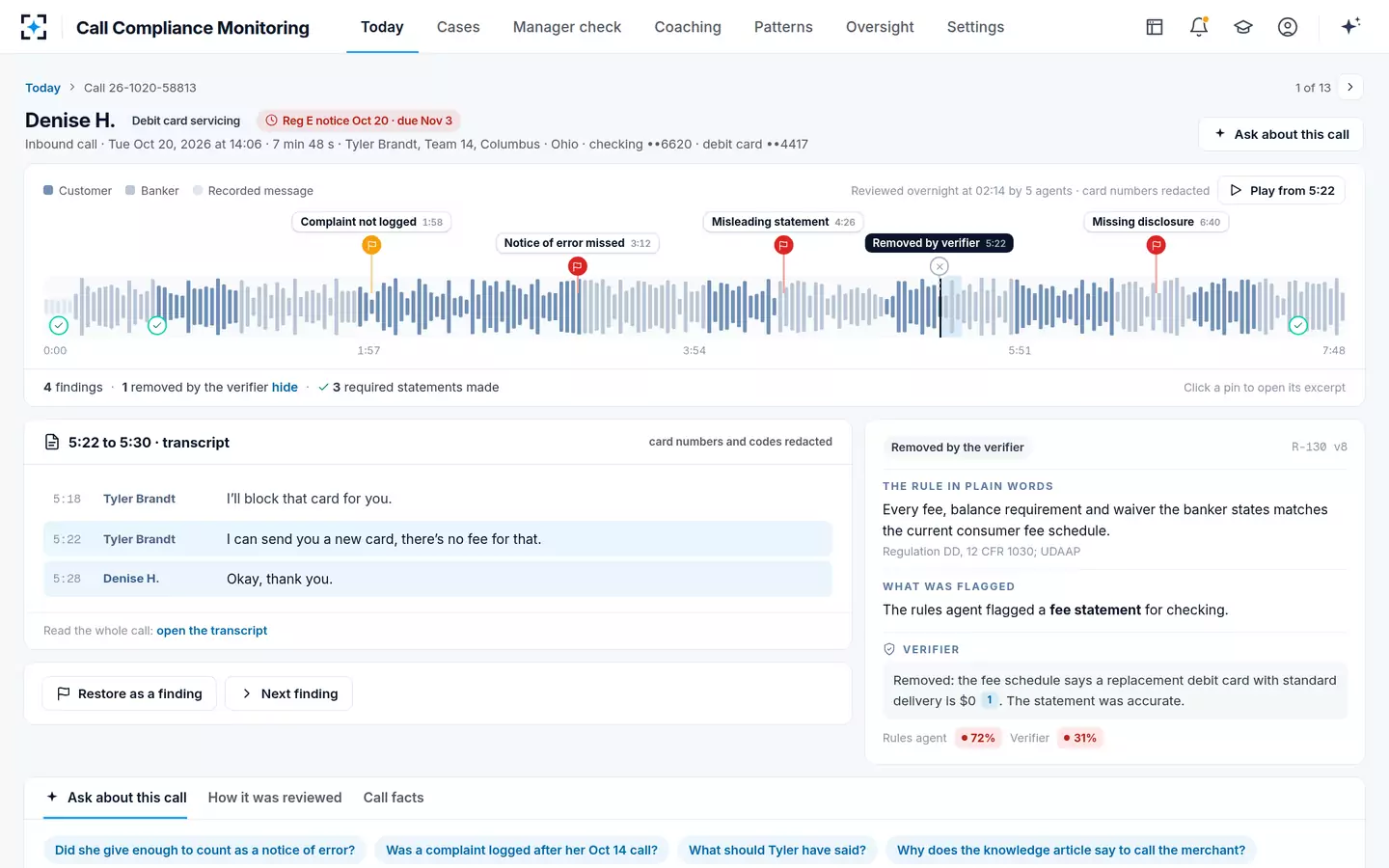
Removing noise only helps if removals can be audited. Every removed flag stays on the call's waveform as a hollow pin with the verifier's reason, and an analyst can restore it as a finding; a restore is counted as an override for model risk. Two percent of removals are drawn for QA review. That is how a bank finds out whether the filter is taking out real findings, rather than assuming it is not.
A false positive removed by the verifier, and still visible
Can AI detect a Reg E dispute on a call?
Yes, if it tests the rule's elements rather than listening for a word. A notice of error under Regulation E can be spoken, and has two elements a transcript can show: it lets the bank identify the customer's name and account, and it says why the customer believes there is an error (12 CFR 1005.11(b)(1)). An agent can check each element on a transcript: was the caller authenticated, so the account is known; did the customer say what is wrong and why; did the banker open a claim, or set a condition first?
On Denise H.'s call the Rules agent proposed the finding at 98% confidence and the verifier kept it at 99%, after re-reading the whole call: "no claim was opened later in the call and no claim exists in case management. The customer was authenticated, so the notice is complete." That last check is the one a keyword tool cannot make. A dispute the banker handled correctly two minutes later is not a finding, and an agent that reads only the sentence will flag it. Why the call itself is the notice, whatever a script says about forms, is set out in Reg E written notification requirements.
Who reviews AI call monitoring flags, and what must stay with a person?
A trained reviewer, usually a QA analyst in Compliance, reviews every flag the verifier keeps, and the decision on a regulatory obligation stays with that person. The reason is not caution for its own sake: the CFPB has already ruled on a bank that let an automated tool decide notices of error.
In 2022 the CFPB penalised Bank of America for letting an automated fraud filter, and nothing else, decide prepaid cardholders' notices of error during the pandemic (CFPB, enforcement action, July 2022; what it means for testing a triage tool is in how to test AI email triage). The point that matters is that the filter acted alone. An automated tool that prepares a decision for a person is a control; one that makes the decision is the practice the order describes.
Model risk guidance does not settle the question for a bank. The interagency guidance the OCC, the Federal Reserve and the FDIC issued in April 2026 leaves generative and agentic AI out of its scope, because the technology is new and changing fast (OCC Bulletin 2026-13; what that leaves a bank to decide is examined in whether a customer risk rating model is a model). A bank using agents to review calls has to set its own validation. Corvane's is written into the product: prompts, models and thresholds are versioned, a model risk validator runs each new version on a golden set of 1,500 interactions, and the Chief Compliance Officer approves it before it goes live.
How accurate is AI call monitoring? Count the misses, not only the false alarms
AI call monitoring is as accurate as three numbers say, and a vendor who quotes one of them is quoting the easy one. The share of flags people confirm measures false alarms. The share of real findings the system never flagged measures misses. And the agreement between reviewers on the same call measures whether "confirmed" means anything at all.
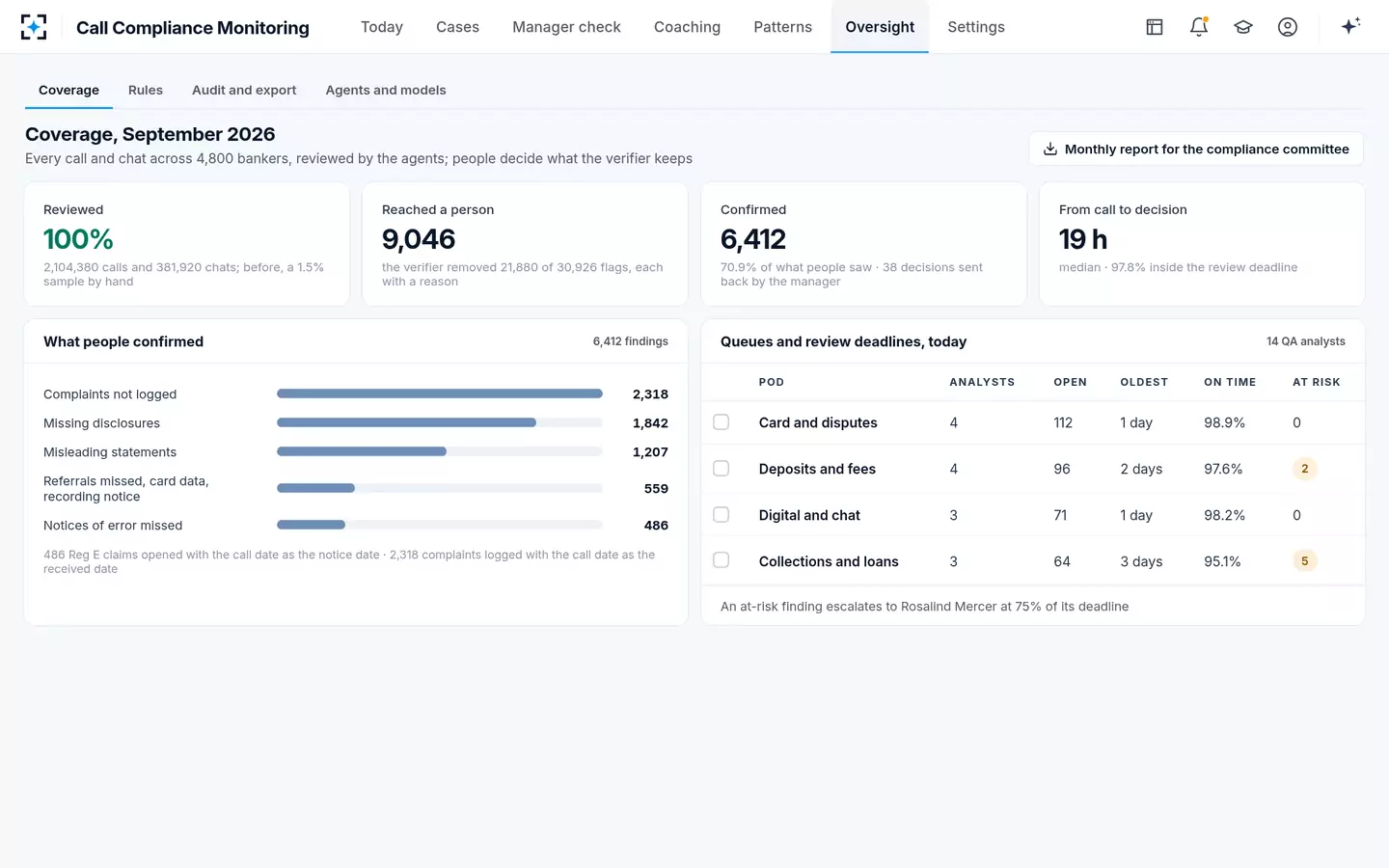
The first is visible every day: at Corvane people confirmed 70.9% of the findings they saw in September. The second has to be built. Seed a set of calls with known notices of error, complaints and misstatements, including ones in ordinary words and from different speakers, and count what comes back; sample the verifier's removals; and sample a slice of calls with no flag at all, because a miss leaves no trace on a queue. The third comes first, because an agent cannot be scored against two reviewers who disagree with each other, and call center calibration shows how to measure that before trusting any accuracy figure.
Coverage for a month: what was reviewed, what reached a person, what people confirmed
Is AI call monitoring legal? Recording consent and the rules the calls must follow
Reviewing recorded calls with software is lawful where the recording itself is lawful, and the recording rules are set by federal and state law. The federal wiretap statute permits interception "where such person is a party to the communication or where one of the parties to the communication has given prior consent to such interception" (18 U.S.C. 2511(2)(d)), which covers a bank recording its own calls. Some states ask for more. Washington makes it unlawful to record a private telephone communication "without first obtaining the consent of all the participants", treats an announcement as consent, and adds that "if the conversation is to be recorded that said announcement shall also be recorded" (RCW 9.73.030).
That last clause makes the recording notice something monitoring has to check, not assume. At Corvane the Listening agent records whether the notice played on each call; on October 20 it found nine calls transferred from branch lines where it had not, all traced to one phone-system change, and the finding went to a technology case rather than to the bankers. Which states' laws apply to a given call is a question for the bank's counsel. The consumer rules apply to the software as they do to people: the CFPB holds chatbots to the same consumer financial laws as the staff they replace (AI customer service in banking quotes it), and a monitoring system that decides nothing but misses a dispute leaves the bank with the same obligation it had before.
What to ask before buying AI call monitoring
Ask to see each answer on a month of your own calls, with your rule library and your fee schedule loaded, not on the vendor's demonstration set. Piloting on last month's calls sets out how to run that test and what to count.
Eight questions for any AI call monitoring product a bank is considering
- What checks a flag before a person sees it?
A second model, a rule, or nothing. Ask what share of flags it removes and whether removals stay visible.
- What does each rule check against?
The fee schedule, hold notices, account and case records, or only the transcript.
- How are misses measured?
Seeded calls, sampled removals and sampled unflagged calls, reported by finding type and speaker group.
- What can the system do without a person?
Open a claim, log a complaint, send a letter, score a banker. Each should be no.
- Which date goes on the case?
The date the customer spoke. Anything later hides a missed Regulation E clock.
- How are versions validated and approved?
A fixed test set, a named validator and an approver for every prompt, model and threshold change.
- What is redacted, and where?
Card data and SSNs in the transcript and the audio reviewers hear, without altering the original recording.
- What can an examiner see?
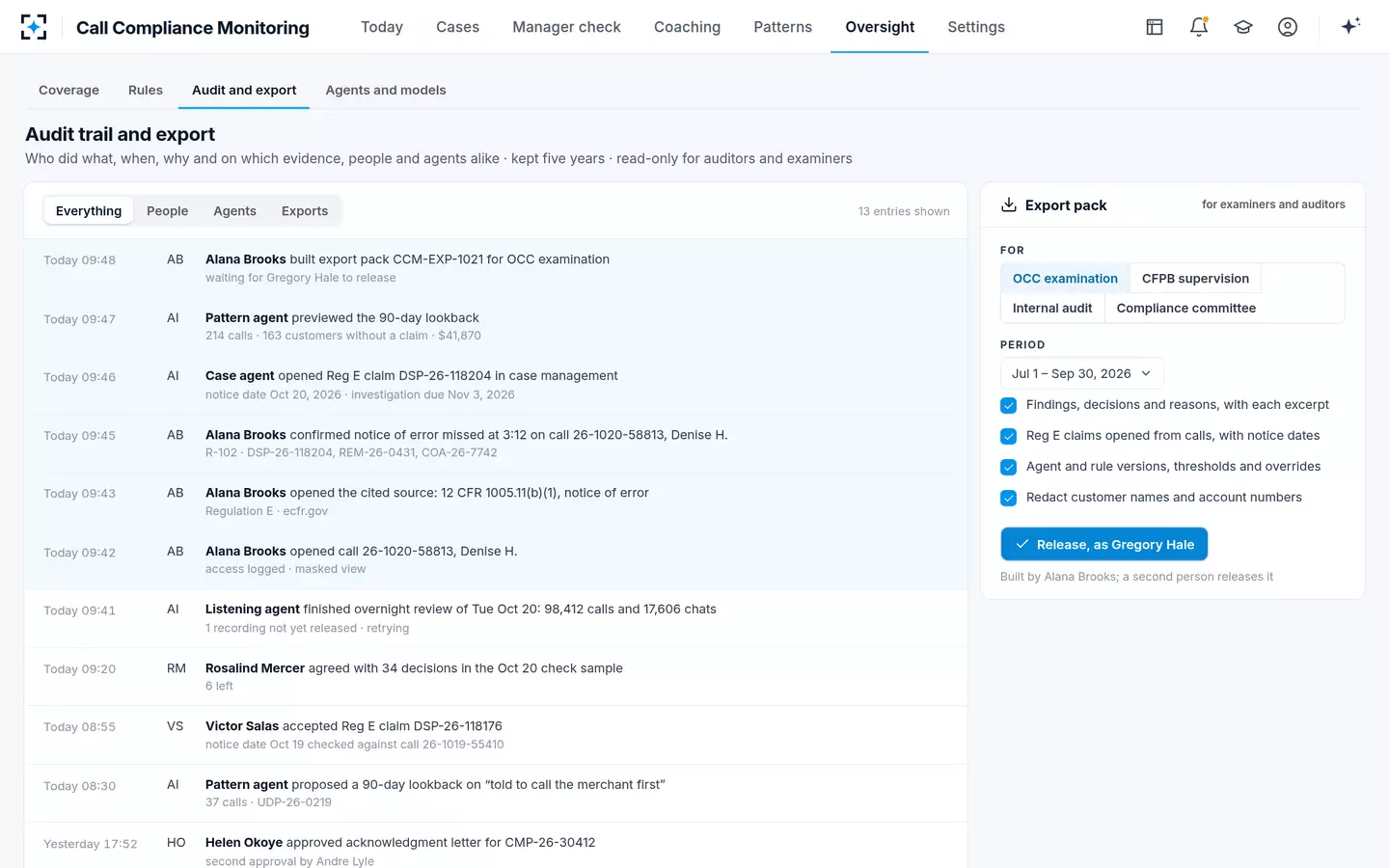
Each decision with its excerpt, rule version, agent version and reason, exportable for a period, released by a second person.
Be clear about where Call Compliance Monitoring fits and where it does not. It reviews calls and chats after they happen, overnight, with a design target of a decided finding within a day; it is not a real-time prompt in the banker's ear. It does not score or rank bankers for performance management, by design. It needs read access to the recordings and transcripts, the core banking system, the card processor, the complaint system and case management, and it writes to the last two only when a person confirms. The agents and their limits are set out on the Call Compliance Monitoring page.
Every decision on the audit trail, and an export for examiners
Questions people ask
Can AI monitor 100 percent of calls?
Yes. Coverage is no longer the hard part; review is. In the sample month the agents reviewed all 2,104,380 calls and 381,920 chats, and the work that remained was people deciding the 9,046 findings the verifier kept.
Does AI call monitoring work on chats as well as calls?
It should, because customers dispute charges and complain in chat too, and a chat message is a written notice. The CFPB's 2023 report put the number of people who engaged with a bank's chatbot in 2022 at over 98 million, about 37% of the U.S. population; a monitoring program that covers only voice misses that channel.
What happens to a flag the verifier removes?
It stays on the call with its reason and citation, and a QA analyst can restore it. In the sample configuration 2% of removals are drawn for QA review, and every restore is recorded as an override for model risk.
How soon after a call does AI call monitoring report a finding?
That depends on the design. Call Compliance Monitoring reviews overnight, and its target is a decided finding within one day; the sample month's median was 19 hours. Speed matters most for notices of error, because the 10-business-day clock runs from the call, not from the review.
Does a person have to review every AI flag?
Every flag that could open a case, yes. The verifier can remove flags with a written reason, but the CFPB's 2022 Bank of America order shows the risk of letting an automated tool decide a notice of error on its own, and a person's confirmation is what makes the decision the bank's.