The difference between a complaint and an inquiry is dissatisfaction. An inquiry asks for information or a service: what is my balance, when will this deposit clear. A complaint says something went wrong and the customer is unhappy about it, whether or not they use the word: "this is the second time I've called about this fee." A third kind of call sits beside both, the Regulation E notice of error, which starts a legal clock of its own. In a bank the line between complaint and inquiry is drawn by the bank's own complaint policy, and it decides whether a call is logged, acknowledged and worked, or simply ends. It is hard to hold because bankers draw it in the moment, on live calls, and few calls are reviewed afterwards. Botminds' Call Compliance Monitoring applies the bank's complaint policy to every call and chat and checks whether each complaint was logged.
The examples come from a fictional sample bank, Corvane National Bank, whose complaint policy counts any expression of dissatisfaction as a complaint. The complaint figures come from the CFPB and the FDIC, linked where they appear.
Inquiry or complaint: what the customer says, and what the bank then owes
Inquiry: "When will my deposit be available?" "What is the fee for a replacement card?"
Complaint: "You told me Monday and it still isn't there." "I was charged a fee nobody mentioned."
Inquiry: A request for information or a service, with no dissatisfaction expressed.
Complaint: Dissatisfaction with the bank's product, service or conduct, as the bank's policy defines it, in any words.
Inquiry: An accurate answer.
Complaint: A log entry, an acknowledgment, a response, and a look at the cause.
Inquiry: None beyond the call.
Complaint: The received date: the day the customer said it, not the day someone noticed.
Inquiry: Rarely: asking whether a payment arrived, without asserting an error, is not one.
Complaint: Often: "you charged me for something I didn't buy" is both, and both obligations apply.
Inquiry: A wrong answer may be a misstatement to correct.
Complaint: No acknowledgment, no cause found, and the customer may go to the regulator instead.
What is the difference between a complaint and an inquiry?
A complaint expresses dissatisfaction or alleges something went wrong; an inquiry asks a question or requests a service without doing either. The CFPB uses the same idea for the complaints it receives: "Consumer complaints are submissions that express dissatisfaction with, or communicate suspicion of wrongful conduct by, an identifiable entity related to a consumer's personal experience with a financial product or service" (CFPB Consumer Response Annual Report, 2025). That definition governs the CFPB's own intake, not a bank's log, but it is a useful model because it turns on what the customer expresses, not on the words used.
On a bank call the difference is often a single sentence. "What's the fee for a replacement card?" is an inquiry. "Why was I charged for a replacement card when the banker said it was free?" is a complaint, and it may also point to a misstatement on an earlier call. "This is the second time I've called about this" turns almost any inquiry into a complaint under a policy that counts dissatisfaction, because the customer is telling the bank the first answer failed.
What counts as a complaint in banking, and who decides?
For a bank's own complaint program, the bank decides, in a written policy, and examiners review how it decided. The FDIC's examination manual tells examiners to "discuss with management how complaints are identified and defined, as consumer inquiries may also highlight areas with increased risk of consumer harm and/or regulatory compliance concerns" (FDIC Consumer Compliance Examination Manual, II-3.1). The same section expects procedures for handling complaints, with the people responsible "designated and known to all institution personnel to expedite responses."
In practice three people decide, in sequence. The banker decides on the call whether to log what the customer said. The bank's policy decides what the banker was supposed to do. And whoever reviews calls afterwards, QA or compliance monitoring, decides whether the banker followed the policy. Where QA samples, the first decision is made on every call and the third on few, which is why the policy's definition matters so much: a definition a banker cannot apply in real time will be applied inconsistently, and a definition nobody checks will drift toward "complaints the customer called complaints".
Is an expression of dissatisfaction a complaint?
Under a policy that defines complaints by dissatisfaction, yes, and that is the definition that catches what customers actually say. Customers usually describe what went wrong rather than announce a complaint, and a definition that waits for the word misses them.
The CFPB's 2025 report shows what dissatisfaction sounds like when it finally reaches the regulator. Checking account consumers described representatives who "were unhelpful or provided wrong or conflicting information"; in response, "companies typically stated that they found no errors when investigating customer service interactions with consumers" (CFPB, 2025). Each of those started as a call to a bank, where the same words could have been logged as a complaint and worked there.
Complaint vs dispute: when a complaint is also a notice of error
A complaint is dissatisfaction under the bank's policy; a dispute, in the Regulation E sense, is a notice of error that triggers a fixed investigation with deadlines. One sentence can be both, and when it is, both obligations apply: the complaint is logged and answered, and the notice of error opens a claim dated from the call. Treating it as only one of the two is how the other gets missed.
Regulation E draws its own line between errors and inquiries, and it does not match the complaint line. The rule excludes "A routine inquiry about the consumer's account balance" and requests for tax or record-keeping information (12 CFR 1005.11(a)(2)). The official interpretation adds that a customer who asks whether a payment was debited or a deposit credited, "without asserting an error", has not triggered error resolution, while "A request for documentation or other information must be treated as an error unless it is clear that the consumer is requesting a duplicate copy for tax or other record-keeping purposes" (Supplement I, comments 11(a)-2 and 11(a)-5). An inquiry under the complaint policy can therefore be a notice of error under Regulation E. Why a phone call is a notice of error covers what the bank may and may not ask for next.
Five calls, three tests: inquiry, complaint, notice of error
| What the customer says | Complaint under a dissatisfaction policy? | Notice of error under Reg E? |
|---|---|---|
| "What's my balance?" | No | No: a routine balance inquiry is excluded |
| "Did my rent payment go out yesterday?" | No, unless they say something went wrong | No, if they are only checking, without asserting an error |
| "Can you send me the receipt for that transfer?" | No | Usually yes: a documentation request is treated as an error unless it is plainly for tax or records |
| "This is the second time I've called about this fee." | Yes: dissatisfaction with how the first call was handled | Only if the fee involves an error the rule lists, such as a bookkeeping error relating to a transfer |
| "There's a charge I never made. I don't even shop there." | Yes, if expressed as dissatisfaction, and often both | Yes, if the bank can identify the account and the customer says why it is wrong |
What happens to complaints that are not logged?
A complaint that is not logged is not acknowledged, not answered and not counted, so its cause is never found and the customer is more likely to take it elsewhere. Most people who complain to the CFPB about a bank account say they went to the bank first.
Most checking and savings complainants to the CFPB had tried their bank first
Checking or savings complaints to the CFPB, 2025
- Reported first trying to resolve it with the company · 92%
- Did not report trying first · 8%
Why an unlogged complaint is lost evidence, not only a lost answer
The bank's first contact was its chance to log the complaint, work it and find the cause. The FDIC puts the purpose plainly: "Complaints may be indicative of a compliance weakness in a particular function or department. Therefore, a compliance officer should be aware of the complaints received and act to ensure a timely resolution" (FDIC, II-3.1). A complaint that was said on a call and never logged cannot do that job. It does not appear in the complaint counts the board sees, it is not in the data a fair lending or UDAAP review reads, and it is not linked to the next customer who says the same thing; the UDAAP casebook shows how often the pattern, not the single call, was what mattered.
What reaches the regulator, and what a bank can find on its own calls
≈104,200
checking or savings complaints the CFPB received in 2025
92%
of those sent to companies where the consumer said they tried the company first
69%
rise in checking account complaints over the prior two years' monthly average
2,318
complaints a fictional sample bank found unlogged on its own calls in one month
Do verbal complaints have to be logged?
If the bank's policy counts them, yes, and a policy that defines a complaint by what the customer expresses does not distinguish between a call, a chat, a letter and a branch visit. Examiners judge the program by how the bank defines complaints and whether it handles them promptly, so a policy that counts spoken dissatisfaction and a contact center that logs only written complaints is a gap an examiner can see in the bank's own documents.
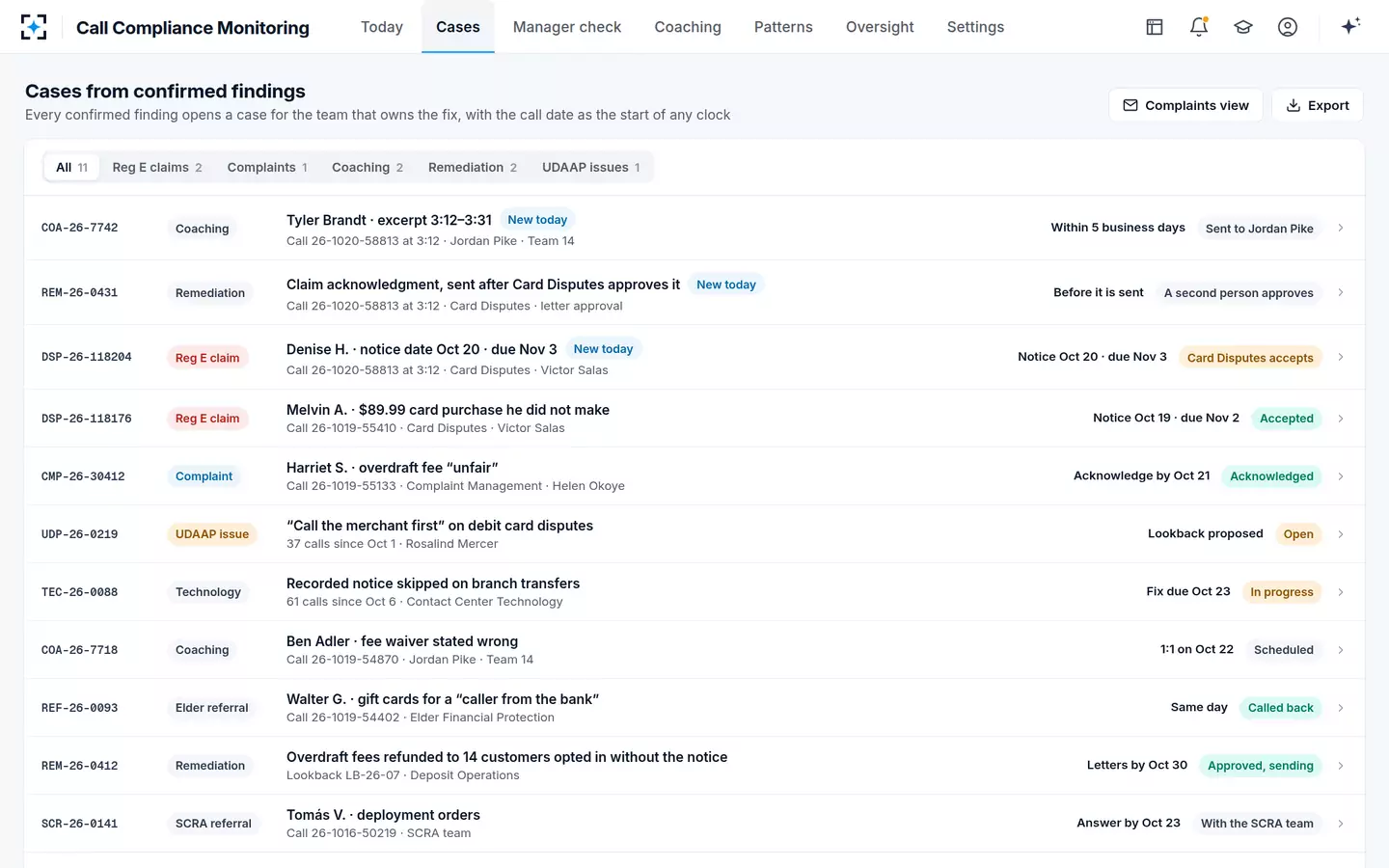
The received date matters as much as the log. A complaint's clock, for an acknowledgment and a response, should start on the day the customer spoke. At Corvane a complaint found on a call and confirmed by a QA analyst is logged with the call date as its received date, and its acknowledgment letter and closing each need a second officer. In the sample month that was 2,318 complaints, the largest single category of what people confirmed. Deadlines for responses vary by product and channel, and the clocks a complaint starts are set out by the complaint management series.
The QA queue: unlogged complaints found on calls, beside the other findings
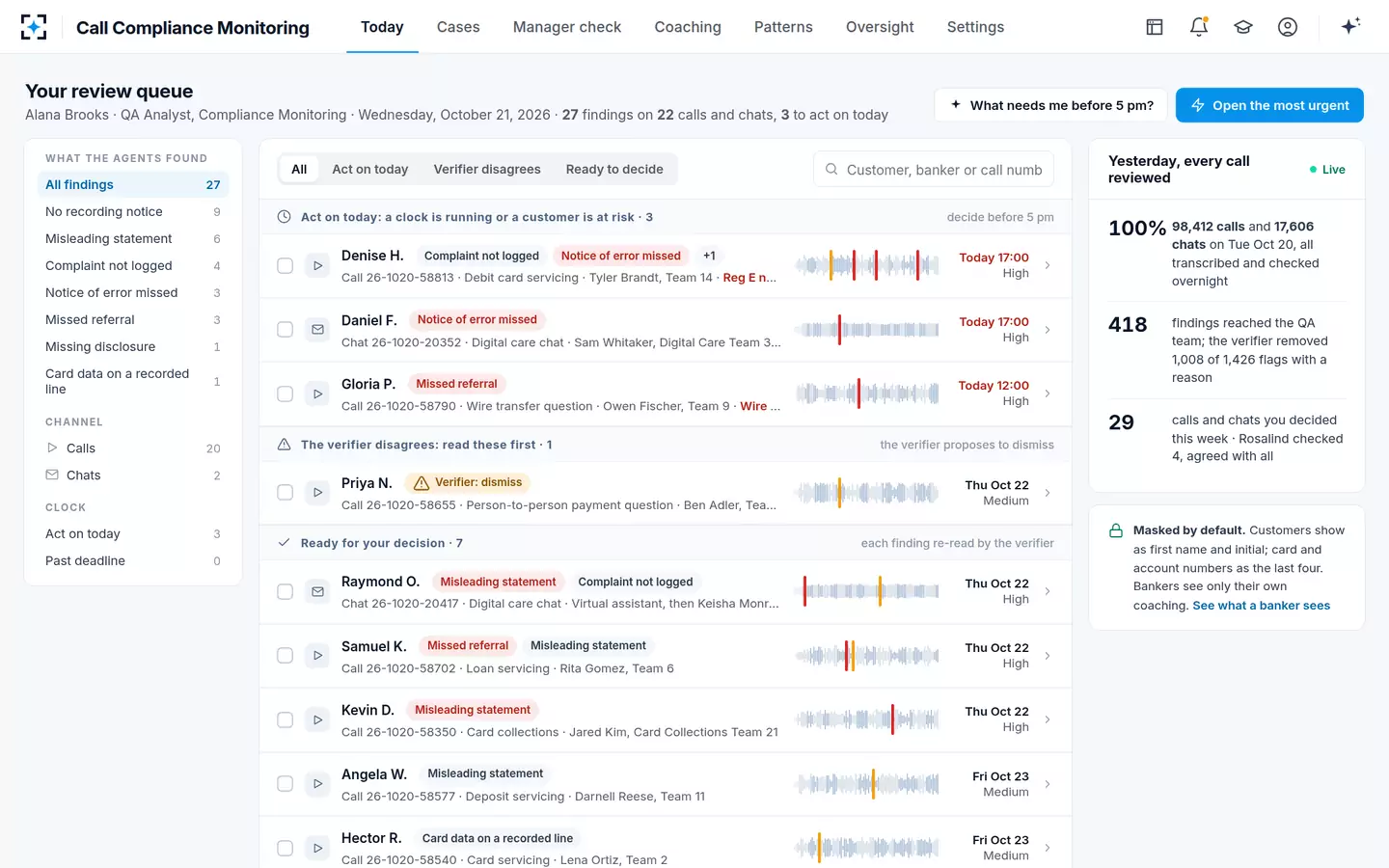
How do you capture complaints from phone calls?
Capture complaints from phone calls in two places: on the call, where the banker logs what the policy counts, and after the call, where every call is checked for dissatisfaction that was not logged. The first depends on training and a definition bankers can apply; the second depends on reviewing enough calls to find what the first missed.
Capturing complaints said on calls and in chats
- A definition a banker can apply live
Any expression of dissatisfaction, with five or six examples from your own calls, including ones without the word.
- One place to log it, from every channel
Calls, chats, secure messages and branches feed the same complaint system.
- The received date is the day the customer spoke
Not the day QA found it or the day it was keyed in.
- Check every call for unlogged dissatisfaction
Compare what was said with what the complaint system holds for that customer.
- A person confirms before anything is logged
An agent can find the sentence; a person decides it meets the policy.
- Log the notice of error too, if there is one
A complaint about an unrecognised charge opens a Reg E claim as well.
- Route by owner, with a second officer on letters
Acknowledgments and closings checked before they go.
- Look for the cause across calls
The same complaint from many customers points to a product, article or system, not a banker.
The agents at Corvane do the second half. The Complaint agent applies the bank's complaint policy to every call and chat, finds dissatisfaction whether or not the customer says the word, and checks the complaint system for a log. A QA analyst confirms each finding, and a case agent then logs the complaint with the call date and routes it to Complaint Management. How the bank's complaint program handles it from there, by product and regulator, is the subject of bank complaint handling procedures; the agents that find it are described on the Call Compliance Monitoring page.
A confirmed complaint becomes a case, with the call as its received date
Questions people ask
Is a complaint resolved on the call still a complaint?
Under a policy that counts dissatisfaction, yes: resolving it quickly is good service, but the customer still expressed dissatisfaction, and logging it is how the bank sees how often the same problem occurs. A program can record complaints resolved on contact separately, so they are counted without being worked twice.
Does a customer have to use the word "complaint"?
Not under a dissatisfaction-based policy, and not under the CFPB's own definition for the complaints it receives, which turns on whether a submission expresses dissatisfaction or suspicion of wrongful conduct. Waiting for the word misses most complaints.
Should complaints made in chat be logged?
Yes, on the same terms as calls. A chat is a written record, so dissatisfaction is easier to find afterwards, and a chat about an unrecognised charge can also be a written notice of error under Regulation E.
What received date should a complaint found by QA carry?
The date of the call. A complaint logged with the date QA found it makes every later deadline look met and hides the days the complaint sat unrecorded; the sample bank's configuration sets the received date to the call date automatically on confirmation.
Who owns a complaint that QA finds on a call?
The complaint management team, as for any other complaint, and the banker's supervisor for any coaching. QA's job is the finding; the FDIC expects the people responsible for handling complaints to be "designated and known to all institution personnel".