A call center quality assurance analyst at a bank listens to recorded calls and reads chats, checks each one against the bank's procedures and the consumer rules behind them, and reports what went wrong to the banker's supervisor and to Compliance. In a bank the finding that matters is rarely about tone. It is whether the call contained something that starts a legal obligation: a customer disputing a debit card charge, which Regulation E treats as a notice of error from the moment it is said; a complaint the banker never logged; a fee or a hold stated wrongly. The hard part is volume. A large bank's contact center can take millions of calls and chats a month and an analyst can hear a couple of dozen a day, so most of the day goes on calls a random draw chose. Botminds' Call Compliance Monitoring has agents review every call and chat overnight, so the analyst's day becomes deciding what they found.
The day described below comes from a fictional sample bank, Corvane National Bank, as it runs through the solution: 4,800 bankers, about 2.5 million calls and chats a month, and a QA team that used to listen to eight calls per banker a month. Every person and number from Corvane is sample data. The research figures come from regulators and linked sources.
The calls come from a workforce of 2.67 million, and it is shrinking
2.67M
customer service representatives employed in 2025, all industries
BLS Employment Projections
−5.3%
projected change in those jobs from 2025 to 2035
$44,770
median annual wage for customer service representatives, 2025
What does a call center quality assurance analyst do at a bank?
A bank QA analyst does four things: takes a set of calls and chats to review, listens to each against the bank's rules for that call type, writes up what went wrong for the banker's supervisor and for Compliance, and watches for the same problem on other calls. The scorecard usually mixes service items (greeting, empathy, hold etiquette) with compliance items (authentication, required statements, accurate fees, disputes and complaints taken properly). Only the second half can put the bank in breach of a regulation.
That second half is what examiners mean by monitoring. The FDIC's examination manual describes monitoring as "a proactive approach by the institution to identify procedural or training weaknesses in an effort to preclude regulatory violations", and expects that "Compliance officers should monitor employee performance to ensure that they are following established internal consumer compliance policies and procedures" (FDIC Consumer Compliance Examination Manual, II-3.1). In many banks the QA analyst is the person who does that monitoring on calls, whether the job sits in the contact center or in Compliance. The difference matters for who sees the findings: a contact-center QA team reports to operations, while compliance monitoring reports a finding as a possible violation, with a rule, a date and an owner.
The same manual says how often reviews should happen, and it is not a fixed sample. "The frequency and volume of employee turnover at an institution should be factored into the schedule for reviews," and reviews are "especially critical after problems have been noted during past audits or examinations, regulation changes, new products are introduced, mergers occur, or when additional branch locations are opened." A contact center with high turnover and a monthly product change is the case the manual describes.
Three findings that start a clock, and why they outrank the courtesy score
Three kinds of finding on a bank call create an obligation with a date on it: a notice of error, a complaint, and a statement that misleads. A missed greeting costs a point on a scorecard. A missed notice of error costs the bank a deadline it did not know was running.
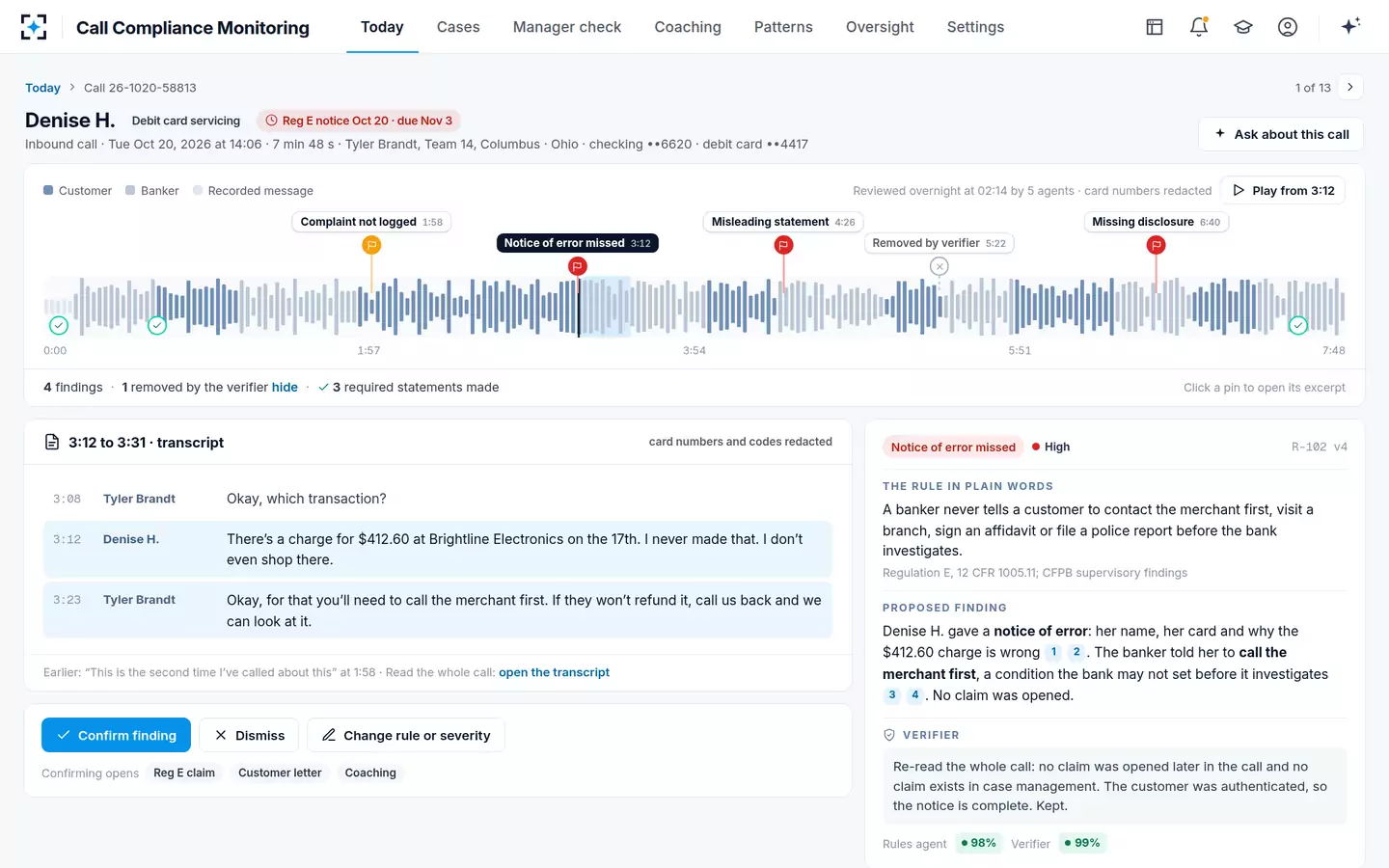
The spoken notice of error. Regulation E's error resolution duties apply to an oral notice as fully as to a written one, as long as it arrives within 60 days of the statement, lets the bank identify the customer and the account, and says why the customer believes there is an error (12 CFR 1005.11(b)(1)). The customer does not have to say "dispute". "I never made that charge" is enough. From that moment the bank has 10 business days to determine whether an error occurred, or longer if it credits the account provisionally. If the banker answers "call the merchant first", the call itself is the notice and the clock has started anyway. Why a phone call is notice under Reg E sets out what a bank may and may not ask for afterwards.
The complaint nobody logged. A bank's own complaint policy decides what counts, and Corvane's counts any expression of dissatisfaction, whatever words the customer uses: "this is the second time I've called about this" may be one. When the banker does not log it, the complaint never reaches the team that has to acknowledge it, find its cause and answer it. The CFPB's 2025 report on the complaints it received describes checking account customers who said bank agents had given them wrong or conflicting information (CFPB Consumer Response Annual Report, 2025). Each of those began as a call to a bank, where a banker could have logged it as a complaint.
The statement that misleads. A banker who says a replacement card is free when the fee schedule says otherwise, or that a deposit will be available Monday when the hold notice says Tuesday, has made a representation the bank can be held to. One wrong statement is a coaching point; the same wrong statement on forty calls, traced to a knowledge article, is a pattern a compliance officer has to treat as a possible unfair or deceptive practice.
The CFPB put the stakes bluntly in its 2023 report on chatbots: for the customer, a dispute nobody recognises or resolves can be ruinous (CFPB, Chatbots in consumer finance; the report's lessons for written replies are in AI customer service in banking).
The CFPB wrote that about chatbots, but it describes the analyst's job just as well: recognising a dispute is the whole of the obligation, and the words a customer uses are not a reliable signal of it.
How many calls does a QA analyst review per day?
There is no standard number; it depends on call length and how much writing each review needs, and on most teams it comes to a few dozen calls a day at most. At the sample bank, a reviewed call took about 18 minutes: seven or eight minutes of audio, then around ten minutes to score it, write up the findings and send them on. On that estimate a 7.5-hour day holds about 20 calls once emails, logging and meetings are taken out.
Multiply it out and the limit is plain. Corvane's old rule of eight calls per banker a month meant 38,400 reviews a month for 4,800 bankers, or about 11,500 hours of listening and scoring, against roughly 2.5 million calls and chats. That is about 1.5% of what customers said. A dispute or a complaint spoken on any of the other 98.5% was never heard by anyone in QA. The arithmetic of how often a sample that size misses a spoken dispute is worked through in the QA sample size calculator; the short answer is that a sample is a measure of quality, not a way of finding every clock.
Two Wednesdays: a sampled day and a day with every call reviewed
The same analyst, the same eight hours, spent in two very different ways. On a sampled day the hours go to finding and hearing calls. On a day when agents have reviewed every call overnight, the hours go to deciding what they found, starting with the calls where a regulatory clock is already running.
Where a QA analyst's day goes: listening on a sampled day, deciding on a reviewed one
- Listening to drawn calls2.75 h
- Scoring and writing up3.25 h
- Emails to supervisors1 h
- Logging, admin0.5 h
- Clocks running today1 h
- Verifier disagreements0.5 h
- Deciding the rest4.5 h
- Same-cause groups0.5 h
- Returns, calibration1 h
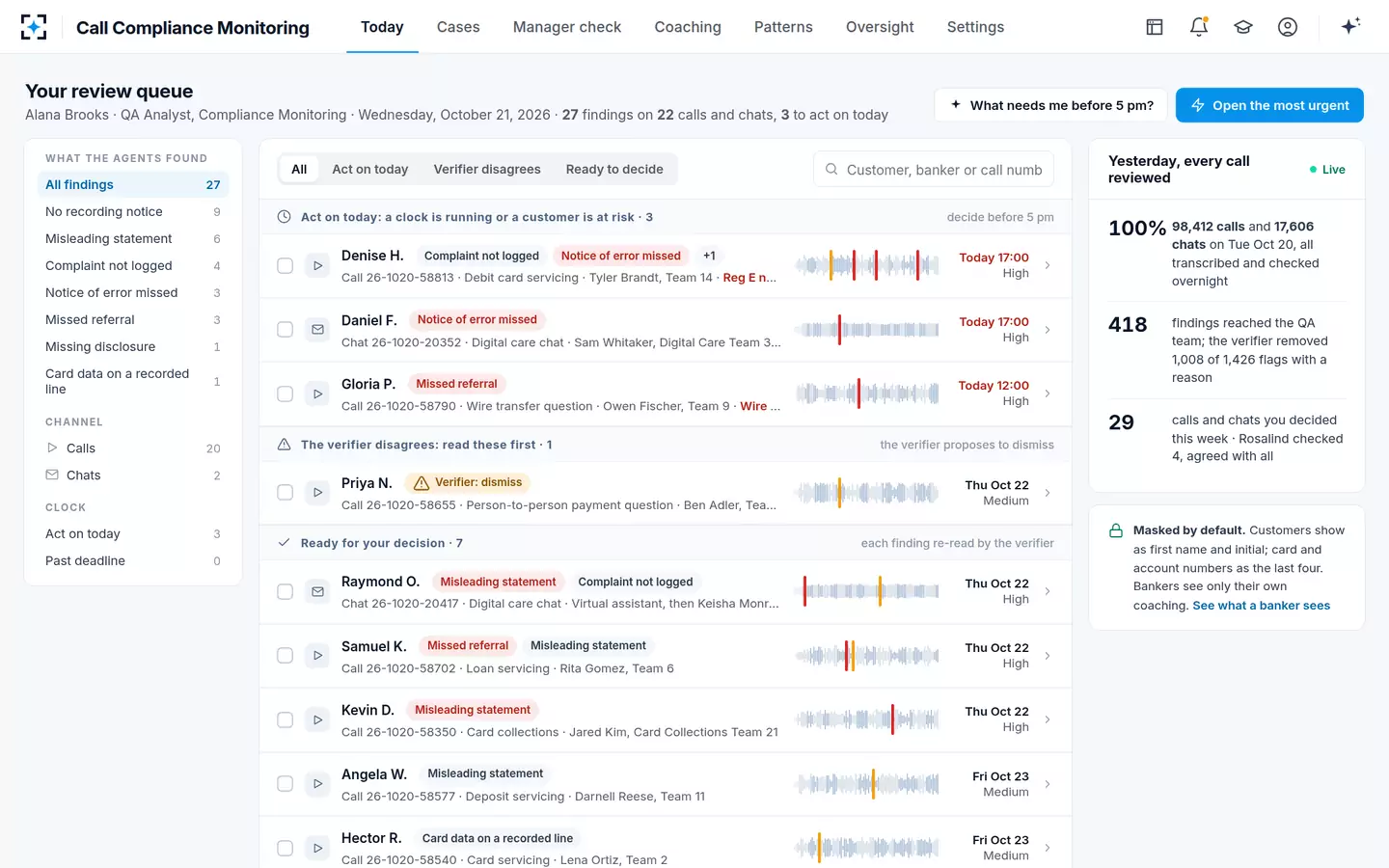
Take Wednesday, October 21, 2026, at Corvane. Alana Brooks, a QA analyst in Compliance Monitoring, opens a queue of 27 findings on 22 calls and chats from the day before. The agents reviewed 98,412 calls and 17,606 chats overnight; their flags went through a verifier agent that removed most of them with a written reason, and 418 findings reached the QA team. Her queue is sorted by clock, not by time of call.
Three are marked act on today. Denise H. disputed a $412.60 card charge and was told to call the merchant first. Daniel F. reported a $600 ATM error in a chat and was told to visit a branch and sign an affidavit. Gloria P., 81, asked about a $9,000 bail wire she had been told to keep secret; the wire has not gone out. After those comes the one call where the verifier disagrees with the first agent and proposes a dismissal, then seven ready for a decision. None of the 27 was chosen at random.
The QA analyst's queue opens on the calls with a clock running
What does a QA analyst listen for in a bank call?
A QA analyst at a bank listens for the moments a rule is touched, and the rules depend on the call type: a debit card servicing call carries different obligations from a collections call or a wire transfer question. The list below is the core of it for consumer deposit and card calls; each item is a place where the words on the call, not the notes afterwards, decide whether the bank complied.
Eight moments a bank QA analyst listens for on a consumer call
- A notice of error, in any words
An unrecognised charge, a wrong amount from an ATM, a lost card with possible unauthorised use. The customer need not say "dispute".
- A condition put before the investigation
Call the merchant first, bring in a police report, wait for the form. The investigation has to start on the notice.
- Written confirmation asked for properly
If the bank requires it, the banker must say so on the call and give the address it goes to.
- Dissatisfaction the policy counts as a complaint
Logged or not, with the date the customer said it, not the date someone noticed.
- Fees, holds and waivers stated correctly
Against the fee schedule and the hold notice the customer received, not the banker's memory.
- Required statements for the call type
Recording notice, authentication, sales disclosures, the closing. A missed statement is often a script or system fault.
- Card data spoken on a recorded line
A security code read aloud is a data problem whether or not the call went well.
- A customer who needs a referral
A possible scam in progress, a servicemember asking about protections, a request for help the banker could not give.
Two of these depend on the rule's own wording. Written confirmation is allowed, but a bank that requires it must tell the customer, and give the address, while the customer is giving the oral notice (12 CFR 1005.11(b)(2)), so the analyst can only tell whether it was done by hearing the call. And a lost card is not automatically a dispute: the official interpretation applies error resolution to a lost-card report only when the customer also says the card may have been used without permission (Supplement I, comment 11(a)-3).
One call as one waveform, with a pin at every second a rule was touched
What happens when a QA analyst finds a compliance issue?
When a QA analyst finds a compliance issue, the finding has to become a case for the team that owns the fix, dated from the day the customer spoke. For a notice of error that is the dispute team, for a complaint the complaint team, for a pattern Compliance, and for the banker's words the supervisor. In a sampled program this is an email, often days later, and the claim is frequently entered with the date someone found it.
The date is not a detail. Regulation E counts the bank's 10 business days from when it received the notice of error (12 CFR 1005.11(c)(1)), and the bank received Denise H.'s notice at 14:06 on October 20, on the call. A claim opened with a later date does not reset that clock; it hides that the clock was missed. At Corvane, confirming the finding sets the notice date to the call date, shows the deadline, Tuesday, November 3, and, if the account is credited provisionally, the 90-day limit that applies to a point-of-sale debit card. Changing the notice date needs a reason and the Card Disputes lead.
Confirming a finding starts the Regulation E clock on the call date
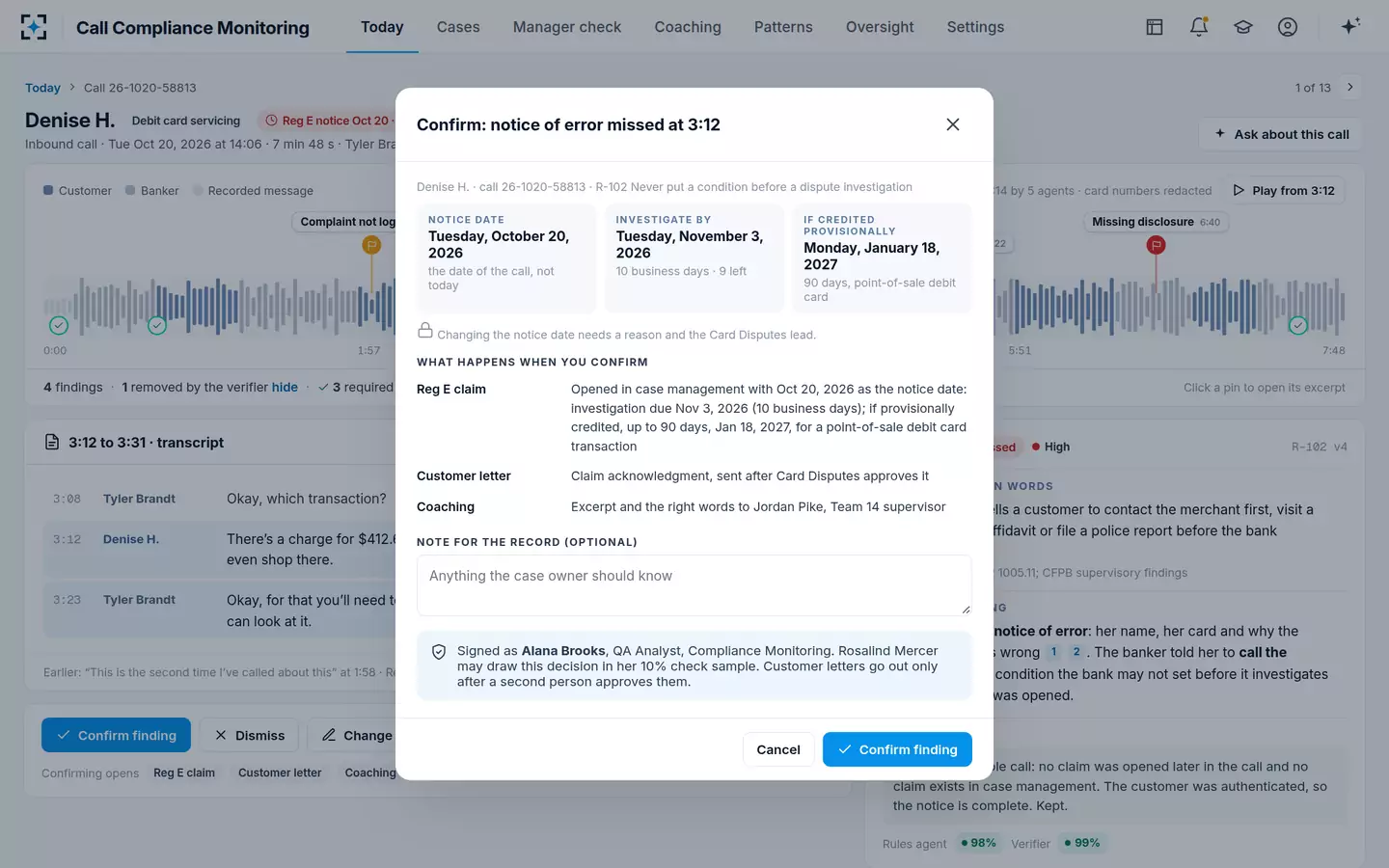
The rest follows from the confirmation. A case agent opens the claim for Card Disputes, a remediation for the acknowledgment letter, which a second person approves before it goes, and a coaching excerpt for the supervisor. The analyst does not discipline anyone and neither do the agents: the supervisor gets the 20 seconds that matter and a note drafted from the bank's own card dispute procedure, edits it and decides what to say.
Who else touches the finding, and what each one sees now
A finding on one call passes through four or five people, and each of them used to get it late and without the words that were said. With every call reviewed, each gets the excerpt, the rule and the clock, and keeps the decision that is theirs.
Four people, one call: what each of them gets from a QA finding
Today
Listened to eight calls per banker a month and filled a scorecard by hand, knowing the rest went unheard.
With agents
Decides about 30 calls and chats with findings a day, reading the excerpt, the rule and the verifier's re-read.
Still theirs: confirm or dismiss, with a reason
Today
Re-sampled a few hundred calls a quarter and found patterns in a monthly report, if at all.
With agents
Checks 10% of confirmations and every High dismissal, with a pre-check beside each, and approves lookbacks.
Still theirs: agree, correct or send back
Today
Heard about a bad call by email, days later, without the words the banker should have used.
With agents
Sees only confirmed findings for the team, the excerpt and a draft note from the bank's procedure.
Still theirs: what to say to the banker
Today
Received disputes found on calls weeks late, dated the day someone noticed them.
With agents
Accepts each claim with the call excerpt and the clock beside it, dated the day the customer spoke.
Still theirs: the investigation and its outcome
The manager's check is what keeps the analyst's decisions honest. Corvane's manager reviews a tenth of confirmations and every High-severity dismissal, with a pre-check that compares the stated reason with the evidence; nobody checks their own decisions. How to measure whether two reviewers would have decided the same call the same way is the subject of call center calibration.
How are QA analysts measured, and which skills does the job need now?
QA analysts are usually measured on volume (calls reviewed), agreement with a second reviewer, and timeliness. When agents do the listening, volume stops meaning much and the other two carry the weight: how often the manager's check agrees with the analyst's decisions, how often a dismissal's reason matches the evidence, and how many decisions are made inside the review deadline, which at Corvane is the same business day for Reg E notices and customers at risk.
The skills shift with it. Fast, attentive listening matters less than reading a rule closely: knowing that a lost card with possible unauthorised use is a notice of error and a request for a balance is not, that written confirmation may be asked for but cannot hold up the investigation, that the bank's complaint policy counts dissatisfaction rather than the word. The new skill is judging a second opinion. An analyst sees where the verifier agent kept a flag, where it removed one with a reason, and where it disagreed; the call that needs the most thought is the one where the two agents differ.
What does not change is that a person answers for the decision. Corvane's design writes it into the screens: no agent opens a case, sends a letter or rates a banker, and every confirmation carries the analyst's name. The agents and the limits on each of them are set out on the Call Compliance Monitoring page.
Questions people ask
What is the difference between QA and compliance monitoring?
QA in a contact center usually scores service quality for coaching and performance. Compliance monitoring checks calls against consumer rules and the bank's procedures and treats a failure as a possible violation with a date and an owner; the FDIC's examination manual calls it a way "to identify procedural or training weaknesses in an effort to preclude regulatory violations." Many banks run both from the same recordings.
Is call center QA analyst a good job?
It is a judgement job that is becoming more so, but official statistics do not track it: the Bureau of Labor Statistics publishes no figures for the job under that name. The nearest official series are compliance officers, 436,400 jobs in 2025 with a median wage of $80,730 and growth of 3.8% projected to 2035, and customer service representatives, whose jobs are projected to fall 5.3%.
Does a QA analyst need to know Regulation E?
Yes, if the bank's calls touch debit cards, ATMs or electronic transfers. Section 1005.11 treats an oral notice of error as a notice and gives the bank 10 business days from receiving it to determine whether an error occurred, so the analyst is often the first person who can see that a clock started on a call and nobody opened a claim.
What skills does a call center QA analyst need?
Close reading of rules and policies, listening for meaning rather than keywords, and writing a finding someone else can act on. Where agents review every call, add judging a second opinion: deciding between the first agent's flag and the verifier's reasons, with the evidence in front of you.
Can AI replace a call center QA analyst?
Not for the decisions. In 2022 the CFPB found it unfair that a bank denied notices of error based solely on an automated fraud filter, and fined it $100 million. Agents can listen to every call and propose findings; AI call monitoring with a verifier agent shows how a person stays the one who decides.
Should a QA analyst coach the banker directly?
Usually not. Coaching belongs to the supervisor, who knows the banker and the team; the analyst's job is a finding the supervisor can trust. At the sample bank, supervisors see only confirmed findings for their own team, and no coaching is proposed when the cause was a system change rather than the banker.