Regulation E does not require a consumer to give written notice of an electronic fund transfer error. Its error rules apply to a notice given by phone just as to one in writing, if it reaches the bank in time, lets it identify the customer and the account, and says why the customer believes there is an error. A phone call that does those three things is a notice of error, and the bank's 10 business days start on the call. What the rule allows is narrower than many scripts suggest: a bank may require written confirmation within 10 business days, but it has to say so on the call and give the address, and it may not wait for the paper before investigating. The hard part is that most calls are never reviewed, so a spoken notice a banker mishandles starts a clock nobody sees. Botminds' Call Compliance Monitoring reviews every call and chat for those notices and dates each missed one from the call.
Where this page uses an example, it comes from a fictional sample bank, Corvane National Bank, and its sample data. The rules are quoted from the regulation and its official interpretation as they stood on eCFR in October 2026.
What call scripts say about written notice, and what Regulation E says
What the customer hears: "We need your dispute in writing before we can open it."
What the rule and its interpretation say: The rule covers spoken notices as well as written ones. The call is the notice, and the investigation starts on it.
What the customer hears: "Call the merchant first, and call us back if they won't refund it."
What the rule and its interpretation say: The CFPB found requiring this before an investigation "was a violation of Regulation E" (2019-BCFP-0001).
What the customer hears: "You'll need to bring in a police report and a signed affidavit."
What the rule and its interpretation say: A bank may ask for a signed statement, but the investigation may not wait for it to arrive.
What the customer hears: "The dispute team has closed; it counts from when you call back."
What the rule and its interpretation say: A notice given after the office closes still counts as given that day.
What the customer hears: "This line doesn't take disputes."
What the rule and its interpretation say: A bank may name a number for notices only if it has "reasonable procedures to refer the consumer" who calls elsewhere.
What the customer hears: "If the form doesn't come back, nothing happens."
What the rule and its interpretation say: Partly true: provisional credit may be withheld if confirmation was required and not received, but the investigation goes on.
Does Reg E require written notice?
No. Regulation E's error procedures apply to a notice given on the phone or in writing, so long as it arrives within 60 days after the statement showing the error, lets the bank identify the customer and the account, and says why the customer thinks there is an error, with the type, date and amount where the customer can give them (12 CFR 1005.11(b)(1)). Spoken words meet that test as well as a letter does; how each element is read in a customer's own words is worked through in what makes a Reg E notice of error, and how the 60 days are counted in the Reg E 60 day rule.
What are the Reg E oral notification requirements?
Fewer than most scripts assume, and most of them fall on the bank. The customer has to do on the call only what a letter would do: identify themselves and the account and say what is wrong. The bank has three duties: treat the call as the notice and date it that day; start investigating at once; and, if it wants the dispute in writing as well, ask for it in the form the rule allows. That is the only writing the rule mentions, and it comes after the call.
A financial institution may require the consumer to give written confirmation of an error within 10 business days of an oral notice.
Regulation E, 12 CFR 1005.11(b)(2)
Confirmation is a follow-up to a notice the bank has already received, not a condition for receiving it. The official interpretation settles the order of events: the investigation starts on the call and does not wait for the written confirmation (comment 11(c)-2), the point every frontline course has to land, as Reg E training sets out.
Can a bank require a written dispute form under Reg E?
Yes, as confirmation of a notice already given, and only on three conditions: the bank tells the customer on the call that confirmation is required, gives the address it must go to, and starts investigating without waiting for it. The first two conditions are in the rule itself, which makes a bank that wants confirmation say so, and name the address it must go to, during the call (12 CFR 1005.11(b)(2)). The third is the comment cited above.
The consequence of a form that never comes back is limited to money, not to the investigation. A bank that cannot finish within 10 business days normally credits the account provisionally while it investigates, but it "need not provisionally credit the consumer's account if" it "requires but does not receive written confirmation within 10 business days of an oral notice of error" (12 CFR 1005.11(c)(2)(i)(A)). The investigation, the decision and the report to the customer are still owed.
What a call monitor can hear about written confirmation
For a call monitor, this turns the written-confirmation question into something audible. If the bank's procedure requires confirmation, the banker must have said so on that call and given the address. If the recording shows the banker said nothing, the bank cannot rely on the missing form to withhold provisional credit, and a QA analyst who hears only "we'll send you a form" has found a gap.
Written confirmation under Reg E: what the bank may do, and what each step needs
| Step | What the rule allows | What has to be on the call or in the file |
|---|---|---|
| Require written confirmation | Yes, within 10 business days of the oral notice | The banker tells the customer it is required and gives the address, during the call |
| Ask for a signed statement | Yes, as a request | No delay to starting or finishing the investigation while it is outstanding |
| Withhold provisional credit | Only if confirmation was required and not received in 10 business days | Proof the requirement and address were given when the customer called |
| Wait for the form to start | No | The claim opened and dated on the day of the call |
| Deny for missing paperwork | No | A reasonable investigation of the bank's own records, whatever the customer sends |
When does the Reg E clock start on a phone dispute?
The Reg E clock starts when the bank receives the notice, and on a phone dispute that is the call, including a call made after the dispute team has gone home. The official interpretation of "business day" runs each day to midnight and treats a notice given outside office hours as given (Supplement I, comment 2(d)-1; the Reg E error resolution calculator counts the days from there). A customer who reaches a banker at 6:30 on a Friday evening has given notice on Friday.
The line the customer calls matters less than many banks assume. A bank may require notice at the telephone number or address it has disclosed, "provided the institution maintains reasonable procedures to refer the consumer to the specified telephone number or address if the consumer attempts to give notice to the institution in a different manner" (comment 11(b)(1)-6). A banker on the general servicing line who answers "this line doesn't take disputes" and ends the call has not referred the customer anywhere.
From that day the deadlines run: 10 business days to decide, longer with provisional credit, longer still for point-of-sale debit card transactions and new accounts. Payment disputes teams own that calendar, and the Reg E dispute timeline lays out every deadline from the first call to the final letter. For call monitoring the point is narrower: the notice date is the call date, and a review that finds the call later cannot move it.
The passage a finding relies on, opened from the call
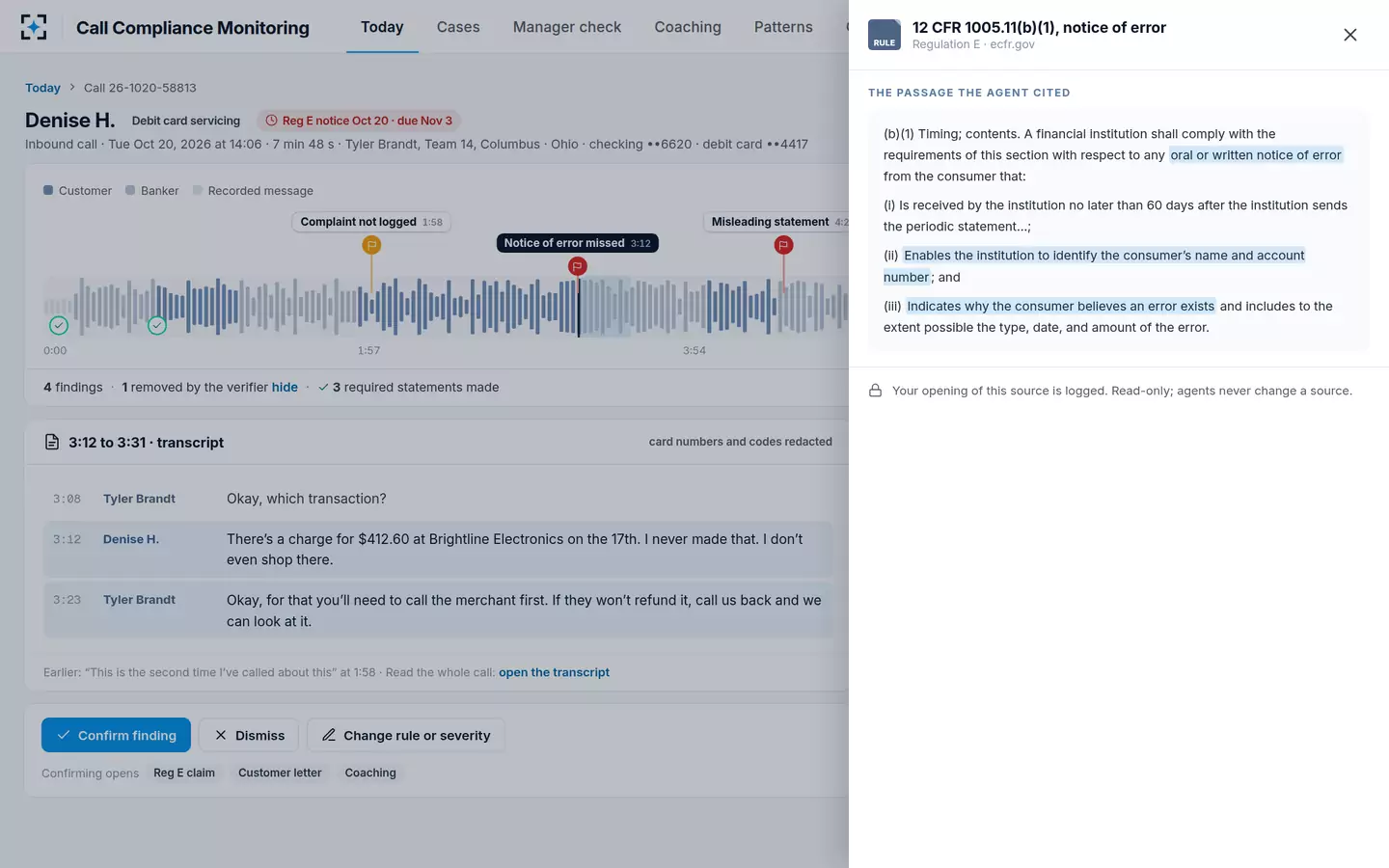
Can a bank deny a Reg E claim for missing paperwork?
No. The CFPB's staff answer to that question is a flat no: once a spoken or written notice is in, the bank starts and finishes its investigation on its own records, and a missing report, affidavit or form is never a reason to wait (CFPB, Electronic Fund Transfers FAQs). The FAQs are staff guidance, last updated January 15, 2025, and point to comments 11(b)(1)-2 and 11(c)-2 for the rule.
Examiners have found the practice more than once. In 2014 the CFPB reported institutions that held phone disputes until a confirmation form came back, one that denied claims "Unless the consumer submitted the additional information requested within 10 days of the original notice", and institutions where "customers who complained about unauthorized transactions were told they must first contact the merchant, where applicable, before an investigation would begin" (Supervisory Highlights, Fall 2014). In 2020 it reported deposit agreements making consumers agree to "cooperate" with error investigations, where cooperation "included providing affidavits and notifying law enforcement authorities"; the agreements "waived consumers' rights in violation of EFTA" (Supervisory Highlights, Summer 2020).
Error resolution is still where Reg E violations are found
136
EFTA and Regulation E violations the FDIC cited in 2025
#2
most cited consumer law in FDIC examinations in 2025, up from fourth
74%
of those violations under the error resolution rules, 1005.11(c) and (d)
486
spoken notices of error a fictional sample bank's bankers missed in one month
Does a chat message count as notice under Reg E?
Yes. A chat message is a written notice if it meets the same three tests: received in time, enough to identify the customer and account, and a reason the customer believes there is an error. Logging in to chat usually settles the second test before the customer types a word. The risk in chat is the same as on the phone, only faster: the answer comes back in seconds, from a person or a virtual assistant, and may set a condition the rule does not allow.
The CFPB's 2023 report on chatbots quotes a customer whose dispute never opened: "I engaged their chat service for help and was told that a dispute would be open and that I would receive conditional credit within 48 hours. The following Tuesday I had still not received credit and in their online banking site the dispute is nowhere to be found" (CFPB, Chatbots in consumer finance). A monitoring program that reads chats should check not only what the customer was told but whether the claim exists in case management afterwards. At Corvane, one of the three findings due on October 21 was a chat: a $600 ATM error, answered with an instruction to visit a branch and sign an affidavit.
What must a call center rep do when a customer reports an error?
A call center rep must recognise the notice in whatever words it comes, open the claim on the call with the call's date, set no condition before the investigation, and, if the bank requires written confirmation, say so and give the address before the call ends. Everything a QA analyst checks on these calls follows from those four duties.
What a call monitor listens for when a customer reports an error
- The notice, in ordinary words
"I never made that charge" or "the ATM gave me $100 less" is a notice; the customer does not need to say "dispute".
- A lost card with possible unauthorised use
The loss alone is not an error; the loss plus a charge the customer does not recognise is.
- A request for documentation
Generally treated as an error notice too, unless the customer clearly wants a duplicate for tax or records.
- No condition before the investigation
Not the merchant, not a police report, not a branch visit, not a returned form.
- Written confirmation, if required, said on the call
The requirement and the address, in the banker's words, while the customer is on the line.
- The claim opened and dated today
Checked afterwards in case management, not taken from the banker's notes.
- A referral if the line is wrong
A transfer or the number to call, not "this line doesn't take disputes".
- What happens next, stated accurately
No promise of a refund, and no deadline the bank does not keep.
Training is where most banks start on these duties, and Reg E training for the frontline covers what each role needs to know. Monitoring is how a bank finds out whether the training held on the calls that actually happened.
How call monitoring finds the spoken notices nobody opened
Call monitoring finds a missed spoken notice by doing what an examiner would: listening to the call, testing the words against the rule's elements, and then checking whether a claim exists. A hand sample does this on a small share of calls, and the odds that a sample hears a spoken dispute are worse than most QA managers expect. Reviewing every call does it on all of them.
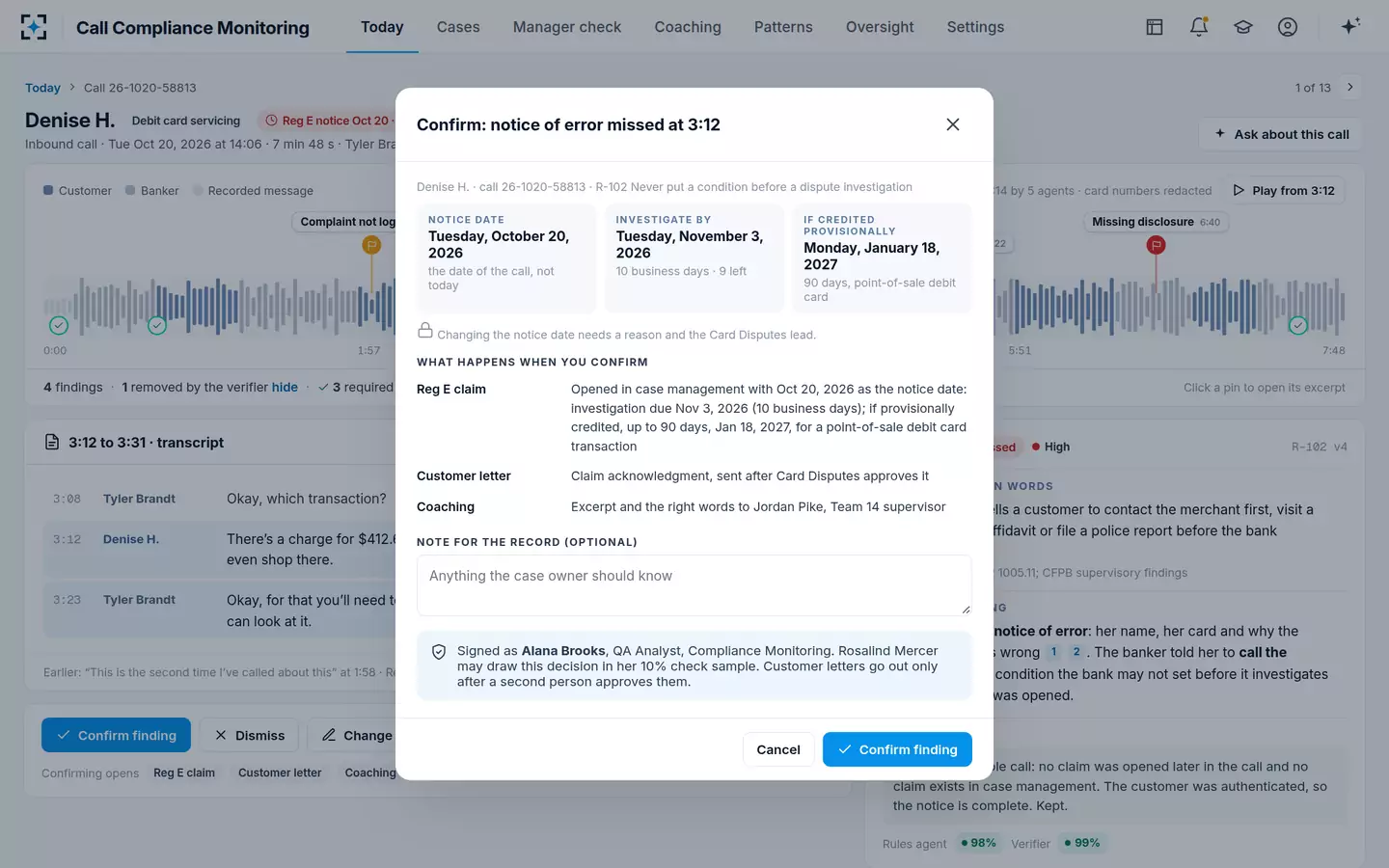
At Corvane the agents found 486 notices of error in September that bankers had not opened, each confirmed by a QA analyst and opened as a claim with the call date as the notice date. One of them was Denise H. On October 20 at 14:06 she told a banker she never made a $412.60 charge, and the banker told her to call the merchant first. The finding reached a QA analyst the next morning; on confirmation the claim opened with October 20 as the notice date and November 3 as the 10-business-day deadline, with nine business days still left. Changing the notice date needs a reason and the Card Disputes lead. How a second agent checks each flag explains why the finding was kept: the verifier re-read the whole call and case management and found no claim.
Confirming a missed notice opens the claim on the call date
Questions people ask
Can a customer dispute a debit card charge by phone?
Yes. Regulation E treats a spoken notice like a written one, so a call that identifies the customer and account and says why the charge is wrong is a notice. The bank's 10 business days to decide start on the call, whether or not anything is sent in writing afterwards.
What if the customer never sends written confirmation?
The investigation still has to be done. If the bank required confirmation, told the customer on the call and gave the address, it may skip provisional credit when nothing arrives within 10 business days; it may not close or deny the claim for that reason.
Does a phone call count for a credit card dispute?
Not as a billing error notice. Credit card billing errors fall under Regulation Z, which needs the notice in writing, at the address or electronic means the card issuer discloses (12 CFR 1026.13(b)). The difference between the two regimes is set out in Reg E vs Reg Z disputes.
Can a bank make customers call a dedicated dispute line?
It may name a number for notices, but only if it has reasonable procedures to refer customers who call elsewhere. A servicing banker who simply declines the dispute has not referred the customer, and the notice has still been given.
Is an after-hours call a notice of error?
Yes. The official interpretation counts a notice given outside office hours as given, although the regulation does not require the bank to staff its phones around the clock. A call taken by anyone at the bank after hours is notice on that day.