The Reg E dispute timeline starts when a bank or credit union receives a notice of error, oral or written, and runs on several clocks at once. Under 12 CFR 1005.11 the institution must investigate promptly and decide whether an error occurred within 10 business days; if it needs longer, it may take up to 45 calendar days, but only if it provisionally credits the consumer within those 10 business days and tells the consumer within two business days after crediting. The 45 days become 90 for point-of-sale debit card transfers, transfers initiated outside the United States and transfers within 30 days of an account's first deposit, and the 10 business days become 20 for that last group. Once it decides, the institution has one business day to correct an error and three to report the result. Botminds' Reg E Dispute Management computes all of them for every claim from the notice date; this guide sets them out so that anyone can check the arithmetic.
Four numbers set the Reg E dispute time frame
10bus. days
to decide, or to credit provisionally and take longer
45days
to finish an investigation with provisional credit
90days
for point-of-sale debit, foreign-initiated and new-account transfers
20bus. days
in place of 10 for transfers within 30 days of the first deposit
How long does a bank have to investigate a Reg E dispute?
A bank or credit union has 10 business days from receiving the notice to investigate and determine whether an error occurred, and up to 45 calendar days if it provisionally credits the consumer within those 10 business days. The extended periods are 20 business days and 90 calendar days, as described above. The statute is the origin of the 45 days: under the Electronic Fund Transfer Act, when an institution provisionally recredits, "Such investigation shall be concluded not later than forty-five days after receipt of notice of the error," and "During the pendency of the investigation, the consumer shall have full use of the funds provisionally recredited" (15 U.S.C. 1693f(c)).
The ten business days are not a target to investigate within; they are the point by which the institution must have either finished or put the money back. Most card, ATM and ACH claims of any complexity cannot be finished in ten business days, which is why the provisional credit, not the investigation, is the date that matters most operationally.
Three Reg E dispute timelines, drawn to scale in calendar days
- Decide or credit10 bus. days
- Investigate, money backto day 45
- Decide or credit10 bus. days
- Investigate, money backto day 90
- Decide or credit20 bus. days
- Investigate, money backto day 90
Day 0: when the Reg E clock starts
Day 0 is the day the institution receives a notice of error, by any channel. Section 1005.11(b)(1) applies to a notice of error given by phone or in writing that arrives within 60 days of the statement on which the error first appeared, identifies the consumer and the account, and says why the consumer believes there is an error. A phone call is a notice; so is a chat message or a secure message. The commentary treats a business day as the full day to midnight for this purpose, so a call at 8 p.m. is received that day.
The most common timeline error happens here, before any deadline is counted. A claim whose notice date is taken from the dispute form that arrives days after the call has every later deadline in the wrong place, and the error is invisible to a tracker that only counts forward. The CFPB listed "Relying on incorrect dates to assess the timeliness of an EFT error notice" among the violations its examiners keep finding. Why the call, not the form, starts the clock, and what frontline staff must log, is the subject of Reg E training.
Days 1 to 10: decide, or credit provisionally
By the end of business day 10 the institution must have done one of two things: determined whether an error occurred, or provisionally credited the consumer's account. If it determined there was an error, it corrects it within one business day of that determination and reports within three business days of completing the investigation. If it determined there was no error, it reports in writing within three business days, with the explanation and the right to request documents. If it has not finished, the provisional credit is what buys the extra time.
Two lawful paths through day 10, and what each one owes
Finish within 10 business days: Not required
Credit by day 10, finish within 45 or 90 days: The amount of the alleged error, with interest where applicable, by business day 10 (20 for new accounts); up to $50 may be withheld only where 1005.6 allows
Finish within 10 business days: None
Credit by day 10, finish within 45 or 90 days: Within two business days after crediting: the amount and the date, with full use of the funds
Finish within 10 business days: Business day 10 (or 20)
Credit by day 10, finish within 45 or 90 days: Day 45, or day 90 for point-of-sale, foreign-initiated and new-account transfers
Finish within 10 business days: Within one business day of the determination
Credit by day 10, finish within 45 or 90 days: Within one business day; the provisional credit becomes final
Finish within 10 business days: Within three business days of completing the investigation
Credit by day 10, finish within 45 or 90 days: Within three business days, including that the credit is final where applicable
When is provisional credit required under Reg E, and when is it not?
Provisional credit is required whenever the investigation will not be finished within 10 business days (20 for a new account) and no exception applies. There are only two exceptions in 1005.11(c)(2)(i): the institution required written confirmation of an oral notice, told the consumer so and gave the address during the call, and did not receive it within 10 business days; or the account is subject to Regulation T, the securities-credit rule for broker-dealers. Even then, comment 11(c)(2)(i)-1 says the institution "must still comply with all other requirements of § 1005.11."
Two details trip up provisional credit in practice. The amount is the alleged error "including interest where applicable," and examiners have cited credits that left interest out. And an institution "may withhold a maximum of $50" only if it has "a reasonable basis for believing that an unauthorized electronic fund transfer has occurred" and has met the disclosure conditions in 1005.6(a). Nothing in the rule allows a provisional credit to be held, frozen or made unusable; the consumer must have "full use of the funds during the investigation."
Two business days to tell the consumer about the credit
Within two business days after provisionally crediting, the institution must tell the consumer the amount and the date of the credit and give full use of the funds. The notice may be oral or written, but if it is oral the date it was given must be documented; examiners in 2024 found institutions that "were unable to monitor and establish that notices were delivered in a timely manner" because they had not recorded it. The CFPB has also cited notice templates that gave a timeframe instead of the specific date of the credit. What the notice must say is set out in Reg E letter samples.
What is the 45 day rule in Reg E, and when do 90 days apply?
The 45-day rule is the outer limit for completing an investigation when the institution has provisionally credited the consumer: 45 calendar days from receipt of the notice. It becomes 90 days when the transfer "was not initiated within a state," "resulted from a point-of-sale debit card transaction," or occurred within 30 days after the first deposit to the account. The point-of-sale extension covers all debit card purchases at merchants, including cash-only transactions at a merchant terminal and mail and telephone orders, but not ATM withdrawals, "even though the ATM may be in a merchant location" (comment 11(c)(3)-1).
The longer periods are an option, not an automatic right. The commentary on initial disclosures says an institution must have disclosed the longer periods to take advantage of them; the model notice in appendix A tells consumers that "for errors involving new accounts, point-of-sale, or foreign-initiated transactions, we may take up to 90 days." And the CFPB has cited institutions that blew both outer limits: examiners found violations "by failing to complete investigations and make a determination within 45 days from receipt of the notice of error and within 90 days from receipt of the notice of error for point-of-sale debit transactions, respectively, after providing provisional credit within 10 business days of the error notice" (CFPB Supervisory Highlights, Issue 24).
What is a new account under Reg E?
For the error-resolution deadlines, the test in 1005.11(c)(3) is whether the disputed transfer was to or from the account "within 30 days after the first deposit to the account was made." It is a property of the transfer's timing, not of the account's age when the notice arrives: a transfer on day 25 after the first deposit keeps the 20 business days and 90 days even if the consumer reports it on day 40. The test needs the first-deposit date from the core, which is one reason clock selection should be computed rather than chosen from a drop-down.
The extension is double: 20 business days in place of 10 to decide or credit, and 90 calendar days in place of 45 to finish. In the model form's words, "For new accounts, we may take up to 20 business days to credit your account for the amount you think is in error."
Every Reg E deadline, its trigger and how it is counted
| Deadline | Counted from | Length | Unit | Source |
|---|---|---|---|---|
| Notice must arrive | Statement first showing the error is sent | 60 | days | 1005.11(b)(1)(i) |
| Written confirmation, if required | Oral notice | 10 | business days | 1005.11(b)(2) |
| Decide, or credit provisionally | Receipt of notice | 10 (20 new account) | business days | 1005.11(c)(1), (c)(2)(i), (c)(3)(i) |
| Tell the consumer about the credit | Provisional crediting | 2 | business days | 1005.11(c)(2)(ii) |
| Finish the investigation | Receipt of notice | 45 (90 POS, foreign, new account) | calendar days | 1005.11(c)(2), (c)(3)(ii) |
| Correct an error | Determination that it occurred | 1 | business day | 1005.11(c)(1), (c)(2)(iii) |
| Report the result | Completion of the investigation | 3 | business days | 1005.11(c)(1), (c)(2)(iv) |
| Honor items after a reversal | Notice of the debit | 5 | business days | 1005.11(d)(2)(ii) |
| Notice after requested documentation | Institution sends the information | 60 | days | 1005.11(b)(3) |
After the decision: one day to correct, three to report
Once the institution determines that an error occurred, it must correct it within one business day, "including, where applicable, the crediting of interest and the refunding of any fees imposed by the institution" (comment 11(c)-6), and report the result within three business days of completing the investigation, including notice that a provisional credit has been made final. The Federal Reserve notes that the three-day requirement "applies to both 10-day and 45-day investigations" (Consumer Compliance Outlook, Third Issue 2025).
A worked example shows how the dates fall. Take a fictional member who calls a credit union on Tuesday, November 3, 2026 about a debit card purchase she did not make, on an account opened years ago. Assume the credit union is open Monday to Friday and closed on federal holidays, so Veterans Day on November 11 does not count. Business day 10 is Wednesday, November 18. If it credits her on Thursday, November 12, the notice of credit is due by Monday, November 16. As a point-of-sale transfer, the investigation must be finished by Monday, February 1, 2027, day 90; had it been an ATM withdrawal, by Friday, December 18, 2026, day 45.
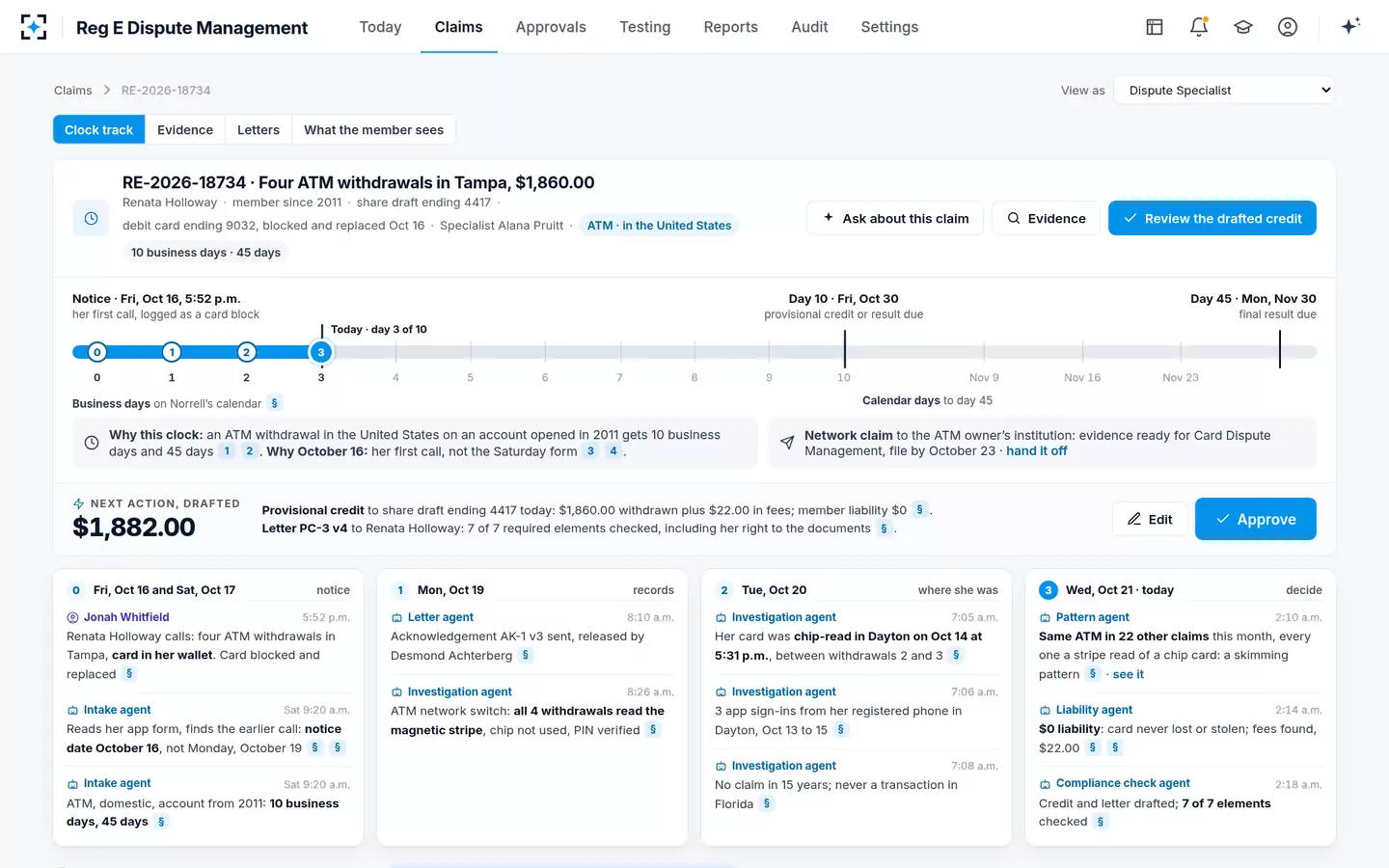
One Reg E claim laid along its legal clock
The tail: reversals, documents and reassertion
The timeline does not end with the result letter when the answer is no error. If the institution debits a provisional credit, it must tell the consumer the date and amount and honor checks and preauthorized transfers for five business days after the notification without overdraft charges; an alternative in the commentary gives notice first and debits five business days later on a stated calendar date. Both are explained in reversal of provisional credit under Reg E.
Two further clocks can reopen the file. A consumer who asks for the documents the institution relied on must get them "promptly." And while a consumer who reasserts the same error after full compliance gets no new investigation, one who asserts an error after receiving documentation or clarification they asked for gets a fresh 60 days from when the institution sent it, under 1005.11(b)(3) and (e). Claims on credit cards run on different clocks under Regulation Z; the side-by-side is in Reg E vs Reg Z disputes.
Reg E Dispute Management's clock track
Reg E Dispute Management computes every clock above for every open claim from three inputs: the notice date, the transfer type and the account's first-deposit date, on the institution's own business-day calendar. Each claim is shown as a track from the notice to its outer deadline, with every agent's step placed on the day it happened, and the queue sorts claims by the days they have left. The clocks set by the rule are locked; the escalation days, business day 7 to the manager and 9 to the head of the department in the sample configuration, are settings.
The queue, sorted by days left, with each claim's clock
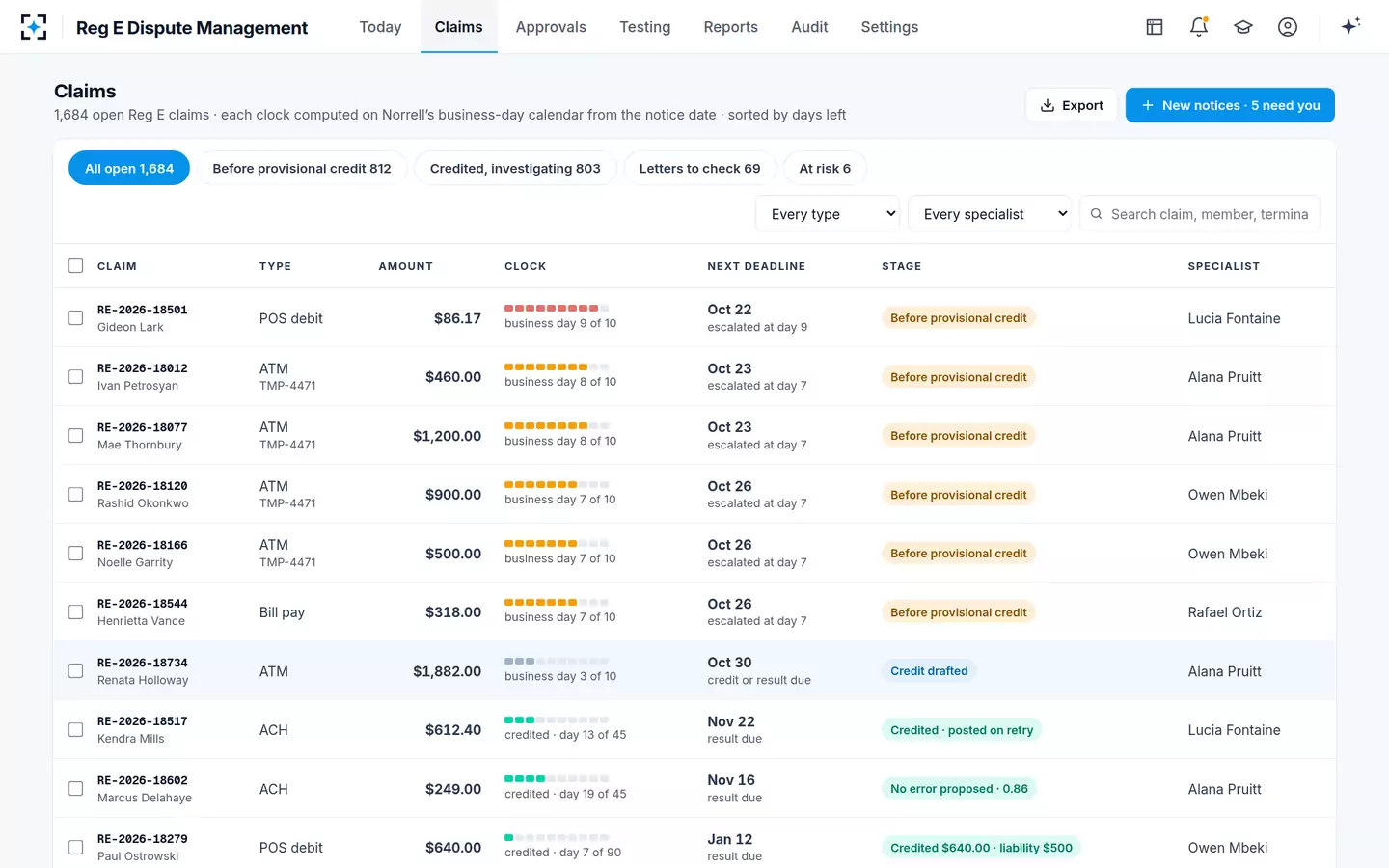
The design target is a provisional-credit decision by business day 3 of 10, which turns the hardest deadline on the timeline into one the institution meets with a week to spare. People still decide every credit and result; the clocks only make sure no one decides late.
Questions people ask
What happens on day 10 of a Reg E dispute?
By the end of business day 10 the institution must either have determined whether an error occurred or have provisionally credited the account. If it has done neither and no exception applies, it has violated 1005.11(c), and under the statute a missed provisional credit combined with a bad-faith or unreasonable investigation can bring treble damages.
Is the 45 days business days or calendar days?
Calendar days. The 10 and 20 periods are business days, while the 45 and 90 periods are calendar days counted from receipt of the notice; the official commentary refers to the “10-business-day or 45-calendar-day time limits”.
Does the 90 day period apply to ATM withdrawals?
No. The point-of-sale extension covers debit card purchases at merchants, including mail and telephone orders, but comment 11(c)(3)-1 excludes ATM transactions even when the ATM is inside a merchant’s premises. An ATM withdrawal gets 90 days only if it was foreign-initiated or within 30 days of the first deposit.
How long after the investigation must the bank notify the customer?
Within three business days after completing the investigation, whatever the result. If the result is no error or a different error, the report must be in writing with an explanation and the right to request the documents relied on.
Can the institution finish early and skip provisional credit?
Yes. If it determines within 10 business days (20 for a new account) whether an error occurred, no provisional credit is needed; it corrects any error within one business day and reports within three. It may also correct the error as the consumer alleged without investigating, but must still meet the other requirements of 1005.11.