Reg E dispute processing is the work of running Regulation E error resolution for a bank or credit union, and software for it does that work with the team: it takes the consumer's notice, keeps each claim on its legal deadlines, gathers the evidence, computes liability and provisional credit, drafts the required notices and tests the results. The part buyers underestimate is the evidence. The official commentary says an institution "may not limit its investigation solely to the payment instructions where additional information within its own records pertaining to the particular account in question could help to resolve a consumer’s claim," and those records are spread across the core banking system, the card processor, the ATM network switch, the ACH platform and digital banking, most of them run by vendors. Botminds' Reg E Dispute Management is built to read those systems and post through the core rather than replace any of them. Whether a product can do that, on your systems, is the question that decides a purchase.
What a Reg E investigation reads, system by system
Contact center, chat, secure messages, branch notes
What it showsThe first contact that describes the error, in the consumer’s words, with its date and time
Which step needs itNotice date; 60-day window; written-confirmation disclosure
Core banking system
What it showsAccount type and owner, first-deposit date, history, interest, fees charged, postings
Which step needs itCoverage and clock; history review; credit to the right account; correction with fees
Card processor
What it showsAuthorizations, how the card was read (chip, stripe, keyed), merchant data, where the card was used
Which step needs itPoint-of-sale vs ATM clock; authorization evidence
ATM network switch
What it showsWithdrawals by terminal, read method, PIN result, surcharges
Which step needs itTerminal patterns; fees to refund
ACH platform
What it showsEntries, originators, authorizations, returns
Which step needs itACH transaction records the commentary names first
Digital banking platform
What it showsSign-ins by device and place; person-to-person and bill-pay instructions
Which step needs itLocation relative to the consumer; whether the consumer initiated
What is Reg E dispute processing software, and what separates the kinds?
Reg E software falls into three broad kinds: case trackers that log claims and count days, case managers that add workflow and templates, and systems that also read the institution's own records and draft the work for a person to decide. All three can show a queue. Only the third changes the part of the claim that examiners keep citing, which is what happens between the notice and the decision: whether the notice was dated right, whether the investigation looked beyond the payment instruction, whether the credit included what it should.
The difference shows up in a single claim. A consumer reports four ATM withdrawals she did not make. A tracker records four amounts. A system that reads the ATM switch sees that all four read the magnetic stripe of a chip card; one that reads the card processor sees the same card chip-read 950 miles away between withdrawals two and three; one that reads digital banking sees her phone signing in from home each day. That is the evidence that settles the claim, and none of it is in the dispute form. A buyer comparing products should ask which of those facts each one would have on the screen without someone pasting it in. The task-by-task view is in Reg E dispute tracking software.
The evidence for one claim, read from four systems
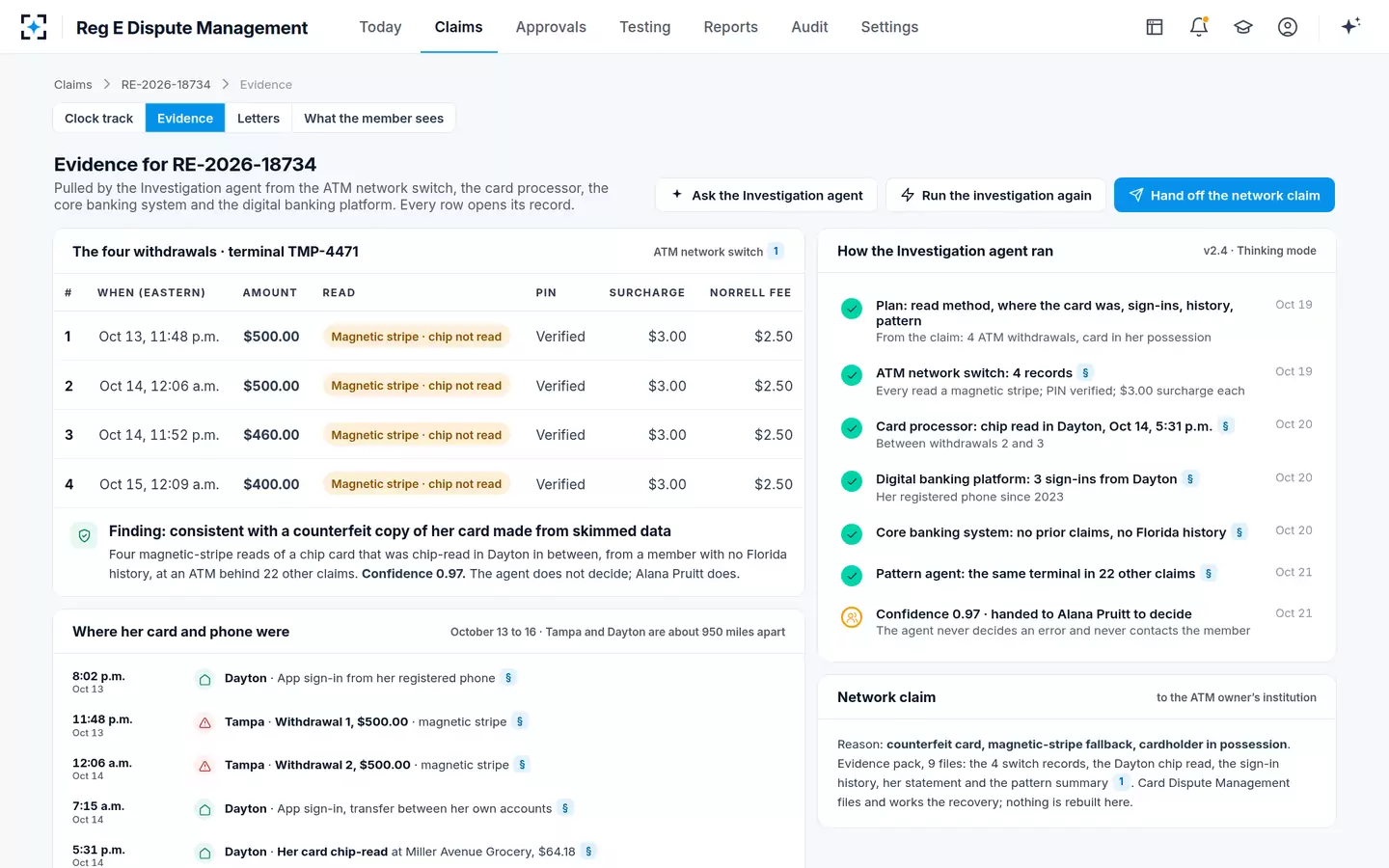
What systems does a Reg E investigation need?
A Reg E investigation needs every system that holds a fact about the disputed transfer or the account behind it: where and how the notice arrived, what the account is and who owns it, how the transfer was initiated and authorized, and what fees and interest it caused. The commentary's list in comment 11(c)(4)-5 is a floor, not a ceiling: ACH transaction records, "the transaction history of the particular account for a reasonable period of time immediately preceding the allegation of error," whether a check number is out of sequence, the location of the transaction or payee relative to the consumer's residence, information held by the institution's third-party service providers where it may be dispositive, and "any other information appropriate to resolve the claim."
The fifth item is the one integration projects forget. When the card processor or the digital banking vendor holds a record that could decide the claim, the commentary treats it as part of what the institution may need to review. Software that can only see the core will miss it, and a team that has to request it by email from the vendor will be late with it.
Does Reg E software replace the core system?
No, and it should not. The core remains the system of record for the account, the posting and the general ledger; Reg E software should read from it and post provisional credits, final credits and reversals through it, so that the account, the statement and the books agree. Replacing or duplicating the core for disputes would create a second balance the consumer never sees. The same applies to the card processor and the ATM switch: they hold the authorizations and reads, and a Reg E system's job is to read them with enough fidelity that a person can decide from the screen.
Posting through the core has a practical consequence a buyer should test: what happens when the core does not answer. In the solution's fictional sample, the core timed out on a provisional-credit posting at 9:41 a.m. and the posting went through on retry 30 seconds later, with the claim's clock unaffected and the retry on the audit trail. The question to ask any vendor is not whether its integration works on a good day but what it does on a maintenance night.
The second person's check, and a core posting that retried once
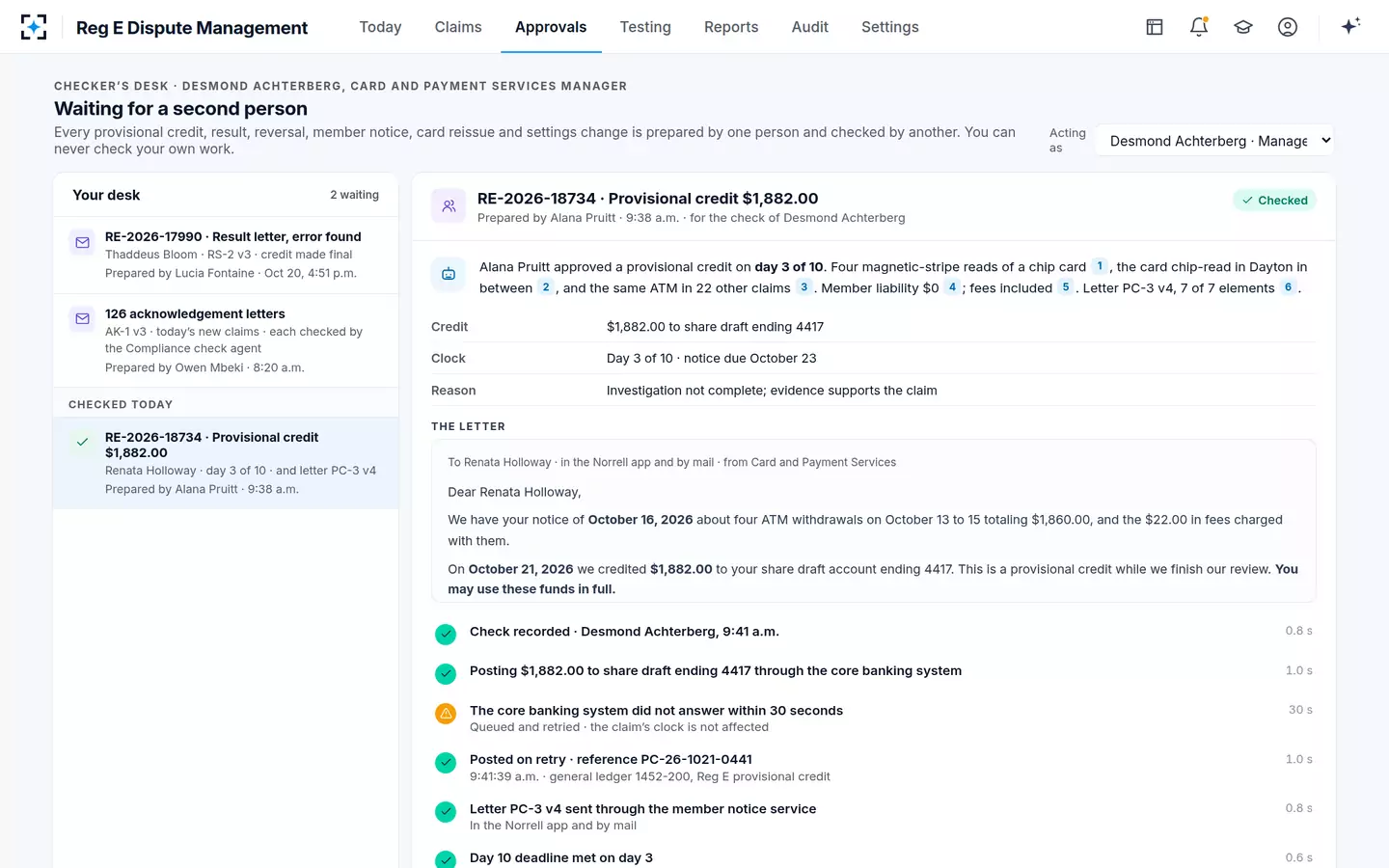
Which transfers must Reg E software handle: ACH, P2P, FedNow and RTP?
Reg E software must handle any electronic fund transfer to or from a consumer account, which is broader than debit cards. Section 1005.3(b) defines an electronic fund transfer as one "initiated through an electronic terminal, telephone, computer, or magnetic tape" to debit or credit a consumer's account, including point-of-sale and ATM transfers, direct deposits and withdrawals, telephone-initiated transfers and "transfers resulting from debit card transactions" (12 CFR 1005.3). The CFPB's EFT FAQs confirm that "Any P2P payment that meets the definition of EFT is covered by EFTA and Regulation E" (CFPB, EFT FAQs); is Zelle covered by Reg E works through that payment by payment.
Which transfers a Reg E system has to take, and which it must route elsewhere
| Transfer | Under Regulation E error resolution? | What the system needs to read |
|---|---|---|
| Debit card at a merchant, online or by phone | Yes; 90 days to finish instead of 45 | Card processor authorizations and merchant data |
| ATM withdrawal, including an ATM inside a store | Yes; 45 days, not 90 | ATM switch reads, PIN result, surcharges |
| ACH debit on a consumer account | Yes | ACH entries, originator, authorization |
| Person-to-person and bill pay from a consumer account | Yes, where it meets the EFT definition | Digital banking instructions, sign-ins, device |
| Consumer payment over FedNow or RTP | Yes, where the transfer is an EFT under Regulation E | The payment message and digital banking session |
| Check, including one paid at a terminal | No; excluded by 1005.3(c)(1) | Route to the check process |
| Wire through Fedwire or a similar system used mainly between institutions or businesses | No; excluded by 1005.3(c)(3) | Route to the wire process |
| Business account | No; Regulation E covers accounts established primarily for personal, family or household purposes | Route to the business dispute process, with the reason |
Instant payments make the point sharper, because they cannot be pulled back. The Federal Reserve's October 2025 article on instant payments notes that both FedNow and RTP are irrevocable and that a consumer payment over either rail is still covered by the EFTA and Regulation E whenever it meets the definition of an EFT (Consumer Compliance Outlook, Third Issue 2025); what that means for a bank answering another bank's return request is in instant payments recall vs return. The same article counts 1,477 FedNow and 1,056 RTP participating institutions as of September 2025. A Reg E system that reads only card data will meet these claims with nothing on the screen.
Instant payment rails now reach well over a thousand institutions
1,477
institutions participating in the FedNow Service, September 2025
1,056
institutions participating in RTP, September 2025
Irrevocable
settlement on both rails, so an error claim cannot wait on a recall
Who is responsible when a vendor misses a Reg E deadline?
The institution is. Federal Reserve examiners found in 2024 that provisional-credit notices went out late "because the institution’s vendor delayed generating and delivering these notices," that neither the institutions nor the vendors crediting accounts on their behalf had working procedures and controls, and they cited the institutions (Consumer Compliance Outlook, First Issue 2026). Their suggested remedy is plain: the compliance department "could meet with the vendor to review Regulation E’s requirements to ensure that when the system provides provisional credit, the consumer has access to the funds."
These errors occurred because the institutions, and the third-party vendors responsible for providing provisional credit on the institution’s behalf, lacked effective procedures and controls to ensure compliance with Regulation E.
Federal Reserve staff, Consumer Compliance Outlook, First Issue 2026
The agencies' third-party risk management proposal of September 2026, open for comment until November 16, 2026, would replace their 2023 guidance but keeps its principle that outsourcing an activity leaves the bank exactly as responsible as if it had done the work itself; the interagency third-party guidance explains the wider rule. The proposal also spells it out for service providers "that are themselves highly-regulated entities." For Reg E software the consequence is contractual and operational. The contract should say who sends which notice by when; the institution should be able to see every vendor-generated notice and posting date in its own data; and its monthly testing should include the vendor's work, as the interagency examination procedures expect.
What going live with Reg E software takes
Going live takes four kinds of input, and only one of them is technical. The connections give the software read access to the systems above and a posting path through the core. The calendar defines the institution's own business days, which drive every count. The templates are the institution's approved letters. And the people decide who approves, who checks, who owns settings changes, and which exceptions go to whom.
What a Reg E software go-live needs from the institution
- Read access to the core, card processor, ATM switch, ACH and digital banking
Extracts or interfaces your vendors provide; the evidence the commentary expects comes from here.
- A posting path through the core
For provisional credits, final credits and reversals, with a defined response to time-outs.
- Contact history from every channel
Call records or transcripts, chat, secure messages, app forms and branch notes: the source of the notice date.
- Your business-day calendar
Including whether Saturday is a business day for you, which depends on whether errors are worked that day.
- Your dispute policy and approved letter templates
Escalation days, written-confirmation choice, approval rules and the notices you send.
- Roles and approvals
Who prepares, who checks, who approves settings changes; no one checks their own work.
- A set of closed claims to test against
Run the software over them and compare its dates, clocks, credits and letters with what happened.
- Vendor responsibilities in writing
Which notices and postings a third party performs, by when, and how you will see the dates.
How long does Reg E software take to implement?
The honest answer is that the software is rarely the long pole; access to the institution's data is. The OCC's November 2025 request for information on community banks and their core service providers records concerns, raised by banks in listening sessions and comments, about "limitations on, and fees related to, accessing and leveraging bank-owned data, including in a format that is comprehensive and compatible with modern operating systems," and about interoperability with other providers (OCC request for information, 2025). A Reg E project that starts by confirming what each vendor will provide, and on what terms, avoids discovering it halfway through.
The safest sequence runs the software on closed claims before any live claim: connections first, then a replay of a set of closed claims scored against what the team decided and what the rule required, then live claims with every credit and letter still approved by a person. Botminds offers to run Reg E Dispute Management on a sample of an institution's own closed Reg E claims first, so the comparison is made on the institution's data rather than on a demonstration.
Questions to put to any Reg E software vendor
The questions that separate products are about data, not features. Ask them on your own systems and claims, and ask for the answer in a running environment rather than a slide.
Integration questions for a Reg E software vendor, and what a good answer sounds like
| Ask | A good answer |
|---|---|
| Which of our systems will you read on day one, and how? | Names each system, the interface or extract, and what happens when a field is missing |
| Where does each finding on a claim come from? | Every value opens the record or passage it came from |
| How do credits and reversals post? | Through the core, to the right account, with a defined retry and an alert |
| Whose calendar counts the days? | Yours, set by you, including Saturdays and closures |
| What do you do with claims outside Regulation E? | Route business accounts, checks and wires out with a reason and a second person |
| What can our vendor-generated notices be checked against? | Their dates and content are visible in the same tests as everything else |
| How is a change to an agent or template approved? | Proposed, tested on closed claims, approved by compliance, versioned |
Where Reg E Dispute Management connects, and what it leaves alone
Reg E Dispute Management works with the systems a Reg E claim already runs on: contact center recordings (calls, chats, app forms and branch notes, read for the notice date), the core banking system (transactions, history, and provisional credit posted to the general ledger), the card processor (authorizations and how each card was read), the ATM network switch (withdrawals by terminal, with the read method), the ACH platform (entries and originator authorizations) and the digital banking platform (sign-ins by device, and the app's dispute forms). It reads them, places each finding on the claim with its source, and posts through the core once a person approves.
It leaves several things alone by design. It does not file or work card network chargebacks; it hands the evidence pack to card dispute management. It does not decide claims, contact members or merchants, or change deadlines. It does not handle business accounts, which it routes out with a reason. And it does not replace the vendor oversight the institution owes; it makes the vendors' dates visible so that the oversight has something to test. How those dates are counted is set out in the Reg E error resolution calculator.
Questions people ask
Can Reg E software handle ACH and P2P claims?
It should: ACH debits and person-to-person transfers from a consumer account are electronic fund transfers when they meet 1005.3(b), and the error-resolution rules apply in full. The software needs to read the ACH platform and digital banking to investigate them, not only the card processor.
Is Reg E software the same as chargeback software?
No. Reg E software runs the institution’s legal duty to its consumer: deadlines, provisional credit, investigation and letters. Chargeback software recovers money from a merchant or another institution under network rules. A card claim often needs both, and the network’s deadlines do not change Regulation E’s.
Does Reg E software need access to the card processor?
For debit card and ATM claims, yes. The processor and the ATM switch hold how the card was read, where and with what result, which is usually the evidence that decides an unauthorized-transfer claim and the fact that decides whether the 90-day period applies.
Do credit unions need different Reg E software?
No: Regulation E applies to credit unions as financial institutions, and the NCUA enforces it for federal credit unions. Practical differences are in vocabulary and configuration, such as share draft accounts, dividends in place of interest, and the credit union’s own business-day calendar.
What data should stay with the institution?
All of it. The system should read records where they live, cite them on each claim and keep the audit trail; Regulation E requires evidence of compliance to be kept for at least two years, and the institution must be able to produce it for an examiner.