A Reg E error resolution calculator takes a notice of error and returns its deadlines: the business day by which the institution must decide or provisionally credit (10, or 20 for a transfer within 30 days of the account's first deposit), the calendar day by which it must finish (45, or 90 for point-of-sale debit card, foreign-initiated and new-account transfers), and the shorter deadlines that follow. The arithmetic is simple; the inputs are not. Regulation E defines a business day as a day the institution's offices are open "for carrying on substantially all business functions," so the calendar is each institution's own; the 90-day extension never applies to an ATM, even one inside a store; and the extended periods can only be used if they were disclosed. Botminds' Reg E Dispute Management computes every claim's clocks on the institution's business-day calendar from the notice date; this guide shows the arithmetic a calculator worth trusting has to show.
Five Reg E claims through the calculator, with the trap in each
ATM withdrawal at a machine inside a grocery store
Notice Wed, Nov 18, 2026, 9:40 p.m. by phone; account opened 2019
Clock10 business days · 45 days
Decide or credit byThu, Dec 3
Finish bySat, Jan 2, 2027
The trapAn ATM in a store is not point-of-sale; Thanksgiving pushes day 10 a day later; day 45 falls on a Saturday
Debit card purchase at a merchant
Notice Fri, Nov 20, 2026; account opened 2015
Clock10 business days · 90 days
Decide or credit byMon, Dec 7
Finish byThu, Feb 18, 2027
The trapPoint-of-sale gets 90 days to finish, not more time to credit
ACH debit on a new account
First deposit Fri, Oct 30; debit Nov 10; notice Mon, Nov 23, 2026
Clock20 business days · 90 days
Decide or credit byTue, Dec 22
Finish bySun, Feb 21, 2027
The trapThe test is the transfer’s date against the first deposit, not the account’s age at notice
ATM withdrawal abroad
Notice Tue, Dec 1, 2026; account opened 2020
Clock10 business days · 90 days
Decide or credit byTue, Dec 15
Finish byMon, Mar 1, 2027
The trapForeign-initiated gets 90 days even at an ATM
Person-to-person transfer
Notice by app on Sat, Dec 12, 2026; Saturday is not a business day here
Clock10 business days · 45 days
Decide or credit byMon, Dec 28
Finish byTue, Jan 26, 2027
The trapWeekday-only counting lands day 10 on Christmas Day
Is there a Reg E deadline calculator you can trust?
You can trust one that takes the institution's own calendar as an input, chooses the clock from the transfer's facts, counts business days and calendar days in the right places, and shows each step with the clause behind it. A calculator that hides its arithmetic is a second opinion nobody can check, and in an examination the institution, not the calculator, answers for the date. The five examples above are the test cases worth running any calculator on before relying on it; each contains a trap a careless count falls into.
The traps are not exotic. The person-to-person example shows the commonest: count ten weekdays from a Saturday notice without a holiday calendar and day 10 lands on December 25, a day no institution is open. The ATM example shows the second: a withdrawal at a machine in a grocery store is still an ATM transaction, so it gets 45 days, not the 90 that a merchant-location flag might suggest. The full set of deadlines these numbers feed is drawn on the Reg E dispute timeline.
How do you count business days for Reg E?
Count only days on which the institution's offices are open for substantially all business functions, which is a fact about the institution, not a national calendar. Section 1005.2(d) makes a business day any day the institution's offices are open to the public for substantially all of their business (12 CFR 1005.2). The commentary then fixes the duration of a day, which matters for when a notice is received:
A business day includes the entire 24-hour period ending at midnight, and a notice required by the regulation is effective even if given outside normal business hours.
Official Interpretations of Regulation E, comment 2(d)-1
Two consequences follow. A notice given at 9:40 p.m. on a business day is received that day, whatever time the contact center closed; a calculator, or a policy, that rolls evening notices to the next day moves every deadline later than the rule allows. And the same comment adds that "The regulation does not require, however, that a financial institution make telephone lines available on a 24-hour basis," which is a statement about phone lines, not about when a message sent through an app at midnight counts.
Does the day of the notice count?
Regulation E's error-resolution section does not say in so many words whether the day of receipt is day 1, and the safe reading is that it is day 0. The regulation runs each period "within 10 business days of receiving" the notice or "within two business days after" an event, and the commentary's own worked count, for the two-business-day liability rule, leaves out both the day the consumer learns of the loss and any day that is not a business day (comment 6(b)(1)-3). Counting the first business day after receipt as day 1 matches that example and the model notice's "within 10 business days after we hear from you."
A program that wants a margin for error should set its own target well inside the legal date rather than shave the count. The design target in Reg E Dispute Management is a provisional-credit decision by business day 3 of 10, and its sample configuration escalates at business day 7 and 9, so a dispute about whether the notice day counts never decides whether a claim is late.
Are Saturdays business days for Reg E?
Only if the institution performs substantially all business functions on Saturday, including back-office work such as investigating errors. The commentary's example is specific: if an institution is open on Saturdays for teller transactions "but not for performing internal functions (such as investigating account errors), then Saturday is not a business day for that institution. In this case, Saturday does not count toward the business-day standard set by the regulation for reporting lost or stolen access devices, resolving errors, etc." (comment 2(d)-2).
Business day or not? The commentary's tests, applied
| Situation | Business day? | Why |
|---|---|---|
| Branches open Saturday for deposits and withdrawals only | No | Back-office functions such as investigating errors are not performed (comment 2(d)-2) |
| Saturday with substantially all functions, but closing at noon | At the institution’s election | An abbreviated day may be treated as a business day (comment 2(d)-3) |
| A Sunday phone line for lost or stolen cards only | No | No other business functions are performed (comment 2(d)-4) |
| A federal holiday on which the institution is closed | No | Offices not open for substantially all functions (1005.2(d)) |
| A weekday on which the institution is open | Yes, for the full day to midnight | Comment 2(d)-1; a notice after closing time is received that day |
The consequence for a calculator is that the calendar must be configurable and versioned. A calculator that assumes the Federal Reserve's holiday schedule, or a plain Monday-to-Friday week, will be right for many institutions and wrong for the ones that matter, such as a credit union that works disputes on Saturdays or closes on a state holiday.
When does the 90 day period apply to debit cards, and does it apply to ATM withdrawals?
The 90-day period applies to every point-of-sale debit card transaction (purchases at merchants, cash-only transactions at a merchant's terminal, and mail and telephone orders), to transfers not initiated within a state, and to transfers within 30 days of the account's first deposit. It does not apply to ATM withdrawals, even at a machine in a merchant's premises, unless the withdrawal was foreign-initiated or falls within a new account's first 30 days (comment 11(c)(3)-1). And it extends only the time to finish: a point-of-sale claim still has 10 business days to decide or credit.
The extension is also conditional on disclosure. The commentary on initial disclosures is explicit:
To take advantage of the longer time periods for resolving errors under § 1005.11(c)(3) (for new accounts as defined in Regulation CC of the Board of Governors of the Federal Reserve System (12 CFR part 229), transfers initiated outside the United States, or transfers resulting from POS debit-card transactions), a financial institution must have disclosed these longer time periods.
Official Interpretations of Regulation E, comment 7(b)(10)-2
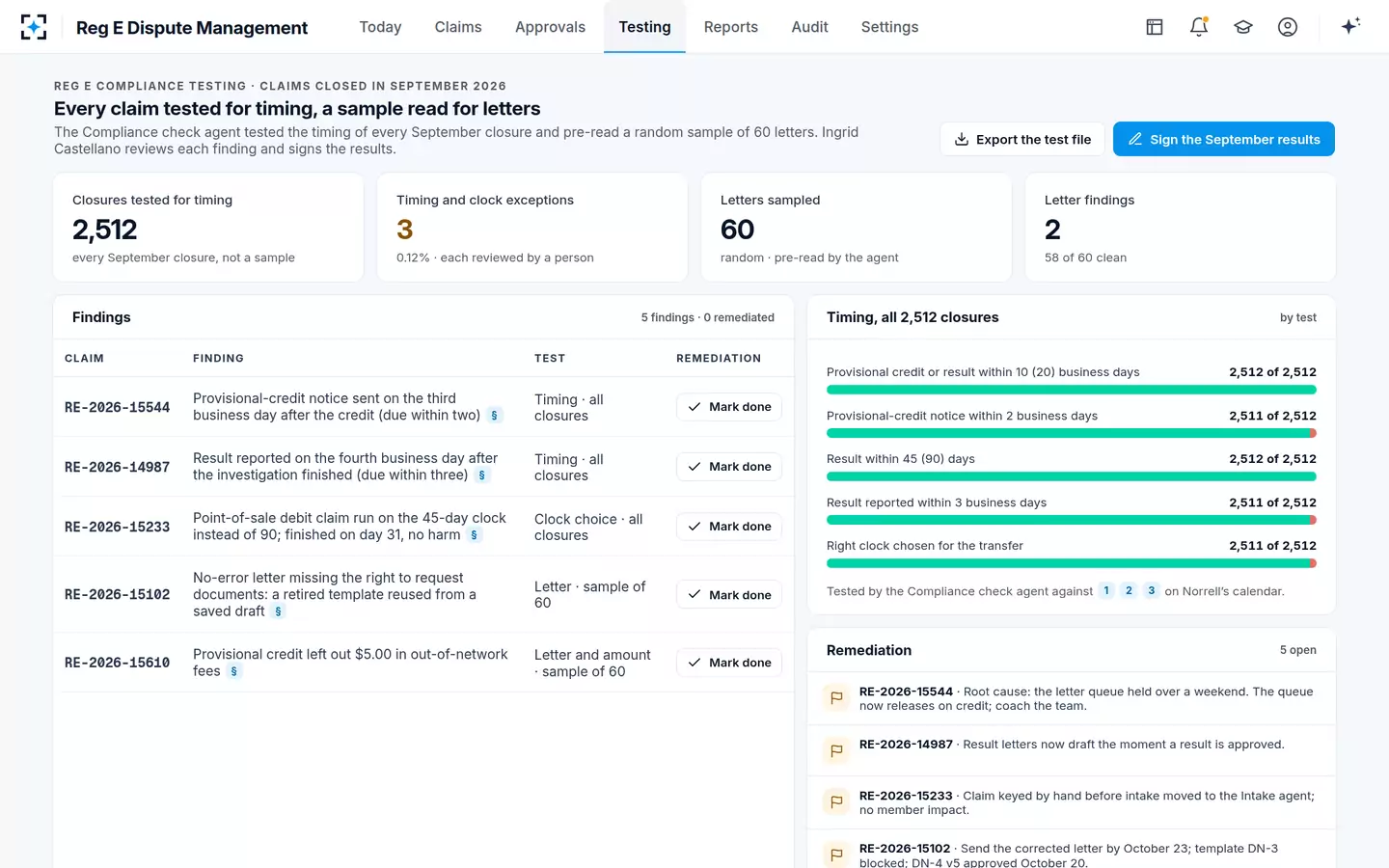
A calculator cannot know whether an institution's disclosures included the longer periods; the institution has to tell it. In the solution's fictional sample month, testing found one point-of-sale claim that had been run on the 45-day clock instead of 90 and finished on day 31; the error favoured the consumer and caused no harm, but it was still logged, because a calculator that is wrong in a harmless direction is wrong in both.
10 or 20 business days: the new-account test
A transfer gets 20 business days in place of 10, and 90 calendar days in place of 45, when it was made to or from the account within 30 days after the account's first deposit. The input a calculator needs is therefore the first-deposit date from the core and the date of the disputed transfer, not the account-opening date or the age of the account when the consumer calls. In the third example above, the first deposit was on October 30 and the ACH debit on November 10, eleven days later; the member called on November 23, by which time the account was 24 days old, and the clock is 20 and 90 whatever the account's age that day.
Business days and calendar days: which unit each Reg E period uses
Counted in business days: 10 (or 20) to decide, or to credit provisionally
Counted in calendar days: 45 (or 90) to finish when credit was given
Counted in business days: 2 after crediting; 3 after completing the investigation; 1 to correct an error
Counted in calendar days: 60 after the statement for a timely notice of error
Counted in business days: 5 of honoring checks and preauthorized transfers
Counted in calendar days: —
Counted in business days: 10 for written confirmation of an oral notice
Counted in calendar days: —
Counted in business days: 2 after learning of a lost or stolen device, as two 24-hour periods
Counted in calendar days: 60 after the statement for later unauthorized transfers
Two business days counted in 24-hour periods
One Regulation E period is counted differently from all the others: the two business days a consumer has to report a lost or stolen card to stay in the $50 liability tier. The commentary counts it as two 24-hour periods, whatever the institution's opening hours and whatever the hour the consumer found out; the Reg E liability calculator works the tiers through. Its example: a consumer who learns of a theft at 6 p.m. on a Friday, at an institution where Saturday is a business day and Sunday is not, has until 11:59 p.m. on Monday, "not at the end of the financial institution's business day on Monday" (comment 6(b)(1)-3).
A calculator that applies the institution's closing time to this period understates the consumer's protection, and the Liability agent's arithmetic in a claim depends on getting it right. The full liability tiers are worked through, with the Federal Reserve's own example, in the Reg E 60 day rule.
Four inputs decide every Reg E clock, and each comes from a different place
| Input | Where it comes from | What it changes |
|---|---|---|
| Notice date and time | The first contact on any channel: call, chat, message, branch | Day 0 for every count; whether the notice is within 60 days of the statement |
| Transfer type and where it was initiated | Card processor, ATM switch, ACH platform, digital banking | 45 or 90 days to finish: point-of-sale and foreign-initiated get 90, domestic ATM withdrawals do not |
| First-deposit date and the disputed transfer’s date | The core banking system | 10 or 20 business days to decide or credit, and 45 or 90 to finish |
| The institution’s business-day calendar | The institution, versioned, including Saturdays and closures | Which days count toward every business-day deadline |
What a Reg E calculator worth buying shows
The useful calculator is not a standalone web form but the part of the dispute system that sets every claim's deadlines, because a date computed once and typed into a tracker is no longer tied to its inputs. Whatever form it takes, the test for buying is the same: can a compliance tester reproduce every date from what the screen shows?
What a Reg E error resolution calculator must show
- The notice date and where it came from
The first contact, by channel, date and time; not the form.
- Why this clock
The transfer type, whether point-of-sale or ATM, foreign-initiated, and the first-deposit test, each with its clause.
- The calendar it used
Which version of the institution’s business-day calendar, and which days it skipped.
- Every deadline, not just day 10
Decide or credit, credit notice, finish, correct, report, and any honoring period.
- The unit of each count
Business days and calendar days labelled, never mixed in one number.
- What happens when an input changes
A corrected notice date or transfer type recomputes every date, visibly.
- Weekend and holiday endings
A calendar-day deadline on a Saturday is shown as such, with the institution’s policy for finishing early.
- That it cannot be overridden quietly
Deadlines set by the rule are locked; escalation days are settings with an approval.
A claim's clock with its reasons shown
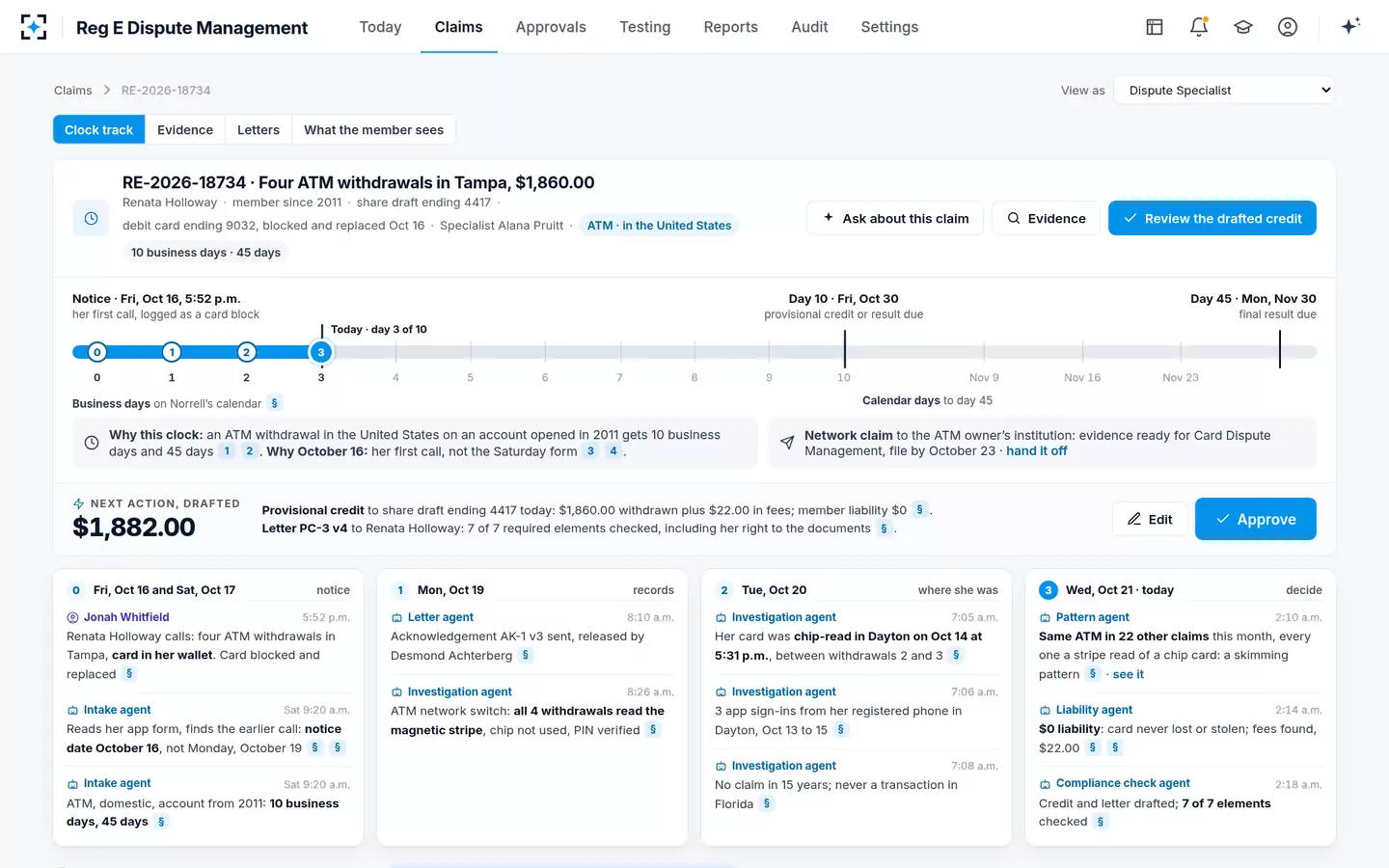
Reg E Dispute Management's clock, and where a calculator stops
In Reg E Dispute Management the Clock agent computes every claim's clocks on the institution's business-day calendar and escalates at business day 7 and 9 of 10 in the sample configuration; it never changes a deadline. The Intake agent supplies the notice date and the clock choice, and the deadlines set by 1005.11 are locked settings that no administrator can edit. Each month the Compliance check agent re-tests every closed claim's timing, which is how the sample month's point-of-sale claim on the wrong clock was found among 2,512 closures.
Every closure re-tested for timing, including the clock choice
Where a calculator stops is where the decision starts. Knowing that day 10 is December 28 does not credit the account; a person still has to approve the credit and a second person check it. And for credit card claims under Regulation Z, which count in days and billing cycles, none of this arithmetic applies; that side is laid out in Reg E vs Reg Z disputes.
Questions people ask
What is a Reg E dispute calculator?
It is a tool that computes a Regulation E claim’s deadlines from its notice date, transfer type and account facts: the day to decide or credit, the day to finish and the notice deadlines in between. It is only reliable if it uses the institution’s own business-day calendar and shows how it chose the clock.
Are federal holidays business days under Reg E?
Not if the institution is closed. A business day is one on which the institution’s offices are open for substantially all business functions, so the holiday calendar is the institution’s own; most banks follow the federal schedule, but the rule turns on what each institution actually does.
What if day 45 falls on a weekend?
The 45 and 90 days are calendar days, and Regulation E does not move a deadline off a weekend or holiday. The safe practice is to finish by the last business day before, which in the ATM example on this page is Thursday, December 31, 2026.
Does a notice on a Saturday start the clock?
The notice is received on Saturday, but if Saturday is not a business day for the institution the count of business days starts on the next one. The 45 and 90 calendar days still run from the Saturday receipt.
Is a Reg E calculator enough for compliance?
No. It gets the dates right; compliance also needs the right notice date going in, timely and complete credits, correct letters, a reasonable investigation and evidence of all of it kept for two years. A calculator is one control among those.