Reversal of provisional credit under Reg E is the debit a bank or credit union makes when its investigation finds that no error occurred, or a smaller error than the consumer claimed, after it had provisionally credited the account to take longer than 10 business days. Regulation E allows it, on conditions. Under 12 CFR 1005.11(d)(2) the institution must notify the consumer of the date and amount of the debit, and that it will honor checks, drafts and similar items payable to third parties and preauthorized transfers for five business days after the notification, without overdraft charges; or, under the official commentary, notify first and debit five business days later on a stated date. A credit already declared final generally cannot be taken back, even if the merchant later refunds. Botminds' Reg E Dispute Management treats every reversal as a decision a person makes and a second person checks, with the notice drafted to match the option the institution actually uses.
Two lawful ways to debit provisional credit, side by side
The regulation's text: debit, then notify: 12 CFR 1005.11(d)(2)
The commentary's alternative: notify, then debit: Comment 11(d)(2)-1
The regulation's text: debit, then notify: On the day of the debit, with the notice
The commentary's alternative: notify, then debit: Five business days after the notice is sent, on the calendar date it names
The regulation's text: debit, then notify: The date and amount of the debit, and that checks and preauthorized transfers will be honored for five business days after the notification
The commentary's alternative: notify, then debit: That the account will be debited five business days from the notice, and the calendar date of the debit
The regulation's text: debit, then notify: Items are paid as if the credit were still there, without overdraft charges, if they would have been paid before the debit
The commentary's alternative: notify, then debit: The credited funds stay in the account until the debit date
The regulation's text: debit, then notify: The notice omits the honoring statement, or staff charge overdraft fees on honored items
The commentary's alternative: notify, then debit: The account is debited early, before the date the notice gave
Can a bank reverse provisional credit under Reg E?
Yes, if it has completed a reasonable investigation and determined that no error occurred, or that the error was different in manner or amount from what the consumer described, and it follows the notice and honoring rules. Section 1005.11(d) applies "in addition to" the ordinary result procedures, so a reversal comes with the written explanation of the findings and the right to request the documents relied on, sent within three business days after the investigation is completed. What a provisional credit reversal means for the consumer is simple: money the institution put back while it investigated is taken out again, with warning and a short protected period.
What a bank may not do is reverse because time ran out. A provisional credit buys the institution 45 or 90 days to finish, not an option to debit at day 45 if it has not. The CFPB has cited institutions that failed to complete investigations within those periods after crediting (Supervisory Highlights, Issue 24); the remedy for an unfinished investigation is to finish it, and a debit without a determination has no basis in the rule.
How much notice before reversing provisional credit?
Under the regulation's text, none before the debit: the institution notifies the consumer upon debiting, and the protection comes after, in the five business days during which items are honored. Under the commentary's alternative, five business days before: the institution notifies the consumer "that the consumer's account will be debited five business days from the transmittal of the notification, specifying the calendar date on which the debiting will occur" (comment 11(d)(2)-1). Either way the consumer has five business days, counted on the institution's own business days, to arrange for other funds.
The same no-error result, debited two lawful ways
- DebitDec 11
- Checks and automatic payments honored, no overdraft charges5 business days
- NoticeDec 11
- Credited funds stay in the account5 business days
The choice between the two is operational, and the Federal Reserve's October 2025 examiner insights warn that the failure is usually a mismatch between the letter and the practice: "Regulators have seen issues when an institution’s notice to consumers does not align with its actual practice for debiting provisional credit. This can happen because template language is not accurate, or employees are not knowledgeable about bank processes" (Consumer Compliance Outlook, Third Issue 2025). A letter that promises five days before the debit, sent by a system that debits the same night, violates the rule on both readings.
Can the bank charge overdraft fees after a reversal?
Not on the items it must honor during the five business days. Comment 11(d)(2)-2 is direct: "The financial institution may not impose fees for items it is required to honor under § 1005.11." Normal fees unrelated to the overdraft are allowed, and after the five days the institution's ordinary overdraft terms apply again. The honoring duty is also limited: the rule says the institution "need honor only items that it would have paid if the provisionally credited funds had not been debited," so an item that would have bounced anyway can still be returned.
Fees and items during the five business days after a reversal
| Situation | Allowed? | Why |
|---|---|---|
| A check presented on day 2 that the provisional credit would have covered | Must be paid, with no overdraft fee | 1005.11(d)(2)(ii); comment 11(d)(2)-2 |
| A preauthorized ACH debit on day 4 that the credit would have covered | Must be paid, with no overdraft fee | 1005.11(d)(2)(ii) |
| An item that would have overdrawn the account even with the credit | May be returned or charged as usual | Honor only items that would have been paid had the credit not been debited |
| A normal per-item or transaction fee unrelated to the overdraft | Allowed | Comment 11(d)(2)-2 |
| The account is still overdrawn after the five business days | Fees under the overdraft credit plan, if any, may apply | Comment 11(d)(2)-2 |
| A fee for the investigation or the documents, where an error did occur | Not allowed | Comment 11(c)-3 bars charges for error resolution when an error occurred |
Partial reversals: when the error is different, not absent
When the investigation finds an error in a different amount from the one claimed, the institution corrects the error it found and may debit the excess provisional credit, but it must follow both the correction rules and the reversal rules. Comment 11(d)-1 says the institution "must comply with the requirements of both §§ 1005.11(c) and (d), as relevant," and may combine the correction notice and the explanation in one letter. The partial debit is still a debit: it needs its date, its amount and the five business days.
The CFPB found this missed in a familiar setting: ATM check deposits. Institutions credited the amounts consumers claimed, retrieved the checks, found them smaller, debited the difference and told consumers the lesser credit was final, without saying what had been taken. The examiners' description is a checklist in itself: the institutions "violated Regulation E by failing to state that they would be debiting the excess amounts originally provisionally credited from the consumers’ accounts, the dates the institutions would be debiting the excess provisional credits, or that the institutions would (as required by the regulation) honor certain transactions for five days after the notification" (CFPB Supervisory Highlights, Issue 26).
Can a final credit be reversed under Reg E?
Generally, no. Once the institution has reported the result and told the consumer that a provisional credit is final, its error-resolution duties are complete, and the Federal Reserve's examiners read that finality as running both ways.
Once a financial institution provides notice that a provisional credit has been made final, the financial institution generally cannot reopen the investigation or reverse the credit.
Federal Reserve examiners, Consumer Compliance Outlook, Third Issue 2025
The examiners' example is the one operations teams meet most: the institution credits, determines an error occurred, tells the consumer the credit is final, "but later learns the merchant refunded the consumer or that the transaction was authorized"; in that case "the institution cannot reverse the credit." The one exception they note is narrow: a foreign remittance transfer where the consumer asserted the same error to both the remittance provider and the account-holding institution and was refunded twice, which the commentary to the remittance rule addresses.
What if the merchant refunds after the credit is final?
Then the consumer keeps both, as far as Regulation E is concerned, and the institution's recourse, if any, lies elsewhere, for example in a card network process against the merchant's side, which runs on its own rules and deadlines (see chargeback reason codes for Reg E and Reg Z). The lesson is upstream. A finality notice should go out only when the investigation has really finished, and the institution's own records, including incoming merchant credits on the account, should be checked before it does.
Timing matters in the other direction too. If a merchant refund posts while the provisional credit is still provisional, it is a fact for the investigation to weigh; if the institution then debits any part of the provisional credit, the debit needs its own notice and honoring period. The CFPB's Summer 2021 edition records an institution that failed to tell consumers their credit was final partly because of "a process deficiency in which both the financial institution and the merchant of the disputed charge issued a simultaneous credit."
Where reversals go wrong in examinations
Reversals fail on notices more often than on decisions. The Federal Reserve's review of 2024 supervisory findings reports institutions that "failed to notify consumers when the institutions reversed provisional credit," and traces some of the failures to training and procedures, and some to an inadequate notice from a vendor: "some violations were caused by reliance on an inadequate notice generated by the institution’s third-party provider" (Consumer Compliance Outlook, First Issue 2026). The CFPB's Summer 2021 edition adds notices that left out "the exact date a credit was or would be debited" or the five-business-day honoring statement, or both.
Before any provisional credit is debited
- The investigation is finished, and the result is no error or a different error
A reversal follows a determination; it is never the consequence of a deadline.
- The result letter explains the findings and notes the right to documents
In writing, within three business days of completing the investigation.
- The debit notice gives the date and the amount
A specific calendar date, not “in five business days”.
- The five business days are stated and honored
Checks and preauthorized transfers paid without overdraft charges, if they would have been paid before the debit.
- The notice matches the system
If the notice says the debit comes in five business days, nothing debits sooner.
- Partial debits are noticed like full ones
Date, amount of the excess and the honoring period.
- No credit already declared final is touched
Check the claim’s history before any debit.
- A second person checks it
Debits take money from a consumer; prepare and check should be different people.
Reversals in Reg E Dispute Management
In Reg E Dispute Management, a reversal is never the agents' decision. The Investigation agent can propose that no error occurred, but below its 0.90 confidence threshold the proposal can only be decided after the specialist has opened every source behind it; the specialist decides, and a reversal, like a provisional credit or a result, needs a second person to check it. The Letter agent drafts the result and the debit notice from the institution's approved templates, and the Compliance check agent checks that the date, the amount, the five business days and the right to documents are all there before a person sees the letter.
A proposed no error below the threshold waits for a person
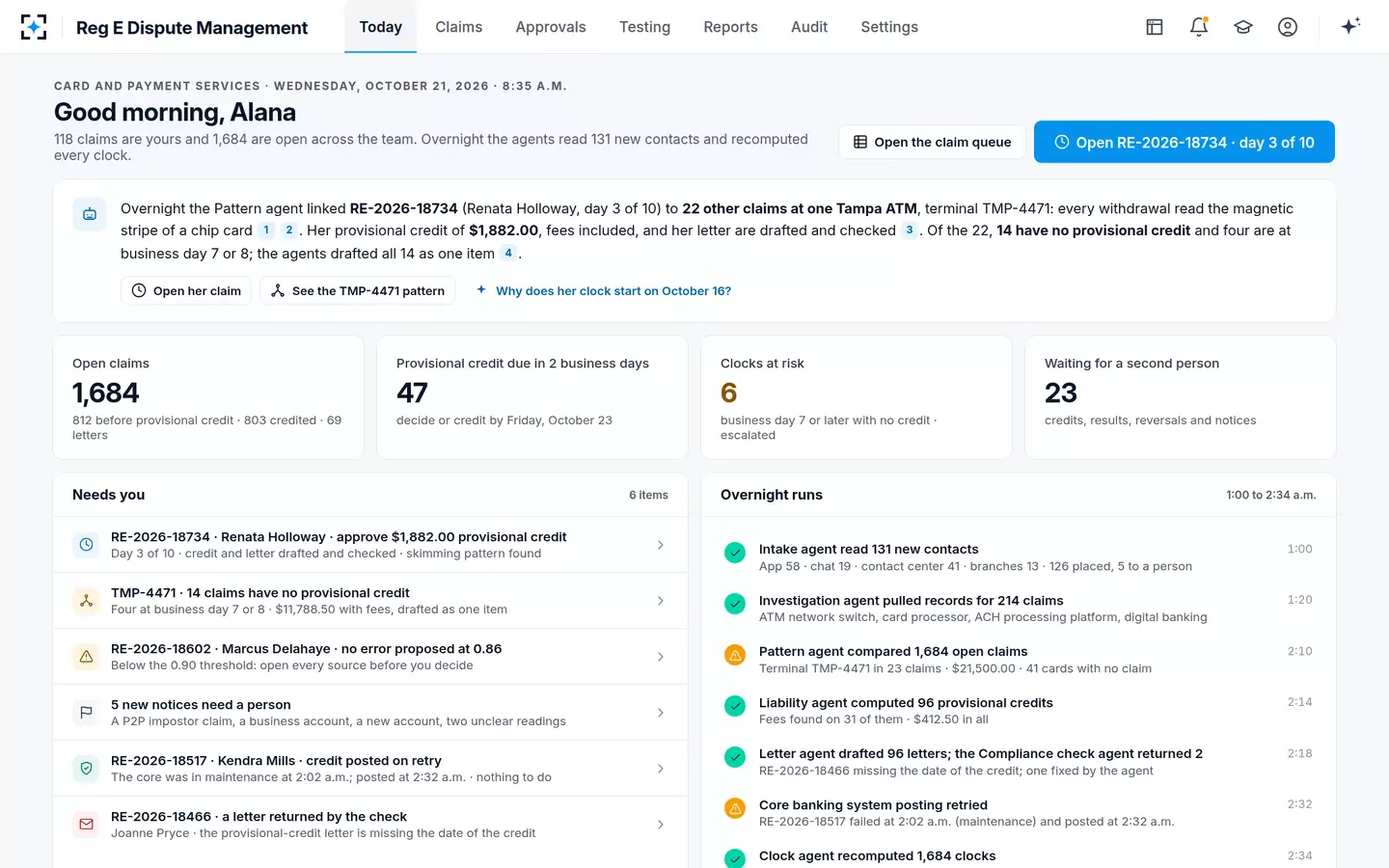
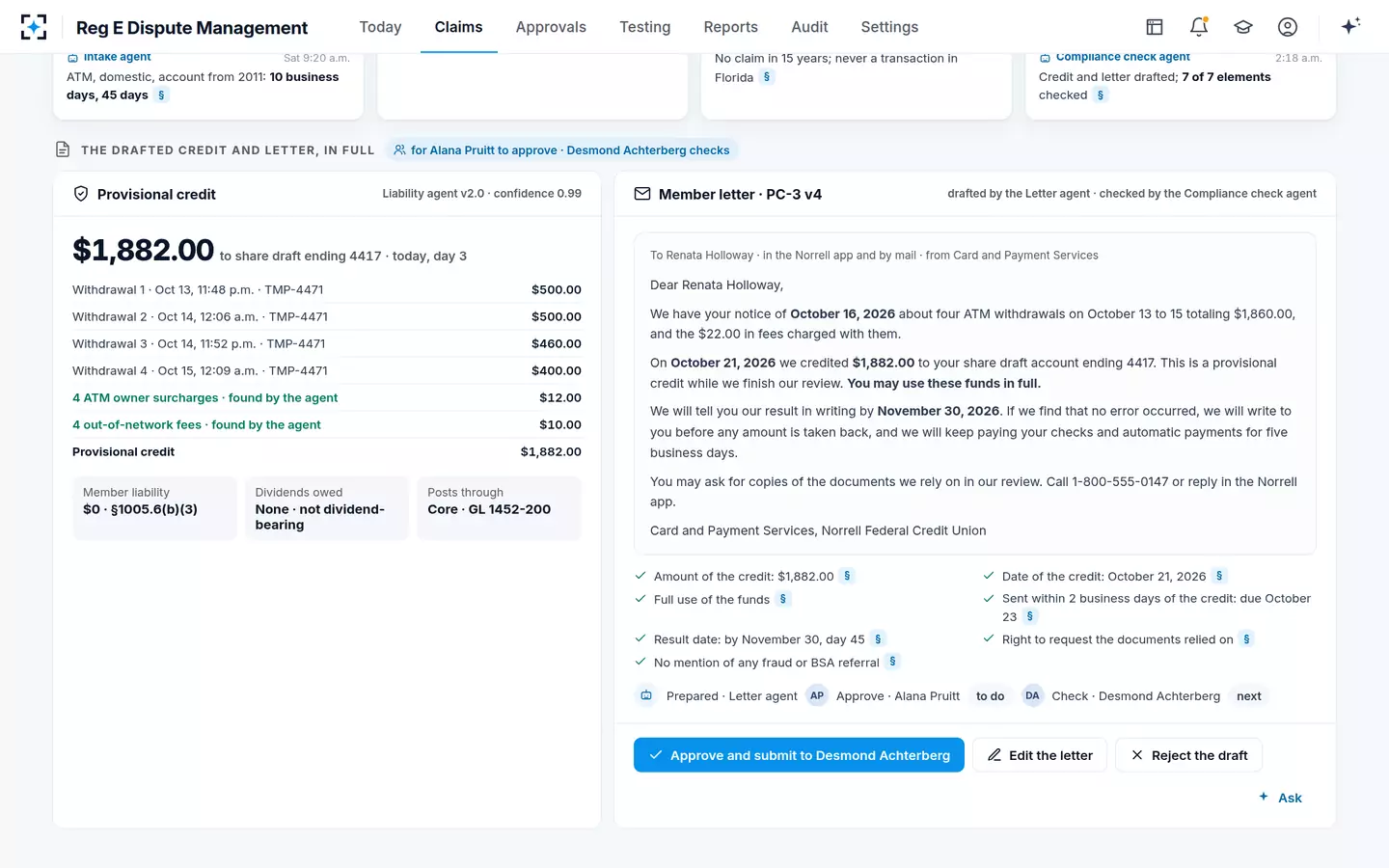
The member letter shows how the reversal promise is made in advance. The solution's sample provisional-credit letter tells the member that if no error is found "we will write to you before any amount is taken back, and we will keep paying your checks and automatic payments for five business days" — the commentary's notify-then-debit option, stated at the start so the later notice holds no surprise.
The reversal promise, made in the provisional-credit letter
Monthly testing then compares every reversal's notice date with its debit date. How those business days are counted, including Saturdays and holidays, is set out in the Reg E error resolution calculator, and the letter itself in Reg E letter samples.
Questions people ask
What does a provisional credit reversal mean?
It means the institution has finished its investigation, found no error or a smaller one, and is taking back some or all of the money it credited while it investigated. It must tell the consumer the date and amount, and either honor checks and automatic payments for five business days after the notice or debit only five business days after the notice.
Can a bank reverse part of a provisional credit?
Yes, when it finds an error in a different amount from the one claimed. It corrects the error it found, may debit the excess, and must give the same notice of date, amount and five business days for the partial debit as for a full one.
Does the five business days include the day of the notice?
The rule speaks of five business days after the notification, and the commentary’s alternative of a debit five business days from transmittal. A conservative calendar counts from the next business day after the notice and names the date explicitly in the letter.
Can a bank reverse a credit for lack of a signed affidavit?
No. A reversal follows a determination that no error occurred, reached through a reasonable investigation. The CFPB has cited institutions that denied claims because consumers did not return an affidavit, without investigating the merits.
What if the consumer only asked for documentation?
When the notice was a request for documentation or clarification, the institution meets its duty by sending what was requested within the time limits, and comment 11(c)-7 allows it to debit any provisional credit it gave upon sending the information.