Chargeback reason codes are the card networks’ labels for what a dispute is claiming: Visa 10.1 says the card was counterfeited, 10.4 says the purchase was made without the card present and without the cardholder, 13.1 says the goods never arrived. They exist so that Visa and Mastercard can route the fight between the issuer and the merchant. They are not the law the bank operates under, and they decide nothing about what the customer is owed. Under every code, the bank still owes its own investigation — Regulation E’s 10-business-day duty on a debit claim, Regulation Z’s billing-error process on a credit card claim — and the two run on separate tracks that only meet at the evidence. This page maps the codes to the rules underneath, with the sample claim from Card Dispute Management as the worked example: three charges, three codes, two legal clocks, one decision each.
Why the map matters more than the codes: customers hold the bank responsible for the outcome, whatever the network decides. When they disagree, they complain to the regulator about the bank, not the network: the CFPB received approximately 50,800 credit card complaints in 2022, and the most common issue was a problem with a purchase shown on the statement — where, the Bureau found, credit card companies would sometimes refund the consumer the disputed charges or would open an investigation, and in other cases declined to refund (CFPB Consumer Response Annual Report, March 2023). The denial letter goes out over the bank’s name, so the legal file has to be right even when the code was.
What chargeback reason codes mean — and what they never decide
A reason code does three jobs, all inside the network’s systems: it routes the dispute to the right rulebook the networks maintain between issuers and merchants, it sets the network’s own deadlines for each round of the fight, and it tells the merchant what evidence answers it. What it does not do is anywhere on the code sheet: it does not start or stop the bank’s legal clocks, it does not define what the customer must be told, and it does not decide whether the bank investigated reasonably. Those come from Regulation E and Regulation Z, and the customer’s rights attach to them whether or not a chargeback is ever filed. A claim can lose at the network and still owe the customer a credit — and win at the network and still be an inadequate investigation.
A chargeback reason code is not a Reg E or Reg Z category
The two vocabularies sort the same facts differently, and the mismatch is where desks get hurt. The networks sort by what the merchant did wrong — fraud, not delivered, not as described, duplicate, credit not processed. The regulations sort by what the customer alleges and which account the money left. The same Reno charge is “counterfeit under the chip liability shift” to Visa and an unauthorized electronic fund transfer to Regulation E; the same Lumen bookcase is “merchandise not received” to Visa and a billing error to Regulation Z. Neither translation is automatic, and a desk that files from the code alone will eventually file a debit claim’s facts under the credit card rulebook or vice versa. The classification step — which rule governs which charge — is a decision, and it belongs to the bank, not to the code on the network’s form.
The map: from the code you file to the rule you still owe, on the sample claim’s three charges
Visa 10.1 · counterfeit, chip liability shift
A chip card read by magnetic stripe at a chip-capable terminal — the Reno charge on the sample claim.
Who counterfeited, and whether the terminal should have read the chip.
Regulation E: an unauthorized electronic fund transfer on a debit card — decide in 10 business days or provisionally credit (12 CFR 1005.11). On a credit card, Regulation Z unauthorized use with its own windows.
Visa 10.4 · fraud, card-absent
An online purchase the customer says she did not make — the SkyHarbor ticket.
Whether the merchant can show the buyer was the cardholder — increasingly answered with Compelling Evidence 3.0.
The same Regulation E or Regulation Z investigation as any other unauthorized claim. The network’s answer does not close it either way.
Visa 13.1 · merchandise not received
A bookcase the merchant says was delivered — Lumen’s reply, tracking number included.
Whether delivery can be shown to the customer’s address.
Regulation Z: a billing error — goods “not accepted by the consumer … or not delivered … as agreed” (12 CFR 1026.13(a)(3)). On a debit card, Regulation E’s list of errors has no such category: the transfer went where it was sent, so recovery runs through the network and the account terms.
The not-as-described family
Goods or services that arrived but were not what was ordered.
What was promised at checkout versus what was delivered.
Regulation Z billing error again — the same clause, read through “as agreed”. The network code changes; the legal box barely does.
Fraud codes, and the Reg E investigation they sit inside
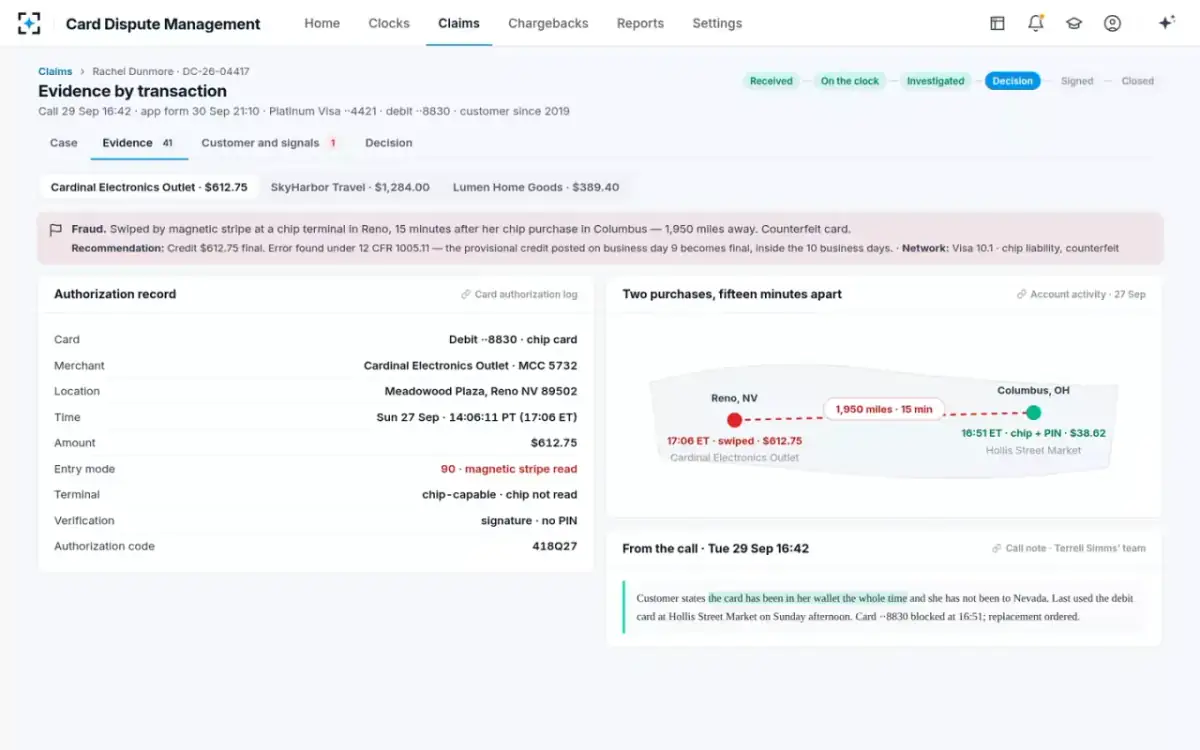
The fraud family is where the two tracks collide hardest. On the sample claim’s debit charge, the network fight is 10.1 — counterfeit under the chip liability shift, because a chip card was read by magnetic stripe at a chip-capable terminal, fifteen minutes after the same card’s chip read in another state. The bank’s own duty, underneath, is Regulation E: investigate promptly and determine whether an error occurred within 10 business days, or provisionally credit the customer and take the longer window (12 CFR 1005.11). Note the order of operations that works: the investigation reads the authorization record first — entry mode 90, signature, no PIN, 1,950 miles from the chip read — and the provisional credit posted on business day 9 makes the deadline moot. The chargeback is then filed from a position of knowledge, with the evidence already in the file. A desk that files to protect the network deadline first, and investigates later, has inverted the only order the law respects.
One charge, both tracks: the 10.1 chargeback filed from a Reg E file that was already decided on its evidence
What is Visa 13.1? Not received, and the Reg Z box it answers to
Merchandise-not-received is the code family with the cleanest legal translation, because Regulation Z names it. The billing-error definition reaches, among other things, a charge “for property or services not accepted by the consumer or the consumer’s designee, or not delivered to the consumer or the consumer’s designee as agreed” — that is the whole of 13.1’s territory in one clause.
Property or services “not accepted by the consumer or the consumer’s designee, or not delivered to the consumer or the consumer’s designee as agreed”.
Regulation Z, 12 CFR 1026.13(a)(3)
On the sample claim, Lumen’s reply said the bookcase was delivered on 28 August and quoted a tracking number; the carrier’s record for that number ends at a front desk in Tacoma, while the order ships to Columbus. The code (13.1) told the merchant what to answer; the regulation told the bank what the customer is owed — the credit, with recovery from the merchant through the network fight afterwards. On a debit card the same facts get a different answer: Regulation E’s seven kinds of error run from an unauthorized or incorrect transfer to a computational mistake (12 CFR 1005.11(a)), and none of them is goods that never arrived when the transfer itself went to the merchant as sent. The debit customer’s route is the network chargeback and the account’s own terms, which is why the map starts from the claim and not from the code.
Compelling Evidence 3.0: what it changes for reason code 10.4 — and what it does not decide
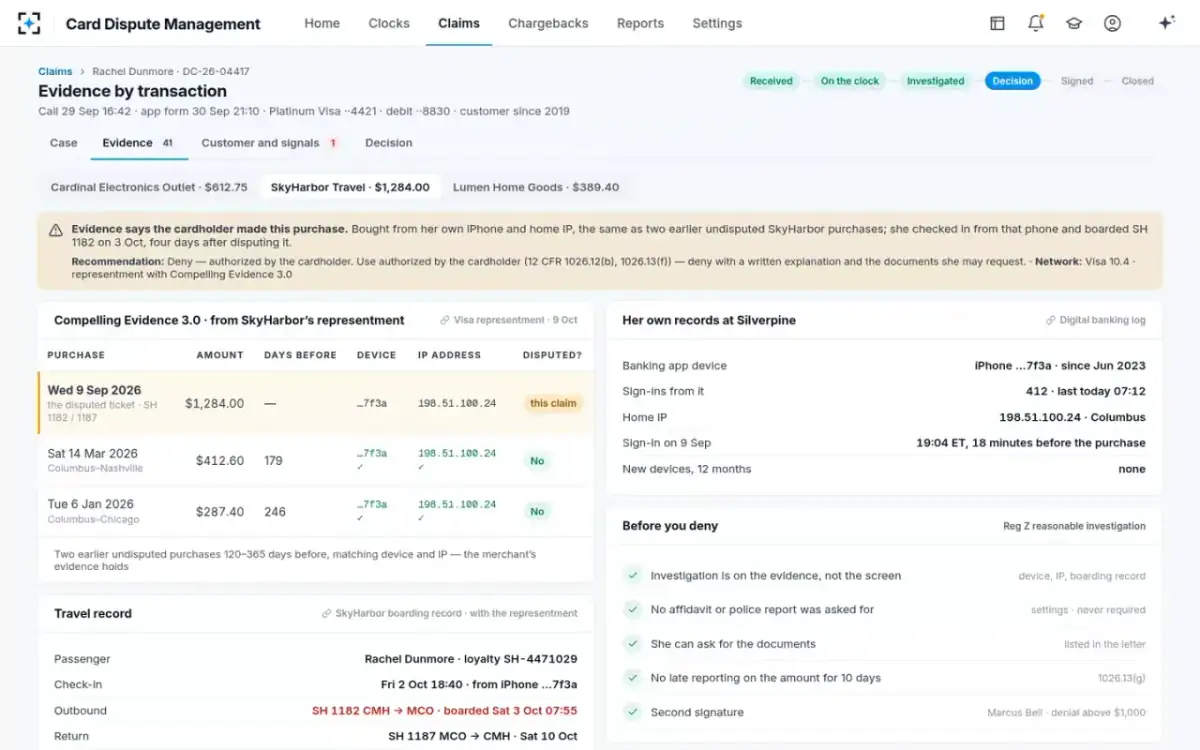
Card-absent fraud — Visa 10.4 — is the family where merchants gained a real weapon. Compelling Evidence 3.0 lets a merchant answer a card-absent dispute by matching the disputed transaction to earlier, undisputed transactions from the same account: same device, same connection, made in the window before the dispute. On the sample claim, SkyHarbor’s representment shows exactly that — the disputed ticket bought from the same phone and home IP as two earlier undisputed purchases, with the bank’s own records agreeing: the device is her banking phone, the IP is her home connection, and she boarded the flight four days after disputing it. That is what the mechanism does, and used honestly it recovers real losses from friendly fraud.
What it does not do is decide the legal claim. The match is evidence to be weighed inside the Regulation E or Regulation Z investigation — checked against the bank’s own records, not the merchant’s PDF alone, and answered in a written explanation if the bank denies. A desk that treats a Compelling Evidence 3.0 match as an automatic denial has let the merchant’s evidence system make its decision, which is the same failure as taking any other reply unexamined, only better dressed. On the sample claim the checks run before the denial: the investigation rests on the evidence rather than the screen, no affidavit was demanded, the letter lists the documents she may ask for, and a second signature carries the decision because it is above the bank’s $1,000 limit.
The 10.4 fight, read both ways: the merchant’s Compelling Evidence 3.0 table against the bank’s own records
Why one claim can carry two codes and one legal clock
Because the network slices by transaction and the regulation slices by notice. One call disputing three charges opens one Regulation E clock for the debit charge and one Regulation Z process per credit card charge, while each charge files its own code into its own network fight — 10.1 for the counterfeit swipe, 10.4 for the card-absent ticket, 13.1 for the bookcase. The codes can even change mid-claim: a 10.4 that meets a Compelling Evidence 3.0 representment may be re-fought at pre-arbitration under different evidence, while the Regulation Z resolution clock runs on, indifferent. The desk that tracks codes instead of clocks will look busy and miss deadlines; the desk that tracks clocks files codes from strength. That is why the case screen in Card Dispute Management shows the legal clocks as the spine of the claim and the chargebacks as one of its outputs.
What the network checks against what Reg E and Reg Z require — on the same charge
What the card network checks: Between the issuer and the merchant, who keeps the money?
What Regulation E and Regulation Z require: Did an error occur, investigated reasonably, on the clock?
What the card network checks: Network rounds and windows, set by the scheme’s rules.
What Regulation E and Regulation Z require: 10 business days or provisional credit on debit; 30 days and two billing cycles on credit.
What the card network checks: What answers this code — chip data, delivery proof, device matches.
What Regulation E and Regulation Z require: Everything relevant in the institution’s own records, reviewed and cited.
What the card network checks: Not a party; the outcome moves money between banks.
What Regulation E and Regulation Z require: Owed a decision, a written explanation for a denial, and the documents she may request.
What the card network checks: The portal’s record of filings and responses.
What Regulation E and Regulation Z require: A defensible file that still reads properly years later, in front of an examiner.
When a merchant’s chargeback evidence meets a Reg E claim
The collision case is a merchant’s strong answer arriving inside a debit claim’s 10 business days — a Compelling Evidence 3.0 match on a card-absent claim, or a signed delivery record on a not-received claim. The desk is tempted to treat the network answer as the investigation. It cannot: the merchant’s evidence was produced by the party that keeps the money, the duty to review belongs to the bank, and Regulation E’s timeline does not pause for the network’s rounds. The workable sequence on the sample claim is the one the solution runs: read the representment the day it lands, verify it against the bank’s own records — device, connection, sign-ins, the boarding record — and let the verified result, not the PDF, drive the decision either way. Where the merchant’s evidence fails verification, as Lumen’s did, the code loses and the legal claim still wins.
Filing the right network code does not satisfy Reg E or Reg Z
This is the sentence to take into any audit of the desk. Filing the right code is a necessary act of recovery; it is not the investigation, and it is not the customer’s remedy. The regulations ask different questions on different clocks — did the bank determine whether an error occurred within 10 business days, did it acknowledge and resolve the billing error in its windows, did the denial carry a written explanation and the documents the customer may ask for — and none of the answers lives in the network’s system. The 2019 USAA order is the expensive proof: the bureau’s findings were about error resolution itself, and the remedy was restitution to customers plus a penalty, not a fine for losing chargebacks. Card Dispute Management keeps the two tracks where they belong — the codes filed from the evidence file, the legal clocks counted on the bank’s calendar, and every decision signed by a named analyst who read both. The classification step that puts each charge under its right rule is worked through in unauthorized transaction or billing error, and the full clock arithmetic in Reg E and Reg Z side by side.
Questions people ask
What do chargeback reason codes mean?
They are the card networks’ labels for what a dispute claims — Visa 10.1 for counterfeit card fraud, 10.4 for fraud in a card-absent purchase, 13.1 for merchandise not received — used to route the dispute between issuer and merchant and to say what evidence answers it. They belong to the networks’ rulebook, not to banking law.
Is a chargeback reason code the same as a Reg E or Reg Z category?
No. The same charge is “counterfeit under the chip liability shift” to Visa and an unauthorized electronic fund transfer to Regulation E. The codes sort by what the merchant did; the regulations sort by what the customer alleges and which account the money left. The bank must translate, and the duty to investigate attaches to the regulation, not the code.
What is reason code 10.4?
Visa’s code for fraud in a card-absent environment — an online or phone purchase the cardholder says she did not make or authorize. It is the family most often answered with Compelling Evidence 3.0, where the merchant matches the disputed purchase to earlier undisputed ones by device and connection.
What is Compelling Evidence 3.0, and which reason code does it apply to?
It is the mechanism that lets a merchant answer a card-absent dispute — Visa 10.4 — by showing the purchase matches earlier undisputed transactions from the same account: same device, same connection, within the programme’s window. It changes the evidence in the network fight; it does not decide the Regulation E or Regulation Z claim, which the bank still owes on its own clock.
Can a merchant’s chargeback evidence override a Reg E claim?
It can win the network fight, but it cannot discharge the bank’s duty. The evidence has to be verified against the institution’s own records and weighed in the investigation; a denial still needs a written explanation and the documents the customer may ask for. Where the merchant’s proof fails verification — a tracking number that ends at the wrong door — the legal claim stands whatever the code does.
Why does one claim sometimes carry two different chargeback codes?
Because the networks slice by transaction while one notice can carry several charges under several rules. A single claim can file 10.1 for a counterfeit swipe, 10.4 for a card-absent ticket and 13.1 for an undelivered order, while the bank runs one Regulation E clock and one Regulation Z process underneath. Track the clocks; file the codes from the evidence.