Why was my card dispute denied? The honest answer has three parts. First, a denial legally means the bank investigated your claim — looked at the evidence for this charge — and concluded the transaction was authorized or valid, and both Regulation E and Regulation Z require that investigation to be real, prompt and documented, with a written explanation of the outcome. Second, the bank's conclusion is only as good as the investigation behind it, and the Consumer Financial Protection Bureau has fined a bank roughly $12 million in restitution plus a $3.5 million penalty for failing to initiate and complete reasonable error resolution investigations. Third, you have rights while the claim runs and moves after it closes: provisional credit on a debit claim, a frozen disputed amount on a credit claim, and the documents behind the decision on request. Botminds' Card Dispute Management enforces that standard file by file, with a written reason per charge and a second human signature on large fraud denials — because a denial a customer can read is a denial a bank can defend.
The worked examples come from the solution's fictional sample bank, Silverpine Bank, and the denial letter it drafts for Rachel Dunmore's claim: two of her three disputed charges credited, one denied with the evidence named. The rules quoted are the current text of the regulations and a consumer guide from the National Consumer Law Center.
A denial has to come with a reason, not just a no
"We have reviewed your claim and determined that the charges were authorized" is not a reason; it is the shape of a reason. A lawful denial tells you what was decided, per charge; why, in words that connect to evidence rather than assertion; and what happens next, including the documents you may ask for. The sample letter to Rachel Dunmore does it the way the standard requires: the Reno purchase and the Lumen bookcase are credited, with the finding each rests on; the SkyHarbor ticket is denied, and the letter says why — the purchase was made from the device and connection she uses for her banking, matched two earlier undisputed purchases under the network's evidence program, and the travel record shows she boarded the flight — and names what she can ask to see. No affidavit was demanded of her before the investigation, and no late reporting was imposed while it ran.
What a denial letter owes you, charge by charge
- The outcome per charge
Credited, denied, or partly resolved — never a single verdict covering different charges that were investigated separately.
- The reason in plain words
Connected to evidence: the authorization, the merchant's proof, the delivery record — not boilerplate.
- The evidence it rests on
Named specifically enough that you could ask for it: the log entries, the representment, the tracking record.
- The documents you may ask for
How to request them, and what the bank relied on when it said no.
- What was not required of you
No affidavit or police report demanded before the investigation, and no penalty for reporting late within the notice window.
- The signatures
Who decided and, on a fraud denial above the bank's threshold, who co-signed — both on the record.
What 'reasonable investigation' means for your claim
"Reasonable" is doing the work in that phrase, and the regulation gives it teeth. For a debit claim, Regulation E requires the bank to "investigate promptly" and determine whether an error occurred within 10 business days — and if it needs more time, to provisionally credit you and finish within 45 days (90 for some transaction types). "Reasonable" means the investigation actually looked: at the authorization for the disputed charge, at what the merchant answered, at the delivery or usage evidence. A bank that denies without pulling the records has not investigated your claim; it has processed it, which is the distinction the CFPB's USAA action punished.
For a credit card claim, Regulation Z requires written acknowledgment within 30 days and a resolution — with a written explanation — within two complete billing cycles, never more than 90 days (12 CFR 1026.13(c)(1)–(2)). The consumer guide from the National Consumer Law Center draws the practical line: the lender "cannot treat the dispute as 'settled' or take collection action against you unless it has completed a reasonable investigation of your claim." If your denial letter cannot show what was reviewed, the investigation is the first thing to challenge.
failing to initiate and complete reasonable error resolution investigations
CFPB, consent order, USAA Federal Savings Bank (2019)
Why your own purchase history is not a reason to deny you
It is the most common — and weakest — basis for a denial: "you have shopped with this merchant before." Prior undisputed transactions are real evidence merchants submit in network disputes, and an investigator should read them. But they are evidence about a pattern, not proof about this charge, and a denial that rests on history alone has skipped the question the regulation asks: does the evidence show you authorized this transaction? A chip read with your PIN, a delivery to your address, a boarding pass scanned at boarding — those are evidence. The fact that you once bought a ticket from the same airline is a lead, and a lead is not a finding.
This is exactly where a disciplined desk separates the signal from the decision. In the sample claim, the first-party screen weighs the customer's history — two earlier disputes in 24 months, both small and decided in her favor — and reports "no pattern." That weighing is shown to the investigator with its source; it never decides the claim. Your history belongs in the file the way any evidence does: read, weighed, and answered by a person.
What Compelling Evidence 3.0 is, and what it isn't proof of
Compelling Evidence 3.0 is Visa's name for a merchant's evidence package in card-not-present fraud disputes: typically earlier undisputed transactions from the same account, matched by device, IP address or other identifiers, inside the program's qualifying window. Its purpose is to tell the network that this account has an established history with this merchant, which matters to the network's own chargeback fight. What it is not: proof that you made this purchase, and it is not a legal category in either Regulation E or Regulation Z. A bank that treats a Compelling Evidence match as an automatic denial has let a network filing standard replace its own investigation duty — and the duty runs to you, not to the network.
What the evidence is worth depends on facts the match alone cannot supply. Device and IP matches are strong when the device really is yours and was in your hands; they are worth little when the "match" is a household connection or a device you once used on a shared network. In the sample claim the match stood because the bank's own records showed the same phone used for its app, and the travel record showed the ticket used — corroboration, not just a match. The question to ask of any denial built on such evidence is always the same: what did the bank check beyond the match?
Can a bank deny a dispute without investigating?
No — and the enforcement record makes the answer expensive to ignore. Regulation E's error resolution duty applies the moment a notice of error arrives, orally or in writing; Regulation Z's billing error procedures attach to a written notice within 60 days of the statement. Both require a prompt, reasonable investigation and a written outcome. The CFPB's 2019 consent order against USAA Federal Savings Bank — approximately $12 million in restitution and a $3.5 million civil money penalty — stands for the proposition that error resolution is not optional housekeeping. A denial issued without investigation is not a hard case decided badly; it is a violation with a date on it.
What skipping the investigation cost one bank
What you're owed while the investigation runs
Your protections do not wait for the outcome. On a debit card claim, Regulation E's provisional credit puts the disputed amount — including interest where applicable — back in your account within 10 business days if the bank has not decided, with full use of the funds while it works. In the sample claim the $612.75 posted itself at 06:00, a day before the bank's own line, under a standing rule; that is what the right looks like when it works. On a credit card claim, the National Consumer Law Center's guide states the parallel protection plainly: "until the dispute is resolved, you do not need to pay the disputed portion of your bill", and the company "cannot take collection action or report you as delinquent to a credit bureau with respect to the disputed amount" — though you must keep paying anything not disputed. The two regimes differ in mechanism; both refuse to let the bank take your money, or your credit standing, while it decides.
The numbers behind your rights while a claim is open
10business days
for a debit claim decision — or provisional credit within the same window
0
collection action or delinquency reporting on the disputed amount while a credit card dispute is open
$50
the most you can owe for unauthorized use of a credit card, however large the charge
What the bank must do after it denies
A denial starts a short list of duties of its own, and each is a check you can run on your letter. On a debit claim, the results must include "a written explanation of the institution's findings" and "note the consumer's right to request the documents that the institution relied on", which the bank must then "promptly provide" (12 CFR 1005.11(d)(1)). If provisional credit was posted, the bank must tell you the date and amount it takes back, and for five business days afterwards it must honor checks and preauthorized payments that the credit would have covered, without overdraft charges (1005.11(d)(2)).
On a credit card claim, the creditor must tell you in writing what you still owe and when it is due, and it may not report the amount as delinquent until your grace period or 10 days, whichever is longer, has passed (12 CFR 1026.13(g)). If you write again inside that time to say the amount is still in dispute, the creditor may report it as delinquent only if it also reports that the amount is in dispute and tells you who received the report. These are the rules a letter is measured against; a letter that skips them is a better complaint than one you write from scratch.
When a late report makes you liable
Some denials are not about the evidence at all but about timing, and on a debit card the timing rules carry money. Under 12 CFR 1005.6(b), a customer who reports a lost or stolen card within two business days of learning of it owes at most $50 of the unauthorized transfers; after two business days, up to $500. And an unauthorized transfer shown on a statement must be reported within 60 days of the statement's transmittal "to avoid liability for subsequent transfers": transfers after that window that the bank shows would not have happened with timely notice can fall on the customer in full. A credit card's cap is simpler, $50 at most for unauthorized use. If your letter cites late reporting, check its dates against these windows; the bank has to establish the facts behind a higher liability, not assume them.
How to challenge a denial you think is wrong
The strongest first step is the least dramatic: ask, in writing, for the documents behind the decision. A bank that investigated reasonably can produce what it reviewed — the authorization entries, the merchant's evidence, the delivery record — and a bank that cannot has told you what your complaint should say. Then match the documents against your own facts: dates, locations, devices. New evidence belongs in writing, not in an argument; a delivery record that ends at another address, a device you have never owned, a signature that is not yours — each is a fact that can reopen a file where assertion could not. Know the limit, though: a bank that "has fully complied with the error resolution requirements has no further responsibilities" under Regulation E if you simply reassert the same error (1005.11(e)), so a second letter has to bring something the first investigation did not have. And if the bank's answer stays boilerplate, the CFPB accepts consumer complaints about exactly this, and a denial that cannot state its own reason is the easiest kind to escalate. What a defensible investigation file contains is worth reading before you write, because it shows you what the bank was supposed to have done.
The decision and the letter, drafted before anyone signs
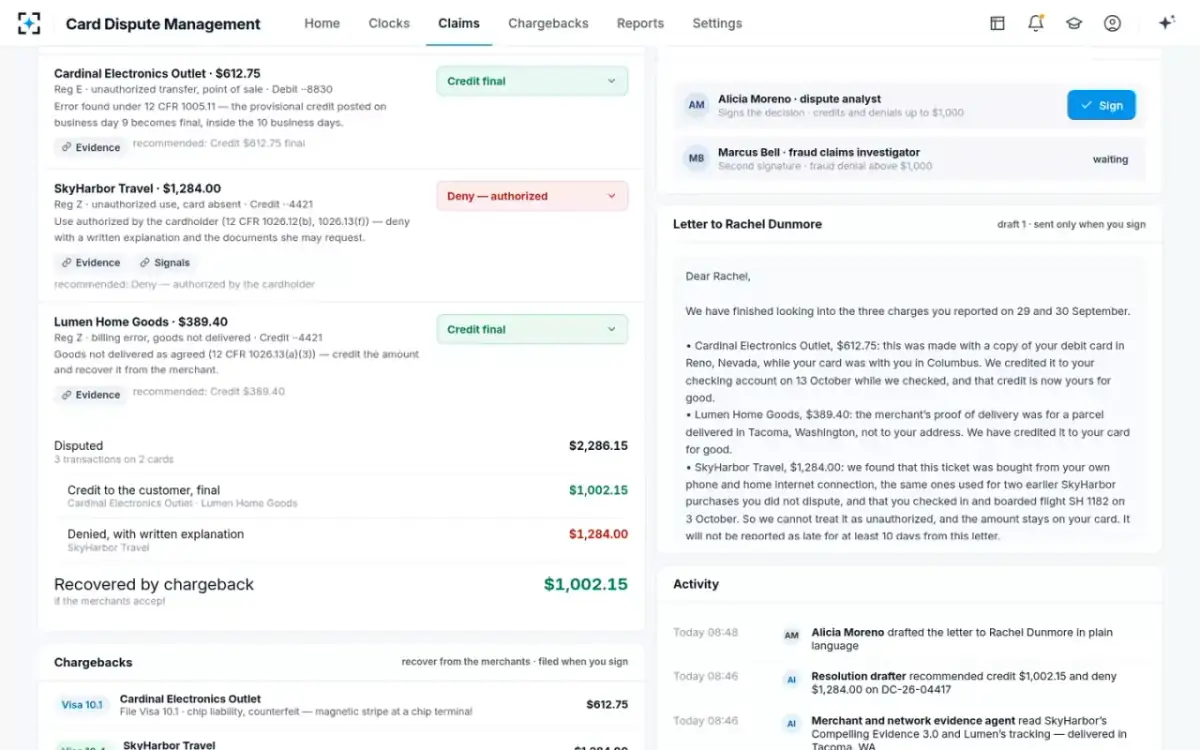
What a second signature means for a fraud denial
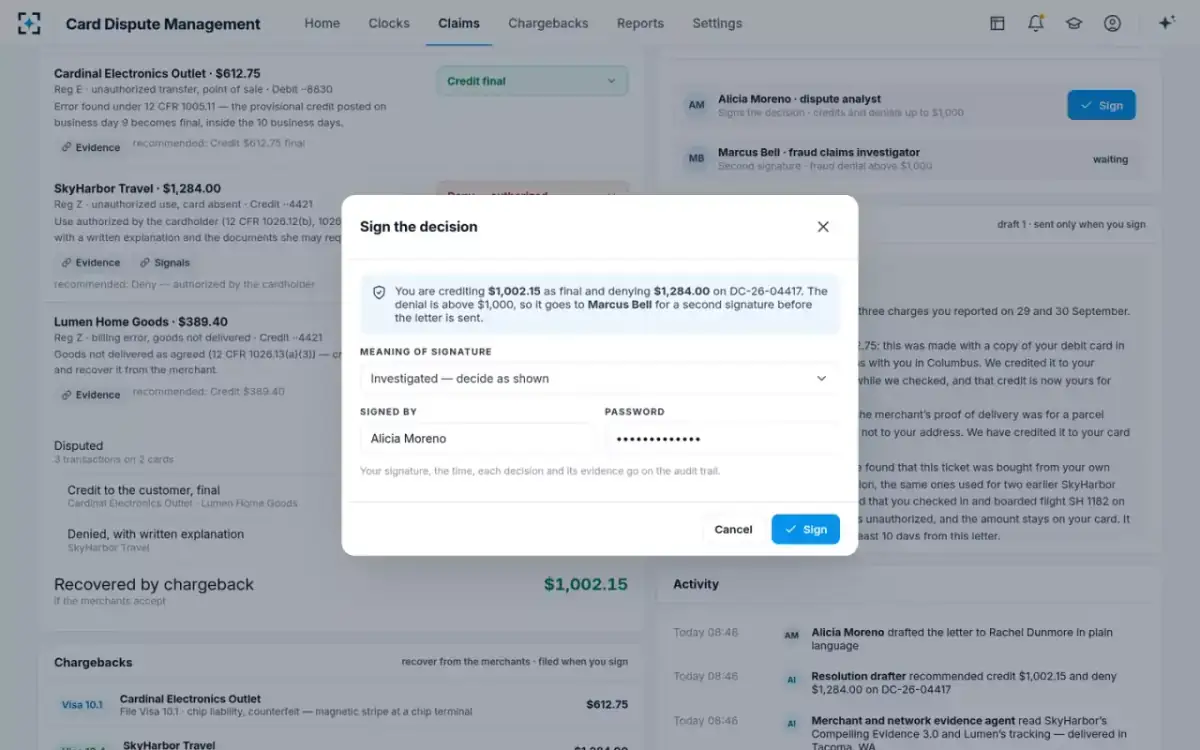
On a well-run desk, a fraud denial above the bank's threshold — $1,000 at the sample bank — does not leave on one person's judgement. A second specialist reads the evidence the denial rests on and co-signs, and both signatures go on the file. For you as the customer, the second signature is evidence that the denial survived a sceptical reader before it reached you; it is not an appeal, and it does not make a wrong denial right, but it sharply changes the odds that the file behind the letter is real. For the bank, it is the difference between a denial and a defensible one — the control that keeps a bad morning from becoming the kind of finding the USAA order records. Card Dispute Management makes the second signature a routing rule, not a courtesy, and keeps the whole trail — decisions, signatures, evidence — where you or an examiner can ask for it.
Signing, and what the signature certifies
Questions people ask
Why was my debit card fraud claim denied?
Because the bank investigated and concluded the transaction was authorized or valid — and it must be able to show that investigation: what was reviewed, per charge, with a written explanation. Regulation E requires a prompt, reasonable investigation and a decision within 10 business days or provisional credit, and federal enforcement has cost banks millions for skipping it. If the letter does not say what was examined, challenge that first.
Can a bank deny a dispute without investigating?
No. Regulation E's investigation duty attaches to any oral or written notice of error; Regulation Z's billing error procedures attach to a written notice. The CFPB's 2019 USAA consent order — approximately $12 million in restitution and a $3.5 million penalty — punished a bank for failing to initiate and complete reasonable error resolution investigations. A denial without investigation is a violation, whatever the letter says.
What can I do if my dispute is denied?
Ask in writing for the documents behind the decision, compare them against your own dates, devices and locations, and send any new evidence in writing; a bank that complied the first time need not reinvestigate the same error reasserted without it. Keep paying only the undisputed amount on a credit card. If the answer stays boilerplate, the CFPB accepts complaints about dispute handling, and a bank that cannot show its investigation has little defense.
Do I get my money back while the dispute is investigated?
On a debit card, Regulation E requires provisional credit within 10 business days if the bank has not decided — the disputed amount, including interest where applicable, with full use of the funds. On a credit card, you may withhold the disputed amount while the claim runs, and the bank cannot collect it or report it delinquent until the dispute is resolved; you must still pay anything not in dispute.
Can a bank deny my claim just because I disputed something before?
Your history is evidence an investigator should weigh, but it is not proof about this charge, and a denial resting on earlier disputes alone has skipped the required investigation of the transaction at hand. The National Consumer Law Center's guide puts the line plainly: the lender cannot treat the dispute as settled unless it has completed a reasonable investigation of your claim.
What is Compelling Evidence 3.0, and can a merchant use it against me?
It is Visa's name for a merchant's evidence package — typically earlier undisputed purchases matched by device or IP — used inside the network's chargeback process. It is not part of Regulation E or Regulation Z and it is not proof you made the disputed purchase; its value depends on whether the bank verified the match against its own records. A denial built on it should still be able to answer: what was checked beyond the match?
What does a second signature on a denial mean for me?
That a second specialist read the evidence before the denial left the bank — on the sample desk, every fraud denial above $1,000 is co-signed, and both signatures, the time and the evidence go on the file. It is not an appeal, but it means the denial survived a sceptical reader, and the trail exists for you to ask for.