AI fraud detection on a credit card dispute can do the reading: pull every authorization, read the merchant's answer the day it lands, weigh first-party signals and draft the recommendation, in seconds where an analyst takes hours. The decision is a different question. Under Regulation E the financial institution must investigate promptly and determine whether an error occurred; under Regulation Z the creditor must resolve the billing error and explain itself in writing. Neither rule says who or what inside the bank makes the call, but both put the duty, and the liability, on the institution, and a denial has to rest on a reasonable investigation the bank can show. That is why a well-built system treats the boundary as a rule enforced in software, not a value stated in a deck: agents read, weigh and draft; a person decides, signs, and answers for it. Botminds' Card Dispute Management is built that way, and this guide shows exactly where the line sits and how it is checked.
The stakes behind this boundary keep rising: consumers reported losing more than $12.5 billion to fraud in 2024, a 25% increase over the prior year, and the FTC received more than 1.1 million reports of identity theft through IdentityTheft.gov (Federal Trade Commission, March 2025). Every one of those losses can become a claim on somebody's desk, and every wrong answer lands on a real customer. The examples below come from the solution's fictional sample bank, Silverpine Bank, and one sample claim worked end to end.
The stakes, and the boundary that protects them
$12.5B
reported lost to fraud by U.S. consumers in 2024, 25% more than the year before
1.1M
identity-theft reports received through IdentityTheft.gov in 2024
$1,000
fraud-denial threshold above which a second person must co-sign, on the sample desk
85s
for six agents to investigate three disputed charges on two cards, every finding cited
What an AI agent can do on a fraud claim today
A modern dispute desk runs six agents in sequence, each narrow, each cited. The notice reader reads call notes, app forms, emails and letters, splits the notice into transactions and names the rule each one runs under. The clock keeper starts every Reg E, Reg Z and network clock on the bank's business-day calendar, escalates one business day early, and posts provisional credit under the bank's standing rule. The transaction investigator pulls every authorization — entry mode, chip, terminal, device, IP, location — with card status and ninety days of activity. The merchant and network evidence agent sends inquiries, reads representments, checks the network's compelling-evidence program and verifies carrier tracking against the customer's address. The first-party screen weighs the signals that the customer made the purchase. The resolution drafter writes the recommendation: credit or deny per charge, with the rule, the letter and the chargebacks prepared.
On the sample claim, all six run in 85 seconds, and each finding lands on the transaction it belongs to — the two card reads under the authorization step, the carrier record under the merchant's reply. Nothing in that sentence decides anything. It compresses the gathering, about fifty elapsed hours from notice to decision when the sample claim is worked by hand, to under two minutes, which is the honest claim for AI on a dispute desk: not better judgement, incomparably faster preparation for judgement. Who does what on the desk around the agents is its own guide; the boundary itself is the rest of this page.
The agents' steps, and the person's Never at the end of each
Agent
Notice readerSplits the notice into transactions, names the rule and the error type per charge.
Never: closes or denies a claim; an unclear notice goes to a person.
Agent
Clock keeperStarts and watches every legal and network clock on the business-day calendar.
Never: moves a deadline, stops a running clock, or decides anything the clock implies.
Agent
Transaction investigatorPulls the authorizations: entry mode, chip, terminal, device, IP, location, card status.
Never: contacts the customer; every finding cites its source.
Agent
Merchant and network evidenceReads representments, checks the compelling-evidence match, verifies carrier tracking.
Never: accepts unverified merchant evidence, or files pre-arbitration without the analyst.
Agent
First-party screenWeighs device and IP match, used tickets, timing and dispute history; shows each signal with its source.
Never: lets a signal decide a claim.
Agent
Resolution drafterDrafts credit or deny per charge with the rule, the letter and the chargebacks.
Never: posts, sends or files without a signature.
A person decides
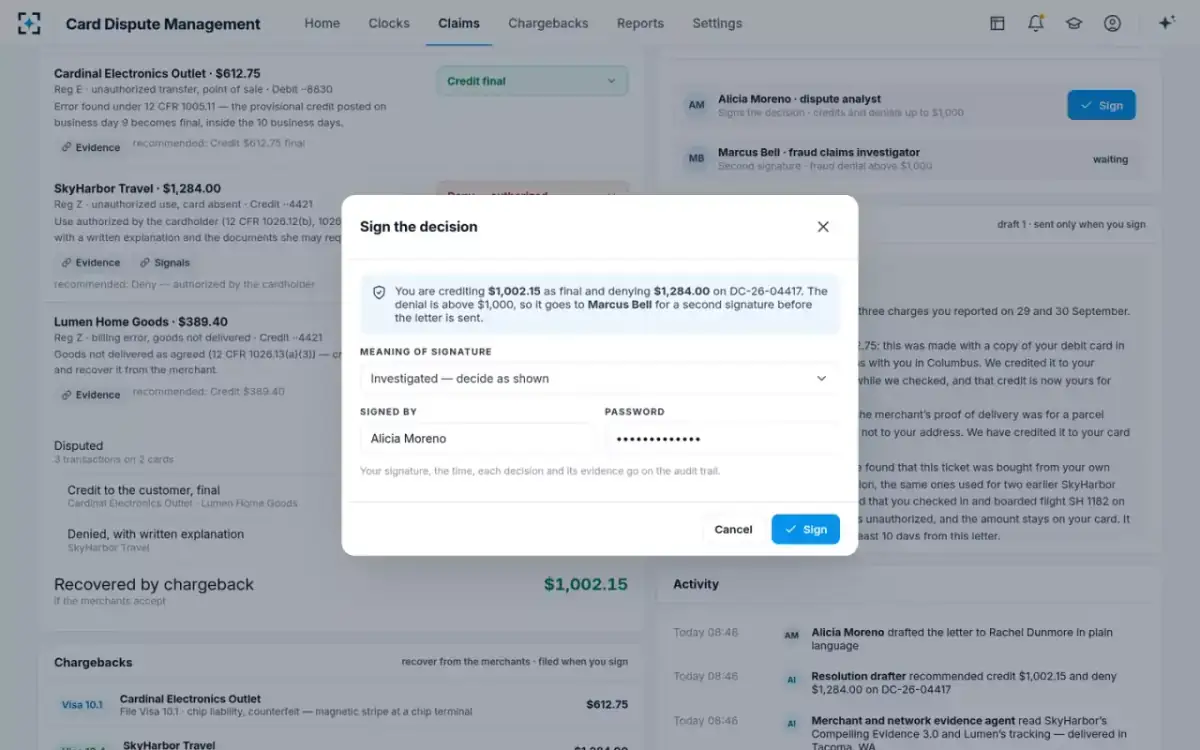
The dispute analyst — and above $1,000, a second signerReads the evidence, decides, signs; the fraud claims investigator co-signs consequential fraud denials.
Never: signs what they have not read.
The line: every signal is shown, no signal decides
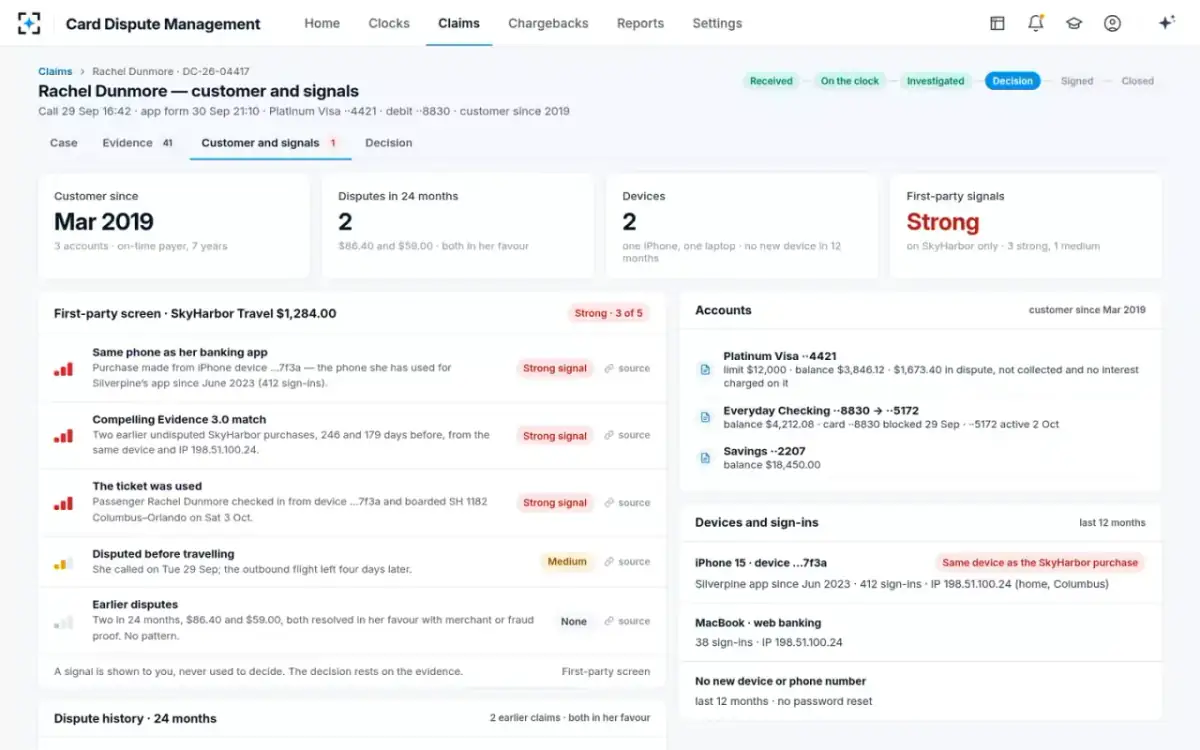
The hardest fraud judgement on a desk is first-party abuse — the dispute where the evidence says the cardholder made the purchase. The signals are real: the purchase came from the phone the customer banks from; the ticket was used; the dispute was filed the day before the flight. A screen that hides those signals loses the bank recoverable money; a screen that lets them decide denies customers on a correlation. The design rule that threads the needle is displayed, not assumed: every signal is shown with its weight and its source, and no signal is the decision. In the sample claim the first-party screen rates the SkyHarbor ticket strong on three of five signals — and separately reports that the customer's two earlier disputes in 24 months were small, decided in her favor, and show no pattern. The investigator reads the grid and then the evidence it points to.
The first-party grid the investigator reads: weight, source, and never the decision
Same device and home IP as the customer's banking app
Strong
The bank's own sign-in records
Whether the device was genuinely hers and in her hands
Two earlier undisputed purchases from the same merchant
Strong
The merchant's evidence filing
The bank's account history — matched, not assumed
Ticket checked in from the phone; flight boarded
Strong
The carrier's travel record
Whether the travel record is the customer's
Disputed before travelling
Medium
Dispute and travel dates
Timing against the itinerary, not against a hunch
Dispute history: two claims in 24 months, small, in her favor
No pattern
The bank's dispute log
Read as context — never as a reason
A signal is shown to the investigator with its weight and its source. A signal is never used to decide: the decision rests on the evidence, and the decision is a person's.
Why a $1,000 fraud denial needs a second human signature
Some decisions concentrate more harm in a single error than the rest of the desk's week combined: a fraud denial tells a customer, in writing, that the bank believes they are lying. The sample desk's rule is that any fraud denial above $1,000 routes to the fraud claims investigator for a second signature, and the investigator reads the evidence the denial rests on — not the screen's rating — before co-signing. The threshold is a versioned setting, changed only with a reason on the audit trail; the signature, the time and the evidence are kept on the claim. It is a control built for the worst case: the day the grid, the model and the momentum of the queue are all wrong at once, a second person has to read the file before the letter goes out.
What the USAA case shows about skipping the human step
The enforcement record is not about AI — it is about what happens when the human step is missing, whoever or whatever did the work. The CFPB's 2019 consent order against USAA Federal Savings Bank found the bank "failing to initiate and complete reasonable error resolution investigations" and ordered approximately $12 million in restitution plus a $3.5 million civil money penalty. Strip the detail and the principle generalizes cleanly: the law holds the institution to a reasonable investigation, claim by claim, and no amount of process automation satisfies a duty that no person performed or checked. An agent that drafts a denial nobody independently read is the same failure with faster typing. The human step is not a courtesy layered on the technology; it is where the legal standard lives.
failing to initiate and complete reasonable error resolution investigations
CFPB, consent order, USAA Federal Savings Bank (2019)
Is it legal for AI to deny a fraud claim?
The regulations do not answer in words, and that is the point to understand. Regulation E requires the financial institution itself to "investigate promptly" and determine whether an error occurred within 10 business days; Regulation Z requires the creditor to resolve the billing error and explain the outcome in writing; neither names a person, a signature or a tool. What they do fix is the standard: a denial must follow a reasonable investigation, come with a written explanation, and be backed by documents the customer may request. A denial no person read is hard to defend against that standard, because the bank cannot show who weighed the evidence or why. So the defensible design treats the rule as a specification: agents prepare every element of the determination, the evidence, the weighing, the draft and the letter, and a named person reads, decides and signs. The institution remains fully liable for the outcome either way, which is why Card Dispute Management never lets software send the denial.
The National Institute of Standards and Technology frames the organizational half of the same rule in its AI Risk Management Framework: under Govern 2, "accountability structures are in place so that the appropriate teams and individuals are empowered, responsible, and trained for mapping, measuring, and managing AI risks." Empowered, responsible, trained — three words that describe a desk where the agents' limits are defined, the signers are named, and the overrides are on the trail. A bank that can name who is accountable for a bad denial is a bank that built the boundary in; a bank that cannot is describing a hope.
What happens when the agent and the analyst disagree
Disagreement is a feature, and the file is built to hold it. The resolution drafter recommends; the analyst reads the evidence behind the recommendation and decides — including deciding the other way. When that happens, the override is itself on the trail: the recommendation, the decision, and who made each, with the time. Over a quarter, the pattern of disagreements is one of the most useful signals a desk has about both its agents and its analysts — persistent overrides in one direction or the other mean the evidence, the rules or the training needs attention. Testing that pattern against already-closed claims, before anything goes live, is the method behind piloting the system on your own files: replay a quarter, score the agents' recommendations against what your people actually decided, and let the disagreements teach you where the line should sit.
Where the audit trail has to show a person's name
A boundary that cannot be checked is a marketing sentence. The trail has to answer, per claim: who decided, who co-signed, what each of them read, and when — with the meaning of the signature stated at the moment of signing ("investigated — decide as shown"), and with the standing rules the agents ran under versioned and attributable: who approved the provisional-credit rule, when it changed last, and why. In the sample claim the trail holds both signatures on the SkyHarbor denial, the time of each, and the evidence each signer read. That is the check an examiner, an auditor or a court can run without trusting anyone's description of the system — and it is the standard a buyer should hold any vendor to, agents or no agents.
The signals with their sources, and the rule printed over the decision
Who is accountable if the AI misses a signal?
The same people who were accountable before the agents arrived. If a fraud signal goes unread, the question that matters is whether the desk's process was built to read it: was the signal in a source the investigation should have covered, was the agent's limit defined, did a person sign what they had read? NIST's Govern 2 makes the assignment of accountability a design requirement, not an afterthought: structures so that "the appropriate teams and individuals are empowered, responsible, and trained." On the sample desk the assignments are concrete — the analyst owns the decision, the investigator owns the second signature, the operations manager owns the standing rules — and each claim's trail shows them doing it. The agents change the speed of the work, not the address of the responsibility. To see the whole division of labour on a live claim, start from Card Dispute Management.
The last step is always a person: sign, and the trail records it
Questions people ask
Can AI detect credit card fraud automatically?
Yes — detection is where AI is strongest: reading every authorization, weighing device, IP, timing and history signals, and flagging the claims that need a human's attention, in seconds. Detection is not decision. A well-built desk lets the agents detect and prepare, and keeps the determination with a person who reads the evidence and signs.
Does AI decide if a dispute is fraud?
No. The agents draft a recommendation per charge, with the rule and the evidence cited; the dispute analyst decides and signs, and a fraud claims investigator co-signs denials above the bank's threshold. A signal from a screen is never the basis for a denial — the National Consumer Law Center's line is the consumer's version of the same rule: no treating the dispute as settled without a reasonable investigation.
Is it legal for AI to deny a fraud claim?
Neither regulation forbids it in so many words, and neither names who decides. Regulation E requires the financial institution to investigate and determine whether an error occurred; Regulation Z requires the creditor to resolve the billing error and explain in writing. The duty and the liability sit with the institution, and a denial it cannot show was weighed by someone accountable is hard to defend as a reasonable investigation, which is why the safer design keeps a named person deciding and signing.
What is human-in-the-loop fraud detection?
A design in which software detects, reads and recommends, and a person decides every consequential action — with the loop closed in the file: the recommendation, the decision, the override if any, and both signatures on the trail. The loop is only real if it can be audited; otherwise "human in the loop" describes a hope, not a control.
Can an algorithm be wrong about first-party fraud?
Yes — device and IP matches are correlations, not facts: shared networks, household devices and stolen-session attacks all produce false positives, and a model can only weigh what it was given. That is why the signals are shown with their sources and checked against the bank's own records, and why the decision rests on the verified evidence rather than the rating.
Who is accountable if an AI agent misses a fraud signal?
The institution — the same accountability as before the agents. NIST's AI Risk Management Framework makes it a design requirement: accountability structures so that "the appropriate teams and individuals are empowered, responsible, and trained." On a well-run desk the names are on the file: the analyst who decides, the investigator who co-signs, the manager who owns the standing rules.
What must a human still check before a dispute is denied?
The evidence the denial rests on, per charge: the authorizations, the merchant's answer and whether it was verified, the delivery or usage records, and the signals with their sources. Then the letter — the reason in plain words, the documents the customer may ask for — and finally the signature itself, whose meaning is stated at signing: investigated, decide as shown.