Who investigates a card dispute is not one person with a generic job description — it is five seats, each with its own work, and one claim that passes between them. The customer service lead who takes the call starts the clock. The dispute analyst owns the claim, weighs the evidence and decides. The chargeback specialist reads what the merchant sends back. The fraud claims investigator second-signs every fraud denial above $1,000. The operations manager watches every running clock. The work is legally timed — a debit claim must be investigated and decided within 10 business days under Regulation E, and the Consumer Financial Protection Bureau has ordered a bank to pay roughly $12 million in restitution for failing to initiate and complete reasonable error resolution investigations — so the seats exist to make sure no claim waits on the wrong person. Botminds' Card Dispute Management is built around exactly this desk: six agents do the reading and counting, and named people hold each seat and sign each decision.
The examples here come from the solution's fictional sample bank, Silverpine Bank, and one sample claim: Rachel Dunmore's three disputed charges on two cards, $2,286.15 in all. The people, the bank and the merchants are invented; the wage and volume figures are published data, linked where they appear.
The desk is a real occupation, with published wages and real volume behind it
$38.99/hr
median wage, 2025, for the BLS group that includes fraud examiners, investigators and analysts
$81,100
median annual wage for the same group
137,800
people employed in that group in 2025
$12.5B
reported lost to fraud by US consumers in 2024, up 25% on 2023
That last number is why the desk exists at all. The FTC found the rise in 2024 losses was "not driven by an increase in fraud reports, which remained stable": the share of people reporting a fraud who said they lost money rose from 27% to 38%, and the agency received more than 1.1 million identity-theft reports through IdentityTheft.gov (Federal Trade Commission, March 2025). Every cardholder caught up in that fraud can start a legally clocked claim with a phone call. Somebody has to take the call, somebody has to investigate, and somebody has to answer for the deadline.
Who actually works a card dispute, seat by seat
One claim, five seats. The seats below are the five personas of the sample claim, with what each person's week holds today and what it holds once the agents take the mechanical part — the reading, the pulling, the counting.
Five seats, one claim: what each person's week holds
Today
Spends the morning gathering evidence and the afternoon racing the clock, across 60 to 70 claims a day on debit and credit at the sample bank.
With agents
Opens each claim with the evidence already on its steps and the clocks already counted, and spends the time on the decision.
Still theirs: The decision and the signature on every claim.
Today
Asks "show me why it is her, not the score", and co-signs every fraud denial above $1,000.
With agents
Sees each first-party signal with its weight and its source, and the evidence the denial rests on, before co-signing.
Still theirs: The second signature on fraud denials above $1,000.
Today
Learns about a missed provisional credit as a finding — eleven missed deadlines in one quarter was a problem.
With agents
Sees 3,412 running clocks by business day, the nine claims due today without a decision, and none missed since July.
Still theirs: The standing rules — when credit posts, when to escalate.
Today
If the merchant's evidence is not read, the bank credits the customer and eats the loss.
With agents
Gets every merchant response read the day it lands, and Compelling Evidence 3.0 checked before pre-arbitration is filed.
Still theirs: Whether the merchant's proof holds.
Today
Wants a dispute logged in one minute, not ten; the calls his team takes start the clocks.
With agents
The call note is read, split into transactions and put on its clocks; what the customer said becomes evidence on the claim.
Still theirs: The first conversation with the customer.
Notice what is missing: a generalist who does all of it. Each seat has a narrow job that is hard enough on its own — reading merchant evidence well is a different skill from deciding a claim, and counting 3,412 clocks is a different job from both. The desk works when each seat's handoff is clean: the call becomes transactions, the transactions become evidence, the evidence becomes a decision, and the decision gets the signatures the law and the bank's own rules require.
The dispute analyst: the seat that owns the claim
The dispute analyst is the seat the job descriptions are written for. The analyst owns the claim from the moment it is logged to the moment the letter goes out: names the rule each charge runs under, assigns the investigation, weighs what comes back, decides credit or denial per charge, and signs. Under Regulation E, the institution "shall investigate promptly" and determine whether an error occurred within 10 business days of the notice — a duty that attaches to the institution, but a duty somebody's desk has to actually perform, claim by claim.
Ownership matters because most of what can go wrong goes wrong between seats. A claim that waits three days for someone to pull the authorizations has lost three days of a ten-day clock before any judgement happened. This is the failure the CFPB punished in its USAA Federal Savings Bank enforcement action, which found the bank "failing to initiate and complete reasonable error resolution investigations" and ordered approximately $12 million in restitution plus a $3.5 million civil money penalty. Not the wrong decision — no investigation worth the name. The analyst's seat is where that failure is prevented, because the analyst is the one person who can see the whole claim at once.
One claim's path across the five seats — the waits are where it stalls
A person decides
Customer service leadTakes the call or app notice, splits it into transactions, starts each clock.
Never: judges the claim or promises an outcome.
A person decides
Dispute analystOwns the claim: names the rule, assigns the investigation, weighs the evidence.
Never: denies on a signal alone — the decision rests on the evidence.
Agent
The six agentsRead the notice, count the clocks, pull authorizations, read merchant replies, screen first-party signals, draft the recommendation.
Never: close, deny, send or file without a signature.
A person decides
Chargeback specialistReads the merchant's answer and checks Compelling Evidence 3.0 before pre-arbitration.
Never: files without the analyst.
A person decides
Fraud claims investigatorSecond-signs every fraud denial above $1,000.
Never: signs on the score alone.
A person decides
Dispute operations managerWatches every running clock; told one business day before any expires.
Never: moves a deadline.
The second signature: why a fraud claims investigator exists
Some decisions are too consequential for one person's morning. When the analyst denies a fraud claim above $1,000, the decision does not leave the bank on one signature: it goes to the fraud claims investigator for a second. In the sample claim that seat is Marcus Bell, and his question is the right one — "show me why it is her, not the score." He reads the evidence the denial rests on, not the first-party screen's rating, before he co-signs.
The second signature is the desk's own answer to the failure mode regulators punish: a denial that rests on a shortcut rather than an investigation. It is also a control with a clear audit trail — the signature, the time, each decision and the evidence behind it are kept on the claim — so a file challenged months later can show who decided, who co-signed, and what they both read. The $1,000 line itself is a bank setting, versioned and on the audit trail, not a rule of law. A bank that sets it at $500 or $2,500 is making the same trade the sample desk made: how much loss exposure may ride on one person's morning judgement before a second set of eyes is cheap.
The seat also does something quieter. Because the investigator reads denials before they leave, analysts write them differently — the reason per charge, the evidence it rests on, the documents the customer may ask for, drafted in plain language. A denial that a sceptical specialist can co-sign without a phone call is a denial that will survive a complaint, an exam and an angry letter, in that order.
The chargeback specialist: reading what the merchant sends back
The card networks add a parallel track the customer never sees. When the bank files a chargeback, the merchant can answer with its own evidence, and the bank has to read it — the reason codes the networks use are a different language from Reg E and Reg Z. The chargeback specialist's job is to decide whether the merchant's proof holds. In the sample claim, Hannah Cho's seat reads two answers: SkyHarbor's representment with two earlier undisputed purchases from the same device and IP, which stands; and Lumen's delivery claim, which the carrier record contradicts — the tracking number ends at a front desk in Tacoma, not the customer's address in Columbus — and so does not.
The skill is reading against verification, not speed. A merchant's delivery claim is only as good as the tracking behind it; a device match is only evidence once someone confirms it is really the customer's device. The specialist's seat exists because an unread merchant answer is a paid claim the bank did not have to pay — or a denied customer it should have credited. Both errors land in the same place: the bank absorbs a loss it could have recovered, or it absorbs a complaint it could have avoided, and either way the analyst's decision was made with one eye closed.
It is also the seat where network rules meet bank policy. Whether to file a chargeback at all, in what amount, and when to answer pre-arbitration rather than fold, are decisions with their own deadlines, made on evidence the specialist has verified. The specialist never decides the customer's claim — but on whether the merchant's side of the story stands, the desk defers to no one else.
The seat customers talk to first: who starts the clock
Every clock on a claim starts with a person taking a message. The customer service lead's team answers the call, and what the customer says — when, which charge, what happened — is the notice that starts the Reg E or Reg Z clock. A call logged in ten minutes instead of one is not a service failure; it is nine minutes of a ten-business-day clock spent on paperwork. Getting the notice complete and split into transactions at the moment it arrives is why this seat exists.
Classification happens here too, at least provisionally: the debit card charge and the credit card charges on one call run under different rules, and which rule applies decides which clock runs. The notice reader in the solution does this splitting automatically, but the seat stays human because an unclear notice goes to a person.
The operations manager's seat: watching every clock at once
Nobody owns 3,412 clocks individually; that is the operations manager's job. The seat watches every running Reg E, Reg Z and network clock by business day, is told one business day before any of them expires, and owns the standing rules — when provisional credit posts, how early to escalate — that keep individual analysts from improvising under pressure. In the sample bank the rule is that Reg E provisional credit posts one business day before the Day 10 line, automatically, under a rule the operations manager approved. That is what "none missed since July" means as a management outcome: not heroics, a rule.
The desk-level view is the difference between managing a queue and managing a system. A queue tells an analyst which claim is oldest; the clock monitor tells the manager which of 3,412 clocks expires first, which claims due today have no decision, and whether the bank's standing rules are doing their job. When the answer to the last question is no, the fix is a rule change with a version and a reason — not a reminder to work faster.
Where a claim's 50 hours go, and what is left for the seats that decide
Worked by hand — 50 hours on one multi-charge claim
- Logging the notice, naming the rule · 8%
- Pulling authorizations and account activity · 32%
- Reading merchant replies, checking tracking · 40%
- Screening first-party signals · 8%
- Writing the decision, letter and chargebacks · 12%
With the agents on the mechanical part — 0.9 hours
- Logging, pulling, reading, screening · 44%
- Writing the decision, letter and chargebacks · 56%
The split is the desk's economics in one picture. Eight of every ten hand-worked hours go to gathering and reading — exactly the work that requires no judgement — leaving the analyst's decision squeezed into whatever the clock leaves. When the agents take that part, the seat's job becomes the job description's promise: investigate, weigh, decide, sign. What that shift is worth in dollars is worked through with real wage numbers in the cost guide.
The claim screen the dispute analyst opens first
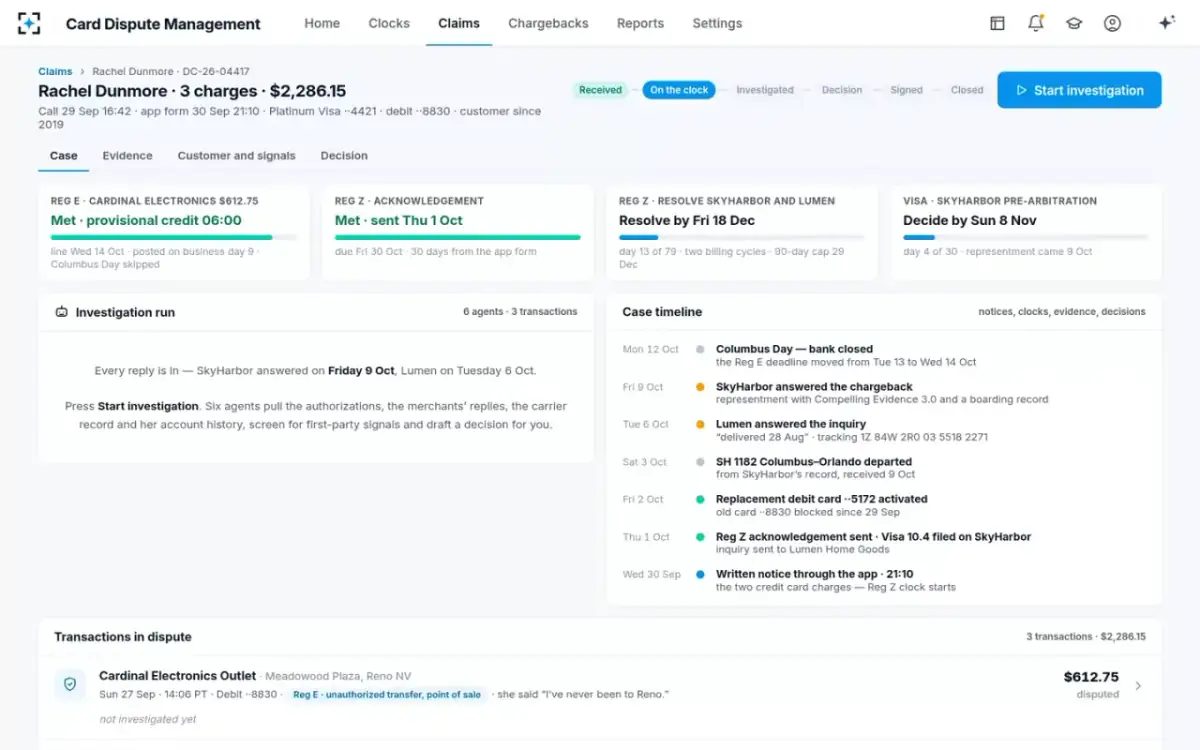
Who is involved in a card dispute?
Five seats inside the bank, one customer, and — in the background — the merchant and the card network. Inside the bank: the customer service lead who takes the notice, the dispute analyst who investigates and decides, the chargeback specialist who reads the merchant's answer, the fraud claims investigator who second-signs large fraud denials, and the operations manager who watches the clocks. Outside: the customer who noticed the charge and answered questions, the merchant who may defend the sale, and the network whose chargeback deadlines run on their own calendar. Every one of them appears somewhere in a defensible file.
What does a dispute analyst do all day?
On a manual desk, most of an analyst's day is not deciding. The solution's own estimates put a multi-charge claim at about 50 elapsed hours end to end: four hours logging the notice and naming the rule, sixteen pulling authorizations and account activity, twenty reading merchant replies and checking carrier tracking, four screening first-party signals — and six writing the decision, the letter and the chargebacks. The deciding part is barely a tenth of the work. That is why two analysts with the same job description can have opposite weeks: one spends it gathering, the other spends it judging, and only the second one is doing the job the regulation actually requires of the bank. Card Dispute Management is built so the analyst's day is the second kind.
Questions people ask
What does a dispute analyst do?
A dispute analyst owns a card claim end to end: names the rule each charge runs under, assigns and weighs the investigation, decides credit or denial per charge, and signs. Under Regulation E the bank must investigate promptly and decide within 10 business days, so the analyst is also the person answerable for the clock. On a manual desk most of the day is gathering evidence; the deciding part is barely a tenth of the hours.
Who investigates a credit card dispute?
Inside the bank, the dispute analyst investigates, with specialists around the edges: the customer service lead takes the notice, the chargeback specialist reads the merchant's answer, and the fraud claims investigator co-signs a fraud denial above $1,000. Agents can pull authorizations, read merchant replies and screen signals, but the investigation's judgement and its signature stay with people.
How many claims does a dispute analyst handle a day?
No published standard sets it, and it varies with claim mix. At the fictional sample bank a senior analyst on the manual desk touches 60 to 70 claims a day across debit and credit: a queue, not 70 investigations. Because most hours on a claim go to gathering rather than deciding, automation that removes the gathering changes what the number means: the same analyst investigates more claims and races fewer clocks.
What is the difference between a dispute analyst and a chargeback specialist?
The analyst owns the claim and the decision; the chargeback specialist owns one kind of evidence. The specialist reads the merchant's representment, checks device and delivery claims, and advises whether the merchant's proof holds before the bank files or answers a chargeback. The analyst decides the claim with that reading in hand — the specialist never decides the claim.
Does a second person have to approve a fraud denial?
Not by law — by bank policy, and the better desks make it a rule. In the sample desk any fraud denial above $1,000 routes to the fraud claims investigator for a second signature, and both signatures, the time and the evidence go on the claim's audit trail. The threshold is a versioned setting, so a bank can set it lower but should know why it set it where it did.
What does a fraud claims investigator do?
The fraud claims investigator is the second signature on consequential denials: before co-signing, they read the evidence the denial rests on — not the first-party screen's rating. The CFPB's USAA action shows what the seat prevents: roughly $12 million in restitution for error resolution investigations the bank failed to initiate and complete.