Dispute management software for banks is any system that carries a card dispute from the customer’s notice to a decision, a letter and a chargeback while keeping every disputed charge on its legal and network clock. The evaluation mistake is comparing feature lists. The honest test is to run one real-shaped claim through each option and watch what gets caught before the clock runs out — because the cost of this work is not the decision, it is the gathering, and the risk is not a slow file but a file that closes without looking. Botminds' Card Dispute Management is one of the four approaches below, used here as the worked example: six specialist agents do the reading and gathering on every claim, and the dispute analyst decides and signs. The other three approaches are spreadsheets and tickler files, legacy case-management systems, and outsourced dispute desks. Most banks have run at least two of them.
Why the choice matters commercially, not just operationally: a dispute handled badly does not stay inside the bank. The CFPB received approximately 50,800 credit card complaints in 2022; the top issue was a problem with a purchase shown on the statement, and the monthly average for the top issue increased 18% compared to the monthly average for the prior two years (CFPB Consumer Response Annual Report, March 2023). The dispute desk is where those complaints are won or lost before they are filed. It is also a regulated one — the duty to investigate rests on the bank, whoever does the work — so the evaluation has to weigh evidence and accountability alongside price.
What dispute management software is — and is not
It is the system of record for the dispute itself: the notice and its transactions, the rule each charge answers to, the running clocks, the evidence, the decision, the letter and the chargebacks, and the audit trail tying them together. It is not a general case-management tool with a dispute template, and it is not a chargeback portal — those handle slices of the work. And it does not replace the people who carry the accountability: Regulation E still requires the institution to investigate promptly and determine whether an error occurred within 10 business days (12 CFR 1005.11), and that sentence names the institution, not its vendor. Software that merely stores what your analysts type is a filing cabinet; the evaluation below separates filing cabinets from systems that do work.
The same claim, four ways
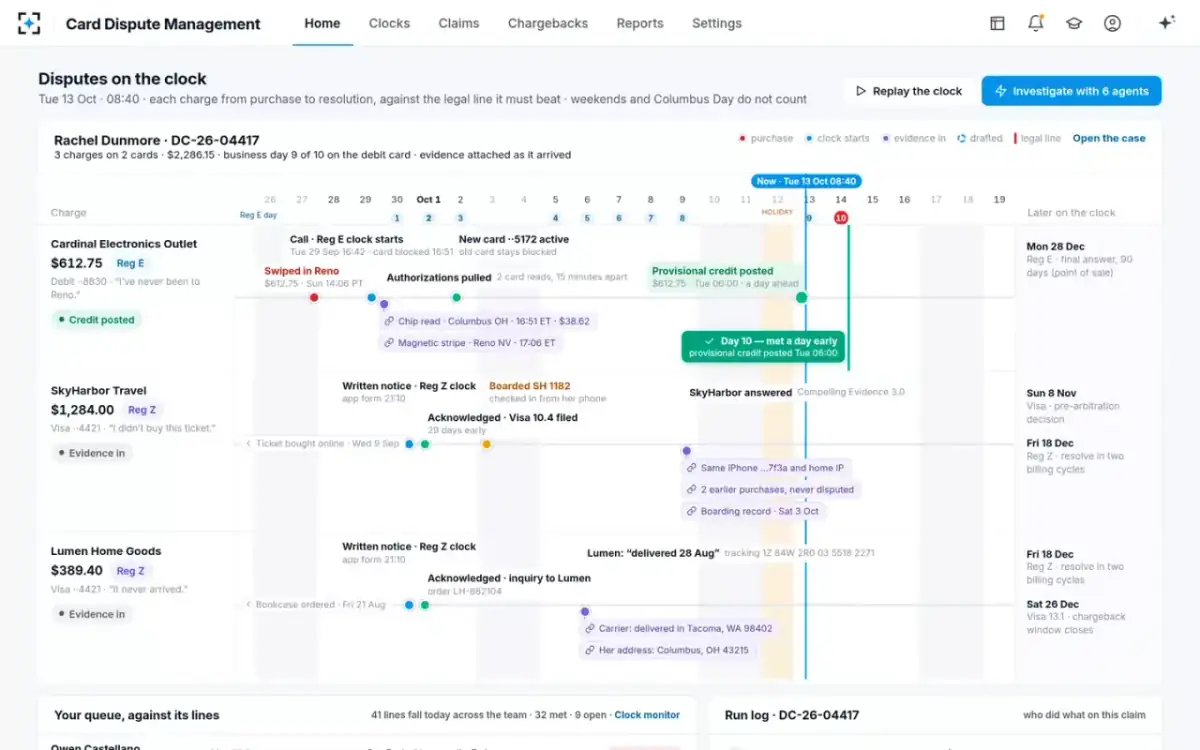
Take one claim — the sample claim that runs through Card Dispute Management, on a fictional bank with fictional people, chosen because its shape is common. A customer calls to dispute three charges on two cards, $2,286.15 in all: a debit charge that falls under Regulation E with its 10-business-day line, and two credit card charges that fall under Regulation Z with a 30-day acknowledgement and two-billing-cycle resolution, all under Visa and Mastercard timeframes on top. One merchant answers with a tracking number. One purchase pattern looks like first-party fraud. Run that claim through each of the four approaches and the differences stop being theoretical.
One claim, four ways of working it: what each approach is, catches, misses and leaves behind
What it is
Statuses and dates typed by hand; clocks counted in calendar days; evidence chased across four systems by email.
A queue, a status and a deadline field per claim; documents attached; the analyst still gathers every fact by hand.
A vendor’s analysts work the claims in a portal under your procedures; you package the notices and QA a sample.
Six specialist agents read the notice, count the clocks on the business-day calendar, pull the authorizations, read the replies, weigh the signals and draft the decision; a named analyst signs.
What it catches before the clock runs out
Nothing by itself. It records what a person already did, after they did it.
Routing and reminders — if the date was typed right, and if the reminder fires before a holiday weekend.
Staffing. The vendor reads the replies and drafts the decisions, usually competently, at volume.
The holiday before it costs a deadline; the tracking number inside the reply; the same phone on the purchase and the banking app — days before a person would have opened the file.
What it misses on this claim
Columbus Day, because the sheet counts calendar days. The Tacoma mismatch, because nothing reads the reply. The device match, because nothing sees it.
The same evidence gaps. The system stores the reply; it does not read it. The 10-day and 30-day clocks are fields, not rules.
The clocks are still yours to miss: turnaround measured in days, a holiday weekend inside it, and the legal duty does not transfer with the work.
Nothing is sent, filed or credited without a signature. What it has not read, it says so.
The file it leaves
A folder of PDFs and a row that says Closed. What closed it is in someone’s memory.
A well-organized folder of unread documents.
Their file, in their portal. Ask whether you can hand every document they relied on to an examiner.
A claim where every finding hangs from the record it cites, openable from the step it proves.
The bank it fits
A credit union with a dozen claims a month and one analyst who is also the fraud desk.
A bank that wants one queue instead of an inbox, and can staff the gathering.
A bank whose problem is heads, not oversight — and that will sample the vendor’s work every month.
A bank whose analysts are gatherers today, and should be deciders tomorrow.
What a spreadsheet and a tickler file miss
The spreadsheet’s real product is a false sense of control. Every row was typed by a person, which means every row is exactly as current as that person’s last good day. On the sample claim the trap is a holiday: the Regulation E line lands on a Wednesday after a federal Monday, and a sheet counting calendar days counts the Monday — the day the bank was closed — and wakes up a day late. The second miss is deeper. Nothing in a sheet reads the merchant’s reply, so the tracking number inside Lumen’s answer is never looked up, and the parcel that ended in Tacoma instead of Columbus goes unseen until the customer calls again. The third is the quietest: no first-party signal is visible at all, so the SkyHarbor pattern — the same phone on the purchase and the banking app — is either missed entirely or, worse, becomes an informal hunch that decides a claim without evidence. A hunch that happens to be right is still a finding.
What the agents see on the same claim in Card Dispute Management: every charge on its line, with weekends and the holiday not counted
What a legacy case-management system adds — and leaves manual
A case tool buys you a queue, a status model and an audit of who changed what. Those are real gains, and for a desk drowning in email they are worth the money. But on the substance of the claim, nothing changes: the analyst still opens four systems by hand, still copies the authorization details into a note, still reads the merchant reply, still does the clock arithmetic in her head and types the deadline into a field. The system stores the evidence — it does not look at it. That matters because the expensive part of the claim is the gathering, not the filing. The dead giveaway in a demo is what happens when you click a claim: if the screen asks a person to go and get things, the tool is a filing cabinet with reminders.
What an outsourced desk changes, and what stays with you
An outsourced desk swaps the staffing problem for an oversight problem. The vendor’s analysts work your procedures in their portal; you forward the notices, and they return decisions and letters. For a bank whose dispute volume outgrew its team, this is often the right call — vendors are good at this work. What does not move is the duty. The regulation names the institution, and the enforcement record makes the point expensively: the CFPB’s 2019 order against USAA Federal Savings Bank came to approximately $12 million in restitution and a $3.5 million penalty for what it called failing to initiate and complete reasonable error resolution investigations (CFPB enforcement action, January 3, 2019). The obligation — and the file — stayed with the bank. So an outsourced desk has to be bought with its sampling plan: you re-review a share of the vendor’s decisions every month, against the evidence, and you ask the one question most buyers forget. Where is the file? If the documents the vendor relied on live only in the vendor’s portal, you cannot show them to your examiner.
The sample claim’s first two weeks, under each way of working it
- Logging and clock math by handday 1
- Chasing authorizations, replies, recordsdays 2–6
- Decision, letter, chargebacksdays 7–9
- Logging and statusday 1
- Same gathering, inside one queuedays 2–6
- Decision, letter, chargebacksdays 7–8
- Packaging and portal handoffdays 1–2
- Vendor queue and readingdays 3–8
- Return, review, letterdays 9–10
- Notice read, clocks checkedminutes
- Authorizations, replies, records pulledsame day
- Analyst reviews and decidesdays 1–2
Dispute management software that runs Reg E and Reg Z together
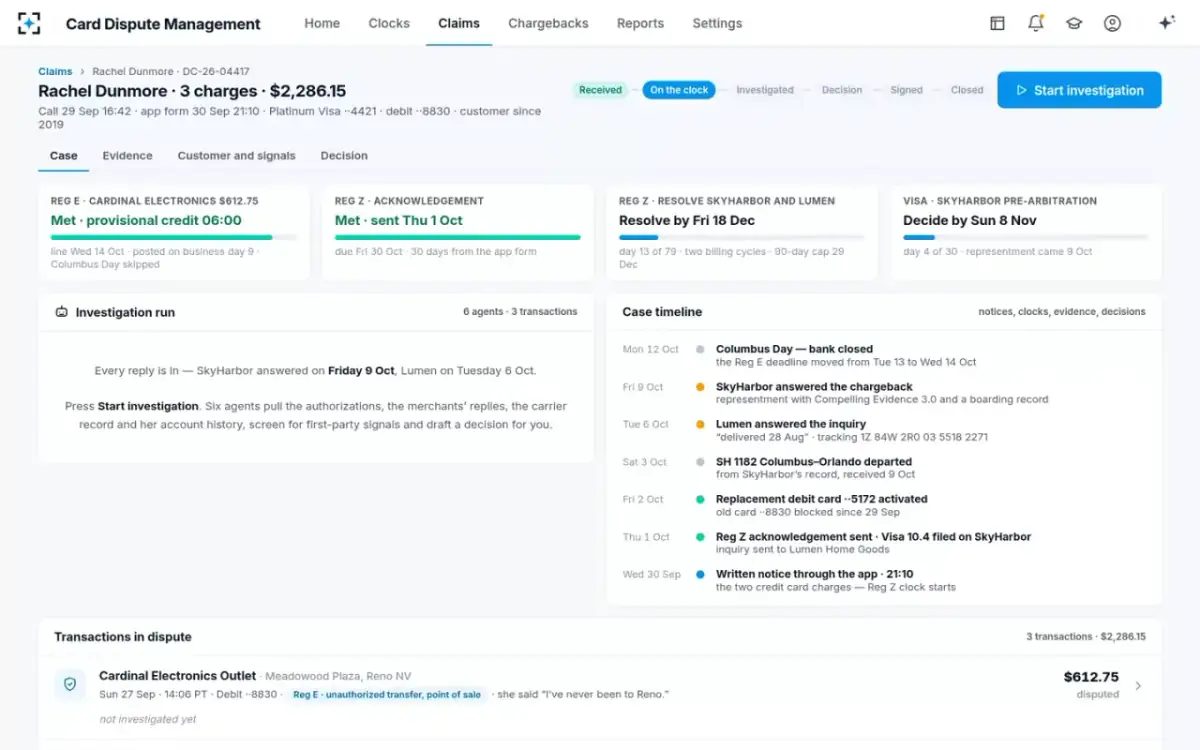
The feature that separates serious dispute software from everything else is boring on a demo screen and decisive in production: one claim, several rules, no mixing them up. The sample claim needs a Regulation E clock on the debit charge — 10 business days to decide or provisionally credit, up to 45 days, 90 for point-of-sale, foreign-initiated and first-30-day transfers on a new account — and Regulation Z clocks on each credit card charge, acknowledged in 30 days and resolved in two complete billing cycles, never more than 90, with the Visa and Mastercard timeframes overlaid. A system that treats “the dispute” as one clock will quietly run the credit card charges on the debit clock or vice versa, and the error only surfaces in an examiner’s sample. Ask to see, on one screen, every running clock on a multi-card claim — counted in business days on the bank’s own calendar — and what the system does the day before any of them expires.
One claim, four clocks: the case screen an evaluator should ask every vendor to show
Do I still need analysts if I buy this?
Yes — fewer of them, doing a better job. The division of labour that works is machines gather, people decide. Gathering is reading-shaped work: pull this authorization, read that reply, look up this tracking number, count that clock. Deciding is judgment-shaped work: weigh the customer’s two-year history against a strong first-party signal, and sign a letter that names the evidence. The people you keep are fraud examiners and investigators — the Bureau of Labor Statistics’ median for the group that includes them is already $38.99 an hour, before benefits and overhead (O*NET OnLine, 2025 BLS data) — and their time is worth more at the decision than at the photocopier. Two rules keep the arrangement safe, and both should be settings you can see: a signal is never the reason for a denial, and anything above a set amount takes a second signature.
The number an examiner asks about: missed Reg E and Reg Z deadlines in a quarter
Dispute management software and your core banking system
It sits beside the core, not instead of it. The core holds the account and moves the money; the dispute system holds the claim, the evidence, the clocks and the letters. The integration questions are therefore narrow and testable: can it read the authorization log (entry mode, chip, terminal, device, IP, location); read account activity, devices and dispute history; post provisional credit under a standing rule a person approved; and file chargebacks into the Visa and Mastercard dispute systems? A vendor who answers those four concretely — with a working screen, not an architecture diagram — is past the hurdle most fail. A vendor who proposes replacing the core to fix disputes has misunderstood the problem.
What to ask any dispute management software vendor before you sign
Run the questions below in the demo, on your own claim shapes, and make the vendor operate the system rather than present it. The answers that matter are screens, not adjectives.
The evaluation checklist: eight questions, asked live, on a claim like yours
- Show one claim with three charges under two rules. What are all its clocks?
Reg E business days, Reg Z 30-day and two-cycle, network windows — counted on the bank’s calendar, with the holiday handled.
- What does it do the day before a clock expires?
Escalate to a named person, post provisional credit under your standing rule — or just colour the row red.
- Open the evidence a finding rests on.
Every finding should cite the authorization, reply, carrier record or call note it came from — openable from the step it proves.
- How does it treat a first-party signal?
Shown with its weight and source, never the reason for a denial. Ask what happens if you try to deny on the signal alone.
- Who signs, and what does the signature mean?
A named analyst, with a second signature above your limit, and the meaning of the signature written down at signing.
- Where is the file, and who can read it in five years?
Yours, exportable, with the audit trail. A portal you lose at contract end is not a file.
- Show the denial letter. What does it tell the customer?
The reason, the evidence in plain words, and the documents she may ask for — sent only on signature.
- Can we replay last quarter’s closed claims through it?
The honest pilot, before anything goes live — the method is in the pilot guide linked from this page.
The honest summary: buy the approach whose files you would hand to an examiner unedited. Card Dispute Management is built to that test — every finding cited to its record, every clock on the business-day calendar, every decision signed by a named analyst, and nothing sent or credited on the software’s own initiative. Where it fits in the buying process is the last step: after the shortlist, run it against your own closed claims, which is exactly what the pilot guide sets out. For what the file must contain once you are in production, see how banks investigate a dispute, and what makes the file hold up.
Questions people ask
What is dispute management software?
Software that takes a card dispute from the customer’s notice to a decision, a letter and a chargeback, keeping each disputed charge on its legal and network clock — Regulation E’s business-day deadlines for debit, Regulation Z’s acknowledgement and resolution windows for credit, and the Visa and Mastercard timeframes on top. Good software also gathers the evidence itself and cites it, so the analyst decides instead of chasing.
What’s the difference between chargeback software and dispute management software?
Chargeback software works the network fight — reason codes, representments, deadlines before the card networks. Dispute management software starts earlier, at the customer’s notice, and carries the legal duty: the Regulation E investigation and provisional credit, the Regulation Z billing-error process, the letter to the customer. A chargeback tool is a component; dispute management is the whole claim.
Is dispute management software the same as a case management system?
No. A case management system routes work and stores documents; it does not read the merchant’s reply, look up the tracking number, count the business-day clocks per rule, or weigh a first-party signal with its source. It records what people did. Dispute management software does the reading and gathering itself and leaves the deciding to people.
Can dispute management software handle Reg E and Reg Z at the same time?
It must — one notice routinely carries both. A call about a debit charge opens a Regulation E clock while a written notice about credit card charges opens Regulation Z clocks, and the system has to run each charge under its own rule on the bank’s business-day calendar. Ask to see it on a multi-card claim; it is the first thing to check in any demo.
Do I still need analysts if I buy this?
Yes. The workable division is that the software gathers — notices, authorizations, replies, records, clocks — and your analysts decide and sign, with a second signature above a set limit and a written explanation on every denial. You need fewer analysts, and their time moves from gathering to judgment.
Does dispute management software replace my core banking system?
No. It sits beside the core: the core holds the account and moves the money, the dispute system holds the claim, the evidence, the clocks and the letters. The integrations to test are reading the authorization log and account history, posting provisional credit under a standing rule, and filing chargebacks into the network systems.