Reg E vs Reg Z disputes comes down to one question — which rule governs the card the charge sat on. A debit card claim runs under Regulation E, which implements the Electronic Fund Transfer Act: the bank must investigate promptly, determine whether an error occurred within 10 business days, and if it cannot, provisionally credit the customer and take up to 45 days to finish. A credit card claim runs under Regulation Z, which implements the Truth in Lending Act: the creditor must acknowledge a written billing error notice within 30 days and resolve it within two complete billing cycles, never more than 90 days, with no duty to advance the money while it investigates. The same customer can put both rules in play in a single phone call. Botminds' Card Dispute Management starts a separate clock for each charge the moment its notice arrives, because mixing the two regimes is how banks miss deadlines they did not know were running.
The worked example here is the sample claim of the solution's fictional bank, Silverpine Bank: one call on Tuesday 29 September about three charges on two cards — one debit, two credit — followed by an app form the next night. Every date below is the sample claim's own; the rules are the current text of 12 CFR 1005.11 and 12 CFR 1026.13, linked where they are quoted.
The four numbers that decide whether a claim is on time
10business days
to investigate and decide a Reg E claim, or post provisional credit
45days
outer limit for a Reg E investigation once provisional credit is given
30days
to acknowledge a Reg Z billing error notice in writing
90days
absolute outer limit for Reg Z resolution — and the Reg E limit for POS, foreign and new-account transactions
Reg E and Reg Z are not the same rule
They come from different statutes, protect different instruments, and were written in different decades — and a card issuer runs both every day. Regulation E covers electronic fund transfers: debit card transactions, ATM withdrawals, and the other ways money moves out of a deposit account electronically. Regulation Z covers open-end credit: credit cards, where the disputed amount is the bank's money, not the customer's. That single difference — whose money is missing — explains almost every divergence between the two clocks, including the most visible one: Reg E makes the bank advance the customer's own money while it investigates, and Reg Z does not.
The confusion is natural because the customer experiences one event ("a charge I don't recognize") and the law sees two or three ("an unauthorized electronic transfer," "a billing error on an open-end credit plan," and maybe "a card network chargeback" on top). The bank's job is to split the customer's one story into the law's separate claims before any clock is counted — which dispute rule applies is a classification problem, and it comes first.
The Reg E clock: 10 days, provisional credit, 45 days
Under 12 CFR 1005.11, a financial institution "shall investigate promptly" and determine whether an error occurred within 10 business days of receiving a notice of error — and a notice can be oral or written, so the clock can start at a phone call. If the institution cannot finish in 10 business days, it "may take up to 45 days from receipt of a notice of error to investigate and determine whether an error occurred", but only if it provisionally credits the consumer's account, including interest where applicable, within 10 business days of the notice, tells the customer within two business days after crediting, and gives "full use of the funds during the investigation". For a transfer made within 30 days after the account's first deposit the decision window stretches to 20 business days, and for point-of-sale debit card transactions, transfers not initiated within a state, and those same first-30-day transfers, the outer limit stretches from 45 days to 90.
Three details of the rule decide real files. The customer has 60 days after the statement that first shows the error to give notice. A bank may require written confirmation of an oral notice within 10 business days, but only if it says so, with the address, during the call; if it asked and the confirmation never arrives, it need not post provisional credit, though it must still investigate. And whatever the outcome, the results go to the customer within three business days after the investigation ends.
The provisional credit is the rule's centre of gravity. It is not a finding — the bank has decided nothing — but the customer, whose own money is gone, gets full use of the funds while the investigation runs. A bank that cannot complete its investigation within the outer limit has a problem with its process, not its calendar: the credit was the price of extra time, and the time has rules.
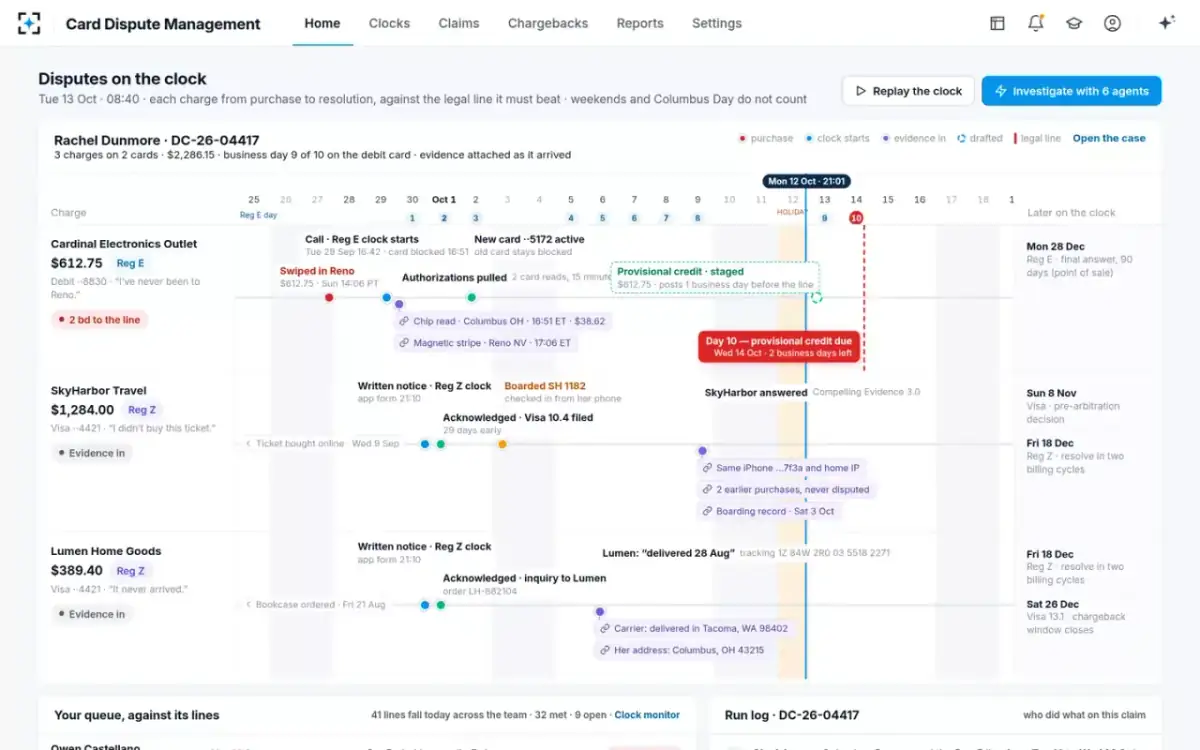
In the sample claim the debit charge is the $612.75 Reno purchase. The notice arrived Tuesday 29 September; Columbus Day sits inside the window and does not count as a business day; the Day 10 line lands Wednesday 14 October. Reg E counts "business days" as days the bank's offices are open for "substantially all business functions" (12 CFR 1005.2(d)), so the bank's own holiday calendar, not a generic one, sets the line. The bank's standing rule posts provisional credit one business day before the line, so at 06:00 on Tuesday 13 October the credit posted itself and the line turned green — Day 10 met a day early, with no decision yet made and no analyst woken up.
The Reg Z clock: 30 days to acknowledge, two billing cycles to resolve
Under 12 CFR 1026.13, the creditor "shall mail or deliver written acknowledgment to the consumer within 30 days of receiving a billing error notice", and "shall comply with the appropriate resolution procedures" within two complete billing cycles, "but in no event later than 90 days". Two differences from Reg E matter in practice. The notice must be a billing error notice — Reg Z's protection attaches to its own categories — and the clock on the back end is measured in billing cycles, which are the creditor's own calendar, capped by the 90-day absolute limit.
While the Reg Z dispute is open, the creditor's hands are tied in ways customers feel immediately: the consumer may withhold payment of the disputed amount and related finance charges; the creditor may not try to collect the disputed amount; and it may not report the disputed amount or account as delinquent for refusing to pay it (12 CFR 1026.13(d)). That is the functional substitute for provisional credit on the credit side — the customer's bill is effectively frozen on the disputed portion until the bank explains itself in writing.
In the sample claim the two credit card charges — Lumen's $389.40 and SkyHarbor's $1,284.00 — arrived as an app form on Wednesday 30 September. The written acknowledgment went out Thursday 1 October, well inside 30 days; resolution is due within two complete billing cycles and in any case by Friday 18 December; and a Visa pre-arbitration decision date of Sunday 8 November runs alongside both, a network clock that neither regulation knows about.
Rachel Dunmore's three charges, drawn to scale on their own clocks
- Investigate, decide — or creditDay 10 · 15 days
- Finish the investigationDay 45 · 90 in three cases
- Written acknowledgmentsent 1 Oct · 30 days
- Resolvetwo complete billing cycles · 18 Dec · 90 days max
Which rule applies to which card?
The card decides the rule. A charge on a debit card, or any electronic transfer out of a deposit account, is a Reg E matter. A charge on a credit card is a Reg Z matter. A prepaid card is generally Reg E. A single transaction can even touch both. When a debit transfer draws on an overdraft line of credit under an agreement with the bank, 12 CFR 1026.13(i) sends the error back to Regulation E's procedures, even though credit was extended; and a credit feature attached to a prepaid card runs under its own rules. That is why the classification belongs at the transaction level, not the customer level. When in doubt, the conservative desk treats a charge under the rule with the shorter clock, because the cost of over-compliance is small and the cost of a missed Reg E line is a finding.
Reg E and Reg Z side by side, row by row
Reg E — Regulation E, 12 CFR 1005.11: Debit, prepaid and other electronic fund transfers out of a deposit account.
Reg Z — Regulation Z, 12 CFR 1026.13: Credit cards and other open-end consumer credit plans.
Reg E — Regulation E, 12 CFR 1005.11: Any notice of error, oral or written, including a phone call, received within 60 days after the statement first showing the charge.
Reg Z — Regulation Z, 12 CFR 1026.13: A written billing error notice, received within 60 days of the first statement showing the charge.
Reg E — Regulation E, 12 CFR 1005.11: Investigate promptly and decide within 10 business days; 20 for a transfer within 30 days after the account's first deposit.
Reg Z — Regulation Z, 12 CFR 1026.13: Written acknowledgment within 30 days of the notice.
Reg E — Regulation E, 12 CFR 1005.11: Provisional credit within 10 business days, including interest where applicable, with full use of the funds.
Reg Z — Regulation Z, 12 CFR 1026.13: No credit duty. The customer may withhold the disputed amount; collection and adverse credit reporting on it must stop.
Reg E — Regulation E, 12 CFR 1005.11: Up to 45 days with provisional credit; 90 days for point-of-sale, foreign-initiated and new-account transactions.
Reg Z — Regulation Z, 12 CFR 1026.13: Two complete billing cycles after the notice, and never later than 90 days.
Reg E — Regulation E, 12 CFR 1005.11: Business days: days the bank's offices are open for substantially all business, so its own holidays do not count.
Reg Z — Regulation Z, 12 CFR 1026.13: Days, then the creditor's own billing cycles.
What happens when one customer triggers both clocks in the same week
This is the case the spreadsheets cannot hold. One customer, one complaint — "three charges I don't recognize" — and the desk inherits a Reg E clock on the debit charge and two sets of Reg Z clocks on the credit charges, plus the network's chargeback deadlines under each. Each charge gets its own classification, its own notice date, its own calendar, and its own letter. Treating the call as one claim with one clock means at least one charge runs unmonitored, and the unmonitored one is the one that becomes a finding.
One notice in, three clocks started
Agent
Notice readerReads the call note of 29 Sep at 16:42 and the app form of 30 Sep at 21:10, and splits them into three transactions.
Never: names a rule without naming the transaction it belongs to.
Agent
Clock keeperStarts the Reg E clock on the $612.75 debit charge and both Reg Z clocks on each credit charge, on the bank's business-day calendar.
Never: counts Columbus Day, or stops a running clock.
A person decides
Dispute analystConfirms each classification — Reg E here, Reg Z there — before the investigation starts.
Never: lets one notice ride on one clock.
A person decides
Operations managerWatches all three clocks at once; told one business day before each expires.
Never: moves a line to make the board look better.
Why Reg E has provisional credit and Reg Z does not
Because the money at risk is different. A disputed debit charge has already left the customer's deposit account — groceries money, rent money — and ten business days is a long time to wait for a bank to decide whether your own cash comes back. Provisional credit puts the customer's money back while the bank does its work; if the bank decides no error occurred, it reverses the credit and explains in writing. A disputed credit card charge, by contrast, is the bank's money. The customer's exposure is the obligation to pay a bill — which Reg Z defuses by freezing collection and adverse credit reporting on the disputed portion (12 CFR 1026.13(d)) until the bank resolves the dispute. Each regime advances what its customer actually stands to lose.
Where the card network's own chargeback clock sits on top
Neither regulation cares about Visa's or Mastercard's deadlines, and the networks do not care about the regulations. A card-absent fraud chargeback has its own filing windows, its own representment and pre-arbitration dates — in the sample claim, a Visa pre-arbitration decision due Sunday 8 November — and missing a network date can forfeit a recovery the bank would otherwise win, whatever Reg E or Reg Z says. The legal clocks decide what the bank owes the customer; the network clocks decide what the bank can recover from the merchant. A desk that tracks only the first set pays claims it could have recovered; a desk that tracks only the second set breaks the law.
What happens if a bank misses either deadline?
Missing is not a bookkeeping matter. A bank that fails to investigate or provisionally credit within Reg E's windows has violated Regulation E — and the CFPB has shown what that costs: the USAA Federal Savings Bank consent order, which found the bank "failing to initiate and complete reasonable error resolution investigations", required approximately $12 million in restitution and a $3.5 million civil money penalty. On the Reg Z side the Truth in Lending Act adds a penalty of its own: a creditor that fails the billing error procedures "forfeits any right to collect from the obligor the amount indicated by the obligor" and the finance charges on it, capped at $50 (15 U.S.C. §1666(e)), on top of supervisory findings and the consumer's right to sue. The lesson both regimes teach is the same: the deadline is the claim. A technically correct denial issued a day late is not a win.
The clock monitor: every running line by business day
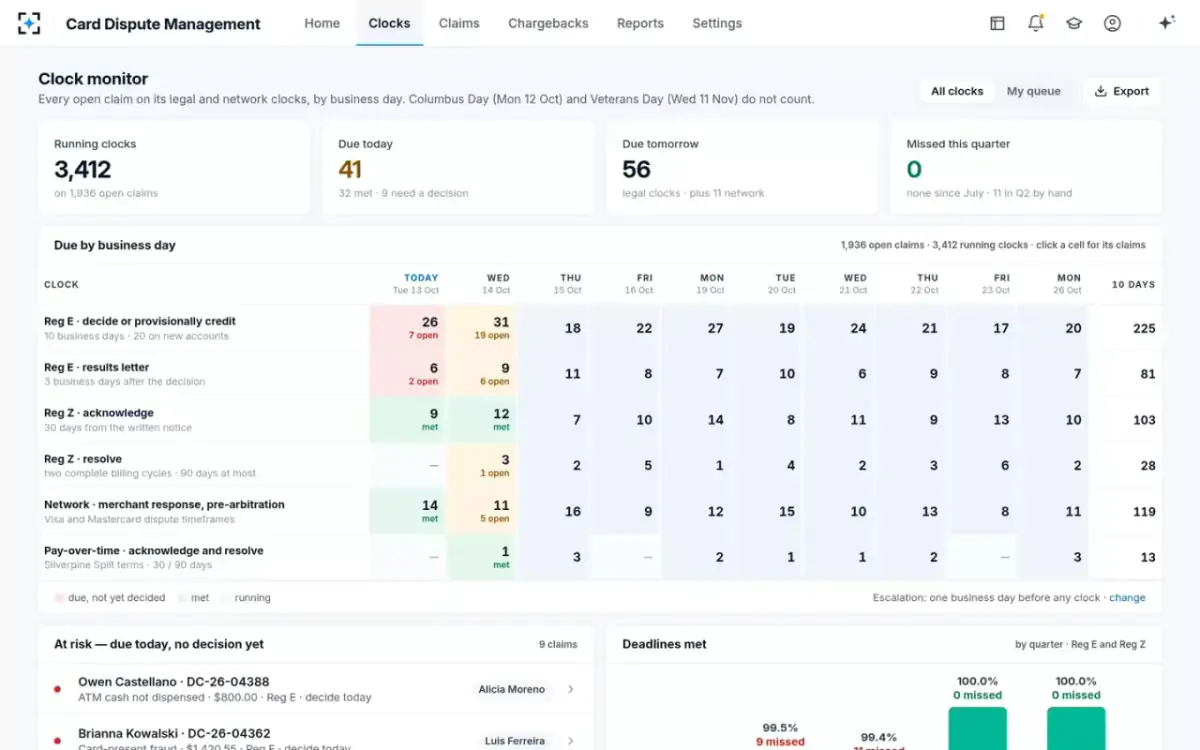
None of this is exotic arithmetic; it is arithmetic nobody can hold in their head across a quarter's volume. The sample desk's answer is to make the calendar a system responsibility — the clock keeper agent starts every line, counts business days on the bank's calendar, escalates one business day early, and posts provisional credit under the standing rule the operations manager approved — while the people on the desk keep the decisions. That division is what "0 missed deadlines" looks like when it is real: not effort, a rule applied to every charge on every claim. See it on the sample claim from Card Dispute Management.
Replay: watching the Day 10 line meet itself a day early
Questions people ask
What is the difference between Reg E and Reg Z disputes?
Reg E covers electronic fund transfers — debit cards, ATMs, prepaid — and gives the bank 10 business days to investigate or provisionally credit, with up to 45 days to finish. Reg Z covers open-end credit — credit cards — and requires written acknowledgment within 30 days and resolution within two complete billing cycles, never more than 90 days, with no provisional-credit duty. The card the charge sat on decides which rule runs.
How long does a bank have to resolve a debit card dispute?
Under Regulation E the bank must determine whether an error occurred within 10 business days of the notice; 20 for a transfer made within 30 days after the account's first deposit. If it cannot, it must provisionally credit the customer within those 10 business days and may then take up to 45 days to finish; for point-of-sale, foreign-initiated and new-account transactions the outer limit is 90 days.
How long does a bank have to resolve a credit card dispute?
Under Regulation Z the creditor must acknowledge a written billing error notice within 30 days and resolve the dispute within two complete billing cycles, and never later than 90 days after the notice. While the dispute is open the customer may withhold the disputed amount and the creditor must stop collection and adverse credit reporting on it.
Can one customer have a Reg E and a Reg Z dispute at the same time?
Yes, and it is common: a customer disputing charges on a debit card and a credit card in one call puts one charge on a Reg E clock and the others on Reg Z clocks, each with its own notice date and calendar, plus the card networks' own deadlines on top. Each charge is classified separately and carries its own clock, its own decision and its own letter.
Does Reg Z cover debit cards?
No. Regulation Z's billing error resolution covers open-end credit — credit cards. A disputed debit card transaction is a Regulation E error resolution matter, even when the customer describes it the same way. Chargeback rights through the card network are a third, parallel track that exists for both but replaces neither rule.
Why does a debit card get provisional credit and a credit card does not?
Because the disputed money belongs to different people. A debit dispute has already taken cash from the customer's own account, so Reg E puts it back provisionally while the bank investigates. A credit card dispute is the bank's money; Reg Z instead freezes the obligation — the customer may withhold the disputed amount, and the bank may not collect it or report it delinquent until the dispute is resolved.