Asked how much a chargeback costs, most desks quote the disputed amount. That is the smallest line in the bill. From the issuing bank’s side, a card dispute costs the time its analysts spend gathering what the decision needs, priced at a loaded rate and multiplied by the book, plus the elapsed days that race the legal clocks (about fifty hours from notice to decision on a multi-charge claim, on the sample data worked below), plus the costs that surface only when something goes wrong: a credit the bank absorbs, a chargeback lost to an unread reply, or a missed Regulation E deadline that arrives as restitution, a civil money penalty and years of reporting. The honest answer to what a chargeback costs is therefore a formula, not a number — and the same formula, run backwards, is how the return on automating the work is measured. Botminds' Card Dispute Management is measured that way in this guide: hours by hand against hours with agents, at published wage data, with every input named so a finance partner can swap in the bank’s own figures.
What a card dispute costs a bank: the credit is the smallest part
Split the cost of one claim into four lines and the shape becomes clear. The first line is recoverable money: the amount in dispute, most of which returns through provisional credit, final credit or the chargeback. The second line is handling: the analyst hours from notice to decision. The third is losses: credits the bank absorbs because the evidence was never read, chargebacks lost at pre-arbitration to a representment nobody checked. The fourth is the tail risk: the missed deadline or the unreasonable investigation, priced by the enforcement record rather than by the bank’s own experience. The first line is what the spreadsheet shows; the second is what the desk's budget pays; the third and fourth are where the money hides, because no report records the evidence nobody read. The pressure on volume is real: consumers reported losing more than $12.5 billion to fraud in 2024, a 25% increase over the prior year, while the number of fraud reports stayed stable (Federal Trade Commission, March 2025), and each loss on a card can arrive at the desk as a claim.
Where the hours go on one multi-charge claim
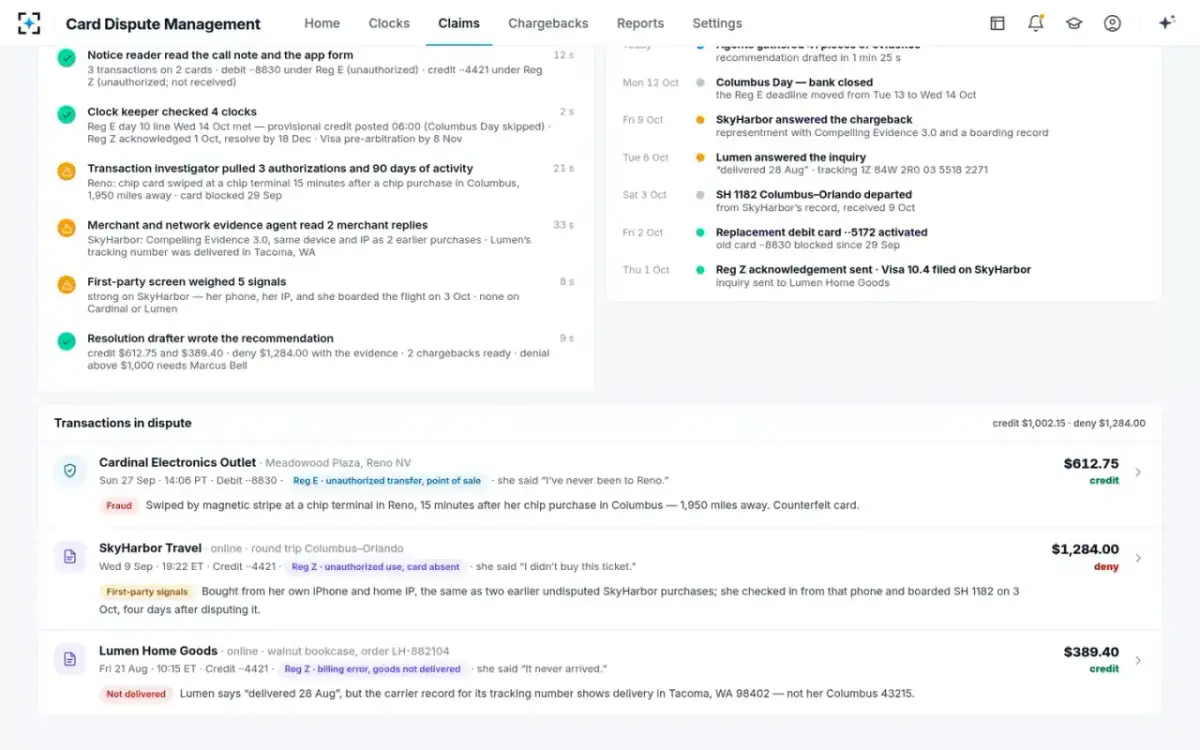
The sample claim from Card Dispute Management carries the standard shape: three disputed charges on two cards, $2,286.15, one debit claim under Regulation E and two credit card claims under Regulation Z, with Visa timeframes on top. Worked by hand, its elapsed hours from notice to decision divide into five kinds of work, and four of the five are gathering, not deciding. These are hours on the clock, not hours of one person's labour: the analyst is working other claims in between. Logging the notice and naming the rule takes about four hours — reading the call note, splitting it into transactions, working out which clock each charge runs on. Pulling the authorizations and account activity takes about sixteen: three authorizations, ninety days of activity, entry modes and devices to compare. Reading the merchant replies and checking the tracking takes about twenty — two replies, one tracking number, one carrier lookup, several comparisons against the customer’s address and history. Screening for first-party abuse takes about four. Writing the decision, the letter and the two chargebacks takes about six. The decision itself — the judgment — is a minority of the total, and it is the part no bank should want to delete.
Where a claim’s hours go: by hand, and with agents reading and gathering
By hand · ≈50 h on the sample claim
- Logging and naming the rule · 4 h · 8%
- Pulling authorizations and activity · 16 h · 32%
- Reading replies, checking tracking · 20 h · 40%
- Screening for first-party abuse · 4 h · 8%
- Decision, letter, chargebacks · 6 h · 12%
With agents · ≈0.9 h of machine time, analyst review on top
- Logging and naming the rule · 0.1 h · 11%
- Pulling authorizations and activity · 0.1 h · 11%
- Reading replies, checking tracking · 0.1 h · 11%
- Screening for first-party abuse · 0.1 h · 11%
- Decision, letter, chargebacks · 0.5 h drafted · 56%
How many hours a card dispute takes, by hand and with agents
The gathering share is consistent across desks, because it is set by the systems, not the people: authorizations in one system, merchant replies in another, carrier tracking and account history in a third, the clocks in a spreadsheet that counts calendar days through a holiday. On the sample bank’s data, the median from notice to evidence gathered is 46 hours by hand — more than a working week per claim, before the decision — and the same sequence with agents reading and gathering lands the evidence the day the replies arrive. That is why the ROI of this automation has two parts. It removes most of the analyst's gathering time, which is the cost line; and it removes the forty-odd elapsed hours of waiting on gathering, which is the deadline line, because those are the hours in which a ten-business-day clock quietly runs down.
The run that replaces the gathering: six agents, 85 seconds, every finding cited to its record
How to calculate what a chargeback costs: hours, loaded rate, volume
The cost formula has three inputs and each belongs to someone. Touch hours per claim comes from the desk: time a sample of recent claims by the minutes a person actually spends on each, split by kind of work. Do not price the fifty elapsed hours above; they measure the clock, not the labour. Loaded rate comes from finance: wage plus benefits and overhead for the analysts doing the work. The median wage for the BLS group that includes fraud examiners, investigators and analysts, $38.99 an hour and $81,100 a year, is the wage before any loading (O*NET OnLine, 2025 BLS data). Volume comes from the card portfolio: disputes a year, split by debit and credit if the desk is split. Multiply the three and the handling cost of a book appears. An illustration with round inputs of our own, not a measurement: at 3 touch hours on a multi-charge claim and the un-loaded median, labour is about $117 a claim; on 2,000 such claims a year it is about $234,000, and loading only moves it up.
From hours to total: the four-step cost build-up a finance partner can audit
1 · Touch hours per claim
analyst time, not elapsed time
A multi-charge claim takes about 50 elapsed hours from notice to decision by hand on the sample data (logging 4 · authorizations 16 · replies and tracking 20 · screening 4 · decision 6), but an analyst works many claims at once. Cost needs the hours a person actually spends on the claim, from your own time study.
2 · Priced at a loaded rate
touch hours × your loaded rate
The median wage for the BLS group that includes fraud examiners, investigators and analysts is $38.99 an hour, $81,100 a year, before benefits and overhead (2025, via O*NET). Your finance partner’s loaded rate sits on top of that.
3 × Annual volume
per-claim cost × claims a year
Illustration only: at 3 touch hours per multi-charge claim and the un-loaded median, labour is about $117 a claim, or about $234,000 a year on 2,000 such claims. Replace both inputs with your own.
4 + When it goes wrong
losses + penalties + remediation
The credit the bank eats, the chargebacks lost to unread evidence, and the rare missed deadline: restitution, civil money penalties, and years of consent-order reporting.
What a chargeback costs beyond the credit itself
Two cost lines never appear in the desk’s budget because they arrive in other departments’ numbers. The first is absorbed loss: credits the bank makes good because the merchant’s evidence was never read — the charge the analyst would have recovered had the tracking number been looked up — plus chargebacks lost at pre-arbitration to representments nobody checked. On a book of any size this is the quiet annual leak, and it is entirely invisible in a system that only records outcomes, not evidence. The second is complaint handling and retention: a dispute handled well ends at the desk — in 93% of the credit card complaints the CFPB analysed for 2022, consumers reported that they attempted to resolve their issue with the company before submitting a complaint — while a dispute handled badly produces the call that costs an hour, the complaint that costs a review, and the account that closes. Neither line needs inventing a number; both are why the ROI formula below carries a losses-avoided term that honest vendors help you estimate from your own closed claims.
What a missed Reg E deadline adds to the bill
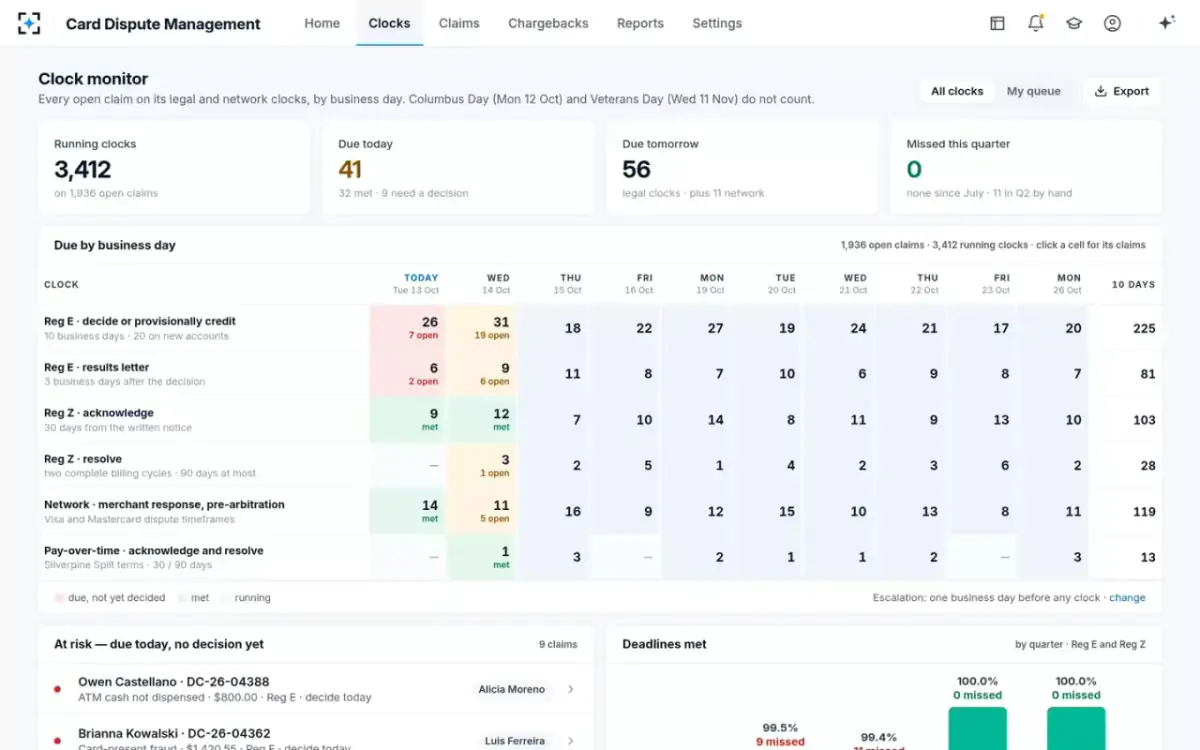
The deadline line is priced by regulators, and the prices are public. Regulation E gives the bank 10 business days to determine whether an error occurred, or to provisionally credit the customer and take the longer window; the duty sounds procedural, and the penalties treat it as substantive. In 2019 the CFPB ordered USAA Federal Savings Bank to pay approximately $12 million in restitution and a $3.5 million civil money penalty, including for failing to initiate and complete reasonable error resolution investigations (CFPB enforcement action, January 3, 2019). In 2025 the same bureau ordered Block, Inc. to pay at least $75 million and up to $120 million in consumer redress and a $55 million civil money penalty for, among other things, failures around EFTA and Regulation E error resolution (CFPB enforcement action, January 16, 2025). For a cost model, the lesson is not that every missed line costs millions — it is that the expected cost of the tail belongs in the formula, and the cheapest component of avoiding it is a calendar that counts business days correctly.
The clock monitor: the cheapest line of defence in the whole cost model
The ROI of automating dispute work, with your own numbers
The return formula, kept honest, is a sum of three gains minus one cost, divided by the cost. The gains: the handling hours the agents remove, at the loaded rate, times volume; the losses avoided — absorbed credits and lost chargebacks — estimated from a replay of closed claims rather than promised by a vendor; and the deadline exposure reduced, counted conservatively as the drop in near-misses rather than as avoided penalties. The cost: the system itself, subscription and implementation, including the pilot. Each input has an owner, and the card below names them. No payback period is quoted here, because the system cost and the losses avoided are yours to measure, not ours to assume; run the formula on your own numbers, in either direction, and it is still the right shape.
The ROI formula, with every input named and the person who supplies it
Touch hours per claim from the desk’s own time study, by hand minus review-and-sign time with agents. Owner: operations.
Finance’s number for the analysts’ hour, wage plus benefits and overhead. Owner: finance.
Disputes a year from the card portfolio, split by debit and credit. Owner: card operations.
Credits absorbed and chargebacks lost on closed claims, re-scored with the evidence actually read. Owner: the pilot, not the vendor.
Near-misses and misses per quarter from the clock log. Owner: compliance.
Subscription plus implementation and the pilot. Owner: procurement, with operations signing the hours math.
Is dispute automation worth it for a small bank?
Often more than for a large one, for an unfashionable reason: the fixed hours weigh heavier. A money-centre desk can absorb a specialist for authorizations, another for chargebacks; a community bank’s two analysts do everything, so the gathering on every multi-charge claim is a proportionally larger share of a smaller team’s week, and one missed line is a proportionally larger event. The sensitivity check below says the same thing from the other side: the handling saving moves most with the hours saved, which is the input a small bank is shortest of. The version of this automation that fits a small book is the one where the agents gather and the same two analysts decide and sign everything, with the second-signature rule unchanged. What does not scale down is the duty: Regulation E’s 10 business days apply identically, which is the strongest small-bank argument for software that counts them.
Which input moves the handling saving most, one change at a time
The worked example above is the cost side; the measurement method that keeps both sides honest — replaying your own closed claims before anything goes live — is set out in piloting card dispute automation on your own closed claims, and the evaluation questions that get real answers from vendors in what to evaluate before you buy.
Questions people ask
How much does a chargeback cost a bank?
More than the disputed amount, which is mostly recoverable. The handling, analyst time gathering evidence across several systems priced at a loaded rate, is the steady cost; evidence nobody read becomes absorbed credits and lost chargebacks; and the occasional missed deadline arrives as restitution and civil money penalties: the CFPB’s USAA order reached approximately $12 million plus a $3.5 million penalty, and its Block order $75 million to $120 million plus $55 million.
How many hours does it take to resolve a card dispute?
On the sample claim’s shape, about fifty elapsed hours by hand from notice to a signed decision: logging 4, authorizations 16, replies and tracking 20, screening 4, and the decision, letter and chargebacks 6. These are hours on the clock, not one person's labour; the sample bank's median from notice to evidence gathered is 46 hours. The gathering is what automation removes, not the deciding.
What drives the cost of a card dispute investigation?
The fragmentation of the evidence: authorizations in one system, merchant replies in another, carrier tracking and account history in a third, and the clocks in a spreadsheet. Every claim sends an analyst around all of them. Volume multiplies the hours, and every claim with a first-party signal adds screening that has to be shown with its source before anyone may rely on it.
How do you calculate the cost of a chargeback?
Hours per claim, times a loaded rate from finance, times annual volume — that is the handling cost. Add credits the bank absorbs because evidence went unread, chargebacks lost to unchecked representments, and the expected cost of deadline misses. The median wage for the BLS group that includes fraud examiners and investigators, $38.99 an hour, is the wage input before loading (BLS 2025, via O*NET).
What does a chargeback cost beyond the credit itself?
Analyst hours, absorbed losses, complaint handling and retention. A dispute resolved well ends at the desk — in 93% of the credit card complaints the CFPB analysed for 2022, the customer had tried the company first — while one resolved badly costs the call, the complaint, and sometimes the account. The enforcement tail — restitution plus penalties — is the rare but largest line.
Is dispute automation worth it for a small bank?
Often more than for a large one: the same fixed hours weigh on a smaller team, and the Regulation E duty is identical. Size the return with the same formula — hours saved at your loaded rate, times your volume — and pilot on your own closed claims before committing; the method costs nothing but the replay.