Reg E letter samples are hard to find because Regulation E does not provide them. Appendix A to 12 CFR Part 1005 gives Model Form A-3, the notice of error-resolution rights an institution sends when an account is opened and each year, but no model for the letters a single claim produces. Their content comes from 12 CFR 1005.11: a provisional-credit notice with the amount and date, a result within three business days, a written explanation with the right to request documents when the answer is no error, and a debit notice with its date and five business days of honoring items when credit is taken back. Examiners have cited templates that gave a timeframe instead of a date, announced credits that were never given, and said only "no error." Botminds' Reg E Dispute Management drafts each of these notices from the institution's approved templates and checks every required element before a person approves it. This guide sets out what each one must say.
The six notices a Reg E claim can need, and what each must contain
| Notice | When | Oral or written | Must contain |
|---|---|---|---|
| Written-confirmation requirement | During the call, if the institution requires confirmation of an oral notice | Oral, at the time | That written confirmation is required, and the address to send it to (1005.11(b)(2)) |
| Provisional credit | Within 2 business days after crediting | Either | Amount and date of the credit; full use of the funds (1005.11(c)(2)(ii)) |
| Result: error found | Within 3 business days after completing the investigation | Either | The result, the correction, and that any provisional credit is final (1005.11(c)(1), (c)(2)(iv)) |
| Result: no error or a different error | Within 3 business days after completing the investigation | Written | A written explanation of the findings and the right to request the documents relied on (1005.11(d)(1)) |
| Debit of provisional credit | When the credit is debited, or five business days before | Either | Date and amount of the debit; five business days of honoring checks and preauthorized transfers without overdraft charges (1005.11(d)(2)) |
| Documents relied on | Promptly, on request | Copies | The documents, in understandable form, with codes explained (1005.11(d)(1); comment 11(d)(1)-1) |
Is there a model Reg E error resolution notice?
Yes, but only for the notice of rights, not for claim letters. Model Form A-3 in appendix A is the error-resolution notice institutions give in their initial disclosures and then "at least once each calendar year," or in short form on every periodic statement (12 CFR 1005.8(b)). Its closing lines summarise what every later letter must deliver: "We will tell you the results within three business days after completing our investigation. If we decide that there was no error, we will send you a written explanation. You may ask for copies of the documents that we used in our investigation."
The model is also a contract with the consumer. Comment 7(b)(10)-1 lets an institution use different wording "so long as the substance of the notice remains the same," and delete provisions that do not apply, such as written confirmation. But a letter that later contradicts the notice of rights, for example by demanding a form the notice never mentioned, is the kind of inconsistency examiners notice first.
What must a Reg E provisional credit letter say?
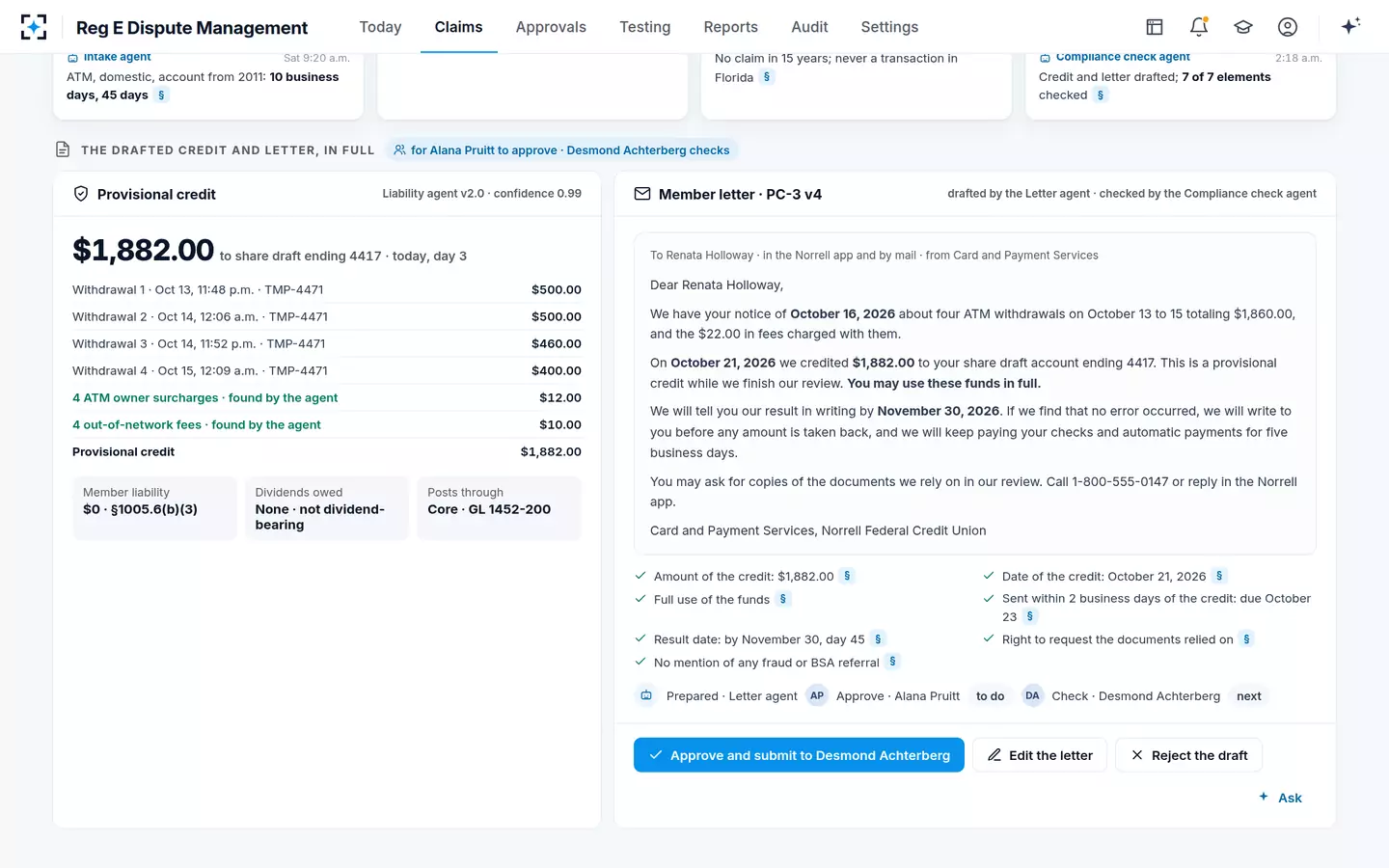
A Reg E provisional credit letter must tell the consumer the amount of the credit and the date it was made, within two business days after crediting, and the consumer must have full use of the funds. That is the whole legal content. A good letter adds what the consumer will otherwise call to ask: that the credit is provisional while the review continues, the date by which the result will come (day 45 or 90), and what happens if no error is found, including the five business days during which items will still be paid.
Three template failures recur. The CFPB's Fall 2014 Supervisory Highlights found that "At least one institution used notice templates referencing the issuance of provisional credit regardless of whether provisional credit was issued" (CFPB, Fall 2014). Its Summer 2021 edition cited "notification templates that either had a timeframe to disclose when a provisional credit would be applied instead of a specific date or lacked any date information," and a failure to tell consumers that a credit had been made final after "an unsuccessful attempt to combine the letter informing consumers of a provisional credit with the letter notifying them the credit would be final" (Issue 24). Each is a template problem that one checked field would have caught.
A provisional credit and its letter, every element checked
What must a Reg E denial letter include?
A Reg E denial letter must include a written explanation of the institution's findings and must note the consumer's right to request the documents the institution relied on, sent within three business days after completing the investigation. Section 1005.11(d)(1) puts both in the report of results and adds that copies must be provided promptly on request. The statute behind it is just as plain: the institution "shall deliver or mail to the consumer an explanation of its findings within 3 business days after the conclusion of its investigation," and "shall include notice of the right to request reproductions with the explanation of its findings" (15 U.S.C. 1693f(d)). The same applies when the institution finds a different error from the one alleged.
An explanation is not a conclusion. Federal Reserve examiners cited denial letters that used generic language, and the CFPB's Spring 2022 edition records institutions that, after findings, "updated their report of results letter templates to explicitly state the consumers’ right to request documents" (CFPB Supervisory Highlights, Issue 26). If the claim was for an unauthorized transfer, the explanation is also where the institution shows it met its burden of proof, from its own records. The sample below shows what that looks like in a letter a consumer can follow; the reasons a denial may not rest on are covered in Reg E denial reasons, and the card side in why card disputes get denied.
A sample Reg E no-error letter, annotated line by line
Dear Odalys Brenning,
1On Monday, March 2, 2026 you told us by phone that a debit card purchase of $186.40 at Corran Street Hardware on Saturday, February 21, 2026 was not made by you.
WhyWhat was disputed and when we heard. The date of the call, not of any form.
2We have finished our review and found that no error occurred. The purchase was made at the store’s checkout at 4:12 p.m. by reading your card’s chip and entering your PIN. Your card has stayed in your possession, and your account shows four earlier chip-and-PIN purchases at the same store since November.
WhyFindings in plain words, from the credit union’s own records. Not “no error” alone, and not resting on the earlier purchases by themselves.
3Because we found no error, we will take back the provisional credit of $186.40 we gave you on Monday, March 9, 2026. It will be debited from your account on Friday, March 27, 2026. Until then your account keeps the full amount.
WhyThe date and amount of the debit. This letter uses the commentary’s alternative: notice first, debit five business days later on a stated date.
4You may ask for copies of the documents we relied on in our review. Call us at the number on your card or reply in the app, and we will send them promptly, with any codes explained.
WhyThe right to request the documents relied on, which every no-error letter must note.
5Card Services, Tillbrook Federal Credit Union · Friday, March 20, 2026
WhySent within three business days of finishing the investigation, which here ended on Tuesday, March 17.
What is the right to request documents under Reg E?
It is the consumer's right, after a no-error or different-error result, to receive copies of the documents the institution relied on, promptly and in a form the consumer can understand. The statute frames it as delivering "reproductions of all documents which the financial institution relied on to conclude that such error did not occur" (15 U.S.C. 1693f(d)). The commentary adds the standard of form (comment 11(d)(1)-1): copies the consumer can understand, which for machine data means printed out with every code explained. What a no-error file must hold behind the letter is set out in Reg E documentation.
That last phrase is the practical test for modern evidence. An ATM switch log or a card processor record, full of entry-mode and response codes, is a document the institution relied on; sending it raw does not meet the standard. A letter template should therefore pair the right with a working way to exercise it (a phone number, an app button) and an internal step that turns codes into words before the copies go out.
What does the reversal notice need?
A reversal notice needs the date and amount of the debit and a statement that the institution will honor checks and similar items payable to third parties and preauthorized transfers for five business days after the notification, without overdraft charges, for items it would have paid had the credit not been debited. The commentary allows an alternative: give the notice first, naming the calendar date five business days later on which the debit will happen, and debit then. The sample letter above uses that alternative. The two options, and what goes wrong with each, are set out in reversal of provisional credit under Reg E.
Can Reg E notices be given orally?
Most can. Comment 11(c)-1 says "Unless otherwise indicated in this section, the financial institution may provide the required notices to the consumer either orally or in writing." The exception is the no-error or different-error result, which must include a written explanation. An oral notice still has to be proven: in its review of 2024 findings the Federal Reserve described institutions that were allowed to notify orally but kept no record of when they did, and so could not show the notices were on time (Consumer Compliance Outlook, First Issue 2026).
A template that fails an exam, and one that passes
Fails: “Your account will be credited within 10 business days.”
Passes: “On October 21, 2026 we credited $1,882.00 to your account. You may use these funds in full.”
Fails: The same text whether or not a credit was given
Passes: Merged only from the posted credit; no credit, no credit paragraph
Fails: “After investigation, no error was found.”
Passes: What the records show, in plain words, and the right to request the documents relied on
Fails: “The provisional credit has been reversed.”
Passes: The date and amount of the debit, and five business days of honoring checks and automatic payments
Fails: A list of questions the rule does not require, sent before any investigation
Passes: Requests that never hold up the investigation or the credit
Template failures examiners have cited, and what they teach
The pattern across the published findings is that letters fail where data and wording are disconnected: a template that says a credit was given because the template always says so, a date field left as a sentence about timing, a right-to-documents paragraph that lives in one template but not its replacement. The CFPB's order against Block shows the same failure in automated form. When consumers filed disputes in the app, the company sent template messages it called macros; one "asked a series of questions seeking information not required by Regulation E before starting an investigation, such as whether and when the consumer attempted to contact the merchant" (CFPB consent order 2025-CFPB-0001).
Two controls answer most of this. Templates should be versioned and approved by compliance, with a retired version impossible to reuse; in the solution's fictional sample month, a no-error letter drafted from a retired template without the right-to-documents line was the finding that led to a corrected template. And every letter should be checked element by element against the claim's own data before a person signs, not sampled afterwards.
Before any Reg E letter goes out
- Every date is a date
The notice date, the credit date, the debit date and the result date, not “within 10 business days”.
- Every amount comes from the posting
The credit or debit actually made, including interest and fees where they apply.
- The letter matches what happened
No credit paragraph without a credit; no “final” without a final decision.
- A no-error result explains itself
The findings in plain words, from the institution’s own records.
- The right to documents is stated, with a way to use it
On every no-error and different-error result.
- A reversal carries its date and the five business days
Under whichever of the two options the institution actually uses.
- It goes out in time, and the date is kept
Two business days after a credit; three after the investigation ends.
- Nothing the consumer should not see
No internal notes, other consumers’ claims, or any fraud or suspicious-activity referral.
How Reg E Dispute Management drafts and checks every letter
In Reg E Dispute Management, the Letter agent drafts each notice (acknowledgement, provisional credit, result, no-error result, reversal and request for information) from the institution's approved templates in plain words, filling every date and amount from the claim itself. The Compliance check agent then checks each required element and its timing before a person sees the letter, and it never passes a letter with a miss. The design target is that 100% of member letters are checked for every required element before a person signs; the specialist approves, and the manager checks as the second person.
What the member sees: the money, the dates and a way to ask for documents
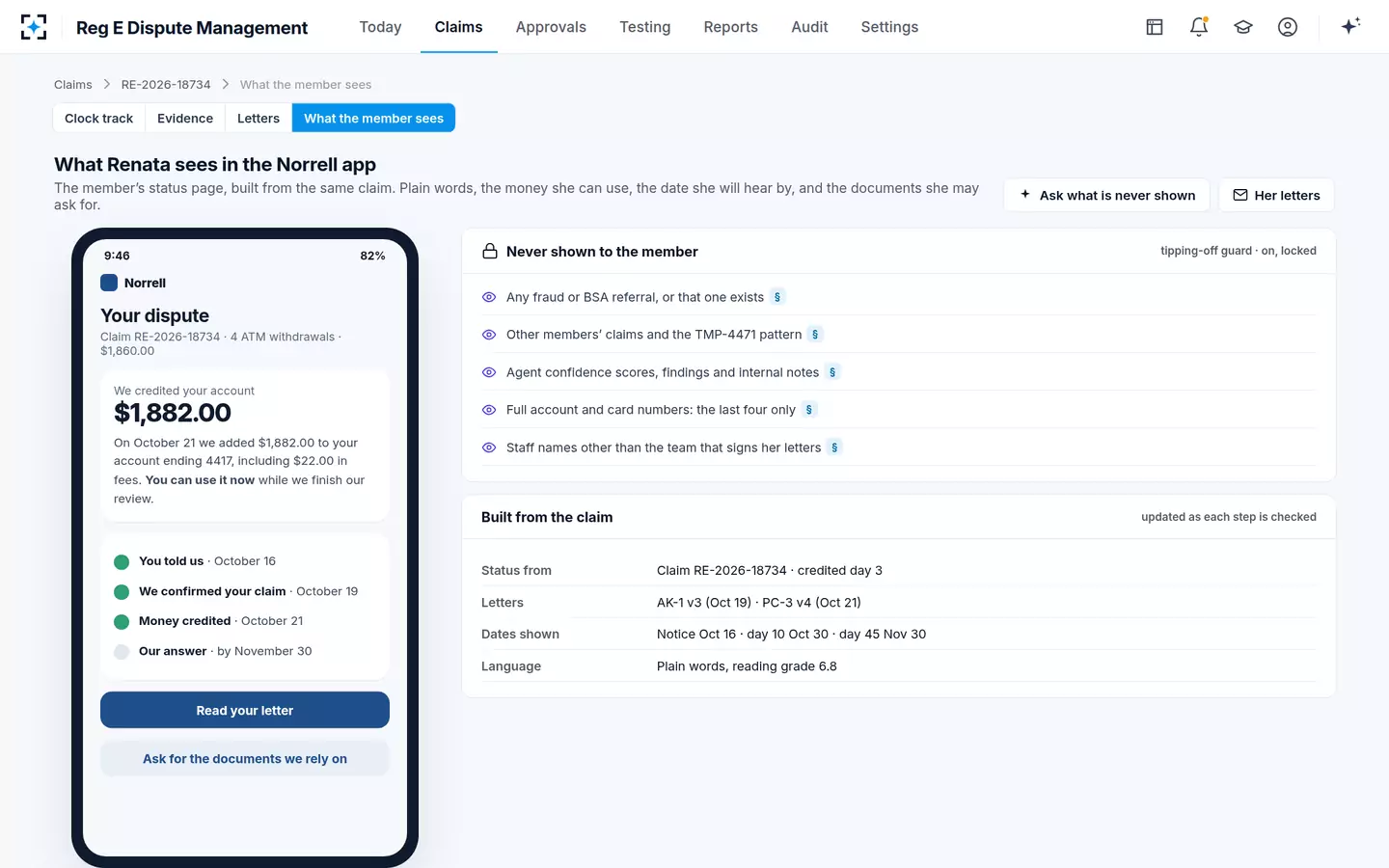
Two things the agents never do: send a letter on their own, or mention a fraud or suspicious-activity referral. Letters go out through the institution's own notice service after a person approves, and the date sent is kept with the claim, which is what makes the timing testable each month, as described in the Reg E audit checklist.
Questions people ask
Do Reg E letters have to be in writing?
Only the no-error or different-error result has to be written; the provisional-credit notice and an error-found result may be oral or written under comment 11(c)-1. If a notice is oral, the institution needs a record of the date it was given to prove it was on time.
Where can I find Reg E error resolution sample letters?
Regulation E provides Model Form A-3 for the notice of rights but no sample claim letters. Institutions build their own from 1005.11’s content rules; the table and annotated letter on this page show the elements each must carry.
Is an acknowledgement letter required under Reg E?
No. Regulation E does not require an acknowledgement of a notice of error, although many institutions send one. It must not ask for anything the rule does not require as a condition of investigating or crediting.
Must the denial letter list every document relied on?
It must note the consumer’s right to request the documents relied on; it need not attach them. On request, the institution must promptly provide copies in understandable form, with codes explained.
Can one letter cover the credit and the result?
A result letter can confirm that a provisional credit is final, and the commentary allows the correction notice and the explanation of a different error to be combined. Combining the provisional-credit notice with a future “final” notice is risky; the CFPB cited institutions whose attempt to merge them meant consumers were never told the credit was final.