Reg E documentation for a denied claim has to show three things: that the bank investigated using its own records, what it found, and that it told the customer in writing, including his right to see the documents behind the decision. The rules are short. Under 12 CFR 1005.11(d)(1) a bank that finds no error sends a written explanation of its findings within three business days of finishing, notes the right to the documents, and provides them promptly on request; under 1005.13 it keeps evidence of compliance for at least two years. Examiners keep finding the same gap: letters that say "no error" and little else. Botminds' First-Party Fraud Detection, software for investigators deciding likely false Reg E claims, builds the file as the investigation runs, so each finding in the letter points to the record it came from. This page is for the QA, compliance and audit teams who test those files.
The clocks a no-error file has to show it met
10
business days to determine whether an error occurred, or provisionally credit and take up to 45 days
3
business days after finishing, to send the written explanation of a no-error finding
5
business days of honouring checks and preauthorized transfers after a provisional credit is debited
2years
minimum retention of evidence of compliance
What Reg E documentation does a denial need?
Three layers, each of which an examiner can ask for separately. The investigation file shows what records were reviewed and what they showed. The results report, the letter, gives the customer a written explanation of the findings and notes his right to the documents. The retention trail shows the bank met its clocks: when the notice arrived, when the investigation finished, when the letter went out, and, if the bank credited provisionally, when and how that credit was debited.
The regulation's own words for the letter are worth having exactly. The bank's report "shall include a written explanation of the institution's findings and shall note the consumer's right to request the documents that the institution relied on in making its determination", and "Upon request, the institution shall promptly provide copies of the documents." Everything else in this page follows from those two sentences: the documents must exist, they must be the ones the decision relied on, and the explanation must say what they showed.
The investigation file: which of the bank's own records must it cover?
Everything in the bank's records that could resolve the claim, not just the payment instruction. The Official Interpretation says the investigation may vary with the facts, but a bank cannot stop at the payment instruction when other records it holds on the account could settle the claim. It then lists what may be reviewed: the account's recent transaction history, where the transaction or payee was relative to the customer's home and usual spending area, and records held by the bank's service providers that could decide the question. The systems those records sit in are mapped in Reg E software that reads your core.
For a first-party claim, that list translates into a handful of systems. The table maps each part of a sample file to where it comes from and what it answers. The sample is a fictional claim at a fictional bank, Tessaly Community Bank: Trevor Haldane disputes a $740.00 P2P payment, saying he never sent it.
A first-party investigation file, part by part
| Part of the file | Comes from | What it answers in the sample |
|---|---|---|
| The customer’s statements, numbered and timed | The app dispute form and the call transcript | Six things he said, from "I never sent this payment" to "I was at my sister’s in Bend all weekend" |
| Device and sign-in records | Digital banking: device registry and session log | Sent from the iPhone registered since September 14, 2024, after a Face ID sign-in; no reset, new device or failed sign-in in 90 days |
| Network and location | Digital banking network history; card processor | His home network in Keizer; a chip-and-PIN purchase in Keizer the next morning |
| Payment history with the recipient | The core and the P2P network gateway | 14 earlier payments, $680 to $760, memo "rent split" |
| Account changes | The core’s change log | The recipient’s phone was his alternate contact until June 2, 2026 |
| Partner data, for a fintech program customer | The partner’s device and session feed | Not needed here; for partner customers, requested under the program agreement |
| Genuine-claim checks | All of the above | No new device, reset, takeover sign, scam contact, SIM change or lost phone; one limit stated |
Two things in that table matter to an examiner beyond the evidence itself. Each part names its source, so the documents the customer can ask for are already identified. And the genuine-claim checks are recorded as results, "none in 90 days", not left blank, because a file that only collects reasons to deny cannot show the bank met its burden. Federal Reserve staff put the standard directly: a reasonable investigation includes reviewing relevant information within the institution's records (Consumer Compliance Outlook, 2025).
How should a no-error finding be written?
As findings about the payment, in plain words, each one traceable to a record, followed by the right to the documents. Not "no error occurred", not "the transaction was verified", and not anything about the customer's character or history. The Federal Reserve's review of its 2024 examinations found institutions whose explanations were a generic "no error", and traced the cause to thin templates in their dispute tracking systems; Reg E dispute tracking software looks at what such a system should check.
The same denial, as a template and as findings
A template no-error letter: "We have completed our investigation and determined that no error occurred."
A findings letter: The payment was made from the customer’s account with his authorization.
A template no-error letter: None, or "based on our records".
A findings letter: His registered phone and Face ID sign-in; no reset or new device in 90 days; his home internet connection; 14 earlier payments to the recipient.
A template no-error letter: Sometimes missing, which examiners cited in 2014 and 2024.
A findings letter: He may ask for copies of the documents relied on, with how to ask.
A template no-error letter: Silent, or a reversal notice that does not match practice.
A findings letter: No provisional credit was made, so nothing is taken from the account.
A template no-error letter: Sometimes "fraud", "suspicious" or a reference to earlier claims.
A findings letter: No accusation, no earlier claims, no mention of any referral.
The result letter, with every finding it rests on
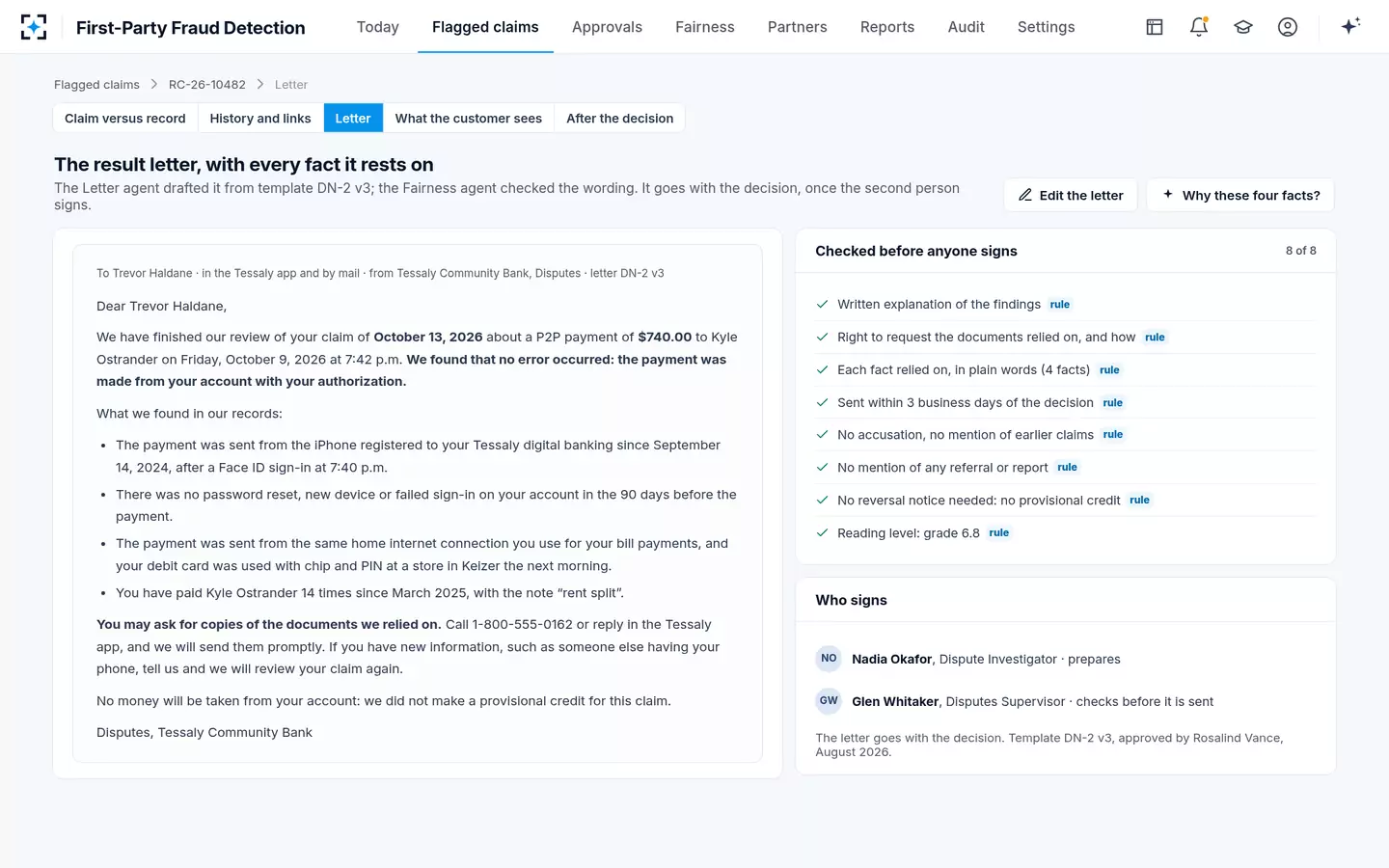
What documents must a bank hand over when the customer asks?
The documents it relied on to decide, promptly, and in a form the customer can read. The commentary is specific: "When a consumer requests copies of documents, the financial institution must provide the copies in an understandable form. If an institution relied on magnetic tape, it must convert the applicable data into readable form, for example, by printing it and explaining any codes." The magnetic tape is dated; the principle is not. A device-registry extract or a session log is the modern equivalent, and it has to arrive with its codes explained.
That has a design consequence for first-party work. If the decision relies on a device identifier, a network history and a P2P enrollment record, those are the documents the customer can ask for, so they should be producible as readable pages, with account, card and device numbers truncated to their last four characters. The Federal Reserve's 2024 review also found violations where an institution's third party "failed to provide copies of the documents relied on", which is a reason to keep the copies with the claim rather than in a vendor's portal.
Eight checks on a no-error letter before anyone signs it
- A written explanation of the findings.
12 CFR 1005.11(d)(1). Findings about the transfer, not a conclusion alone.
- The right to request the documents relied on, and how.
1005.11(d)(1); cited when missing in the CFPB’s Fall 2014 report.
- Each finding in plain words.
Device, sign-in, location, payment history: whatever the decision rests on.
- Sent within three business days of finishing the investigation.
1005.11(d)(1) read with (c)(1); the date sent is kept with the claim.
- No accusation and no earlier claims.
Neither is a finding about this transfer.
- No mention of any referral or report.
Suspicious activity reports are confidential under 31 CFR 1020.320(e).
- The right reversal language, or none.
If a provisional credit is debited, the date, amount and five business days of honouring items; if none was made, say so.
- Readable by the customer.
The sample bank sets a reading-level check; the rule asks for documents in understandable form.
Why "no error" templates keep showing up in exam findings
Because the letter is usually generated by a dispute-tracking system or a third party, and nobody owns its wording. The Federal Reserve's account of its 2024 examinations is blunt about root causes: violations of section 1005.11(d) came mostly from weak oversight of third parties, including the templates they supplied, together with gaps in training, policies and controls.
The pattern is old. In 2014 the CFPB reported standard-form notices that "failed to include a statement regarding a consumer’s right to obtain the documentation that the institution relied on" (Supervisory Highlights, Fall 2014). In 2021 it reported provisional-credit notices built on templates that gave a rough timeframe, or no date at all, where a specific date was required (Supervisory Highlights 24; the six notices are laid out in Reg E letter samples). A template is a policy decision made once and applied to every customer, which is why a bad one becomes a remediation project.
The fix is not a better template but a letter built from the findings. In the sample, the letter agent drafts from an approved template, version DN-2 v3, and fills the findings from the same pairs the investigator and supervisor read, and the template itself changes only with the Compliance Officer's approval.
How do examiners test Reg E denials, and how can a bank test them first?
By sampling denied claims and asking whether the investigation met the bank's burden. Federal Reserve staff describe the test a compliance department can run on itself: take a sample of denied claims and confirm, for each, that staff reviewed everything relevant in the bank's records and that the findings met the bank's burden of proving no error occurred. The Reg E audit checklist turns that into a test with planted errors.
That test can be turned into measures a QA team reports every month. Accuracy for a denial is not "did the investigator agree with the agents"; it is whether every finding in the letter traces to a record, whether any forbidden reason crept in, whether the clocks were met, and whether the denied claims survive the burden-of-proof test.
Five measures of denial accuracy, and who owns each
Traceable findings
findings with a cited record ÷ findings in denial letters
The target is every finding. A finding without a source is a conclusion, and an examiner will read it as one.
QA
Forbidden reasons
count of denials resting on a reason the policy forbids
Earlier claims, prior dealings alone, negligence, reporting time inside the rule, a missing police report. The target is zero.
Compliance officer
Clock compliance
letters sent > 3 business days after the investigation ended
A count, not a rate, with the 10- and 45-day clocks beside it.
Disputes operations
Document requests
requests answered with readable copies ÷ requests received
Measured on what the customer received, not on what was sent to a vendor.
Disputes operations
Burden-of-proof test
sampled denials that hold ÷ denials sampled
The Federal Reserve’s own suggested test, run monthly on a random sample of denied claims.
Compliance testing
The sample bank adds a sixth, comparing denial rates across programs and transfer types each month; how that comparison works, and what it caught, is in first party fraud prevention. Who carries each of these measures, and why the person who prepares a denial never checks it, is in the dispute fraud specialist guide.
How long must Reg E records be kept?
At least two years, and longer in two cases. The regulation requires any person subject to it to "retain evidence of compliance with the requirements imposed by the Act and this part for a period of not less than two years from the date disclosures are required to be made or action is required to be taken" (12 CFR 1005.13(b)(1)). A bank that knows it is under investigation or enforcement, or has been served with an action under the EFTA, keeps the related records until the matter is finally disposed of.
The second case is suspicious activity. If the bank files a report, it must keep a copy and the supporting documentation, original or business-record equivalent, for five years from filing (31 CFR 1020.320(d)). Because a referral can follow a denial months later, the sample bank keeps every decision file for five years, the longer of the two.
Every action by people and agents, with the evidence behind it
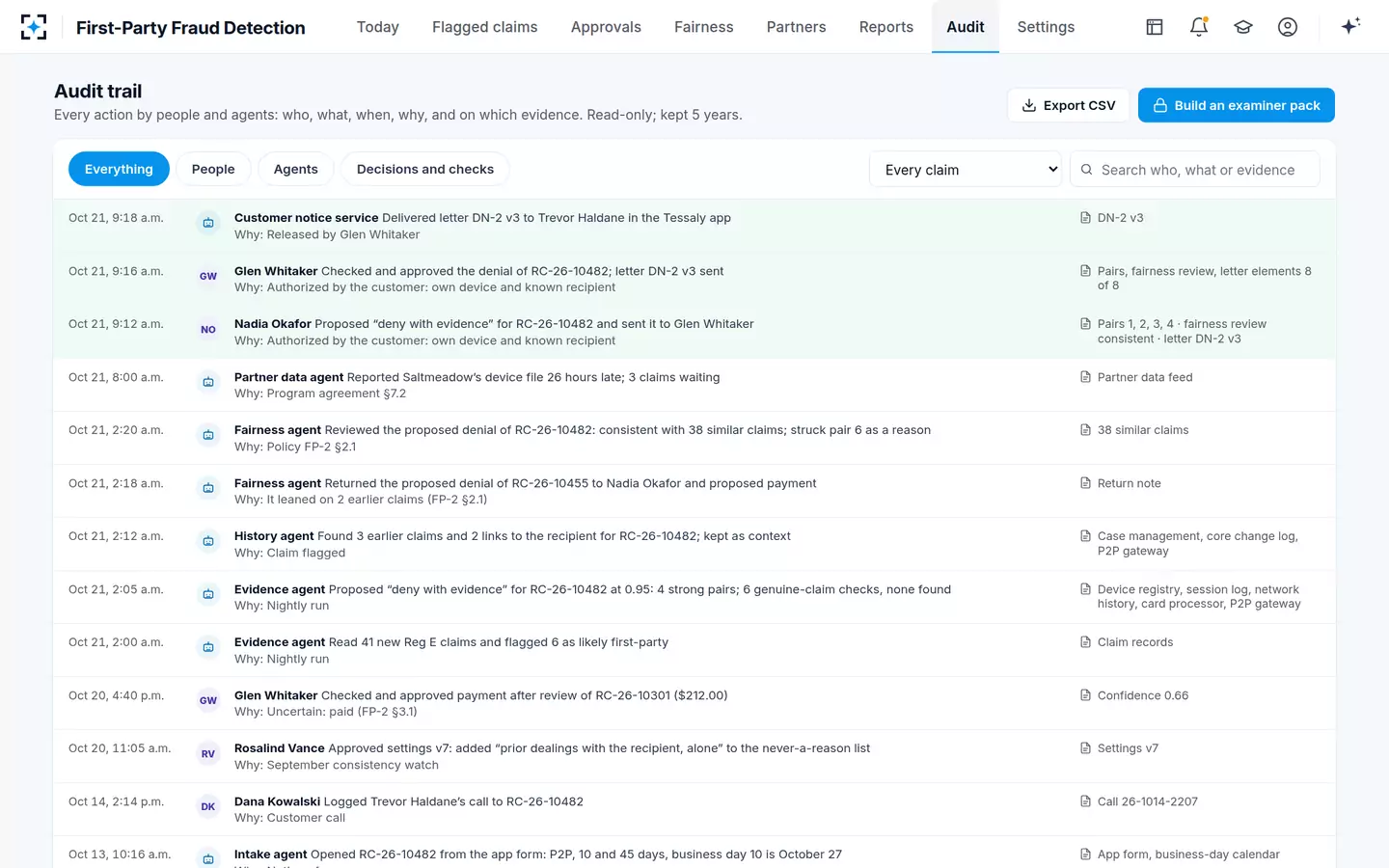
What stays out of the customer's file, and why the decision never relies on it
Anything the customer may not see should be kept out of what the decision relies on, so that it never becomes one of the documents he can request. The clearest case is a referral for suspicious activity: a report, and anything that would reveal one exists, is confidential under 31 CFR 1020.320(e). If a denial leaned on a referral, the bank would face a request for documents it cannot hand over.
The sample keeps the two apart by design. The decision rests on device, sign-in, network and payment records; the referral to the BSA Officer is proposed only after the denial has been checked, is visible only to her, and never appears in a letter, a customer screen or an export. Earlier claims sit on the same side of the line: context for the investigator and for a referral, never a finding. For a card dispute file under both Reg E and Reg Z, see how banks investigate card disputes.
Questions people ask
What must a Reg E denial letter include?
A written explanation of the bank's findings and a note of the customer's right to request the documents relied on, sent within three business days of finishing the investigation. If the bank had credited the account provisionally, the letter or a separate notice also gives the date and amount of the debit and says checks and preauthorized transfers will be honoured for five business days.
What is a reasonable investigation under Reg E?
One that reviews the relevant information in the bank's own records rather than stopping at the payment instruction: account history before the error, the location of the transfer or payee against the customer's usual area, and information held by its service providers where it could settle the claim. A bank cannot deny a claim without one.
Does a bank have to send the actual device logs if the customer asks?
It has to provide copies of the documents it relied on, in an understandable form, which means readable pages with any codes explained. A bank that relied on a device registry or session log should be ready to produce those records that way, with sensitive numbers truncated.
How long does a bank have to provide the documents?
Regulation E says "promptly" and sets no number of days. The sample bank's own commitment, shown on the customer's screen, is five business days.
Can a customer reopen a Reg E claim after a denial?
Not by repeating the same error: a bank that fully complied with 1005.11 has no further duty if the customer reasserts it. A bank may still reconsider when new information arrives; in the sample, "Tell us something new" reopens the claim and runs the agents again.